Most organisations believe their CCTV systems are working. Cameras are mounted, recording lights are blinking, and footage is being stored. But there is a significant gap between watching and actually seeing, and that gap is where security incidents happen.
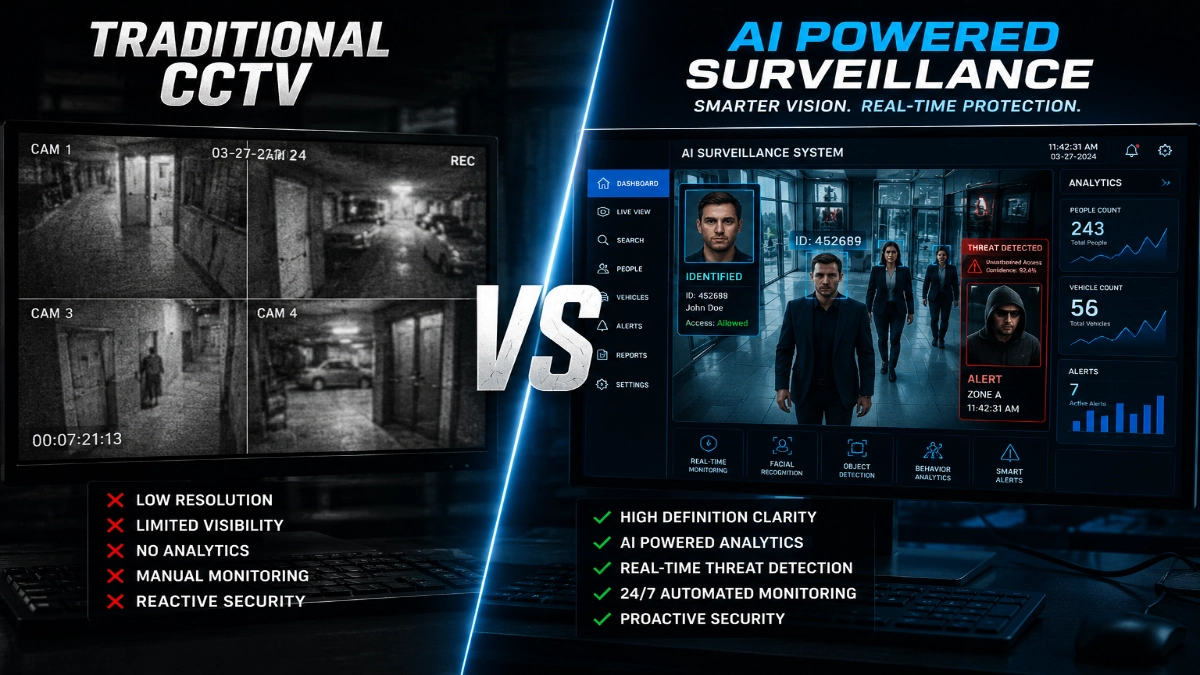
Traditional surveillance systems were designed for a simpler era. They recorded. They stored. And when something went wrong, they helped investigators find out what happened after the fact. That reactive model no longer meets the demands of modern security operations.
Intelligent CCTV systems are changing the equation. By combining AI-powered surveillance, edge processing, and advanced video analytics, these platforms do not just record, they understand, analyse, and respond. This article explains why organisations across every industry are making the switch, what the technology actually delivers, and what decision-makers need to know before upgrading.
What Is an Intelligent CCTV System?
An intelligent CCTV system is a security platform that integrates artificial intelligence, machine learning, and video analytics directly into the surveillance workflow. Unlike traditional cameras that passively record footage, intelligent systems actively analyse video streams to identify people, objects, behaviours, and events in real time.
The core components of a modern intelligent surveillance system include:
- AI-powered cameras with built-in processing capabilities
- Edge AI modules that analyse footage at or near the camera
- Cloud-connected platforms for centralised management and storage
- Video analytics engines that detect specific events and patterns
- Automated alert systems that notify operators instantly
- Integration layers connecting with access control and other security infrastructure
| Expert Insight: Edge AI processing is the critical differentiator in next-generation surveillance. When analysis happens at the camera level, response times drop from minutes to milliseconds, and bandwidth costs fall significantly. Organisations deploying edge-enabled intelligent CCTV see measurably faster incident response than those relying on centralised cloud analysis alone. |
The intelligence in these systems comes from deep learning models trained on millions of real-world scenarios. They can distinguish between a person and an object, identify unusual behavioural patterns, read license plates, and detect unattended luggage, all without human intervention.
What Is Traditional Surveillance?
Traditional CCTV surveillance refers to systems built around passive recording technology. Cameras capture footage and store it locally or on a network video recorder. A human operator monitors live feeds, and security incidents are reviewed after the fact by manually scrubbing through hours of recorded video.
This model was the industry standard for decades. It provided a visual deterrent and a forensic record. But it was never designed to be proactive. Its core limitations include:
- No automated detection: Everything depends on a person watching a screen.
- No behavioural analysis: Cameras record, but cannot interpret.
- Delayed response: Incidents are typically discovered after they occur.
- Scalability bottlenecks: More cameras require more operators.
- High operational costs: Large monitoring teams are expensive to maintain.
For organisations managing dozens or hundreds of cameras across multiple sites, traditional surveillance has become operationally unsustainable.
Why Businesses Are Moving Away from Traditional CCTV
The shift toward intelligent video surveillance is not driven by technological novelty. It is driven by measurable operational failures in traditional systems.
Human Monitoring Limitations
Studies in security operations consistently show that human attention degrades significantly after 20 minutes of continuous screen monitoring. After 30 minutes, the probability of an operator detecting an incident on a monitor drops below 50%. Traditional surveillance depends entirely on human attention, which is inherently unreliable at scale.
| Expert Insight: Security teams using traditional monitoring systems spend an estimated 70% of their time reviewing footage after incidents occur. That is reactive security at its worst. Intelligent systems flip that ratio, moving resources toward prevention, not investigation. |
Delayed Incident Response
In a traditional setup, the average time between an incident occurring and an operator responding can range from several minutes to never if the operator is watching a different screen. Intelligent CCTV systems generate automated alerts within seconds of detecting a defined event, regardless of how many cameras are active.
High Manpower Costs
A single operator can realistically monitor six to eight camera feeds simultaneously with any degree of effectiveness. For an enterprise site with 200 cameras operating 24/7, that translates to a significant permanent security team. Intelligent systems reduce this dependency substantially through automation.
Lack of Actionable Insights
Traditional CCTV generates footage. Intelligent CCTV generates data. The difference is significant. AI-powered systems can produce occupancy analytics, dwell time reports, crowd density maps, and behavioural trend analysis information that improves both security and operational decision-making.
Key Advantages of Intelligent CCTV Systems
The capabilities that modern intelligent surveillance platforms deliver go well beyond what traditional systems can offer:
- Real-time threat detection and automated intrusion alerts.
- Facial recognition for access management and watchlist matching.
- Vehicle identification and license plate recognition (LPR).
- Behaviour analysis to flag loitering, aggression, or crowd surges.
- Smart search finds specific people or objects across hours of footage in seconds.
- Perimeter protection with virtual tripwires and zone-based alerts.
- AI-powered incident management with automated reporting.
- Significant reduction in false alarms through intelligent filtering.
- Remote monitoring capability for multi-site operations.
- Seamless integration with access control and alarm systems.
| Expert Insight: Facial recognition and vehicle identification are no longer exclusive to government or large enterprise deployments. Intelligent CCTV solutions from distributors like Impact by Honeywell CCTV Distributor in India are making these capabilities accessible to mid-sized businesses across the manufacturing, retail, and logistics sectors. |
Industry-Specific Applications
The business case for intelligent CCTV differs by sector, but the underlying value of faster detection, better insight, and lower operational cost is consistent across industries.
- Manufacturing Plants: Monitor production floors for safety compliance, detect unauthorised zone entry, and identify equipment anomalies.
- Warehouses and Logistics: Track inventory movement, prevent theft, and manage loading dock access with LPR.
- Smart Buildings: Integrate surveillance with BMS systems for occupancy-based automation and energy efficiency.
- Retail Environments: Analyse foot traffic patterns, detect shoplifting behaviour, and manage queue lengths.
- Data Centres: Monitor access to server rooms with facial recognition and multi-factor visual verification.
- Airports: Manage crowd density, identify unattended baggage, and support perimeter security across large areas.
- Educational Institutions: Protect campuses with visitor management, behavioural detection, and emergency response integration.
- Hospitals: Manage patient safety in high-risk wards, detect aggressive behaviour, and control access to restricted areas.
- Critical Infrastructure: Protect power plants, water facilities, and utilities with 24/7 AI-powered perimeter monitoring.
- Commercial Facilities: Monitor parking areas, building entrances, and common spaces with automated alerts.
Traditional CCTV vs Intelligent CCTV: Feature Comparison
| Feature | Traditional CCTV | Intelligent CCTV |
| Monitoring | Manual, requires constant human attention | Automated AI-driven 24/7 monitoring |
| Analytics | None — recording only | Real-time video analytics and pattern recognition |
| Response Time | Delayed — depends on operator awareness | Instant automated alerts within seconds |
| Scalability | Limited by manpower and hardware costs | Scales easily via cloud and edge AI |
| Operational Costs | High — large security teams required | Lower long-term costs with automation |
| Security Effectiveness | Prone to human error and fatigue | Consistent, accurate, fatigue-free detection |
| Incident Investigation | Time-consuming manual video review | Smart search finds footage in seconds |
| Automation Capabilities | None | Alerts, reports, and responses fully automated |
Challenges of Intelligent CCTV Adoption
The case for intelligent surveillance is strong, but honest adoption planning requires acknowledging real challenges:
Initial Investment Costs
High-quality AI cameras, edge processing hardware, and analytics platforms represent a meaningful upfront investment. However, the total cost of ownership analysis consistently shows that the reduction in security staffing costs delivers ROI within 18 to 36 months for most deployments.
Privacy and Data Protection
Facial recognition and behavioural monitoring raise legitimate privacy concerns. Organisations must align deployments with applicable data protection regulations, including GDPR and relevant local privacy laws. Clear data governance policies, retention schedules, and access controls are non-negotiable.
Cybersecurity Considerations
AI-powered surveillance systems are connected devices, and connected devices are potential attack surfaces. Network segmentation, firmware management, encrypted data transmission, and regular security audits are essential components of any responsible deployment.
AI Accuracy Limitations
No AI system is infallible. Environmental factors, camera placement, lighting conditions, and model limitations can affect detection accuracy. Intelligent systems should be positioned as tools that augment human judgment, not replace it entirely.
Training and Change Management
Security teams transitioning from traditional monitoring require training on new platforms and workflows. Change management is a genuine requirement, not an afterthought.
| Common Mistakes Businesses Make: 1. Choosing cameras based on megapixel count rather than AI processing capability. 2. Deploying intelligent systems without a data governance policy in place. 3. Underestimating integration complexity with existing infrastructure. 4. Failing to train security staff on new alert management workflows. 5. Ignoring cybersecurity requirements for network-connected cameras. |
Buying Considerations Before Upgrading
- Assess your current infrastructure, what can be integrated, and what needs replacing
- Define your primary security objectives before evaluating technology
- Evaluate vendors on analytics accuracy, not just camera specifications
- Request proof-of-concept deployments before committing to large-scale rollout
- Confirm compliance with local privacy and data protection requirements
- Ensure the vendor provides ongoing firmware updates and cybersecurity support
- Work with experienced integrator providers like Impact by Honeywell CCTV Distributor in India, which offer enterprise-grade solutions with full integration and support services
The Future of Surveillance Technology
The trajectory of intelligent surveillance points toward systems that are increasingly autonomous, predictive, and deeply integrated into broader smart infrastructure.
- Edge AI Surveillance: More processing capability built into cameras reduces cloud dependency and latency.
- Predictive Security: AI models that identify conditions likely to precede incidents, enabling intervention before events occur.
- Cloud Video Analytics: Scalable, subscription-based analytics platforms that eliminate the need for on-premise hardware investment.
- Smart City Integration: Surveillance systems interconnected with traffic management, emergency services, and public safety infrastructure.
- Hybrid Human-AI Monitoring: AI handles routine detection and alerting; human operators focus on judgment-intensive decisions.
- Autonomous Surveillance Systems: Drone-integrated and robotic patrol systems that extend coverage beyond fixed camera positions.
| Expert Insight: The convergence of edge AI, 5G connectivity, and advanced analytics is compressing the timeline for autonomous surveillance significantly. Security decision-makers who begin building AI-ready infrastructure now will be positioned to adopt next-generation capabilities without costly rearchitecting. |
Conclusion
The question for most organisations is no longer whether to adopt intelligent CCTV but when and how.
Traditional surveillance served its purpose in a simpler security landscape. But in a world where threats move faster, operations are more complex, and the cost of a security failure is higher than ever, passive recording is no longer sufficient.
Intelligent CCTV systems offer something fundamentally different: surveillance that thinks. That detects. That responds. And that continuously improves.
The organisations investing in AI-powered video analytics today are not just upgrading their cameras. They are building a security infrastructure capable of meeting the demands of the next decade and the one after that.
The technology is proven. The business case is clear. The only remaining question is whether your current system can afford to stay passive.
Read Also: Why Warehouses and Factories Prefer Impact by Honeywell CCTV Systems