India lost over ₹1.2 lakh crore to business theft, pilferage and security breaches in 2024.
Traditional CCTV cameras installed, forgotten and reviewed only after the damage is done could not prevent a single rupee of it.
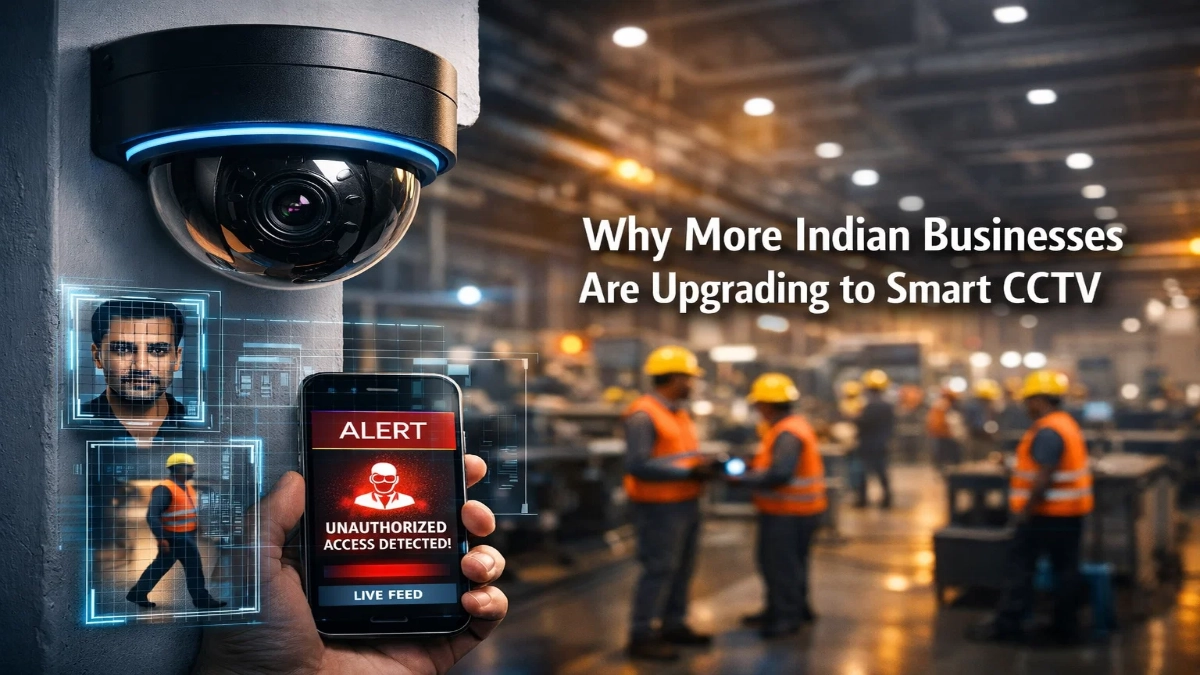
That is changing fast. Across Delhi NCR, Bangalore tech parks, Mumbai warehouses and Pune manufacturing zones, business owners are replacing old analogue systems with smart CCTV systems powered by artificial intelligence.
This isn’t a luxury upgrade. It’s a survival move in 2026.
Key stats driving the shift:
- India’s AI surveillance market is projected to reach ₹28,400 crore by 2028
- AI-based CCTV adoption among Indian businesses grew 34% year-on-year in 2024–25
- Businesses using smart CCTV report up to 60% reduction in theft and pilferage
- 72% of Indian enterprises plan a security technology upgrade before the end of 2026
The question isn’t whether your business needs smart surveillance. The question is: how long can you afford to wait?
What is a Smart CCTV System?
A smart CCTV system is an AI-powered surveillance solution that doesn’t just record video; it actively analyses it in real time.
Unlike passive traditional cameras, smart CCTV uses deep learning algorithms, computer vision and cloud connectivity to detect threats, identify behavioural patterns and send instant alerts to your phone.
Simple definition: Traditional CCTV is a security guard who is always asleep. Smart CCTV is a guard who never blinks, never tires, and calls you the moment something goes wrong.
Traditional CCTV vs Smart CCTV — Side-by-Side:
| Feature | Traditional CCTV | Smart AI CCTV |
|---|---|---|
| Recording | Yes | Yes |
| Real-time alerts | No | Yes |
| Mobile access | No | Yes |
| AI threat detection | No | Yes |
| Cloud storage | No | Yes |
| Business analytics | No | Yes |
| Face recognition | No | Yes |
| Night vision (AI-enhanced) | Basic | Advanced |
| Incident detection accuracy | ~30% | ~95% |
The difference isn’t just technological. It’s the difference between reactive security and proactive security.
Why Traditional CCTV is Failing Indian Businesses
Most Indian businesses installed CCTV cameras 5 to 10 years ago. At the time, simply having cameras was enough of a deterrent. Today, that thinking is dangerously outdated.
No Real-Time Alerts
Traditional systems only record. By the time your security team reviews footage, the thief is gone, and the damage is done.
A Noida garment factory owner shared: “We had 24 cameras and still couldn’t catch a repeat theft for three months because nobody was watching the feed at 3 AM.”
Smart CCTV eliminates this gap. The moment an intrusion, loitering, or unauthorised access is detected, you get an instant alert on your mobile, no matter where you are.
No Analytics or Business Intelligence
Footage is data. But raw video is unusable data. Traditional CCTV gives you hours of recordings with zero searchability, zero pattern recognition and zero business insights.
Smart systems tag events automatically, allow instant search by activity or time, and generate reports on footfall, staff movement and operational patterns.
Manual Monitoring is Unreliable and Expensive
To effectively monitor a traditional CCTV system, you need security staff watching screens 24 hours a day, 7 days a week. That means high manpower costs, human error, fatigue and distraction.
Smart AI surveillance automates 80% of monitoring tasks. Your team is alerted only when action is required.
DVR Failures and Footage Loss
Traditional DVR-based systems fail silently. Hard drives corrupt. Footage gets overwritten. When you actually need evidence, it’s gone.
In 2025, a Mumbai retail chain owner discovered that three months of CCTV footage had been silently corrupted. The DVR hard drive had failed, and no one knew. Cloud-based smart CCTV eliminates this risk.
No Remote Access
In a post-pandemic world where business owners manage multiple locations, the inability to check their cameras from a mobile phone is a serious operational weakness. Smart CCTV gives you live access from any device, anywhere in the world.
Top Reasons Indian Businesses Are Upgrading to Smart CCTV
AI-Based Threat Detection
Smart CCTV doesn’t wait for you to notice something wrong. It detects it before you would.
AI algorithms identify: unauthorised entry, perimeter breaches, loitering beyond a set time threshold, object removal or abandonment, crowd formation and vehicle intrusion in restricted zones.
A logistics company in Bhiwandi reduced warehouse break-ins by 78% within 90 days of installing an AI-based perimeter detection system. The system triggered alerts and activated floodlights automatically; no security guard intervention was needed.
This is next-gen protection that traditional cameras simply cannot offer.
Remote Monitoring from Mobile
Imagine sitting in your home in Gurgaon and watching your factory floor in Manesar in real time.
Smart CCTV systems offer live HD video streaming directly to your smartphone or tablet. Multi-location business owners, retail chains, franchise operators and factory groups can monitor all sites from a single app.
Features include:
- Live video feed with two-way audio
- Instant push notifications for detected events
- Cloud playback of past footage from anywhere
- User-based access control for managers, security teams, and owners
Cloud Storage and Data Security
Traditional DVR storage is the weakest link in any security system. It can be stolen, damaged or corrupted.
Cloud-based smart CCTV stores all footage on encrypted remote servers. Your data is:
- Automatically backed up in real time
- Accessible from any authorised device
- Protected against physical tampering
- Compliant with Indian data protection standards
Most providers offer 30, 60, or 90-day cloud retention plans. Some enterprise solutions offer unlimited storage with tiered pricing.
Advanced cloud CCTV monitoring means your evidence is always safe, even if your physical camera is destroyed.
Reduced Manpower Costs
Security manpower is one of the highest operational costs for Indian businesses, especially factories, warehouses, and large retail stores.
Smart surveillance reduces the security headcount needed without compromising protection. AI handles continuous monitoring, pattern detection and alert generation. Your human security team focuses only on response, not watch duty.
Estimated savings for a mid-size factory (5,000 sq. ft. facility):
- Traditional model: 3–4 security guards per shift × 3 shifts = 9–12 staff
- Smart CCTV model: 1–2 response-ready staff + AI monitoring
- Monthly savings: ₹80,000 to ₹1,50,000 in manpower costs alone
Business Intelligence — Footfall and Behaviour Analysis
This is where smart CCTV goes beyond security and starts generating business value.
Smart video analytics India platforms now offer:
- Footfall counting: Know exactly how many people enter your store, branch, or facility each hour, each day
- Heat mapping: Identify which areas of your floor get the most traffic
- Dwell time analysis: See how long customers spend in specific zones
- Queue detection: Get alerts when checkout queues exceed a threshold
- Staff activity monitoring: Track productivity and movement patterns
For a retail chain in Bangalore, heat map data from smart cameras revealed that 40% of customers never reached the back of the store. A simple floor rearrangement increased back-section sales by 22% in one quarter.
This is security infrastructure that pays for itself through business insight alone.
Industry-Wise Use Cases in India
Factories and Manufacturing Plants
Indian factories face unique challenges: large premises, shift-based operations, high-value machinery and raw material theft.
Smart CCTV for factories delivers:
- Perimeter intrusion detection for large outdoor areas
- Access control integration only authorised personnel in sensitive zones
- PPE (Personal Protective Equipment) compliance monitoring, AI detects if workers are not wearing helmets or safety gear
- Automated incident reporting for insurance and compliance
A Pune automotive parts manufacturer reduced raw material pilferage by 65% after deploying AI CCTV with object removal alerts at storage entry points.
Warehouses and Logistics Hubs
Warehouse theft in India costs the logistics sector an estimated ₹8,000 crore annually. Smart surveillance is the most cost-effective countermeasure available.
Use cases include:
- Dock and gate monitoring with vehicle number plate recognition
- Inventory zone access logging
- Night-time perimeter patrol automation
- Real-time alerts for after-hours movement
Cities like Bhiwandi (Mumbai), Kundli (Delhi NCR) and Whitefield (Bangalore) are seeing rapid adoption of industrial CCTV system upgrades in their logistics corridors.
Retail Chains and Supermarkets
Retail shrinkage, a combination of shoplifting, employee theft and vendor fraud, costs Indian retailers 1.5% to 3% of total revenue on average.
Smart AI CCTV for retail provides:
- Shoplifting detection with behavioural pattern alerts
- Billing area monitoring to prevent cashier fraud
- Customer footfall and conversion analytics
- Staff attendance and movement tracking
A 12-outlet supermarket chain in Delhi NCR deployed smart surveillance across all locations and reduced annual shrinkage losses by ₹42 lakhs in the first year.
Corporate Offices and IT Parks
Data security, visitor management, and employee safety are the primary concerns for corporate environments.
Smart CCTV for offices includes:
- Facial recognition-based access control
- Visitor log automation
- Sensitive zone monitoring (server rooms, finance departments)
- Emergency response integration, panic button triggers camera focus and alerts
Bangalore and Hyderabad’s IT parks are among the earliest adopters of integrated smart surveillance systems in India.
Smart CCTV Features You Should Look For
When evaluating AI security camera India options, prioritise these features:
Face Recognition: Identifies individuals against a watchlist or access database. Essential for offices, gated communities, and high-security facilities. AI-based systems can recognise faces even with masks or in low light.
Motion Detection with AI Filtering: Basic motion detection triggers thousands of false alerts, such as trees, shadows, and animals. AI-powered motion detection filters out noise and only alerts for human or vehicle movement. Accuracy rate: 95%+.
Night Vision (AI-Enhanced): Standard infrared night vision gives grainy, monochrome footage. AI-enhanced low-light cameras (often called “colour night vision”) deliver clear, full-colour footage in near-zero lighting conditions critical for after-hours monitoring.
Integration with Alarms and Access Control: Your CCTV system should not operate in isolation. Look for systems that integrate with:
- Burglar alarm panels
- Electric fencing and perimeter sensors
- Door access controllers
- Fire detection systems
License Plate Recognition (LPR): Critical for factories, warehouses, gated communities, and logistics hubs. Automatically logs all vehicles entering and exiting premises, with instant alerts for blacklisted plates.
Edge AI Processing: Top-tier smart cameras process AI analytics directly on the camera (edge computing) rather than sending all footage to the cloud for analysis. This reduces bandwidth costs, speeds up response time and improves privacy.
Two-Way Audio: Allows security teams to communicate through the camera speaker, useful for deterrence and real-time instructions.
Cost vs ROI of Smart CCTV in India
The most common objection to smart surveillance: “It’s too expensive.”
The reality: it’s too expensive not to upgrade.
Typical Investment Range (2025–2026 India Market):
| System Type | Setup Cost (Approx.) | Monthly Maintenance |
|---|---|---|
| Basic AI CCTV (4–8 cameras) | ₹60,000 – ₹1,50,000 | ₹2,000 – ₹5,000 |
| Mid-range Smart System (16 cameras) | ₹2,00,000 – ₹5,00,000 | ₹5,000 – ₹12,000 |
| Enterprise AI Surveillance (50+ cameras) | ₹10,00,000 – ₹40,00,000 | ₹20,000 – ₹60,000 |
| Cloud Storage Add-on | ₹500 – ₹3,000/camera/month | Included |
Where Businesses Recover the Investment:
- Theft and pilferage reduction: ₹3–10 lakhs annually for mid-size businesses
- Manpower savings: ₹80,000–₹2,00,000 per month for large facilities
- Insurance premium discounts: 10–25% reduction with certified AI surveillance
- Faster incident resolution: Reduced legal and investigation costs
- Business intelligence ROI: Revenue uplift from footfall and behaviour data
Average payback period: 12–18 months for SMEs. 18–30 months for enterprise deployments.
The long-term savings consistently outweigh the initial investment, often by a factor of 3× to 5× over five years.
How to Choose the Right Smart CCTV Provider in India
With hundreds of vendors claiming “AI CCTV” capabilities, selecting the right partner is critical. Use this checklist:
Certifications and Product Quality
- Look for cameras with IP66 or IP67 weatherproofing ratings
- Insist on ONVIF-compliant systems for future integration flexibility
- Prefer brands with BIS (Bureau of Indian Standards) certification
- Ask for demo footage from actual deployed sites, not marketing renders
Software and Analytics Capabilities
- Does the platform support all the AI features you need?
- Is the management software intuitive? Request a live demo
- Check cloud platform reliability and uptime guarantees
- Ensure the system scales as your business grows
After-Sales Support
- Is there a local support team in your city?
- What is the guaranteed response time for hardware failures?
- Is remote diagnostics and firmware updating included?
- Check customer reviews specifically about post-installation support
Custom Solutions
- One-size-fits-all packages rarely serve complex business needs well
- The right provider will conduct a site survey before proposing a solution
- Ask for a phased implementation plan if the budget is a constraint
Data Privacy Compliance
- With India’s Digital Personal Data Protection Act (DPDPA) 2023 now enforced, your CCTV system must comply with data storage and processing regulations
- Ask providers specifically about their data handling, retention policies and encryption standards
Future of Smart Surveillance in India (2026–2030)
India is not just adopting AI surveillance. It is on track to become one of the top three AI security markets in the world by 2030.
Key trends shaping the next five years:
Smart Cities Integration: The Indian government’s Smart Cities Mission covers 100+ cities, including Noida, Pune, Surat and Bhopal. Integrated city-wide surveillance networks are being built and businesses within these zones will benefit from connected infrastructure.
5G-Enabled Remote Surveillance: As 5G rolls out across metro and Tier-2 cities in India, ultra-low latency video streaming will allow real-time 4K remote monitoring at scale, eliminating the need for on-premise servers.
Predictive Security Analytics: Next-generation platforms will not just detect incidents, they will predict them. By analysing historical patterns, AI will flag high-risk time windows, locations, and personnel behaviours before an incident occurs.
Drone Integration: Large industrial campuses in cities like Surat (textile), Ludhiana (manufacturing), and Chennai (auto industry) are beginning to integrate aerial drone surveillance with ground-based smart CCTV for perimeter-free coverage.
Facial Recognition at Scale: As accuracy improves above 99.5% and regulatory frameworks mature, large Indian enterprises will integrate facial recognition across all entry points, replacing physical ID cards entirely.
AI + IoT Convergence: Smart CCTV will increasingly work alongside IoT sensors, temperature, vibration and sound, to create multi-modal security networks that can detect anomalies invisible to cameras alone.
Businesses that invest in scalable smart CCTV infrastructure today are positioning themselves for a seamless transition into this future.
Conclusion: The Upgrade Your Business Cannot Afford to Delay
Traditional CCTV is not a security system. It is a false sense of security.
In 2026, with AI-powered threats, organised retail crime and increasingly sophisticated industrial theft on the rise, Indian businesses need surveillance that works as hard as they do.
Smart CCTV systems offer real-time protection, business intelligence, remote management, cloud-grade reliability and a provable return on investment. From a ₹60,000 small business setup in Noida to a ₹3 crore enterprise rollout across Mumbai warehouses, the technology is accessible, scalable, and proven.
The businesses winning in India right now are not the ones with the most security guards. They are the ones with the smartest security infrastructure.
The time to upgrade is now.
Read Also: Top CCTV Technology Trends Businesses Should Watch in 2026
Read Also: CCTV Camera Supplier in Noida for Industrial Use
FAQs — Smart CCTV Systems India (AEO Optimized)
Q1. What is a smart CCTV system? A smart CCTV system is an AI-powered video surveillance solution that analyses footage in real time to detect threats, recognize faces, monitor behaviour, and send instant alerts to authorized users via mobile or cloud platform — unlike traditional systems that only record footage passively.
Q2. Is AI CCTV worth it for small businesses in India? Yes. Even for small businesses with 4–8 cameras, AI CCTV pays for itself within 12–18 months through theft reduction, insurance savings, and manpower efficiency. Entry-level smart systems start at approximately ₹60,000 to ₹1,50,000 for a complete setup.
Q3. What is the cost of a smart CCTV system in India? Costs vary by scale: basic AI systems for small businesses start at ₹60,000–₹1,50,000, mid-range systems for 16 cameras cost ₹2–5 lakhs, and enterprise systems for 50+ cameras range from ₹10–40 lakhs. Cloud storage adds ₹500–₹3,000 per camera per month.
Q4. What is the difference between IP CCTV and smart CCTV? IP (Internet Protocol) CCTV refers to cameras that transmit footage over a network — it is a connectivity standard. Smart CCTV refers to AI-enabled cameras that analyse footage intelligently. Most modern smart CCTV systems are also IP-based, but not all IP cameras are smart. The key differentiator is on-board or cloud AI analytics.
Q5. Can smart CCTV work without internet? Yes, partially. Most AI cameras can perform edge-based analytics (on-device AI processing) without internet. However, cloud storage, remote access, and mobile alerts require an active internet connection. Hybrid systems store footage locally and sync to the cloud when connectivity is available.
Q6. Is smart CCTV legal in India for businesses? Yes. Businesses are legally permitted to install CCTV on their premises for security purposes. However, under India’s DPDPA 2023, you must display visible notices informing people they are being recorded, ensure data is securely stored, and not use footage for purposes beyond stated security objectives.
Q7. Which industries in India benefit most from smart CCTV? Manufacturing and factories, warehouses and logistics, retail chains and supermarkets, corporate offices and IT parks, hospitals and educational institutions, and banking and financial institutions all see significant ROI from smart surveillance. Any business handling high-value goods, large staff, or multiple locations benefits substantially.