Introduction: Most Businesses Get This Wrong Before a Security Audit
Here’s a scenario that plays out more often than it should: A factory in Pune invests ₹4–5 lakhs in a CCTV system. The cameras look good. The footage is clear. But during a government compliance audit, the entire setup is flagged because the cameras weren’t STQC-certified.
The result? Costly replacements, delayed approvals and a painful lesson about why compliance matters as much as camera resolution.
If you’re a business owner, facility manager, or procurement head looking to set up or upgrade your commercial CCTV system in 2026, this guide will walk you through everything you need to know, including which cameras actually tick all the boxes.
What is STQC Certification and Why Should You Care?
STQC stands for Standardisation Testing and Quality Certification. It is a directorate under India’s Ministry of Electronics and Information Technology (MeitY) that tests and certifies electronic products for quality, safety and performance.
When a CCTV camera carries STQC certification, it means the product has been independently tested and verified to meet Indian standards for reliability, build quality and increasingly cybersecurity. It’s not just a label. It’s proof that the camera won’t fail when you need it most.
For commercial buyers, STQC certification matters for three key reasons:
Government projects and tenders increasingly mandate STQC-certified surveillance equipment. If your business operates in sectors like banking, education, healthcare or public infrastructure, non-certified cameras can disqualify you outright.
Insurance and legal compliance are easier to demonstrate when your security hardware meets certified standards. In a dispute or incident, certified equipment carries more evidentiary weight.
Cybersecurity assurance is built into the STQC framework. Certified cameras are less likely to have firmware vulnerabilities that could expose your network to external threats, a growing concern in 2026 as IP camera hacking incidents rise across India.
Why STQC-Compliant CCTV Is Now a Business Necessity in India
India’s surveillance infrastructure is maturing rapidly. With the expansion of smart city projects, stricter data localisation norms and the rise of industrial IoT, the government has pushed harder for quality assurance in electronic systems used in public and commercial spaces.
The BIS (Bureau of Indian Standards) and MeitY have been progressively tightening norms around electronic imports and domestic products alike. STQC compliance often works in parallel with these frameworks, signalling that a product has gone through rigorous local testing.
For commercial facilities, whether a warehouse in Gujarat, a retail chain in Delhi, or a pharmaceutical plant in Hyderabad, having STQC-compliant cameras is no longer optional. It’s becoming a baseline expectation in procurement checklists, especially for multi-site businesses that deal with audits and certifications regularly.
Choosing the wrong camera brand can cost you not just in money, but in security clearances, vendor approvals and operational downtime.
Types of CCTV Cameras for Commercial Use
Understanding the right camera type for your facility is the first step in making a smart buying decision. In commercial settings, two formats dominate: bullet cameras and dome cameras. Each has its place and the best setups often use both.
Bullet Cameras: Long-Range, Directional Surveillance
Bullet cameras are cylindrical in shape and designed to monitor a specific, targeted direction. They’re ideal for:
- Entry and exit gate monitoring
- Long corridors, parking lots and perimeter walls
- Outdoor areas where distance coverage is key
- Warehouses where you need to watch a specific aisle or loading bay
Their visible form factor also acts as a deterrent, when people see a bullet camera pointed at them, they know they’re being watched.
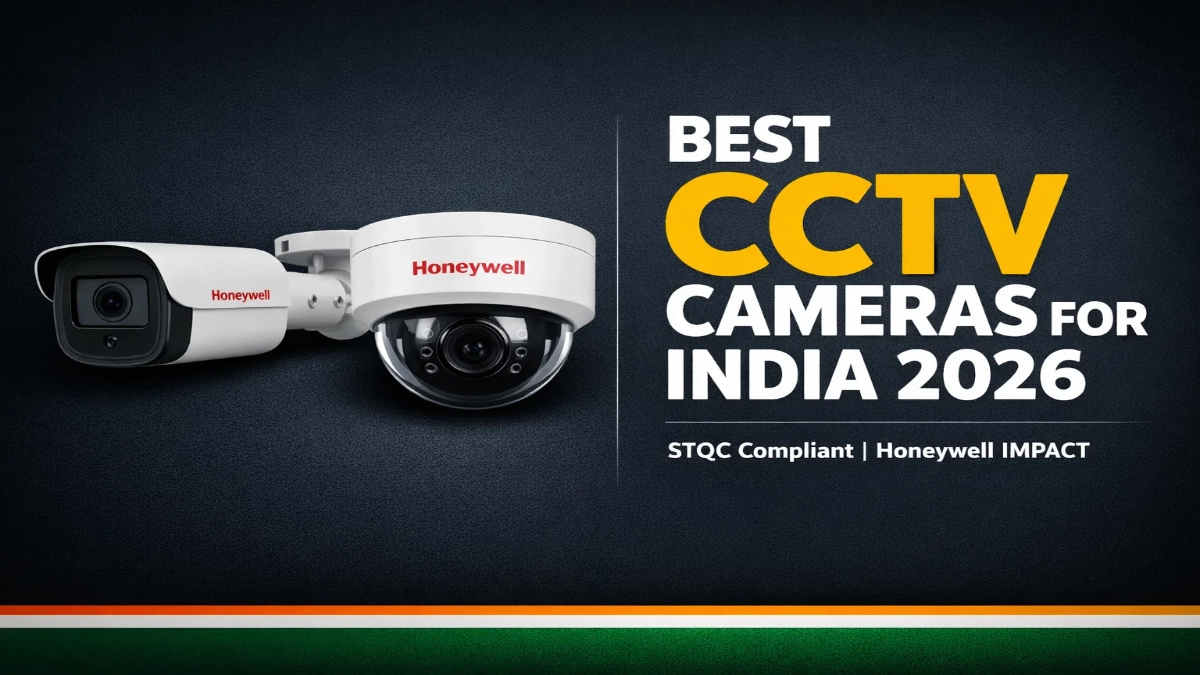
Honeywell IMPACT bullet cameras are particularly well-regarded for commercial use in India because they’re engineered for real-world environments dust, humidity and fluctuating power supply included.
The Honeywell IMPACT IP 5MP Motorized Bullet Camera is one of the standout options for long-range surveillance. The motorized lens lets you adjust the field of view remotely, which is a huge advantage in large facilities where access to camera mounts is difficult. Think: monitoring the perimeter of a 2-acre factory compound or covering a highway-facing retail entrance.
For facilities that need flexible coverage without a premium price tag, the Honeywell IMPACT IP 5MP Varifocal Bullet Camera offers similar versatility with manual varifocal adjustment, ideal for construction sites or mid-sized warehouses where the viewing angle may need occasional reconfiguration.
The Honeywell IMPACT IP 4MP Motorized Lens Bullet Camera strikes an excellent balance between resolution and flexibility. At 4MP, it delivers sharp, detailed footage suitable for identifying faces or vehicle license plates at moderate distances. It’s a solid fit for logistics hubs and distribution centres.
For budget-conscious installations where a fixed viewing angle is acceptable such as a corridor leading to a server room or a single-lane vehicle gate the Honeywell IMPACT IP Fixed Bullet Camera is reliable and cost-efficient. Similarly, the Honeywell IMPACT IP 4MP Fixed Lens Bullet Camera provides a step-up in resolution with the same no-fuss fixed design.
When indoor long-range coverage is the priority say, monitoring a large open-floor factory from one end the Honeywell IMPACT IP 2MP Motorized Bullet Camera is a practical choice. The motorized lens gives you adjustability, while 2MP keeps the cost of storage and bandwidth manageable across large deployments.
Dome Cameras: Discreet, Wide-Angle, Vandal-Resistant
Dome cameras have a compact, low-profile design that makes them the preferred choice for indoor commercial environments. They blend into ceilings without drawing attention and their dome casing makes it harder for bystanders to determine exactly where the camera is pointing, a useful psychological deterrent.
Key applications include:
- Office lobbies, reception areas, and meeting rooms
- Retail floors and shopping aisles
- Hotel corridors and hospitality spaces
- Bank branches and ATM vestibules
- Hospitals and educational institutions
The Honeywell IMPACT IP Vandal Dome Camera is the go-to choice for any environment where tampering is a real risk, fuel stations, public-facing retail outlets, school campuses or any area accessible to the general public. Its reinforced casing is rated to resist physical impact, which means even a deliberate attempt to disable it is unlikely to succeed.
The Honeywell IMPACT IP 5MP Varifocal Dome Camera is excellent for large retail spaces or open-plan offices where you need to adjust the zoom level to cover a specific section of the floor. With 5MP resolution, the footage is detailed enough for forensic review if needed.
For standard office deployments where the goal is reliable, clear coverage of a fixed area, the Honeywell IMPACT IP Fixed Dome Camera delivers consistent performance. It’s easy to install and manage, making it a favourite for IT managers handling multi-floor office buildings.
The Honeywell IMPACT IP 4MP Dome Camera offers a resolution upgrade over standard 2MP options while staying within a reasonable budget. It’s well-suited for conference rooms, stairwells and corridors where you want slightly more detail than a basic camera provides.
For facilities that want high-resolution coverage without the complexity of varifocal adjustment, the Honeywell IMPACT IP 5MP Dome Camera delivers excellent image quality in a fixed-lens format, ideal for boardrooms, server rooms and executive areas where the camera position is set once and never changed.
In multi-camera deployments where cost per unit matters such as a hospital with 40+ cameras or a hotel with cameras on every floor, the Honeywell IMPACT IP 3MP Dome Camera offers solid mid-range performance at a scale-friendly price point.
Best STQC-Compliant CCTV Cameras for Commercial Use in India (2026)
Let’s get specific. Here are the top picks from the Honeywell IMPACT range, organised by use case and deployment type.
Best Bullet Cameras for Commercial Use
1. Honeywell IMPACT IP 5MP Motorized Bullet Camera Best for: Large perimeters, factory gates, highway-facing retail
This camera earns its place at the top of the bullet category for one simple reason, flexibility. The motorized zoom lens means your security team can adjust coverage remotely, without sending someone up a ladder. At 5MP resolution, it captures faces and number plates clearly even at distance. If you’re protecting a large outdoor area and need long-range clarity, this is your camera.
2. Honeywell IMPACT IP 4MP Motorized Lens Bullet Camera Best for: Warehouses, logistics centers, entry/exit monitoring
A step below in resolution but not in capability. The 4MP motorized lens variant handles most commercial use cases with ease. It’s particularly useful in warehouses where the camera might be positioned high up and needs remote lens adjustment to cover a specific zone.
3. Honeywell IMPACT IP 5MP Varifocal Bullet Camera Best for: Construction sites, mid-sized manufacturing plants
When you know you’ll need to tweak the field of view occasionally but not frequently enough to justify a motorized lens the varifocal option is the sweet spot. Manual adjustment is easy and the 5MP resolution ensures nothing important gets missed.
4. Honeywell IMPACT IP Fixed Bullet Camera Best for: Budget deployments, fixed-angle corridors, gate monitoring
Not every camera needs to zoom or adjust. For fixed points with a clear line of sight, this camera does the job efficiently. It’s the right choice when you’re deploying across multiple entry points on a tight budget without sacrificing Honeywell’s build quality and compliance credentials.
Best Dome Cameras for Offices and Retail
1. Honeywell IMPACT IP Vandal Dome Camera Best for: Retail stores, fuel stations, school campuses, public-access areas
If your installation is in a location where cameras could be targeted for tampering, this is non-negotiable. The vandal-resistant casing protects the unit from physical interference while the wide-angle lens keeps coverage broad.
2. Honeywell IMPACT IP 5MP Varifocal Dome Camera Best for: Large retail floors, open-plan offices, showrooms
High resolution plus adjustable coverage makes this an excellent choice for spaces where one camera needs to cover a lot of ground. The 5MP clarity means footage is usable for detailed review even when zoomed in digitally during playback.
3. Honeywell IMPACT IP 5MP Dome Camera Best for: Boardrooms, server rooms, executive areas
When you want premium image quality in a fixed-lens form, this delivers. It’s designed for controlled indoor environments where the camera position is permanent and the need for adjustment is low.
4. Honeywell IMPACT IP 3MP Dome Camera Best for: Hospitals, hotels, educational institutions, high-volume deployments
For organisations deploying 30 or more cameras, cost per unit becomes significant. This model offers reliable performance at a scale that makes large projects financially viable without compromising on the compliance credentials you need.
Bullet vs Dome: Which Should You Choose?
This is one of the most common questions from commercial buyers. The honest answer is: most large facilities need both.
| Feature | Bullet Cameras | Dome Cameras |
|---|---|---|
| Best for | Outdoor, perimeter, long range | Indoor, wide angle, discreet |
| Tamper resistance | Moderate | High (especially vandal dome) |
| Visibility as deterrent | High | Low-to-moderate |
| Lens flexibility | High (motorized options) | Moderate |
| Installation | Pole/wall mounted | Ceiling mounted |
| Example models | IMPACT IP 5MP Motorized Bullet | IMPACT IP Vandal Dome |
For a warehouse, a typical deployment might combine the Honeywell IMPACT IP 4MP Motorized Lens Bullet Camera at entry gates with the Honeywell IMPACT IP 4MP Dome Camera across the interior floor. For a retail chain, the Honeywell IMPACT IP Vandal Dome Camera at customer-facing points and the Honeywell IMPACT IP Fixed Bullet Camera at rear exits creates a cost-effective layered system.
Key Features to Look for in STQC-Compliant CCTV Cameras
When evaluating cameras for commercial purchase, go beyond resolution. These are the features that matter in practice:
IP Rating (Weatherproofing): For any outdoor installation, look for IP66 or IP67 ratings. This ensures the camera is protected against dust and water ingress, essential in Indian climate conditions from coastal humidity to North Indian dust storms.
IR Night Vision Range: Commercial facilities don’t close at night. Ensure your cameras have adequate infrared (IR) night vision, at least 30 metres for indoor use, and 50–80 metres for outdoor perimeter cameras. The motorized bullet variants in the Honeywell IMPACT range are equipped for extended night vision performance.
Compression Standard (H.265): H.265 compression dramatically reduces storage requirements compared to older H.264 cameras. Over a 3–5 year deployment lifecycle, this can translate to significant savings in NVR storage and bandwidth costs.
Wide Dynamic Range (WDR): This is critical for cameras placed near windows, entrances, or areas with mixed lighting. WDR ensures the camera doesn’t blow out bright areas or lose detail in shadows a common problem in Indian lobbies and entrance corridors with strong sunlight.
Cybersecurity Features: In 2026, firmware security matters. Look for cameras that support encrypted data transmission, password-protected access, and regular firmware update channels. This is an area where certified brands like Honeywell carry a meaningful advantage over uncertified alternatives.
PoE Support: Power over Ethernet simplifies installation and reduces wiring costs. Most Honeywell IMPACT IP cameras support PoE, which is a practical advantage in large commercial rollouts.
CCTV Installation Tips for Indian Commercial Properties
Getting the hardware right is only half the job. Installation quality determines whether your investment pays off.
Plan your camera placement before purchase: Walk through your facility and identify blind spots, high-risk zones, and coverage overlaps. A well-planned layout with fewer cameras often outperforms a poorly planned layout with more.
Use professional, licensed installers: In India, sub-standard installation is a leading cause of camera failure and compliance gaps. Ensure your installer is familiar with IP camera networking, PoE switch configuration, and NVR setup.
Ensure network segregation: Your CCTV network should be on a separate VLAN from your business network. This protects against both security breaches and network congestion affecting camera performance.
Check local regulations: Some states in India have specific rules about camera placement in common areas, employee-facing zones, and near residential boundaries. Verify compliance before installation.
Plan for storage: At 5MP resolution, footage files are large. Calculate your required storage based on camera count, recording hours per day, and retention period (typically 30–90 days for commercial use). Cloud backup options are worth considering for critical footage.
Test during commissioning: Before signing off on an installation, review footage from every camera in day and night conditions. Adjust angles, focus, and IR settings before the system goes live.
Invest in Compliance, Not Just Coverage
Choosing CCTV cameras for a commercial property in India in 2026 is no longer just about picture quality or price. It’s about ensuring your security infrastructure meets regulatory expectations, holds up in audits and protects your business against both physical and digital threats.
The Honeywell IMPACT range, covering bullet cameras from the feature-rich 5MP Motorized variant down to the practical Fixed Bullet, and dome cameras from the rugged Vandal Dome to the high-resolution 5MP Dome, gives commercial buyers a versatile, compliance-ready portfolio that works across industries.
Whether you’re setting up surveillance for a new facility or upgrading a legacy system, starting with STQC-compliant, trusted hardware like Honeywell IMPACT cameras is the decision that pays for itself, in peace of mind, in audit clearances and in security that actually works when it matters.
Read Also: Why More Indian Businesses Are Upgrading to Smart CCTV
Read Also: Top CCTV Technology Trends Businesses Should Watch in 2026
Frequently Asked Questions (FAQs)
Honeywell is one of the few global security brands with a strong compliance track record in the Indian market. Their IMPACT range of IP cameras is designed to meet the quality and performance benchmarks required for STQC certification. For current certification status of specific models, buyers should verify with the authorised Honeywell distributor in India or check the STQC portal directly, as certifications are periodically renewed and updated.
For a factory environment, the combination of the Honeywell IMPACT IP 5MP Motorized Bullet Camera (for perimeter and gate coverage) and the Honeywell IMPACT IP 4MP Dome Camera (for indoor floor monitoring) is a highly effective pairing. Motorized lenses are especially valuable in large facilities where repositioning cameras physically is impractical.
For a warehouse, bullet cameras work best at entry/exit points and along external perimeter walls, while dome cameras are more practical indoors — particularly on high ceilings over storage aisles. The Honeywell IMPACT IP 4MP Motorized Lens Bullet Camera is a strong outdoor choice, while the Honeywell IMPACT IP Vandal Dome Camera handles indoor aisle monitoring well.
For most commercial use cases, 4MP to 5MP resolution provides sufficient detail for face identification and number plate recognition at standard distances. Lower resolution (2MP) cameras can work in lower-risk interior zones. For critical areas like server rooms, cash handling zones, or main entrances, 5MP cameras like the Honeywell IMPACT IP 5MP Dome Camera are recommended.
Both allow you to adjust the field of view (zoom in or out), but in different ways. A varifocal lens is adjusted manually — you physically turn the lens or use a small adjustment tool during installation. A motorized lens is adjusted remotely through the camera’s software or NVR interface. Motorized lenses are more convenient for cameras mounted at height or in hard-to-reach locations, which is why they’re preferred in large commercial deployments.
Certified cameras may carry a modest price premium, but the total cost of ownership often favours certified products. You avoid the risk of having to replace non-compliant equipment, benefit from better build quality and longer operational life, and reduce the probability of firmware-related security incidents that can be extremely costly to remediate.