Walk into any enterprise security briefing, and the conversation inevitably starts with camera specifications. Megapixels, lens types, IR range, and weather ratings dominate early discussions. Meanwhile, the infrastructure that actually determines whether that camera network will perform reliably or collapse under operational pressure receives far less attention.
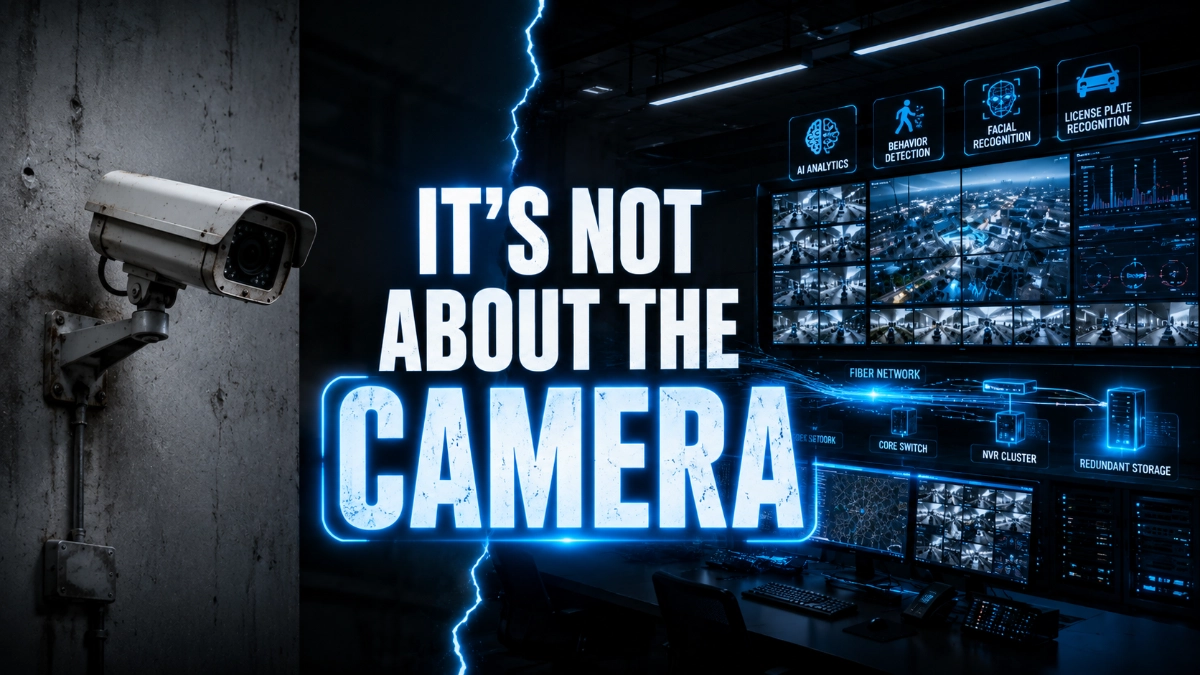
This is the core problem with how many organisations approach enterprise CCTV. They treat surveillance as a hardware purchase rather than an infrastructure engineering challenge. The cameras are visible. The rest of the system is not. And it is precisely this invisible layer spanning network design, power architecture, storage engineering, AI analytics, redundancy planning, and cybersecurity hardening that determines whether an enterprise surveillance deployment succeeds or fails.
This article examines what truly goes into enterprise CCTV infrastructure, why the hidden layers matter more than most organisations realise, and how intelligent infrastructure engineering transforms surveillance from a passive recording system into an active operational intelligence platform.
What Enterprise CCTV Infrastructure Actually Includes
Enterprise CCTV infrastructure is best understood as a layered technology stack. Each layer builds on the one below it, and a weakness at any level propagates upward, degrading video quality, increasing latency, reducing AI analytics accuracy, and ultimately undermining the value of the entire investment.
The Seven Layers of Enterprise Surveillance Infrastructure
- Physical Layer: Camera hardware, housings, mounting systems, cable runs, conduit, and field enclosures.
- Power Layer: PoE/PoE+ switches, uninterruptible power supplies, power distribution units, and generator backup circuits.
- Network Layer: Switches, routers, VLANs, fibre backbone, wireless bridges, and bandwidth management systems.
- Compute Layer: Network Video Recorders (NVRs), Video Management Servers (VMS), edge computing devices, and GPU analytics servers.
- Storage Layer: RAID arrays, Network Attached Storage (NAS), Storage Area Networks (SAN), and cloud archival tiers.
- Analytics Layer: Edge AI processors, centralised analytics engines, AI video analytics pipelines, and machine learning models.
- Operations Layer: Command centre interfaces, alarm management platforms, access control integration, and emergency response workflows.
Most organisations invest heavily in the physical layer and neglect everything above it. Enterprise-grade surveillance deployments treat all seven layers with equal engineering discipline.
Why Camera-Focused Thinking Is Outdated
The idea that better cameras equal better surveillance made sense in the era of analogue CCTV. A higher-resolution camera genuinely improved what an operator could see. That logic still applies up to a point.
In modern enterprise environments, camera specifications beyond a certain threshold deliver diminishing returns. A 4K camera recording at full resolution but connected to a misconfigured network segment, writing to an undersized storage array, with no AI analytics processing the feed, contributes far less operational value than a well-planned 2MP camera deployment backed by solid infrastructure.
The shift from reactive recording systems to proactive operational intelligence platforms demands a fundamentally different approach. Enterprise surveillance consultants, system integrators, and SOC teams must now think in terms of infrastructure design, not just hardware procurement.
The Hidden Engineering Components That Determine System Performance
1. Network Architecture Design
Surveillance networks carry enormous amounts of data. A single 4K camera stream can consume between 8 and 25 Mbps, depending on compression and scene complexity. A 500-camera enterprise deployment can generate between 5 and 12 Gbps of sustained traffic.
Designing a network that handles this load reliably requires dedicated VLAN segmentation for surveillance traffic, QoS (Quality of Service) policies that prioritise video streams, proper switch sizing with sufficient backplane capacity, and uplink redundancy to prevent single points of failure. Mixing surveillance traffic with general enterprise IT traffic on a flat network is one of the most common causes of degraded video quality and dropped streams in mid-size to large deployments.
2. PoE Power Planning
Power over Ethernet is the standard delivery mechanism for IP cameras. However, the engineering behind PoE planning is frequently underestimated. Each camera requires a specific power budget, and the total power demand of a camera deployment must be carefully mapped against switch power capacity.
Enterprise deployments require industrial-grade managed PoE+ switches (IEEE 802.3at, delivering up to 30W per port) or PoE++ switches (IEEE 802.3bt, up to 90W per port) for PTZ cameras, thermal imagers, and cameras with onboard heaters. Power budgets must account for worst-case simultaneous demand, not average load. Underpowered switches cause intermittent camera dropouts, a problem that is notoriously difficult to diagnose in the field.
Redundant power inputs, UPS backup, and in critical environments, generator-backed power distribution are essential components of a robust PoE architecture.
3. Fibre Backbone Infrastructure
Copper Ethernet reaches its practical limits at approximately 100 meters. Enterprise campus environments, industrial facilities, warehouses, and multi-building deployments require fibre-optic backbone infrastructure to carry aggregated video traffic over long distances.
Single-mode fibre is preferred for long-distance backbone runs, while multi-mode fibre suits shorter intra-building runs. Fibre routing, splice points, and optical budgets must be engineered with redundant paths to ensure that a single fibre cut does not take down an entire surveillance zone. In transportation and smart city deployments, hardened fibre with armoured jackets and burial-grade protection is standard.
4. Video Management Systems (VMS)
The Video Management System is the operational brain of an enterprise surveillance deployment. A VMS handles live video display, recording management, playback, event-triggered recording, alarm correlation, user access control, and integration with third-party systems.
Enterprise VMS platforms must be architected for scale. This means distributed server architectures where recording load is shared across multiple servers, failover configurations where a standby server automatically assumes duties if a primary server fails, and database management systems that handle millions of recorded video segments without performance degradation.
VMS selection also determines the ecosystem of compatible cameras, analytics engines, and integration modules available to the deployment. Choosing a closed or proprietary platform without evaluating long-term vendor roadmaps can severely limit future scalability.
5. Edge AI Processing
Edge AI refers to the execution of artificial intelligence inference, object detection, classification, and behaviour analysis directly on a camera or edge device, rather than sending raw video to a central server for processing.
Edge AI dramatically reduces bandwidth requirements. Instead of streaming 4K video to a central analytics server, an edge-capable camera sends only metadata: detected person at coordinates X, Y, object classification: backpack, confidence: 94%. This approach allows large-scale deployments to run AI analytics across hundreds or thousands of cameras without proportionally scaling network and server infrastructure.
Modern edge AI cameras embed dedicated neural processing units (NPUs) capable of running complex deep learning models at full frame rate. Platforms built on AI-native hardware architectures, such as those found in advanced enterprise cameras aligned with Impact by Honeywell ecosystems, support edge inference for face detection, license plate recognition, crowd density estimation, and behavioural anomaly detection.
6. GPU-Assisted Central Analytics
While edge AI handles per-camera inference, GPU-accelerated analytics servers perform complex cross-camera analysis that requires a broader field of view. Person re-identification across multiple cameras, crowd flow analysis across an entire facility, and predictive threat modelling require the computational power of dedicated GPU clusters.
Enterprise surveillance analytics servers use NVIDIA A-series or similar GPUs to run dozens of deep learning inference pipelines simultaneously. Proper GPU memory management, model batching, and cooling infrastructure are engineering considerations that directly affect analytics throughput and uptime.
7. Video Storage Engineering
Storage is frequently where enterprise CCTV deployments are most severely under-engineered. Calculating storage requirements demands more than multiplying camera count by days of retention. Engineers must account for variable bitrate encoding, scene complexity (a busy intersection generates far more data than an empty corridor), simultaneous read/write demands during playback and recording, and storage tiering strategy.
Enterprise storage tiers typically include:
- Hot Tier: High-speed SSDs or NVMe arrays for recent footage requiring fast access.
- Warm Tier: High-capacity HDD RAID arrays for medium-term retention.
- Cold Tier: Cloud or tape archive for long-term compliance retention.
RAID configurations (RAID 5, RAID 6, or RAID 10, depending on the required balance of capacity, performance, and redundancy) protect against drive failures. In critical environments, dual-parity RAID 6 configurations ensure that two simultaneous drive failures do not result in data loss.
8. Bandwidth Engineering
Bandwidth engineering encompasses both the capacity planning and the traffic management disciplines that keep video streams flowing reliably. H.265 (HEVC) compression reduces bandwidth requirements by up to 50% compared to H.264 while maintaining equivalent video quality. Smart compression technologies adjust bitrate dynamically based on scene activity, reducing storage and bandwidth demand during low-activity periods.
Bandwidth management also includes QoS policies, traffic shaping, and multicast streaming configurations that prevent surveillance traffic from overwhelming network capacity during peak activity periods.
9. Multi-Site Synchronisation
Enterprise organisations, logistics networks, retail chains, manufacturing groups, and smart city authorities operate surveillance systems across dozens or hundreds of geographically distributed sites. Multi-site synchronisation ensures that operators at a central command centre see live and recorded video from all sites with consistent time-stamping, unified search capabilities, and centralised alarm management.
Time synchronisation via NTP (Network Time Protocol) or PTP (Precision Time Protocol) is critical. Timestamp discrepancies of even a few seconds create serious problems for incident reconstruction and legal evidence chain-of-custody.
10. Latency Management
Latency, the delay between a real-world event and its appearance on an operator’s screen, matters enormously in high-stakes environments. In a typical enterprise IP surveillance deployment, latency below 200 milliseconds is considered acceptable for monitoring. Critical applications such as perimeter intrusion response or active shooter scenarios demand latency below 100 milliseconds.
Latency is determined by camera processing time, network transmission time, VMS decoding time, and display rendering. Each element must be engineered and tested. High-resolution streams processed on underpowered VMS servers introduce disproportionate latency that operators often attribute to network problems.
11. AI Video Analytics Pipelines
A mature AI video analytics pipeline in an enterprise surveillance deployment is a multi-stage processing architecture. Raw video frames enter the pipeline, pass through pre-processing (frame normalisation, noise reduction), through inference engines running object detection and classification models, through post-processing (NMS, confidence filtering), and finally output structured metadata to an event management layer.
Analytics pipelines must be designed for both accuracy and throughput. False positive rates above a few per cent overwhelm SOC operators with nuisance alerts. False negatives and missed detections reduce the operational value of the system. Model tuning, threshold calibration, and regular retraining with site-specific data are ongoing engineering activities, not one-time setup tasks.
12. Cybersecurity Hardening
Surveillance systems present a significant cybersecurity attack surface. IP cameras are network-connected devices that, if unprotected, can be compromised and used as entry points into enterprise networks or incorporated into botnets. In 2021 and 2023, large-scale breaches of enterprise surveillance systems made global headlines.
Enterprise cybersecurity hardening for surveillance infrastructure includes:
- Network segmentation and VLAN isolation for surveillance devices.
- Default credential elimination and certificate-based authentication.
- Regular firmware update procedures and vulnerability management.
- Encrypted video streams (TLS/SRTP) in transit.
- Role-based access control on VMS platforms.
- Intrusion detection systems monitor surveillance network segments.
- Air-gapped configurations for classified or critical national infrastructure environments.
13. Cloud and Hybrid Surveillance Infrastructure
Cloud-connected surveillance infrastructure enables remote access, off-site storage, archival, AI model updates, and centralised management across geographically distributed deployments. Hybrid architectures combine on-premise edge recording, ensuring continued operation during WAN outages with cloud-based analytics, long-term archival, and unified management portals.
Cloud-native enterprise surveillance platforms handle automatic load balancing, elastic storage scaling, and global video search without requiring on-premise server management. For enterprise organisations managing dozens of sites, cloud-managed surveillance dramatically reduces operational overhead.
14. Failover and Disaster Recovery
Business-critical surveillance environments, such as airports, data centres, financial institutions, and utilities, require guaranteed uptime. Failover architectures use hot-standby recording servers that maintain real-time synchronisation with primary servers and assume recording duties within seconds of a primary failure.
Disaster recovery planning for surveillance infrastructure specifies Recovery Time Objectives (RTO) and Recovery Point Objectives (RPO) how quickly the system recovers and how much recorded footage can be lost in a worst-case failure. These parameters drive hardware specification, replication strategy, and geographic distribution of infrastructure.
15. Access Control and Fire Alarm Integration
Integrated physical security platforms correlate surveillance video with access control events and fire alarm activations in real time. When a door access event triggers an alarm, the integrated platform automatically displays the closest camera feed on the operator’s workstation, accelerating incident assessment.
Fire alarm integration enables automatic camera pan-tilt-zoom to the area of alarm activation, captures video of evacuation routes, and supports post-incident forensic review of events leading up to the alarm. Building Management System (BMS) integration extends this correlation to HVAC, lighting, and elevator systems, creating a unified operational picture.
16. Smart Event Escalation Workflows
Modern enterprise surveillance platforms replace manual monitoring with intelligent event escalation workflows. Instead of operators watching dozens of screens continuously, AI analytics identify potential incidents and escalate them for human review. Tiered escalation workflows route low-confidence alerts to a review queue, high-confidence alerts to immediate operator attention, and critical alerts to automated emergency response protocols.
These workflows significantly reduce operator fatigue, improve response consistency, and ensure that high-priority events receive immediate attention even in large, complex environments.
Real-World Deployment Examples
Airports
International airports deploy enterprise surveillance systems spanning thousands of cameras across terminals, aprons, perimeter fencing, baggage handling areas, and roadways. Multi-site synchronisation connects remote terminal buildings to a centralised security operations centre. AI analytics monitors passenger flow, detects abandoned objects, and identifies behaviour anomalies in security screening zones. Redundant fibre backbone infrastructure ensures that a cable fault in one terminal does not affect surveillance coverage in adjacent zones.
Smart Cities
Smart city surveillance deployments integrate traffic cameras, public area monitors, license plate recognition systems, and emergency service coordination platforms into a unified operational intelligence platform. Edge AI reduces the bandwidth demands of city-scale deployments, while cloud analytics provide city-wide pattern recognition for traffic optimisation and public safety analytics. Multi-agency access controls allow law enforcement, transport authorities, and emergency services to share surveillance resources securely.
Manufacturing Plants
Industrial manufacturing environments require surveillance systems engineered for harsh conditions, such as heat, vibration, dust, and chemical exposure. Ruggedised camera housings, sealed fibre junction boxes, and ATEX-certified equipment are standard in hazardous areas. AI analytics monitors production line activity, detects safety violations such as missing PPE, and identifies quality defects in real time. Surveillance data integrates with Manufacturing Execution Systems (MES) to correlate security events with production records.
Warehouses and Logistics Hubs
High-throughput warehouses and logistics hubs use surveillance infrastructure to monitor inventory movement, verify dispatch procedures, and detect theft or process deviations. Wide-angle fisheye cameras combined with AI dewarping and analytics provide full coverage of large floor areas with minimal camera density. License plate recognition at entry and exit points integrates with Warehouse Management Systems (WMS) for automated vehicle tracking and dwell time monitoring.
Data Centers
Data centre surveillance operates under some of the most demanding uptime requirements of any enterprise environment. Multi-layer perimeter surveillance, biometric-integrated access control, raised-floor camera systems, and aisle-level monitoring are standard. Surveillance systems must operate continuously with zero tolerance for gaps in coverage, a requirement that drives highly redundant infrastructure design with sub-second failover capabilities.
Commercial Campuses and Multi-Building Enterprises
Corporate headquarters, university campuses, and healthcare systems manage surveillance across multiple buildings with varying security requirements. Enterprise VMS platforms unify these environments under a single management interface while allowing zone-specific analytics configurations. Visitor management integration, parking management, and emergency mustering functions leverage the surveillance infrastructure for broader operational value.
Why Many Enterprise CCTV Deployments Underperform
Despite significant capital investment, a large proportion of enterprise CCTV deployments fail to deliver their intended operational value. The root causes follow consistent patterns.
- Network underspecification: Surveillance traffic added to existing enterprise networks without proper segmentation or bandwidth planning causes stream dropouts and recording failures.
- Storage miscalculation: Systems sized for average bitrate rather than peak demand fill storage arrays within weeks of deployment, triggering premature overwrite of critical footage.
- VMS platform mismatch: Consumer or SMB-grade VMS platforms deployed in enterprise environments lack the scalability, redundancy, and integration capabilities that large deployments require.
- No edge AI strategy: All analytics processing routed through central servers creates bandwidth bottlenecks and analytics latency that reduce operational effectiveness.
- Cybersecurity neglect: Cameras deployed with default credentials on flat networks create security vulnerabilities that compromise both surveillance integrity and broader enterprise IT security.
- Integration gaps: Surveillance systems deployed in isolation from access control, fire alarm, and BMS platforms miss the operational intelligence value that integration delivers.
- No failover planning: Single points of failure in recording servers, network switches, or storage arrays create coverage gaps at precisely the moments when reliability matters most.
- One-time calibration: AI analytics models are deployed once at commissioning and never recalibrated, drifting in accuracy as lighting conditions, environment, and operational patterns evolve.
How Intelligent Infrastructure Changes Surveillance Operations
Organisations that invest in properly engineered enterprise surveillance infrastructure experience operational outcomes that extend well beyond traditional security functions.
Accelerated Incident Response
Integrated AI escalation workflows reduce the time from event occurrence to operator engagement from minutes to seconds. Automated camera positioning, instant forensic search by object type or behaviour, and correlated access control data transform incident response from a reactive to a near-real-time function.
Operational Intelligence
Surveillance data analysed through AI pipelines generates operational intelligence that informs business decisions. Retail environments use customer flow analytics to optimise store layouts. Manufacturing plants use safety violation detection data to improve training programs. Logistics operators use dwell time analytics to optimise dock scheduling. The surveillance infrastructure becomes a source of operational insight, not just a compliance and security tool.
Reduced Operator Load
Smart event escalation and AI-assisted monitoring significantly reduce the cognitive load on SOC operators. Operators review flagged events rather than monitoring live feeds continuously. Response quality improves, operator fatigue decreases, and human attention is directed where it adds the most value.
Business Continuity
Redundant, failover-capable surveillance infrastructure with documented disaster recovery procedures ensures that security coverage is maintained during infrastructure failures, power outages, and network disruptions. For regulated industries, banking, healthcare, and critical infrastructure, continuous surveillance coverage is a compliance requirement, not just an operational preference.
Basic CCTV vs. Enterprise Intelligent Surveillance: A Direct Comparison
| Dimension | Basic CCTV Deployment | Enterprise Intelligent Surveillance |
| Camera Installation | Full-stack infrastructure design from day one | |
| Consumer-grade PoE switches | Industrial PoE+ switches with redundant power | |
| Local NVR with limited storage | Tiered storage: edge + SAN/NAS + cloud archive | |
| Basic motion detection only | AI video analytics: behavior, crowd, object, anomaly | |
| Single-site, isolated system | Multi-site synchronized surveillance platform | |
| No network segmentation | VLAN-segmented, zero-trust cybersecurity hardening | |
| Manual video review | AI-assisted search and automated event escalation | |
| No failover or redundancy | Hot-standby servers, RAID, and disaster recovery | |
| Limited integration | Full integration: access control, fire alarm, BMS, ERP | |
| Reactive incident response | Proactive predictive analytics and automated alerts | |
| No cloud capability | Hybrid/cloud-native surveillance with remote access | |
| Fixed capacity, hard to scale | Modular architecture with elastic scalability |
Future-Focused: Where Enterprise Surveillance Is Heading
AI-Native Surveillance Ecosystems
The next generation of enterprise surveillance systems will be built AI-first rather than adapted for AI retrospectively. Camera firmware, VMS platforms, and analytics engines will share a unified AI runtime environment, enabling model deployment and updates across entire deployments from a central management console without field visits.
Predictive Surveillance Analytics
Machine learning models trained on historical event data will enable predictive analytics, identifying pre-incident behavioural patterns before an event occurs. Crowd dynamics analysis, anomalous movement pattern detection, and environmental sensor fusion will give SOC teams a warning of developing situations.
Edge Intelligence and Autonomous Monitoring
As edge AI hardware becomes more powerful and cost-effective, more intelligence will migrate to the camera level. Fully autonomous monitoring scenarios where cameras identify, classify, escalate, and in some cases respond to events without human intervention will become practical for defined use cases such as perimeter intrusion detection and parking lot management.
Digital Twins for Surveillance Infrastructure
Digital twin technology creates a virtual model of physical surveillance infrastructure that mirrors real-world system state in real time. Engineers and operators can simulate camera repositioning, test analytics configurations, and model failover scenarios in the digital twin before implementing changes in the physical environment. This capability dramatically reduces commissioning time and operational risk for large-scale deployments.
Cloud-Native Enterprise Surveillance Architecture
Cloud-native surveillance architectures use containerised microservices, Kubernetes orchestration, and cloud-agnostic storage to deliver surveillance management capabilities with the scalability, resilience, and operational flexibility of modern cloud infrastructure. For enterprise organisations with dozens of sites across multiple geographies, cloud-native architecture eliminates the overhead of maintaining server hardware at every location.
Unified Security Operations Platforms
The convergence of physical security (surveillance, access control, fire and life safety) with cybersecurity operations in unified Security Operations Centre (SOC) platforms is accelerating. Integrated platforms that correlate physical access events, surveillance anomalies, and cyber threat indicators in a single operational view give enterprise security teams capabilities that siloed systems cannot match.
Enterprise solution ecosystems such as Impact by Honeywell, distributed through authorised Impact by Honeywell distributors in India and globally, are positioning these unified operational intelligence capabilities as the standard for large-scale commercial and industrial security infrastructure.
Read Also: Why CCTV Infrastructure Is Becoming a Strategic Business Asset
Read Also: What Makes Modern CCTV Systems Smarter Than Traditional Surveillance