Walk into almost any modern industrial facility, and you will find fire detection hardware everywhere, such as smoke detectors, heat sensors, manual call points, fire suppression systems, an addressable fire alarm panel or a conventional fire alarm panel in the control room. On paper, the facility looks protected.
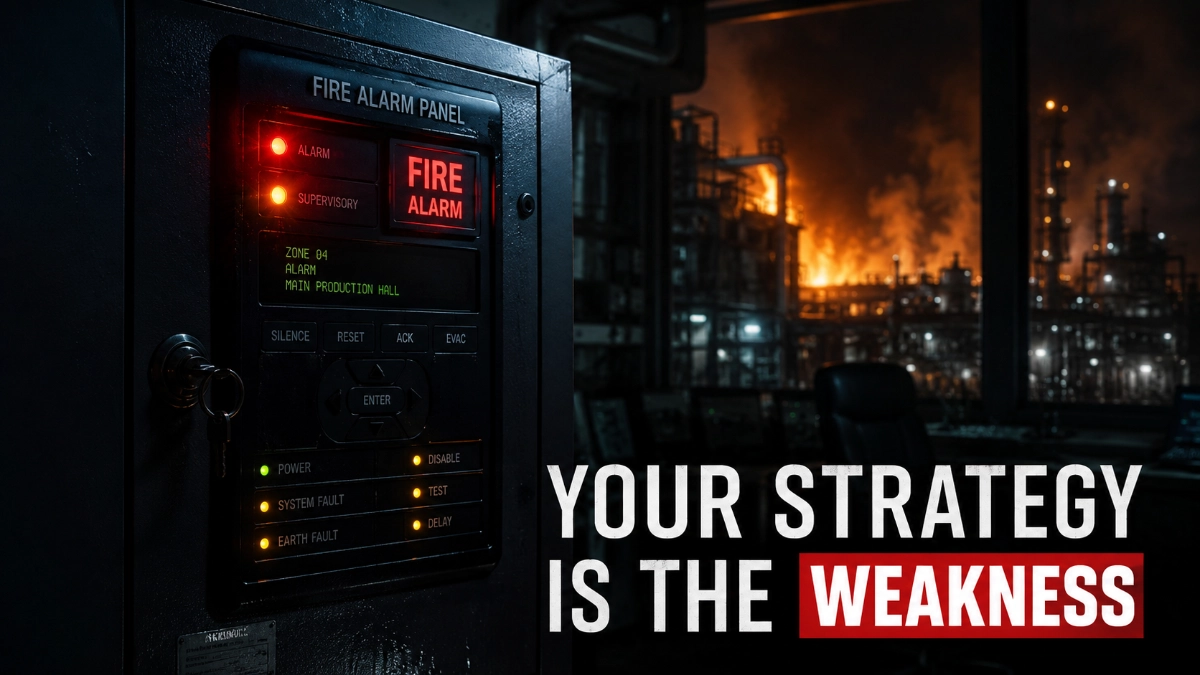
But fire safety professionals know something that procurement teams often do not: hardware does not equal safety. A facility can invest heavily in fire detection infrastructure and still face a high fire risk, not because the equipment is faulty, but because the strategy around it is weak.
Every year, industrial facilities across manufacturing, oil and gas, logistics and critical infrastructure sectors suffer significant fire-related losses despite having installed modern fire alarm systems. Investigations consistently reveal the same pattern: the equipment worked, but the system around it failed. Poor integration between fire alarm and building automation systems. Inadequate cause-and-effect programming. Zones that were poorly mapped to actual operational areas. Maintenance records that existed on paper but were not in practice.
This article examines the deepest structural weaknesses in industrial fire safety strategies, the ones that most facilities fail to identify until they face an incident. Whether you are a fire safety consultant reviewing a client site, a plant manager assessing your current infrastructure, or an EHS professional building a compliance framework, these insights will help you move beyond hardware thinking and toward genuinely resilient fire safety planning.
What Makes Industrial Fire Safety Uniquely Challenging
Industrial environments are fundamentally different from commercial buildings. They are dynamic, hazardous and operationally complex. The fire risks they carry are not static; they shift with production processes, chemical inventories, occupancy patterns and seasonal conditions.
A warehouse storing lithium-ion batteries presents entirely different fire behaviour than one storing paper goods. A pharmaceutical manufacturing plant has cleanroom restrictions that affect detector placement and suppression system design. An oil and gas facility must manage explosive atmospheres, complex process interlocks, and offshore or remote-site conditions. A data centre must protect mission-critical equipment from both fire and the suppression agents used to fight it.
These environments demand layered and intelligent fire safety strategies, not just reactive detection, but proactive risk management built into every layer of the system architecture. Here is what that means in practice:
- Multi-layer detection: Combining smoke, heat, flame, and gas detection across different zones.
- Intelligent cause-and-effect programming: Defining exactly what should happen when a specific detector activates.
- System integration: Connecting fire alarm infrastructure with HVAC, access control, BMS, and suppression systems.
- Predictive maintenance: Moving from reactive repairs to proactive health monitoring of all detection components.
- Human response coordination: Ensuring that the people who must act during a fire event know exactly what to do and when.
The Difference Between Compliance-Driven Safety and Operationally Effective Safety
This is one of the most important distinctions in industrial fire risk management and one of the most commonly ignored.
Compliance-driven safety means meeting the minimum standards set by local regulations, insurance requirements, and codes such as BS 5839, NFPA 72, or EN 54. It means passing annual inspections, having the required number of detectors per square metre, and holding a valid fire certificate.
Operationally effective safety means designing a fire safety system that actually works under the real conditions your facility faces during a shift change, during peak production, during a network outage, during the most challenging scenario your site can experience.
The gap between these two states is where most industrial fire safety failures live. A facility can be fully compliant on paper and still have a fire alarm system that will fail to protect its people and assets when it matters most. Compliance gives you a baseline. Operational effectiveness gives you resilience.
The 16 Major Weaknesses Commonly Found in Industrial Fire Safety Strategies
The following weaknesses appear repeatedly in fire safety audits, post-incident investigations and system design reviews across industrial sectors worldwide. Understanding them is the first step toward eliminating them.
1. Poor Integration Between Fire Alarm and Building Systems
Many industrial facilities operate their fire alarm panel as a standalone system, completely isolated from HVAC, access control, lifts, BMS and suppression systems. This is one of the most operationally dangerous configurations possible.
When a fire event occurs, a fully integrated system can automatically shut HVAC dampers to prevent smoke spread, release magnetic door holders to enable evacuation, isolate electrical circuits in affected zones, activate suppression systems in the right area, and alert building management platforms in real time. A standalone system does none of this automatically. Every action requires manual human intervention, and in a fast-moving fire scenario, seconds matter.
Example: In a large commercial campus in South Asia, a fire in an electrical riser room went uncontrolled for over twelve minutes because the conventional fire alarm panel had no integration with the HVAC system. Smoke was actively being redistributed through the ventilation network before the first responder physically silenced the damper in the mechanical room. A GST fire alarm system with integrated BMS output would have triggered HVAC isolation within seconds of the initial detector activation.
2. Overdependence on Manual Intervention
A surprising number of industrial fire safety strategies rely on human action at every critical decision point. Operators must acknowledge the alarm. Engineers must silence false alerts. Security staff must physically verify activation before suppression systems discharge.
Manual dependency creates fatal delays. In a chemical processing plant, the time between an alarm and a decision to activate suppression can be the difference between a contained incident and a catastrophic loss. Intelligent cause-and-effect programming in an addressable fire alarm system eliminates unnecessary manual steps while preserving human oversight where it genuinely adds value.
3. Inadequate Cause-and-Effect Programming
Cause-and-effect (C&E) logic is the operational brain of your fire alarm system. It defines what happens automatically when a specific detector or zone activates. Poor C&E programming is one of the most common and most dangerous weaknesses in industrial fire safety.
Symptoms of inadequate C&E programming include: suppression systems that activate across entire floors instead of targeted zones, HVAC systems that continue running during a fire event, evacuation announcements that trigger in unaffected areas while ignoring the actual fire zone, and output relays that never activate because they were never correctly mapped.
Every addressable detector in a well-configured system should have a defined response matrix that activates, isolates, and notifies, and in what sequence. This requires detailed engineering at the design stage, not an afterthought during commissioning.
4. Ageing Fire Detection Infrastructure
Industrial facilities often run fire detection infrastructure long past its recommended service life. Detectors that are ten or fifteen years old may still generate signals, but their sensitivity has drifted significantly from the original calibration. They may be producing increased false alarms, or worse, failing to detect real fire conditions within their rated response time.
Ageing conventional detectors are particularly problematic because they offer no per-device diagnostic data. When a zone trips, engineers cannot tell whether it is one detector or multiple, where exactly the activation occurred, or whether the device generating the signal has a maintenance fault. Transitioning to addressable detectors provides individual device-level identity, event logging, and health status, critical capabilities for managing ageing infrastructure intelligently.
5. Lack of Predictive Maintenance
Most industrial facilities still operate on scheduled preventive maintenance cycles, with quarterly or annual inspection visits by a service provider. While better than no maintenance, this approach creates windows of vulnerability between visits. A detector that fails the week after an inspection will go undetected for months.
Modern intelligent fire alarm systems generate continuous device health data. Addressable fire alarm panels with diagnostic capabilities can flag drift in detector sensitivity, communication faults on loop devices, and power supply degradation before they become failures. This shift from scheduled to predictive maintenance is one of the highest-value improvements available in industrial fire protection today.
6. Weak Evacuation Coordination
Fire evacuation in industrial facilities is not simply a matter of sounding an alarm and expecting everyone to leave. Large sites have complex layouts, multiple entry and exit points, areas where noise levels prevent audible alarm perception, zones where personal protective equipment may muffle signals, and sections where personnel cannot leave their post without following a defined safe-shutdown procedure.
Effective evacuation coordination requires zone-specific alarm escalation, visual alert systems in high-noise areas, voice evacuation systems with clear pre-recorded or live instructions, and defined assembly point procedures that account for shift population and contractor headcount. Many industrial facilities have none of these elements properly planned or integrated into their fire alarm system design.
7. Improper Detector Zoning
Detector zoning is the physical and logical division of a facility into fire detection areas. Poor zoning means that when a detector activates, responders cannot quickly identify where in a large zone the event is occurring, wasting critical minutes.
In a large warehouse or manufacturing facility using a conventional fire alarm panel, a single zone might cover thousands of square metres. When that zone activates, the response team must physically walk the entire area to locate the source. An addressable fire alarm system with properly mapped zones can identify the precise detector location down to the specific shelf row, plant room, or production cell within seconds.
8. Delayed Response Visibility
In many industrial facilities, fire alarm events are visible only at the main control panel, often located in a security office or control room that may not be staffed around the clock. If the alarm activates during a night shift with minimal staffing, or during a shift handover when control room attention is divided, the response delay can be catastrophic.
Remote monitoring solutions and cloud-connected fire alarm infrastructure solve this problem by pushing real-time event notifications to multiple stakeholders simultaneously, facility managers, fire safety officers, maintenance teams, and contracted monitoring centres, regardless of the time of day or staffing level.
9. Poor Maintenance Documentation
Fire safety audits frequently reveal significant gaps in maintenance documentation. Service visit records are incomplete. Detector replacement dates are unrecorded. System modifications made during facility upgrades were never reflected in the as-built drawings. Battery replacement logs are missing.
Poor documentation creates two problems. First, it prevents the maintenance team from understanding the true health of the system. Second, it creates compliance liability insurers and regulators require demonstrable evidence of systematic maintenance. Digital maintenance management platforms integrated with addressable fire alarm systems can automate documentation, generate compliance-ready reports, and create a continuous audit trail.
10. False Alarm Fatigue
False alarm fatigue is one of the most underestimated threats in industrial fire safety. When a fire alarm system generates frequent false activations triggered by dust, steam, welding fumes, or poorly sited detectors, facility staff begin to treat alarms as noise rather than emergencies. Evacuations become slower. Investigations become cursory. The critical assumption that every alarm represents a real event is eroded.
In a hospital with a history of frequent false alarms, clinical staff have been observed hesitating before initiating patient evacuation procedures, a dangerous behaviour pattern created entirely by a poorly maintained fire detection system. The solution is not simply to acknowledge false alarms more quickly, but to eliminate their root causes through better detector selection, intelligent multi-sensor devices, and proper environmental assessment during system design.
11. Lack of Real-Time Monitoring
Many industrial facilities, even large ones, have no real-time remote monitoring of their fire alarm infrastructure. The system operates in isolation, generating local panel events that are only reviewed during working hours. Faults that develop overnight may go unnoticed for twelve hours or more.
Continuous real-time monitoring is now achievable at a reasonable cost through cloud-connected fire monitoring platforms that receive event data from the fire alarm panel via IP connectivity, generate instant fault and alarm notifications, and provide remote access to system status for authorised personnel. For mission-critical sites, such as airports, data centres, hospital campuses, oil and gas terminals, this capability should be considered mandatory, not optional.
12. Inconsistent Testing Procedures
Regular testing of fire detection systems is a regulatory requirement in most jurisdictions. But the quality of testing varies enormously. Some facilities conduct thorough, documented zone tests on a defined schedule. Others rely on annual service visits where a contractor walks the site for a few hours and generates a generic sign-off sheet.
Inconsistent testing creates hidden failure detectors that are mechanically present but no longer communicating, suppression system interfaces that have lost their activation link, and sounders that have failed silently. A robust testing programme should include functional testing of every detector and output device, documented evidence of activation response, and verification of all cause-and-effect outputs.
13. Communication Failures During Emergencies
When a fire event occurs, clear communication between the fire alarm system, the response team, building occupants, and emergency services is essential. Industrial facilities frequently fail at this point, not because the fire alarm sounds, but because the information it provides is insufficient or inaccessible.
Facility responders need to know which zone has activated, whether the activation has escalated from alert to confirmed fire, what automated responses have already occurred, and what manual actions are required. Without a properly configured fire alarm panel display, a networked repeater panel, or a digital dashboard, responders are acting on incomplete information in a high-stress environment.
14. Network Instability in Smart Fire Systems
As fire alarm systems become increasingly networked, connecting multiple panels across a campus, integrating with BMS and SCADA platforms, and transmitting data to cloud monitoring services, network stability becomes a fire safety issue.
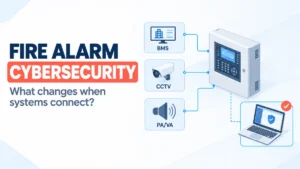
A network fault that isolates a remote panel, interrupts the BMS integration, or breaks the monitoring connection creates an undetected vulnerability. Cybersecurity threats are also a growing concern: poorly secured fire alarm networks can be accessed by malicious actors, potentially allowing suppression systems to be triggered or disabled remotely.
Industrial fire safety professionals must now include network architecture resilience, redundant communication paths, and cybersecurity protocols in their system design standards, not as IT considerations, but as fire safety requirements.
15. Limited Scalability Planning
Industrial facilities are not static. They expand, reconfigure, add new process areas, and change their operational footprint over years or decades. A fire alarm system that is designed for current conditions without scalability planning becomes a liability as the facility grows.
Conventional fire alarm panels are particularly vulnerable to scalability limitations, as each additional zone requires additional wiring infrastructure. Addressable fire alarm systems offer significantly greater scalability because each device on an addressable loop can be individually identified, programmed, and modified without rewiring. Scalability planning should be a formal requirement in every fire safety system specification for industrial facilities.
16. Human Error During Critical Events
Even well-designed systems can fail if the people operating them are not adequately trained, or if the system interface presents too much information in an inaccessible format during a high-stress event.
Fire alarm panel interfaces that are complex, counter-intuitive, or poorly labelled create conditions for operator error. If a security officer or plant operator must navigate multiple menus to understand which zone has been activated and what action to take, they will lose critical time. User interface design, regular simulation exercises, and clearly defined emergency response procedures are as important as the technical system itself.
Why Compliance Alone Does Not Guarantee Fire Safety
Regulatory compliance frameworks for fire safety, whether national building codes, NFPA standards, EN 54 series requirements, or local authority conditions, define minimum acceptable standards. They are designed to ensure that a baseline level of protection exists across all regulated buildings and facilities. They are not designed to guarantee operational resilience.
Consider what compliance typically requires: a minimum number of detectors per zone, a maximum zone size, regular service visits, an operational fire alarm panel, functional call points, and audible sounders throughout the building. Meet these requirements, and you will receive your fire certificate.
What compliance does not require: intelligent cause-and-effect programming, BMS integration, real-time remote monitoring, predictive maintenance diagnostics, addressable device-level identification, cybersecurity protocols on networked systems, or scalability planning for future expansion.
All of these capabilities, the ones that actually differentiate a resilient fire safety system from a compliant but vulnerable one, exist entirely outside the compliance framework. They are choices. And in many industrial facilities, they are choices that are not being made.
The practical consequence is that two facilities can have identical compliance status but radically different levels of actual fire safety. One has an intelligent, integrated, proactively maintained fire detection infrastructure. The other has detectors, a panel, and a certificate. They are not equivalent, but compliance alone cannot distinguish between them.
The Operational Gaps Most Facilities Fail to Identify
Beyond the technical weaknesses outlined above, industrial fire safety strategies often contain operational gaps that are invisible during a routine compliance audit but become critical during an actual event.
Shift handover blind spots: Fire alarm events that occur during shift changeover when outgoing staff are focused on handover tasks and incoming staff are not yet fully situationally aware are consistently associated with delayed responses. Many facilities have no defined protocol for fire alarm status communication during shift handover.
Contractor management gaps: Temporary contractors working in industrial facilities are often unfamiliar with site-specific fire alarm procedures. They may not know which alarm signals require evacuation versus investigation, where assembly points are located, or how to communicate a fire event to the control room. Contractor induction procedures that include fire safety briefings are inconsistently applied.
Hot work management failures: Welding, cutting, and grinding operations generate heat, sparks, and fumes that can trigger fire alarms and, more critically, start fires in adjacent materials. Hot work permit systems are a standard industrial safety requirement, but their interface with the fire detection system, temporarily isolating detectors in the work area while maintaining protection in adjacent zones, is often poorly managed.
Post-modification system gaps: Facility modifications that add new structures, partition spaces, or change occupancy patterns without updating the fire detection system create unprotected areas. A detector that was correctly positioned for an open-plan warehouse may become ineffective after partition walls are installed.
Emergency response plan currency: Fire emergency response plans that have not been updated to reflect current facility layout, staffing arrangements, or system capabilities create confusion during an incident. Plans that reference equipment that has been replaced, evacuation routes that have changed, or assembly points that no longer exist are worse than no plan; they direct people the wrong way.
Reactive vs. Intelligent Proactive Fire Safety: A Comparison
The table below illustrates the key operational differences between a reactive fire safety strategy and an intelligent proactive approach based on modern addressable fire alarm ecosystems.
| Comparison Factor | Reactive Fire Safety Strategy | Intelligent Proactive Strategy |
| Detection Approach | Spot detection only; single-zone response | Multi-layer detection; addressable zone mapping |
| Alarm Response | Manual intervention required | Automated cause-and-effect logic |
| System Integration | Fire panel isolated from BMS/HVAC | Fully integrated with building systems |
| Maintenance Model | Scheduled periodic checks only | Predictive diagnostics with real-time alerts |
| False Alarm Handling | High false alarm rate; alarm fatigue common | Intelligent verification reduces false alarms |
| Monitoring | On-site only; delayed response | Cloud-connected, 24/7 remote monitoring |
| Scalability | Fixed capacity; costly upgrades | Addressable architecture; scalable design |
| Data & Reporting | Manual logs; incomplete records | Digital audit trails; automated compliance reports |
| Evacuation Support | General PA announcements | Zone-specific intelligent evacuation routing |
| Compliance Status | Meets minimum code requirements | Exceeds compliance; proactive risk management |
| Response Time | Minutes to hours depending on staffing | Immediate automated response + staff notification |
How Modern Facilities Can Strengthen Fire Safety Resilience
Improving industrial fire safety resilience does not always require replacing your entire system. In many cases, targeted upgrades to integration, programming, monitoring, and maintenance processes can dramatically improve operational effectiveness without a full infrastructure replacement.
Step 1: Conduct a Comprehensive Fire Safety System Audit
Begin with an honest assessment of your current system, not a compliance audit, but an operational effectiveness review. Map every detector to its physical location and verify that its coverage area matches the current facility layout. Review your cause-and-effect matrix and test every output. Assess your BMS and HVAC integration status. Review the last three years of maintenance records and identify gaps.
Step 2: Migrate to Addressable Architecture Where Possible
If your facility is still operating on a conventional fire alarm panel with zone-based detection, a phased migration to an addressable fire alarm system will deliver immediate improvements in detection precision, response speed, and maintenance visibility. Modern addressable detectors provide individual device identity, environmental compensation, and diagnostic data that conventional detectors cannot offer.
The GST fire alarm system range, for example, offers scalable addressable architectures suitable for facilities ranging from medium-sized industrial plants to large multi-building campuses, with full integration capabilities for BMS, HVAC, and access control systems.
Step 3: Invest in Cause-and-Effect Engineering
Work with a qualified fire systems engineer to build a comprehensive cause-and-effect matrix for your facility. Define exactly what should happen and in what sequence for every credible fire scenario. Test the matrix against real operational conditions. Document it formally and review it after every facility modification.
Step 4: Implement Real-Time Remote Monitoring
Connect your fire alarm panel to a cloud-based monitoring platform or a contracted alarm receiving centre. Ensure that critical events, alarms, faults, and communications failures generate immediate notifications to defined stakeholders. For large industrial sites, consider installing repeater panels at key locations so that responders have access to system information without returning to the main control room.
Step 5: Establish a Predictive Maintenance Programme
Move beyond scheduled maintenance visits to a continuous monitoring approach. Addressable fire alarm systems with built-in diagnostics can provide real-time health status for every device on the loop. Use this data to generate maintenance work orders based on actual device condition rather than calendar intervals.
Step 6: Integrate Cybersecurity Into System Design
For any fire alarm infrastructure that includes network connectivity, whether for BMS integration, remote monitoring, or multi-panel campus networking, cybersecurity must be addressed as a fire safety requirement. Implement network segmentation, access controls, encrypted communications, and regular vulnerability assessments for all connected fire alarm infrastructure.
Step 7: Train, Simulate, and Improve
Technical systems are only as effective as the people operating them. Implement a regular fire emergency simulation programme that tests your response procedures under realistic conditions. Debrief every exercise to identify gaps in knowledge, communication, or procedure. Update your emergency response plan after every simulation and after every facility modification.
The Future of Industrial Fire Safety: Intelligence, Integration, and Prediction
Industrial fire safety is undergoing a technological transformation driven by artificial intelligence, cloud connectivity, digital modelling, and smart building integration. The following capabilities are reshaping what is possible in fire protection for industrial facilities.
AI-Assisted Fire Monitoring
Artificial intelligence platforms are now capable of analysing fire alarm system data in real time to identify patterns that indicate pre-fire conditions, anomalous detector readings, unusual combinations of environmental data, or behavioural changes in device performance. AI-assisted monitoring can provide early warning of developing fire risk before a detector threshold is crossed, giving facilities additional response time.
Predictive Diagnostics
Next-generation addressable fire alarm systems use machine learning algorithms to analyse detector performance data over time and predict which devices are likely to fail or require servicing before they generate a false alarm or miss a real event. Predictive diagnostics transform maintenance from a cost to an intelligence capability.
Digital Twin Fire Safety Modelling
Digital twins, virtual replicas of physical facilities built from BIM data, sensor inputs, and operational records, allow fire safety engineers to simulate fire scenarios, test detector placement, and model evacuation flows before making physical changes to a building. For large industrial facilities undergoing expansion or redesign, digital twin fire modelling can significantly reduce the cost and time required to optimise fire safety system design.
Smart Building Fire Integration
Modern smart buildings use integrated platforms that connect fire alarm systems, HVAC, access control, lighting, and occupancy sensors into a unified operational environment. In a smart building fire scenario, the system can automatically adjust lighting to guide evacuation, unlock emergency exits, override access control restrictions, and provide real-time occupancy data to fire crews, capabilities that are simply impossible in a standalone fire alarm installation.
Context-Aware Alarm Systems
Context-aware fire alarm systems use occupancy data, environmental sensors, and operational scheduling information to adjust alarm thresholds and response protocols dynamically. A detector in a welding area during an active hot work permit can operate at a modified threshold to reduce false alarms, while automatically reverting to standard sensitivity when the permit expires. Context awareness dramatically reduces false alarm rates while maintaining full protection.
Cloud-Connected Fire Monitoring
Cloud connectivity allows fire alarm data to be aggregated, analysed, and reported across multiple facilities in real time. Facility managers overseeing portfolios of industrial sites can monitor the fire safety status of every location from a single dashboard, receive instant alerts for any event anywhere in the network, and generate portfolio-wide compliance reports automatically.
Intelligent Evacuation Systems
Intelligent evacuation platforms use real-time occupancy tracking, dynamic route calculation, and zone-specific audio messaging to guide building occupants to safety along the most efficient available routes, automatically accounting for blocked exits, smoke spread direction, and local alarm conditions. These systems are already in use in airports, hospitals, and large commercial campuses, and are increasingly being adopted in complex industrial facilities.
Fire Safety Resilience Is a Strategic Choice
Industrial facilities that want genuine fire safety resilience, not just a compliance certificate, must make a conscious strategic decision to go beyond minimum requirements. They must invest in intelligent system architecture, integration, predictive maintenance, human training, and continuous improvement.
The technology to build truly resilient industrial fire safety strategies exists today. Addressable fire alarm systems with cause-and-effect programming, BMS integration, real-time remote monitoring, and predictive diagnostics are proven, available, and increasingly affordable for facilities of all sizes. The gap between compliant and resilient has never been smaller, but closing it still requires deliberate action.
The biggest weakness in many industrial fire safety strategies is not the equipment. The assumption is that the equipment is sufficient. Real fire safety resilience comes from treating your fire detection infrastructure as an integrated, intelligent, continuously managed system, one that protects your people, your assets, and your operational continuity every hour of every day.
Read Also: The Dangerous Assumption Many Industries Make About Fire Detection
Read Also: What Fire Alarm Engineers Notice That Most Facility Owners Ignore