India is changing fast. New factories, data centres, hospitals, airports, and high-rise buildings are appearing across every major city. With this rapid expansion comes a serious challenge: keeping people, assets, and operations safe from fire and security threats.
Traditional safety systems were built for a simpler era. Today, there are simply not enough. Facility managers, plant heads, and safety officers across India are recognising that intelligent fire detection and surveillance is no longer optional; it is a business necessity.
This article explains why demand is rising, how intelligent systems work, and what decision-makers should consider when upgrading their safety infrastructure.
Why Fire and Security Risks Are Increasing in India
India reported over 10,000 major fire incidents in industrial and commercial establishments in 2023 alone. Losses ran into hundreds of crores of rupees. Beyond the financial cost, lives were lost, and operations were disrupted for months.
Several factors are pushing fire and security risks higher:
- Rapid industrialisation is creating more facilities that handle flammable chemicals, compressed gases, and high-voltage equipment.
- Urbanisation is driving the construction of dense residential and commercial complexes where fire spreads quickly.
- Older buildings retrofitted for new uses often lack adequate fire protection.
- Increased electricity consumption, especially with data centres and EV charging infrastructure, is creating new ignition risks.
- Theft, vandalism, and insider threats are growing concerns alongside physical safety risks.
The combination of these trends means that the cost of inadequate safety systems has never been higher.
The Shift from Conventional Systems to Intelligent Detection
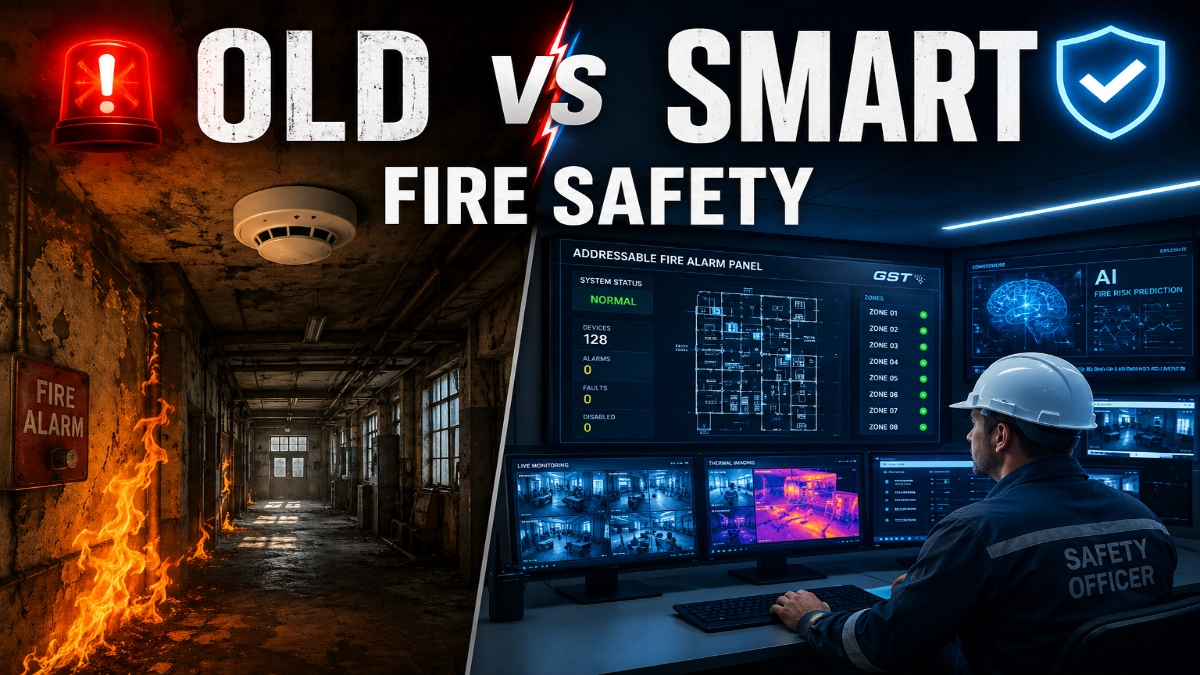
For decades, Indian facilities relied on conventional fire alarm panels and basic smoke detectors. These systems work on a zone-based model. When a detector triggers, the panel shows which zone has an alarm, but not the exact device or cause.
A conventional fire alarm panel is adequate for smaller, simpler buildings. However, it struggles to scale and cannot pinpoint faults or fires precisely in large or complex facilities.
An addressable fire alarm panel changes this fundamentally. Each detector has a unique address on the system. When an alarm triggers, the panel identifies the exact device, location, and device type within seconds. This level of precision saves critical response time.
Addressable detectors also communicate continuously with the panel, reporting their status, contamination levels, and health. This makes maintenance proactive rather than reactive.
Intelligent fire detection systems go further still. They incorporate multi-sensor detectors that analyse heat, smoke, and carbon monoxide simultaneously. They use algorithms to distinguish between a real fire and a burnt toast or steam from a shower, dramatically reducing false alarms.
How AI-Powered Surveillance Is Transforming Safety Management
Modern surveillance has moved well beyond passive recording. AI-powered camera systems can actively analyse video in real time and alert security teams to specific events as they happen.
Key capabilities of AI surveillance include:
- Smoke and flame detection through video analytics: Cameras can detect fire before heat-based sensors trigger.
- Perimeter intrusion detection: The system identifies unauthorised entry and raises an alert instantly.
- Crowd density monitoring: Critical for malls, stadiums, and public buildings.
- Behavioural analysis: Detecting loitering, abandoned objects, or unusual movement patterns.
- Licence plate recognition for access control in industrial and commercial campuses.
When surveillance integrates with fire detection, the result is a unified safety ecosystem. A fire event triggers camera verification, automated alerts to the fire brigade, and lockdown protocols, all without human intervention.
Benefits of Integrated Fire Detection and CCTV Monitoring
Integration delivers benefits that standalone systems cannot match:
- Faster response: Verified alerts mean responders arrive knowing exactly what they face.
- Reduced false alarms: Video verification confirms whether an alarm is real before evacuation is triggered.
- Lower insurance premiums: Insurers increasingly offer discounts for certified intelligent safety systems.
- Operational continuity: Early detection prevents small incidents from becoming catastrophic losses.
- Centralised management: One dashboard monitors fire, security, and access control across multiple sites.
- Audit trail: Every event is logged with time-stamped video and sensor data essential for compliance and investigations.
For a plant head or facility manager, this translates directly into lower risk, lower cost, and greater peace of mind.
Conventional vs Intelligent Safety Systems: A Comparison
The table below shows how the two approaches differ across the most important criteria.
| Feature | Conventional Systems | Intelligent Systems |
| Detection Speed | Slow — manual inspection needed | Near real-time, within seconds |
| Accuracy | Prone to environmental errors | AI-driven precision analysis |
| False Alarm Rate | High — nuisance alarms common | Up to 90% reduction |
| Remote Monitoring | Not supported | Full remote access via app/cloud |
| Scalability | Complex and costly to expand | Easily scalable across sites |
| Maintenance | Manual checks required | Automated self-diagnostics |
| Analytics | None | Predictive insights and dashboards |
| Compliance Readiness | Basic NBC/TAC compliance | Meets NBC, NFPA, ISO, and TAC standards |
Industries Driving Adoption in India
Demand for intelligent fire detection and surveillance systems is growing across multiple sectors:
- Manufacturing and chemicals: Facilities handling flammable materials face strict compliance requirements and a high risk of catastrophic loss.
- Data centres: A single fire can destroy irreplaceable data and trigger massive financial and reputational damage. Intelligent early warning is non-negotiable.
- Healthcare: Hospitals operate 24/7 and cannot evacuate quickly. Precise, fast detection is critical.
- Retail and logistics: Large warehouses and distribution centres store high-value stock across thousands of square metres.
- Smart buildings and commercial real estate: Developers and property managers are integrating safety systems from the design stage.
- Educational institutions: Schools and universities are increasingly required to demonstrate safety compliance to regulators and accreditation bodies.
Each of these sectors is investing heavily in fire safety technology as the Indian industry matures and expectations rise.
Regulatory and Compliance Factors Influencing Demand
India’s regulatory environment for fire safety is tightening. Key frameworks shaping procurement decisions include:
- The National Building Code (NBC) 2016 mandates fire detection and alarm systems for a wide range of building types and occupancies.
- The Factories Act and state-level fire services acts impose obligations on industrial facilities.
- Insurance companies increasingly require certified fire alarm systems, including addressable fire alarm panels, as a condition of coverage.
- International standards such as NFPA 72 and ISO 7240 are being adopted by multinational companies operating in India.
- The Bureau of Indian Standards (BIS) certification for detectors and panels is becoming a baseline expectation.
For organisations tendering for government contracts or attracting foreign investment, compliance with these standards is not just a legal requirement; it is a commercial advantage.
Common Challenges Organisations Face
Despite the clear benefits, many organisations struggle with the transition to intelligent systems:
- Budget constraints: Upfront costs appear high compared to conventional systems, though lifecycle cost analysis typically shows intelligent systems are more economical over five to ten years.
- Legacy infrastructure: Many facilities have existing wiring and panels that complicate upgrades.
- Lack of expertise: In-house teams often lack the skills to evaluate, install, and maintain advanced systems.
- Vendor selection: The market is crowded with products of variable quality. Distinguishing reliable systems from substandard alternatives requires technical knowledge.
- Change management: Operational teams accustomed to conventional systems need training to use intelligent platforms effectively.
Working with experienced, certified safety consultants and established system providers helps organisations navigate these challenges efficiently.
Best Practices for Selecting Intelligent Safety Systems
Decision-makers should follow these steps when evaluating fire detection and surveillance solutions:
- Conduct a detailed site risk assessment before selecting any technology.
- Prioritise systems certified to BIS, NFPA, and EN standards.
- Choose scalable platforms that your system should grow with your facility.
- Demand proven integration between fire and surveillance subsystems.
- Evaluate the vendor’s after-sales support, training capability, and local service network.
- Insist on a phased implementation plan that minimises operational disruption.
- Review the total cost of ownership, not just purchase price.
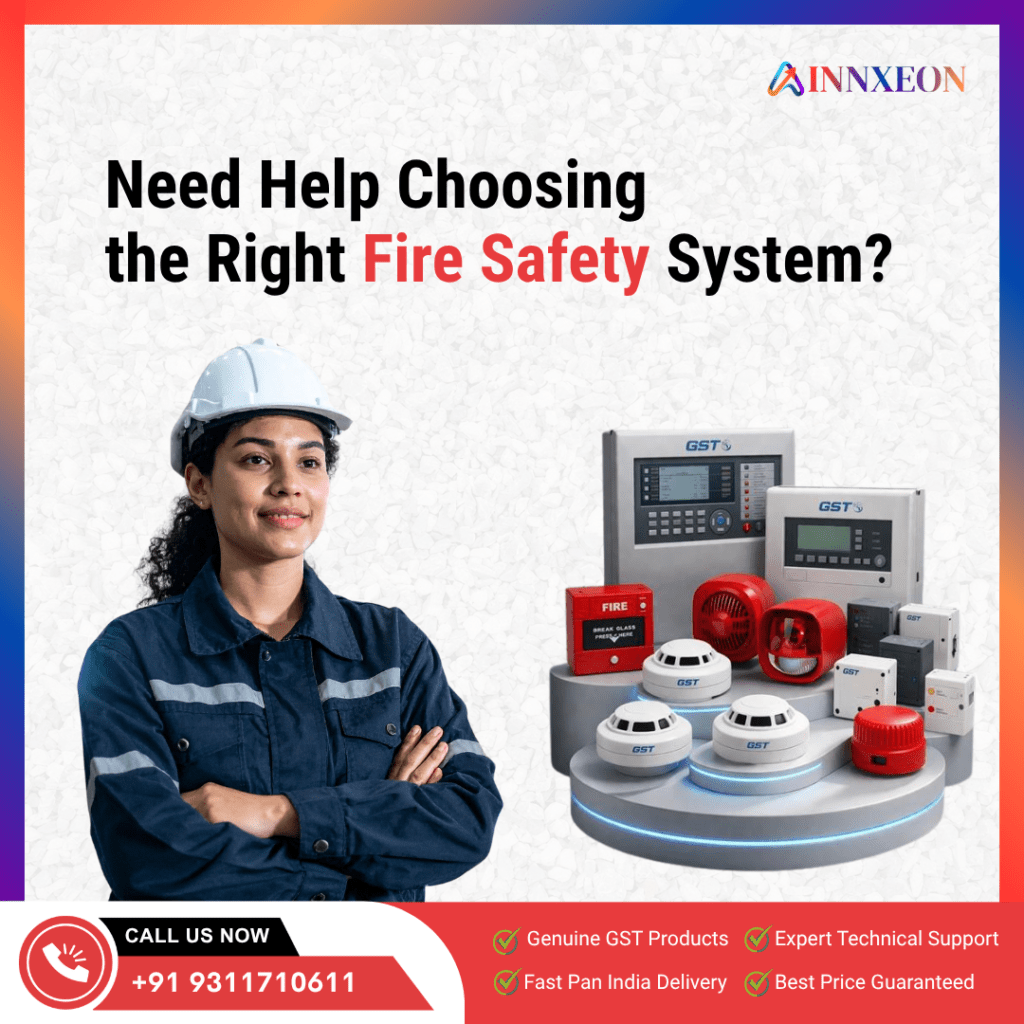
GST Fire Alarm Systems is one of the established names in the Indian market, offering addressable fire alarm panels, conventional detectors, and integrated safety solutions backed by technical expertise and certified products.
Future Trends in Fire Detection and Surveillance
The next five years will bring significant advances:
- IoT integration: Detectors and cameras will communicate with building management systems, enabling predictive maintenance and automated responses.
- Cloud-based monitoring: Central command centres will monitor multiple sites remotely, reducing the need for on-site security personnel.
- AI and machine learning: Systems will learn from historical data to predict high-risk periods and locations.
- Wireless addressable systems: Easier to install in heritage buildings and facilities where cable runs are impractical.
- Drone integration: Surveillance drones will respond to perimeter breaches in large industrial campuses.
Early adopters of these technologies will gain a significant safety and competitive advantage as India continues to develop its industrial and urban infrastructure.
Key Takeaways
- India’s rapid industrialisation and urbanisation are increasing fire and security risks significantly.
- Conventional fire alarm panels and basic detectors are inadequate for modern, complex facilities.
- Addressable fire alarm panels and AI-powered surveillance deliver faster detection, fewer false alarms, and better compliance.
- Integration of fire detection and CCTV monitoring creates a unified, more effective safety ecosystem.
- Regulatory requirements from the NBC, BIS, NFPA, and insurers are driving adoption.
- Selecting the right system requires a structured evaluation process and a trusted implementation partner.
Conclusion
The case for intelligent fire detection and surveillance in India is clear and compelling. Rising fire incidents, tightening regulations, and the growing complexity of modern facilities have made conventional safety systems inadequate.
Addressable detectors, smart fire alarm panels, and AI-powered surveillance are not luxury add-ons; they are the foundation of responsible safety management for any serious organisation in India today.
The transition requires investment, planning, and the right implementation partner. But the alternative, inadequate protection in an environment of growing risk, is far more costly.
For organisations ready to upgrade, the first step is a thorough risk assessment and a conversation with an experienced provider. GST Fire Alarm Systems and similar established players in the Indian market offer the expertise, certified products, and support networks to guide facilities through this critical transition.
Intelligent safety is not the future; it is the present requirement for every facility that values its people, its assets, and its continuity.
Read Also: Why Most Industrial Facilities Are Upgrading Their Fire Alarm Infrastructure
Read Also: How GST Fire Alarm Systems Improve Large Facility Fire Detection Efficiency