A security guard monitors 64 camera feeds simultaneously. Within minutes, fatigue sets in, attention drifts, and critical moments get missed. This is the fundamental flaw of traditional surveillance; it relies entirely on human attention, which is finite.
AI changes that equation entirely.
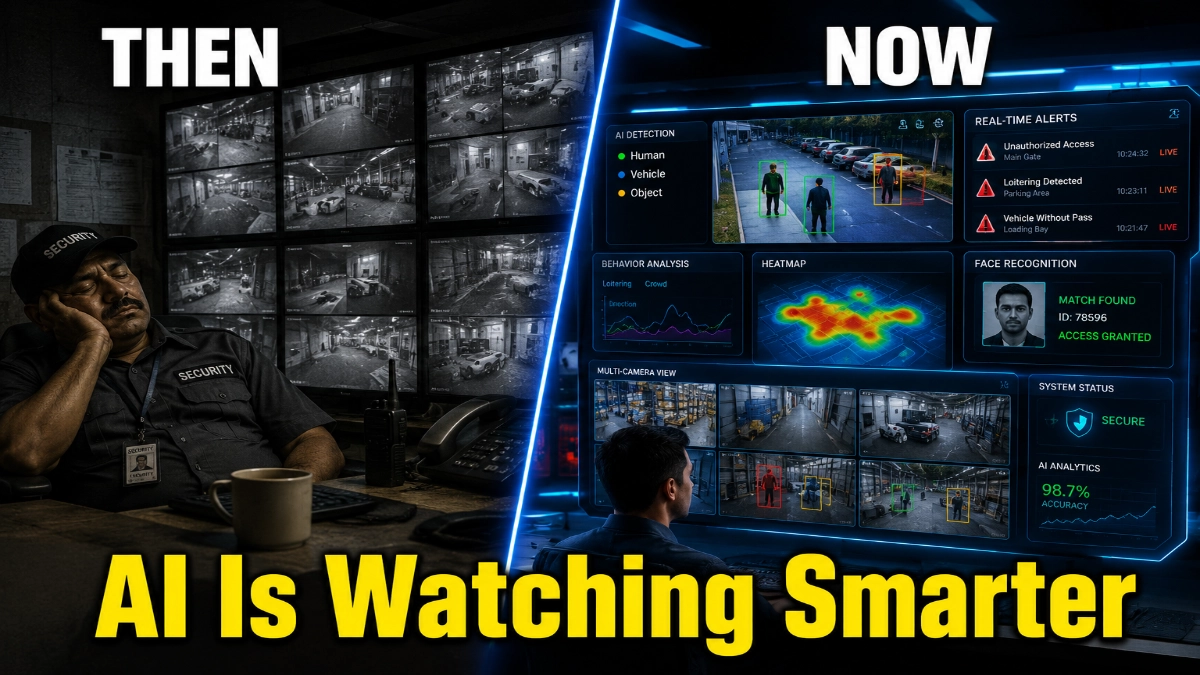
Modern AI-powered surveillance systems do not just record what happens. They understand it. They detect anomalies before incidents escalate, identify patterns across thousands of hours of footage, and trigger automated responses in seconds. The shift is not incremental; it is structural.
This article explains exactly how that transformation works, what technologies drive it, where it is being applied, and what decision-makers need to know before deploying AI surveillance in their own environments.
Why Traditional Surveillance Is No Longer Enough
Traditional CCTV systems were built around one idea: record everything and review footage after an incident. That reactive model made sense when cameras were expensive, storage was limited, and threats were simpler.
Today, none of those conditions holds.
Threat environments have grown more complex. Insider threats, coordinated intrusions, and fast-moving incidents demand real-time awareness, not post-event review. Meanwhile, camera counts in large facilities have exploded; a single airport or hospital campus may operate thousands of endpoints simultaneously.
The core problem with passive surveillance:
- Human operators cannot maintain effective vigilance across large camera grids for extended periods.
- Reviewing archived footage to investigate incidents is slow, labour-intensive, and often inconclusive.
- Traditional systems generate no actionable intelligence, only raw video.
- Alarm systems tied to motion detection produce high false-positive rates, causing alert fatigue.
Expert Tip: Studies on human attention consistently show that operator effectiveness drops sharply after 20 minutes of continuous monitoring on a multi-screen setup. AI does not experience this degradation.
The industry needed a fundamentally different approach. AI provided one.
What AI Surveillance Actually Means
AI surveillance refers to security systems that use machine learning, computer vision, and data analytics to automatically analyse video feeds, extract meaningful information, and support or trigger responses without requiring a human to watch every frame.
The key distinction from traditional systems is understanding versus recording.
A traditional camera captures pixels. An AI-enabled camera or an AI platform processing its feed interprets those pixels. It can answer questions like “Is this person carrying a weapon?” Has a vehicle been parked in a restricted zone for more than 10 minutes? Is this crowd behaviour consistent with pre-fight agitation?
AI surveillance does not replace human judgment in complex situations. It amplifies human capacity by filtering the noise, surfacing the signal, and delivering operators the information they actually need, at the moment they need it.
From Passive Monitoring to Intelligent Decision-Making
The evolution of surveillance can be mapped across three distinct generations:
| Generation | Capability | Limitation |
|---|---|---|
| Analog CCTV | Record and store video | No search, no analysis, tape-based |
| IP/Digital Cameras | Network access, HD resolution | Still passive; requires human review |
| AI-Powered Systems | Real-time analysis, automated alerts, predictive insight | Requires infrastructure investment and data governance |
The leap from Generation 2 to Generation 3 is not a hardware upgrade. It is a paradigm shift.
In a Generation 3 system, the camera feed feeds a continuous analytical pipeline. Algorithms process each frame, match objects and behaviours against trained models, assign risk scores, and surface alerts, all in milliseconds. Operators receive curated intelligence rather than raw video.
Did You Know? Some AI surveillance deployments reduce security operator workload by filtering over 95% of irrelevant motion events before they ever reach a human screen. (Source: MarketsandMarkets)
This shift moves surveillance from a passive archive to an active decision-support system.
Core AI Technologies Behind Modern Surveillance
Understanding what AI surveillance can do requires understanding the specific technologies that power it.
Computer Vision
Computer vision is the foundational layer. It enables cameras and software to interpret visual data, detecting objects, people, vehicles and environmental conditions within a frame.
Modern computer vision systems process video at 30+ frames per second and can simultaneously track dozens of objects across a field of view. Unlike earlier motion-detection algorithms, which flagged any pixel change, computer vision systems understand context. A tree moving in the wind is not a person moving through a restricted zone.
Deep Learning
Deep learning enables AI models to recognise patterns by training on massive labelled datasets. In surveillance, deep learning models learn what a “normal” scene looks like, then flag deviations.
A deep learning model trained on pedestrian flow in a transit hub, for example, can identify when movement patterns suggest crowd panic, even before any physical confrontation begins. The model learned from thousands of examples, and it does not need to be explicitly programmed with rules.
Facial Recognition
Facial recognition maps the geometry of a face, including the distance between the eyes, the jawline shape, and the nose bridge, and compares it against a database. Modern systems achieve high accuracy even with partial occlusions, varying angles, and low-light conditions.
In controlled access environments, facial recognition can authenticate personnel in milliseconds without requiring them to stop or interact with a reader. In public safety applications, it can surface watchlist matches in real time.
Important caveat: Facial recognition is one of the most regulated AI technologies globally. Its use in public spaces is subject to legal restrictions in many jurisdictions, and deployment decisions must involve legal and compliance review.
Object Detection
Object detection identifies and classifies specific items within a scene, such as vehicles, packages, weapons, fire, and more. Unlike facial recognition, which focuses on identity, object detection focuses on things.
Practical applications include:
- Detecting unattended bags in transit hubs
- Identifying weapons (knives, firearms) in restricted access zones
- Monitoring PPE compliance on construction sites
- Tracking vehicle license plates across a campus
Behavior Analysis
Behaviour analysis moves beyond identifying what is present to understanding what is happening. It interprets the movement, trajectory, and interaction of people and objects within a scene.
Examples of behaviours AI can be trained to detect:
- Loitering in a restricted area beyond a defined time threshold
- Perimeter line-crossing in unauthorised zones
- Crowd density buildup indicates potential crowd crush risk
- Aggressive gestures or rapid movement consistent with physical altercations
Expert Tip: Behavior analysis is most effective when trained specifically on the environment in which it will operate. A model trained on retail foot traffic may not perform optimally when deployed in an industrial facility.
Predictive Analytics
Predictive analytics uses historical patterns and real-time data to forecast risk. Rather than detecting a threat that is actively occurring, predictive systems identify conditions that historically precede incidents.
In practice, this means a system might flag that a vehicle has circled a parking structure four times in 20 minutes, a pattern that, in historical data, correlates with vehicle theft reconnaissance, and alert security before any theft attempt begins.
Real-World Applications Across Different Industries
AI surveillance is not a monolithic solution. Its applications vary significantly by sector.
Retail: Retail loss prevention teams use AI to detect shoplifting behaviours, identify individuals previously flagged for theft, and analyse customer movement patterns to prevent organised retail crime. AI also helps retailers distinguish between genuine theft and accidental walk-outs, reducing false accusations.
Critical Infrastructure: Power plants, water treatment facilities, and data centres use AI to monitor perimeters, detect unauthorised access attempts, and track personnel in high-security zones. These environments often integrate AI surveillance with access control and alarm systems for a layered response.
Transportation Hubs: Airports, metro systems, and bus terminals use AI to manage passenger flow, identify abandoned baggage, detect restricted items at entry points, and monitor for suspicious behaviours across large, complex spaces.
Healthcare: Hospitals deploy AI surveillance to monitor patient safety in high-risk wards, detect falls in corridors and rooms, manage visitor access, and track asset movement, including medical equipment that frequently goes missing in large facilities.
Smart Cities: Municipal governments use AI surveillance networks to monitor traffic flow, detect road accidents, identify illegal dumping, and manage public safety during large events.
Manufacturing and Industrial: Factories use AI cameras to enforce safety compliance, detecting when workers enter machine exclusion zones, fail to wear required PPE, or operate near hazards. This application directly reduces workplace accidents and insurance liabilities.
How AI Helps Security Teams Respond Faster
Speed of response is often the difference between prevention and consequence. AI compresses the time between incident detection and human response.
Here is a practical example of how an AI-enhanced response workflow operates:
- Detection: An AI system identifies a person climbing a perimeter fence at a logistics warehouse at 02:14 AM.
- Classification: The system classifies the intrusion as high confidence (not a false positive caused by an animal or debris).
- Alert routing: An automated alert is pushed to the on-duty operator’s mobile device with a snapshot and the relevant camera feed.
- Response activation: The operator reviews the alert within 15 seconds and activates the pre-defined response protocol, triggering lights, audio deterrents, and notifying local security personnel.
- Documentation: The system automatically tags, timestamps, and archives the incident footage for legal and reporting purposes.
This entire sequence from detection to response activation can occur in under 60 seconds. In a traditional setup, the same event might not be noticed until the morning shift review, hours later.
Common Mistake: Many organizations implement AI surveillance but retain the same slow, manual alert escalation processes. The technology performs at AI speed; the response protocol needs to match.
Benefits for Businesses and Critical Infrastructure
AI surveillance delivers measurable value across several dimensions:
Operational efficiency: Fewer operators can effectively monitor larger environments. AI handles first-level filtering, allowing human attention to focus on verified threats.
Reduced false alarms: Traditional motion detection generates high false-positive rates, a persistent problem in alarm management. AI classification significantly reduces false alarms, which in turn reduces the costly “cry wolf” effect where responders begin to discount alerts.
Evidence quality: AI systems automatically archive relevant footage with metadata, timestamps, and contextual annotations, making evidence far more usable in legal proceedings than raw, unstructured recordings.
Preventive posture: Moving from reactive to preventive security measurably reduces incident rates. Deterrence increases when potential bad actors know a facility uses intelligent, always-on monitoring rather than passive cameras.
Insurance and compliance: Many insurers now offer premium reductions for facilities deploying certified AI surveillance systems. Similarly, regulated industries can demonstrate compliance through automated audit trails.
Challenges, Ethical Concerns and Privacy Considerations
AI surveillance carries significant responsibilities. Deploying these systems without addressing their limitations and ethical dimensions creates legal exposure and erodes public trust.
Accuracy and bias: AI models are only as good as the data they were trained on. Models trained on non-representative datasets can exhibit systematic errors against specific demographic groups. This is particularly critical in facial recognition, where documented accuracy disparities have led to wrongful identifications.
Privacy: Continuous AI monitoring of individuals in workplaces, public spaces, or residential environments raises legitimate privacy concerns. In many jurisdictions, including the European Union under GDPR and various U.S. state laws, AI surveillance in public spaces requires an explicit legal basis, transparency, and, in some cases, individual consent.
Data security: AI surveillance systems generate and process vast quantities of sensitive data. That data must be protected against unauthorised access, breach, and misuse. End-to-end encryption, role-based access controls, and secure storage protocols are not optional additions; they are baseline requirements.
Over-reliance on automation: AI surveillance supports human decision-making; it does not replace it. Allowing automated systems to take consequential actions, denying access, issuing alerts, triggering law enforcement response, without human review in the loop, creates serious risks of error escalation.
Regulatory landscape: The EU AI Act classifies certain surveillance applications (including real-time remote biometric identification in public spaces) as high-risk or prohibited. Organisations operating internationally must maintain compliance across multiple regulatory frameworks.
Expert Tip: Before deployment, conduct a Data Protection Impact Assessment (DPIA) and involve legal counsel familiar with AI regulation in your operating jurisdictions.
Future Trends in AI Surveillance
The trajectory of AI surveillance points toward deeper integration, greater autonomy, and expanded analytical capability.
Edge AI processing: Instead of sending all video to central servers for analysis, next-generation cameras will perform AI processing locally on the device. This reduces bandwidth, lowers latency and addresses some data privacy concerns by limiting what leaves the camera.
Multi-modal sensing: Future systems will combine video with audio analysis, thermal imaging, radar, and environmental sensors. A system might detect an intrusion through a combination of fence vibration, thermal signature, and acoustic anomaly, even when visual conditions are poor.
Federated learning: AI models can be trained collaboratively across multiple sites without sharing raw data, a technique called federated learning. This allows models to improve from experience across a network of deployments while preserving data privacy at each site.
Integration with access control and response systems: AI surveillance will increasingly function as the intelligence layer for integrated physical security ecosystems, automatically adjusting access permissions, activating countermeasures, and coordinating multi-system responses based on real-time threat assessment.
Explainable AI: Regulatory and ethical pressure is driving demand for AI systems that can explain their decisions in human-understandable terms. “This alert was triggered because this individual matched three behavioural indicators associated with pre-attack reconnaissance” is more defensible and more useful than a black-box risk score.
Best Practices Before Implementing AI Surveillance
Organisations considering AI surveillance deployment should work through a structured evaluation before committing to technology choices.
- Define specific use cases first: AI surveillance is not a general-purpose solution. Identify exactly what problems you are trying to solve: perimeter intrusion, crowd safety, theft prevention, and select technologies designed for those specific applications.
- Audit your existing infrastructure: AI surveillance often requires network bandwidth, compute capacity, and storage that legacy CCTV infrastructure cannot support. Conduct a full technical audit before selecting a platform.
- Evaluate vendor transparency: Understand how models were trained, what datasets were used, and how accuracy is measured. Reputable vendors provide this information. Vendors who cannot or will not are a risk.
- Plan your data governance framework: Define who can access surveillance data, for how long it is retained, and under what circumstances it can be shared. Document these policies and train staff on them.
- Pilot before scaling: Deploy AI surveillance in a limited environment first. Measure performance, identify failure modes, and refine configuration before rolling out across a full facility or estate.
- Maintain human oversight: Design your response workflows so that consequential decisions affecting individuals’ access, liberty, or safety are reviewed by a qualified human before action is taken.
Many leading enterprise security deployments in India and globally use systems from recognised brands in the surveillance ecosystem. Organisations sourcing enterprise-grade solutions in the region often work with an Impact by Honeywell CCTV Distributor in India to evaluate and deploy platforms that meet these requirements at scale. Impact by Honeywell CCTV represents one established product line in this category, combining hardware quality with growing AI integration capability.
Conclusion
Surveillance technology has moved decisively beyond the camera-and-guard model. AI has transformed what security systems can do not by removing humans from the picture, but by making human judgment more effective, more focused and more timely.
Organisations that deploy AI surveillance thoughtfully with clear use cases, robust governance, and genuine attention to ethical responsibilities gain a material security advantage. Those who deploy it carelessly, or avoid it entirely while threats evolve, accept growing exposure.
The question for security professionals and enterprise decision-makers is no longer whether AI belongs in surveillance strategy. It is how to deploy it with the rigour these powerful systems demand.
Read Also: What Industrial Leaders Should Know About AI-Powered Monitoring
Read Also: How AI Is Changing the Way Facilities Detect and Respond to Risks