Industrial operations have never been more complex or more exposed. Workforce shortages are stretching teams thin, regulatory requirements are multiplying, and the cost of a single unplanned equipment failure or safety incident can run into millions of dollars. Meanwhile, traditional monitoring approaches, such as periodic inspections, manual patrols, and reactive maintenance, were designed for a simpler era.
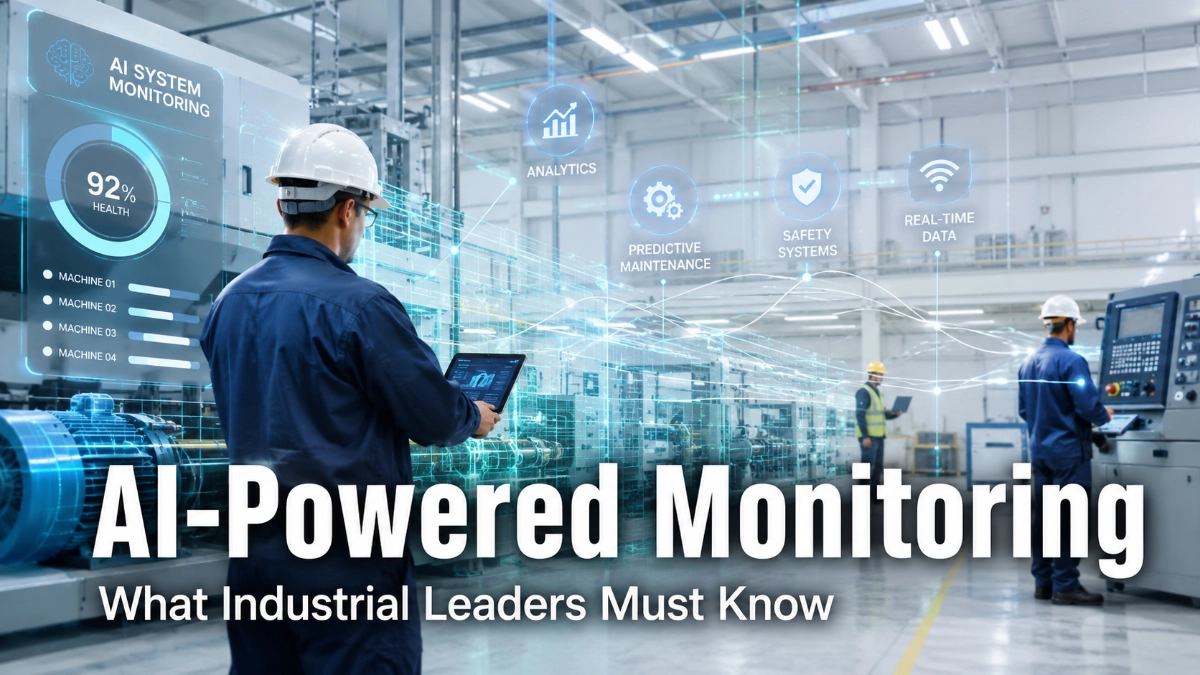
Today, industrial leaders need real-time visibility across people, assets, processes, and perimeters simultaneously. That is exactly where AI-powered monitoring is redefining what is operationally possible.
This is not a speculative technology. Across manufacturing plants, oil and gas facilities, logistics warehouses, and critical infrastructure sites, intelligent monitoring systems are already reducing incidents, cutting downtime, and helping organisations meet compliance obligations with greater confidence.
What Is AI-Powered Monitoring?
| AI-powered monitoring is the use of artificial intelligence including machine learning, computer vision, and predictive analytics to continuously analyse data from cameras, sensors, and industrial systems. Unlike traditional monitoring, which relies on human review or simple threshold alerts, AI systems detect patterns, predict failures, identify anomalies, and trigger automated responses in real time. |
Traditional CCTV and sensor systems generate enormous volumes of data that human operators simply cannot process in real time. AI changes this equation fundamentally. A smart monitoring system does not just record, it understands. It watches for unsafe behaviours, flags equipment anomalies, detects unauthorised access, and delivers actionable intelligence to the right people at the right moment.
Key technologies driving this capability include computer vision (enabling cameras to interpret visual environments), video analytics (extracting meaningful events from video streams), machine learning models (recognising patterns from historical data), and predictive intelligence (forecasting problems before they occur).
Why Industrial Organisations Are Adopting AI Monitoring
Adoption is accelerating for practical, measurable reasons not hype. Here are the core drivers:
- Safety improvement: Manufacturing fatality rates remain unacceptably high in many sectors. AI systems that detect PPE non-compliance or unsafe behaviours the instant they occur give safety teams the ability to intervene before incidents happen.
- Operational efficiency: Process bottlenecks, idle assets, and workflow inefficiencies that were invisible to manual oversight become clearly visible when AI analyses operations continuously.
- Asset protection: Unplanned equipment downtime costs industrial organisations an estimated $50 billion annually across sectors. AI-driven predictive maintenance identifies failure precursors weeks before a breakdown occurs.
- Compliance management: Environmental health and safety regulations are becoming more demanding globally. AI monitoring creates auditable, timestamped records that support compliance reporting and regulatory defence.
- Faster decision-making: When an AI system automatically classifies an event, alerts the right team, and provides visual evidence, response times drop from hours to minutes.
Key Applications Across Industrial Facilities
Workplace Safety Monitoring
Computer vision models can detect whether workers are wearing hard hats, high-visibility vests, safety goggles, and gloves, in real time, across multiple camera feeds simultaneously. The system flags violations immediately rather than waiting for a supervisor’s walkthrough. Beyond PPE detection, AI can identify unsafe behaviours such as standing on elevated surfaces without fall protection, operating equipment in unauthorised ways, or accessing restricted zones without clearance.
Equipment and Asset Monitoring
Sensors embedded in machinery feed data to AI models that have learned the normal operating signatures of that equipment. Subtle deviations a slight vibration pattern change, an unusual temperature reading, abnormal acoustic output are detected early and classified by likely failure type. This shifts maintenance from reactive (fix after failure) to predictive (intervene before failure), extending asset life and eliminating costly unplanned outages.
Perimeter and Access Security
Intelligent surveillance systems monitor facility perimeters continuously, distinguishing between vehicles, personnel, and wildlife to eliminate false alarms. Unauthorised access attempts trigger immediate alerts with video context attached. Unlike static security cameras, AI-powered intrusion detection learns from the environment and adapts to changing conditions such as lighting, weather, and seasonal changes.
Operational Efficiency and Workflow Optimisation
AI monitoring extends beyond safety and security into process intelligence. Systems can track resource utilisation, identify production bottlenecks, measure cycle times, and flag process deviations. A plant manager gains a data-driven view of where inefficiencies are occurring rather than relying on anecdotal reporting from the floor.
Environmental and Hazard Monitoring
Vision-based smoke and flame detection responds faster than conventional sensors because AI analyses visual changes rather than waiting for particulate thresholds to be reached. In facilities handling hazardous materials, AI can detect spillage, identify gas cloud formation, and trigger automated containment protocols.
Benefits Industrial Leaders Can Expect
Organisations that have deployed AI monitoring consistently report measurable outcomes across multiple dimensions:
- Incident reduction: Facilities report significant reductions in workplace injuries when AI safety monitoring is implemented, particularly through proactive PPE compliance enforcement and behavioural risk detection.
- Faster emergency response: Average response times to security and safety events drop dramatically when AI automatically classifies incidents and delivers alerts with supporting video evidence.
- Compliance confidence: Continuous, automated documentation of safety and security events reduces audit preparation time and strengthens regulatory defence.
- Lower operational costs: Predictive maintenance programs reduce unplanned downtime costs and extend equipment lifespans. Industry analysts estimate predictive maintenance can reduce maintenance costs by 10–25%.
- Data-driven culture: When operations generate structured, analyzable data, management decisions shift from intuition-based to evidence-based improving outcomes across the board.
- Enhanced business continuity: Fewer unexpected shutdowns, faster threat response, and better asset management collectively strengthen an organisation’s operational resilience.
Common Misconceptions About AI Monitoring
Myth: AI replaces human workers
Reality: AI monitoring augments human judgment, it does not replace it. The technology handles continuous data analysis at scale, while skilled personnel make decisions, investigate flagged events, and manage operations. Most organisations find that AI monitoring actually increases the strategic value of their security and safety teams.
Myth: AI systems operate without oversight
Reality: All AI monitoring systems require configuration, ongoing tuning, and human oversight. Models need to be trained on facility-specific conditions, performance must be monitored, and outputs require validation.
Myth: AI monitoring is only for large enterprises
Reality: Scalable, cloud-connected solutions have made AI monitoring accessible to mid-sized and even smaller industrial facilities. Entry costs have dropped substantially, and modular deployments allow organisations to start small and expand.
Myth: Implementation is prohibitively expensive
Reality: Total cost of ownership calculations must weigh AI monitoring investment against the cost of incidents, downtime, compliance failures, and security breaches. For most industrial environments, the ROI case is compelling.
Myth: AI surveillance solves every security challenge automatically
Reality: AI reduces risk and accelerates response, but it is one layer of a broader security and safety strategy. Physical controls, trained personnel, clear procedures, and organisational culture all remain critical.
Challenges and Considerations Before Implementation
Organisations that approach AI monitoring implementation thoughtfully achieve better outcomes than those that treat it as a plug-and-play technology. The following areas deserve careful attention:
Data privacy and workforce trust
Employees need to understand what is being monitored, why, and how data is used. Transparent communication, clear policies, and involvement of worker representatives during rollout reduce resistance significantly.
Cybersecurity
Connected monitoring systems expand an organisation’s attack surface. Cybersecurity architecture, network segmentation, encrypted communications, and access control, must be addressed from the design stage.
System integration
AI monitoring platforms need to connect with existing SCADA systems, access control infrastructure, and operational technology environments. Integration complexity is often underestimated. Work with vendors who have proven integration experience.
False positives and alarm fatigue
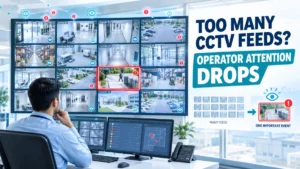
Poorly tuned AI systems generate excessive alerts that operators learn to ignore. Rigorous model configuration, site-specific training, and continuous performance review are essential to maintaining system credibility.
Change management
Successful deployment is as much an organisational challenge as a technical one. Leadership sponsorship, cross-functional involvement, and early wins help build institutional confidence in the technology.
Future Trends Industrial Leaders Should Watch
The AI monitoring landscape is evolving rapidly. Here are the developments with the most significant implications for industrial operations over the next five to ten years:
- Edge AI: Processing intelligence moves directly onto cameras and sensors rather than relying on centralised servers. Edge AI reduces latency, cuts bandwidth costs, and enables monitoring in connectivity-constrained environments.
- Digital twins: Combining AI monitoring with digital twin technology creates a continuously updated virtual replica of a facility. Operators can simulate interventions, model failure scenarios, and optimise operations in ways that were previously impossible.
- Predictive analytics maturation: As AI models accumulate more operational data, their predictive accuracy improves. Failure prediction windows extend from hours to days or weeks, fundamentally changing maintenance planning horizons.
- Autonomous monitoring: Advanced systems will move from alerting humans to autonomously executing responses, adjusting process parameters, activating containment systems, or rerouting workflows based on detected conditions.
- Generative AI integration: Conversational interfaces will allow plant managers to query operational data in natural language, and generative AI will assist with incident report creation, anomaly explanation, and procedure recommendation.
- Multi-sensor intelligence: Combining visual, acoustic, thermal, chemical, and vibration sensor data into unified AI models produces a monitoring capability that far exceeds what any single sensor type can deliver independently.
- Industrial IoT convergence: The boundaries between monitoring, control, and optimisation will blur as AI-enabled IoT devices create fully connected, adaptive industrial environments.
Industrial organisations evaluating solutions in this space from companies building on established hardware platforms to those exploring newer integrated offerings will find an increasingly rich market. Products distributed through specialised channels (such as an impact by Honeywell CCTV distributor in India) reflect how global technology platforms are reaching industrial buyers across diverse geographies. The broader category of intelligent video systems, including impact by Honeywell CCTV infrastructure, represents one segment within a market that now spans dozens of hardware and software vendors.
Conclusion: From Security Technology to Strategic Business Tool
Industrial leaders who view AI-powered monitoring purely as a security or safety investment are capturing only a fraction of the available value. The organisations gaining the greatest competitive advantage from these systems are those that recognise them as foundational intelligence infrastructure, providing the continuous, real-time operational visibility that modern industrial management demands.
The action case is no longer about whether AI monitoring will transform industrial operations. That transformation is already underway across manufacturing plants, logistics hubs, energy facilities, and critical infrastructure sites around the world. The practical question for industrial decision-makers today is whether their organisation will lead this transition or respond to it.
Begin with a clear-eyed assessment of where operational risk and visibility gaps are most acute. Start with high-value, well-defined use cases. Measure outcomes rigorously. Build from demonstrated success. The technology is ready, and the operational imperative has never been stronger.
Read Also: How AI Is Changing the Way Facilities Detect and Respond to Risks
Read Also: Why Future Facilities Will Be Built Around Data, Visibility and Safety