For decades, fire safety meant one thing: meet the regulations. Install the required fire alarm control panel, pass the annual inspection, file the paperwork, and move on. Compliance was the ceiling, not just the floor.
That mindset is changing rapidly. Modern buildings, smart infrastructure, industrial facilities, data centres, healthcare campuses and commercial complexes demand far more. They require fire protection systems that think, communicate, and adapt in real time.
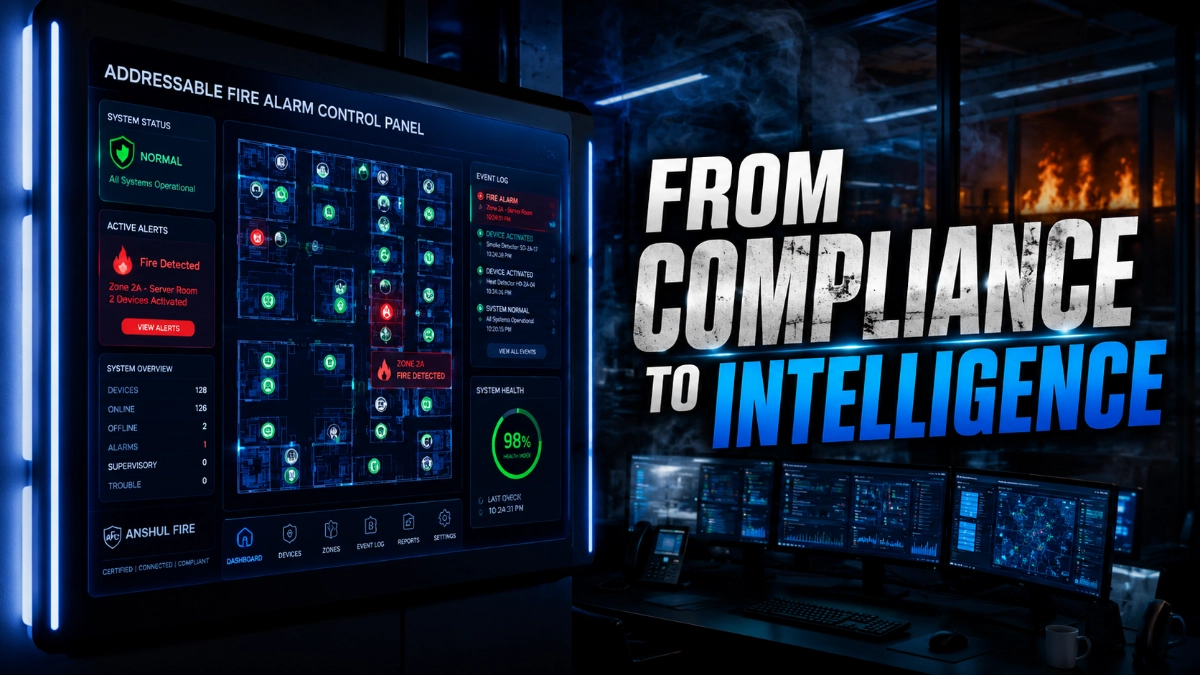
This article explores how fire safety is transitioning from a purely compliance-driven obligation to a dynamic, intelligence-led safety ecosystem that actively protects people, assets, and operations.
| The next generation of fire protection does not wait for smoke. It monitors, predicts, and alerts before danger becomes disaster. Here is what that transformation looks like, and why it matters for every building owner and safety professional today. |
What Does Compliance-Based Fire Safety Mean?
Compliance-based fire safety is built around regulatory obligations. A building installs a conventional fire alarm panel, conducts annual testing, maintains inspection records, and satisfies the applicable fire codes. That is the entire scope.
This model served well in simpler times. Buildings were less complex, occupancy types were more uniform, and risk profiles were relatively predictable. The conventional detectors triggered zone-level alerts, and the fire brigade responded.
The limitations of this approach become clear quickly. Compliance-based systems tell you that something is wrong somewhere in a zone. They do not tell you exactly what, where, or how urgent. And they rarely tell you anything at all until a fire is already developing.
Why Traditional Fire Safety Approaches Are No Longer Enough
Building complexity has grown exponentially. Mixed-use developments, high-rise towers, underground transit, data centres, and smart manufacturing plants pose fire-risk scenarios that a simple zone-based system cannot handle well.
Consider a large data centre. It may contain thousands of servers, multiple suppression zones, redundant power systems, and strict uptime requirements. A false alarm that triggers indiscriminate suppression can cost millions. A delayed response to a real fire can cost more.
Other pressing challenges include:
- Human error in manual inspection and maintenance routines.
- Delayed emergency response due to imprecise alarm locations.
- Lack of visibility into device health between inspection cycles.
- Inability to distinguish between nuisance alarms and genuine threats.
- Growing regulatory complexity across multi-jurisdictional facilities.
The Rise of Intelligent Fire Safety Systems
Intelligent fire safety systems move beyond simple detection. They combine addressable technology, networked devices, real-time diagnostics, event logging, and smart detection algorithms into an integrated life safety platform.
At the core of this evolution is the addressable fire alarm panel. Unlike a conventional fire alarm panel that identifies only a zone, an addressable panel identifies the exact device that triggered the alert. This precision changes everything from response time to troubleshooting efficiency.
Modern intelligent systems continuously monitor device health, log events, track environmental data, and communicate across networks. They are not passive watchers; they are active safety platforms.
Technologies Driving Intelligent Fire Protection
Addressable Fire Alarm Systems
An addressable fire alarm system assigns a unique address to every detector, call point, and module on the network. When an event occurs, the fire alarm control panel immediately identifies the specific device and its precise location.
This precision allows facility teams to respond faster, troubleshoot faults more efficiently, and reduce evacuation disruption. Addressable detectors can also communicate their own status, reporting drift, contamination, or low sensitivity before a fault develops into a failure.
Multi-Sensor Detection
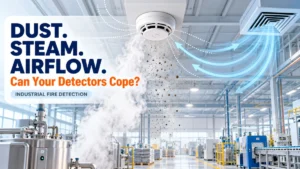
Modern multi-sensor detectors do not rely on a single trigger mechanism. They combine smoke sensing, heat sensing, and carbon monoxide detection with environmental monitoring algorithms that distinguish genuine threats from cooking fumes, steam, or dust.
The result is significantly lower false alarm rates and higher detection confidence, particularly in environments like commercial kitchens, workshops, and industrial facilities where single-sensor detectors have historically struggled.
IoT-Enabled Monitoring
IoT connectivity allows fire safety systems to move beyond the building. Remote visibility dashboards let facility managers and safety officers monitor device status, alarm history, and system health from any location in real time.
Centralised monitoring platforms aggregate data from multiple sites, creating a unified view of fire safety across an entire portfolio of buildings. Asset health tracking flags issues before they become failures.
Data Analytics and Predictive Maintenance
Perhaps the most transformative shift is in maintenance. Traditional fire safety relied on scheduled inspections, regardless of actual device condition. Modern systems use data analytics to identify patterns that indicate emerging issues.
Detector contamination, device communication faults, signal drift, and battery degradation are all detectable trends in a connected system. Predictive maintenance replaces calendar-driven schedules with condition-based interventions, reducing costs and improving reliability.
How Artificial Intelligence Is Influencing Fire Safety
Artificial Intelligence is beginning to play a practical role in fire safety, though it is important to be realistic about what AI can and cannot do today.
Current AI applications in fire safety focus on pattern recognition and event analysis. Machine learning algorithms trained on large event datasets can distinguish high-priority alerts from nuisance events with greater accuracy than traditional threshold-based logic.
AI-assisted monitoring platforms analyse alarm patterns over time, identify recurring false alarm locations, and flag detector placements that may need review. Intelligent alert prioritisation helps control room operators manage high volumes of events without missing critical ones.
Risk prediction is an emerging application, where systems analyse environmental trends and historical data to flag elevated risk conditions before any alarm triggers. This is still developing, but the direction is clear.
Smart Buildings and Integrated Life Safety Ecosystems
A modern fire safety system does not operate in isolation. In a smart building, the fire alarm control panel is integrated with the Building Management System, access control systems, CCTV surveillance, public address systems, emergency communication systems, and HVAC controls.
When a fire alarm triggers, the integrated ecosystem responds automatically. HVAC systems switch to smoke control mode. Access control unlocks evacuation routes. Public address systems broadcast emergency instructions. CCTV cameras pan to the alarm location for visual verification.
This level of integration dramatically improves emergency response and reduces the risk of human error during high-pressure situations. It also provides richer data for post-incident analysis and continuous improvement.
Real-World Applications of Intelligent Fire Safety
Intelligent fire safety systems are already deployed across diverse environments:
- Commercial buildings: Addressable systems enable precise evacuation management across multi-floor office towers.
- Airports: Integrated life safety ecosystems manage complex multi-zone environments with thousands of devices.
- Hospitals: Multi-sensor detectors reduce false alarms in clinical areas while maintaining high detection sensitivity.
- Manufacturing facilities: IoT monitoring tracks environmental changes in high-dust, high-heat production environments.
- Educational campuses: Networked systems cover distributed building portfolios with centralised monitoring.
- Data centres: Predictive maintenance ensures suppression systems remain operationally ready without costly downtime.
- Smart cities: Cloud-connected fire systems feed data into city-wide emergency response platforms.
Benefits of Moving from Compliance to Intelligence
| Factor | Traditional Compliance Model | Intelligent Fire Safety Model |
| Detection Speed | Zone-level, delayed identification | Device-level, instant, precise location |
| Response Efficiency | Manual assessment required | Automated integration with BMS, access control, and PA |
| Maintenance Approach | Calendar-based scheduled inspections | Condition-based predictive maintenance |
| System Visibility | Limited to local panel readout | Real-time remote dashboards and centralised monitoring |
| Reporting | Manual logs and inspection certificates | Automated digital event logs, trend reports, audit trails |
| Operational Risk | High risk of delayed or incorrect response | Reduced risk through early warning and system integration |
Future Trends in Fire Safety
The trajectory of fire safety technology points toward several developments already underway:
- AI-assisted monitoring will move from pattern recognition to genuine predictive risk scoring, flagging elevated hazard conditions before any alarm occurs.
- Digital twins of buildings will allow fire safety planners to simulate emergency scenarios, test evacuation models, and validate system configurations without physical trials.
- Cloud-connected fire systems will enable portfolio-wide monitoring with real-time benchmarking across multiple sites and jurisdictions.
- Predictive maintenance will become standard, replacing reactive servicing with data-driven intervention schedules.
- Smart city integration will connect building fire systems to city-wide emergency response networks, enabling faster dispatch and better resource coordination.
- Cybersecurity considerations will grow in importance as fire systems become networked, requiring robust access controls and encryption to prevent tampering.
| Expert Insight: The buildings that will be safest in the next decade are not those with the most detectors. They are the ones where every device communicates, every event is logged, and every decision is informed by real data. Future-ready fire safety is about operational intelligence, not just regulatory compliance. Facilities that invest in intelligent systems today are building a foundation for continuous safety improvement, not just passing an annual audit. |
Conclusion
Fire safety has moved well beyond its origins as a regulatory checkbox. The buildings, facilities, and critical infrastructure of today require fire protection systems that are active participants in operational safety, not passive compliance tools.
The shift from conventional detectors and zone-based panels to addressable systems with real-time diagnostics, IoT connectivity, predictive analytics, and integrated building ecosystems represents one of the most significant advances in life safety in a generation.
For organisations in India looking to adopt this generation of technology, GST fire alarm systems represent a well-established platform for intelligent addressable fire protection. Innxeon Technologies serves as a GST fire alarm system distributor in India, making these systems accessible to facility managers, fire consultants, MEP engineers and building owners across the country.
The question for safety professionals today is not whether to move from compliance to intelligence. It is how quickly that transition can be made, and how comprehensively the new capabilities can be put to work.
Read Also: What Would the Ideal Fire Safety Infrastructure Look Like in 2030?
Read Also: Fire Safety Lessons from the Rapid Growth of India’s Data Centre Sector