| EXECUTIVE SUMMARY: The next generation of facilities will not be defined by square footage or structural innovation alone. They will be defined by how intelligently they collect, process and act on data. Across industrial plants, smart buildings, healthcare campuses, logistics hubs and critical infrastructure, organisations are shifting from reactive management to predictive, data-driven operations. This article explores why data intelligence, operational visibility and integrated safety systems are becoming the non-negotiable foundations of future facility design. |
The Shift From Buildings to Intelligent Ecosystems
Walk through a typical industrial facility from a decade ago. You would find operators relying on manual inspections, paper logs, and periodic maintenance schedules. Alerts were reactive. The equipment failed before anyone acted. Buildings were designed to shelter operations, not to enable them.
That model is changing rapidly.
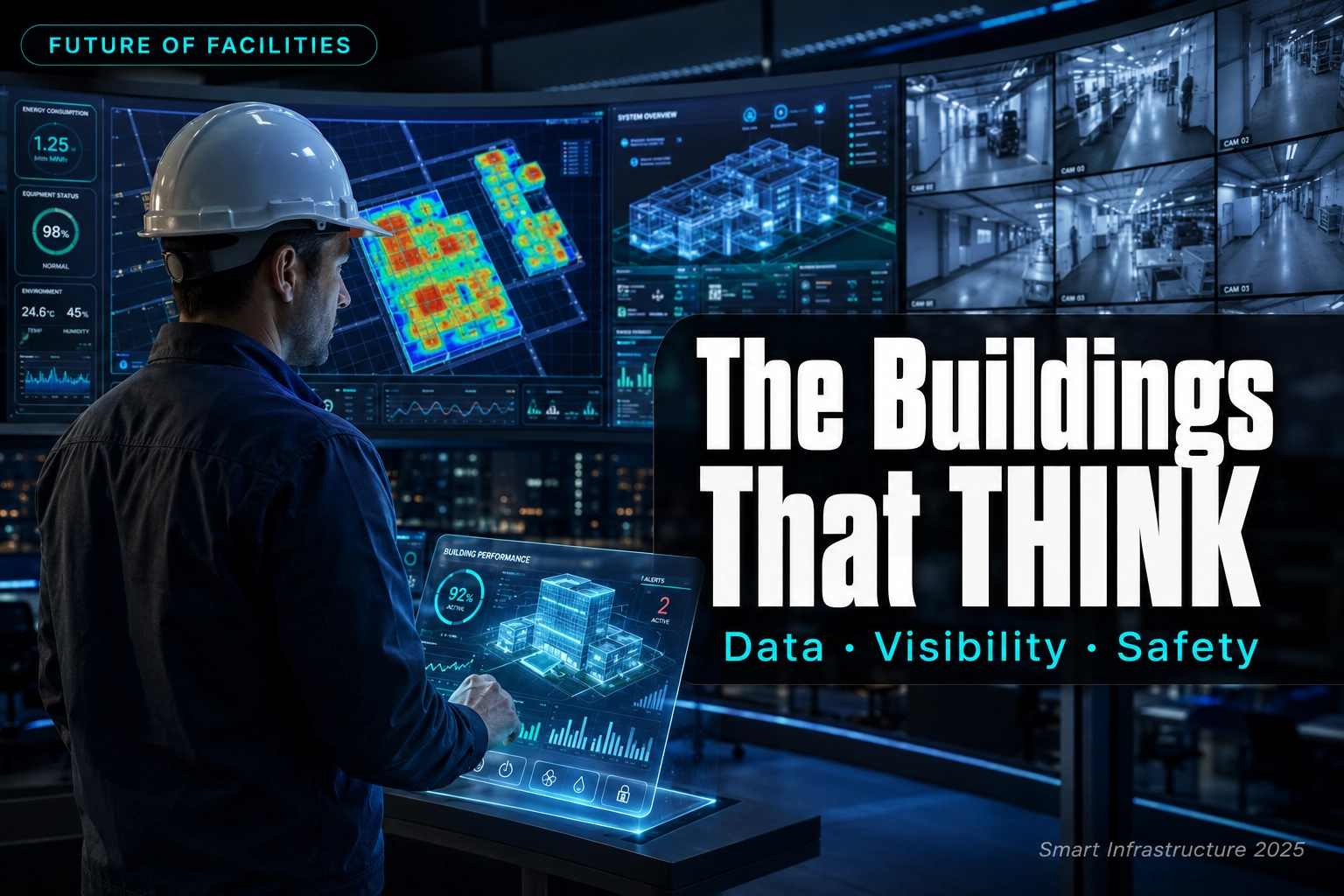
Today, facility design must account for a world where sensors monitor thousands of data points per second, AI systems predict equipment failure weeks in advance, and surveillance infrastructure provides real-time situational awareness across every corner of a site. A modern facility is no longer just a physical structure. It is an intelligent ecosystem where every system communicates, every asset is monitored, and every decision is informed by data.
This shift is not optional. The organisations building future-ready facilities now will outperform, outlast and outcompete those still managing buildings the old way.
Why Traditional Facilities Are No Longer Enough
Traditional facility management has always been reactive by nature. Something breaks, someone fixes it. An alarm triggers, and someone investigates. A safety incident occurs, and a report is filed. This cycle of response works until the consequences of delayed action become too costly to absorb.
Consider the compounding risks facing modern facilities:
- Energy costs have increased dramatically across all sectors.
- Ageing infrastructure increases the probability of unplanned downtime.
- Regulatory requirements around safety and emissions are tightening globally.
- Workforce shortages make manual monitoring increasingly unsustainable.
- Insurance and liability exposures grow with every unmonitored asset.
The financial argument is compelling. According to multiple industry studies, unplanned downtime costs industrial manufacturers an average of $50 billion annually worldwide. A single fire or safety incident in a commercial facility can result in losses that dwarf years of operational savings. The reactive model simply cannot scale to meet the demands of the modern world.
The Rise of Data-Centric Infrastructure
Data has become the most valuable asset in facility operations. Every piece of equipment, every environmental system, and every human interaction within a facility generates data. The question is no longer whether data is available. It is whether organisations are capturing, analysing, and acting on it effectively.
Data-centric infrastructure means designing facilities from the ground up with sensor integration, connectivity, and analytics in mind. Key elements include:
- IoT sensors embedded in HVAC, electrical, plumbing, and structural systems.
- Building Management Systems (BMS) that centralise control and monitoring.
- Edge computing devices that process data locally for real-time response.
- Cloud platforms that aggregate multi-site operational data for strategic analysis.
- AI and machine learning models are trained on historical facility data to predict future outcomes.
This infrastructure does not just improve operations. It transforms them. Facility managers move from managing events to anticipating them. Engineers shift from diagnosing failures to preventing them. Safety teams transition from investigating incidents to eliminating the conditions that cause them.
Visibility: The Missing Layer in Facility Operations
Of all the capabilities intelligent facilities unlock, operational visibility may be the most transformative. Visibility means knowing what is happening across every system, in every zone, at every moment, without dispatching a person to go and look.
Historically, visibility gaps have been responsible for some of the most costly failures in facility history. Equipment that failed silently. Hazardous conditions that went undetected. Security incidents that escalated before anyone responded. These failures were not inevitable. They were the result of insufficient visibility.
| Key Insight | Modern video surveillance systems go far beyond passive recording. Advanced platforms with AI-driven analytics detect anomalies, recognise patterns, and alert operators before minor issues escalate into major incidents. Organisations evaluating enterprise-grade video monitoring solutions, including options from Impact by Honeywell CCTV, are discovering that the value of these platforms lies not just in security but in operational intelligence. |
Real-time visibility enables facility managers to identify performance deviations before they cause failure, monitor energy consumption at the asset level, ensure compliance with occupancy and safety protocols and document operational events with automated precision. Visibility is not a luxury feature. It is the foundation upon which all intelligent facility capabilities rest.
Safety as a Strategic Business Function
Safety has traditionally been treated as a compliance obligation, a regulatory requirement to be met and documented. Forward-thinking organisations are recognising that this framing misses the true value of safety as a strategic driver of business performance.
A facility with a strong safety culture and intelligent safety systems gains real competitive advantages:
- Lower insurance premiums through demonstrated risk reduction.
- Reduced downtime from safety-related incidents and investigations.
- Higher workforce productivity in environments where employees feel protected.
- Stronger regulatory relationships and faster permitting for new projects.
- Reduced liability exposure and associated legal costs.
Modern safety systems integrate fire detection, gas monitoring, access control, emergency response coordination, and environmental sensing into unified platforms. Fire protection engineers and safety consultants working on next-generation facilities are specifying integrated safety ecosystems rather than isolated point solutions. When a smoke detector triggers, the system does not just sound an alarm. It identifies the zone, notifies emergency responders, initiates HVAC isolation protocols, and provides real-time status updates to the facility command centre.
This level of intelligent, coordinated safety response saves lives and assets simultaneously.
How AI, IoT and Automation Are Transforming Facilities
Artificial intelligence, the Internet of Things and building automation are no longer emerging technologies. They are operational realities being deployed across facilities worldwide. Together, they form the technical backbone of intelligent facility management.
AI brings pattern recognition and predictive capability to operational data. IoT provides the sensor network that generates that data continuously. Automation closes the loop by executing responses without human intervention when predefined conditions are met.
Practical applications already operating in advanced facilities include:
- Automated HVAC optimisation based on real-time occupancy and weather data.
- Predictive maintenance alerts triggered by vibration and thermal sensor anomalies.
- AI-powered video analytics that detect unauthorised access, crowd formation, or equipment interference.
- Smart energy management systems that shift loads to off-peak periods autonomously.
- Automated compliance reporting that eliminates manual documentation processes.
The cumulative effect of these capabilities is significant. Facilities using integrated AI and IoT systems consistently report reductions in energy costs of 20 to 30 per cent, maintenance cost reductions of 15 to 25 per cent, and substantial improvements in safety incident rates.
Predictive Maintenance and Real-Time Decision Making
The shift from preventive to predictive maintenance represents one of the most significant operational improvements available to facility managers today. Preventive maintenance schedules equipment servicing at fixed intervals, regardless of actual condition. Predictive maintenance services equipment when sensor data indicates it is approaching failure, not before and not after.
This distinction matters enormously in practice. Unnecessary maintenance consumes resources and introduces the risk of improper reinstallation. Delayed maintenance results in failure. Predictive maintenance eliminates both failure modes by making decisions based on real equipment condition rather than calendar dates.
| Real-World Impact | A large manufacturing facility deploying vibration, temperature, and current sensors across its rotating equipment portfolio can reduce unplanned downtime by up to 45% within the first year of implementation. The return on investment for predictive maintenance infrastructure typically occurs within 18 months of deployment. |
Real-time decision making extends beyond maintenance. When integrated facility platforms surface live operational data, managers can make faster, more accurate decisions about energy dispatch, space utilisation, safety responses, and resource allocation. The quality of decisions improves when they are grounded in current data rather than lagging reports.
Digital Twins and the Future of Facility Intelligence
A digital twin is a real-time virtual replica of a physical facility, updated continuously by sensor data to mirror actual conditions. Digital twins represent the convergence of facility design, operational management, and data analytics into a single, unified model.
For facility planners and engineers, digital twins enable simulation of proposed changes before physical implementation, identification of design inefficiencies in existing structures, modelling of emergency scenarios and evacuation routes, and long-term scenario planning for capacity, energy, and safety management.
For operations teams, digital twins provide a single interface for monitoring every system across a facility in real time. Anomalies appear visually in the context of the physical space, making them faster to identify and easier to diagnose.
As the cost of implementing digital twin technology declines, adoption is accelerating across data centres, healthcare facilities, industrial plants, and large commercial campuses. Organisations that build digital twin capability into their facility infrastructure now will find themselves with a substantial operational and strategic advantage within the next five years.
Building Resilience Through Connected Systems
Resilience in facility operations means the ability to absorb disruption, adapt quickly, and recover without catastrophic impact. Connected systems are the primary mechanism through which modern facilities achieve resilience.
When every system is isolated, the failure of any single component can cascade unpredictably. When systems are connected and integrated, failures are contained. Fallback protocols activate automatically. Operators receive immediate notification with context and recommended responses. Recovery is faster and more orderly.
Resilience planning for future facilities must address:
- Cybersecurity for operational technology and building management networks.
- Power resilience through redundant supply and intelligent load management.
- Communication system redundancy for emergency coordination.
- Data backup and recovery for operational intelligence platforms.
- Physical security integration with access control and monitoring systems.
Connected systems also enable facilities to respond dynamically to external disruptions, whether caused by extreme weather, supply chain interruptions, or grid instability. The facilities that survive and operate through major disruptions will be those whose systems are interconnected, monitored, and capable of autonomous response.
The Convergence of Security, Operations and Safety
One of the most important trends in facility management is the convergence of physical security, operational technology, and life safety systems into unified platforms. Historically, these domains operated in isolation, managed by different teams using incompatible tools and data formats.
That separation creates dangerous gaps. A security camera network that cannot communicate with the fire alarm system provides incomplete situational awareness during an emergency. An access control system that does not integrate with occupancy data creates compliance blind spots. Operational sensors that do not feed into the safety management platform miss the connections between equipment behaviour and safety risk.
In India and across the Asia-Pacific region, technology procurement ecosystems are evolving rapidly to support this convergence. Infrastructure professionals evaluating integrated security and safety platforms are increasingly turning to specialised regional channel partners, such as an impact by Honeywell CCTV distributor in India, to source enterprise-grade surveillance and safety solutions tailored to local regulatory and operational requirements.
Converged platforms deliver unified monitoring across all domains, faster incident response through coordinated system activation, and comprehensive audit trails that satisfy both safety regulators and insurance requirements. The organisations implementing converged security, operations, and safety infrastructure today are building the facilities that will define industry standards for the next decade.
Predictions for the Next Decade of Facility Design
Looking ahead to 2030 and beyond, several structural shifts in facility design appear highly probable:
- Autonomous facility management platforms will handle routine operations with minimal human intervention, with humans focusing on exception management and strategic decisions.
- Sustainability performance metrics will be embedded into facility operations platforms, with real-time carbon accounting becoming a standard reporting requirement.
- Physical and cybersecurity will be managed as a single integrated discipline, as operational technology networks become primary targets for malicious actors.
- Digital twin adoption will exceed 60% among large commercial and industrial facilities within five years, driven by falling implementation costs and rising operational complexity.
- AI-generated operational insights will replace periodic management reports, with decision-makers receiving continuous, contextual intelligence rather than backwards-looking summaries.
Key Challenges Organisations Must Prepare For
The path to intelligent, data-driven facilities is not without obstacles. Organisations must navigate:
- Integration complexity when connecting legacy systems with modern IoT and analytics platforms.
- Cybersecurity vulnerabilities introduced by increasing connectivity across operational technology networks.
- Skills gaps as facility management roles evolve to require data literacy alongside traditional engineering competencies.
- Data governance challenges arise as the volume of operational data generated by sensor networks grows exponentially.
- Capital investment requirements can be substantial for organisations retrofitting existing facilities rather than building new ones.
Organisations that address these challenges proactively, through strategic technology partnerships, workforce development, and phased implementation roadmaps, will achieve the transformation that gives intelligent facilities their competitive advantage.
Conclusion: Why Data, Visibility and Safety Will Define Competitive Facilities
The facilities that will define the next decade of industrial, commercial and critical infrastructure performance will not be the largest or the most expensively constructed. They will be the most intelligently designed. Data gives facilities the ability to know their own state in real time. Visibility gives operators and managers the ability to act on that knowledge decisively.
Safety systems give organisations and the people within them the confidence to operate at full capacity without unnecessary risk. These three capabilities are not independent. They reinforce each other. Better data produces better visibility. Better visibility enables more effective safety management. Stronger safety systems generate more reliable operational data. The intelligent facility is not a collection of technologies. It is an integrated system where every component makes every other component more effective.
For facility managers, engineers, safety consultants, and technology leaders, the strategic question is no longer whether to build intelligent, data-driven facilities. It is how quickly and how well to make the transition. The organisations that act decisively now will set the operational benchmarks that others spend years trying to match.
Read Also: The Future of Video Intelligence in Manufacturing and Logistics
Read Also: What Happens When Surveillance Systems Become Predictive Instead of Reactive?