Most facility managers and fire safety consultants will tell you that choosing a fire alarm system is not really about picking hardware. It is about choosing a long-term infrastructure commitment, one that affects your occupant safety, your insurance liability, your maintenance costs, and your regulatory standing for the next 15 to 25 years.
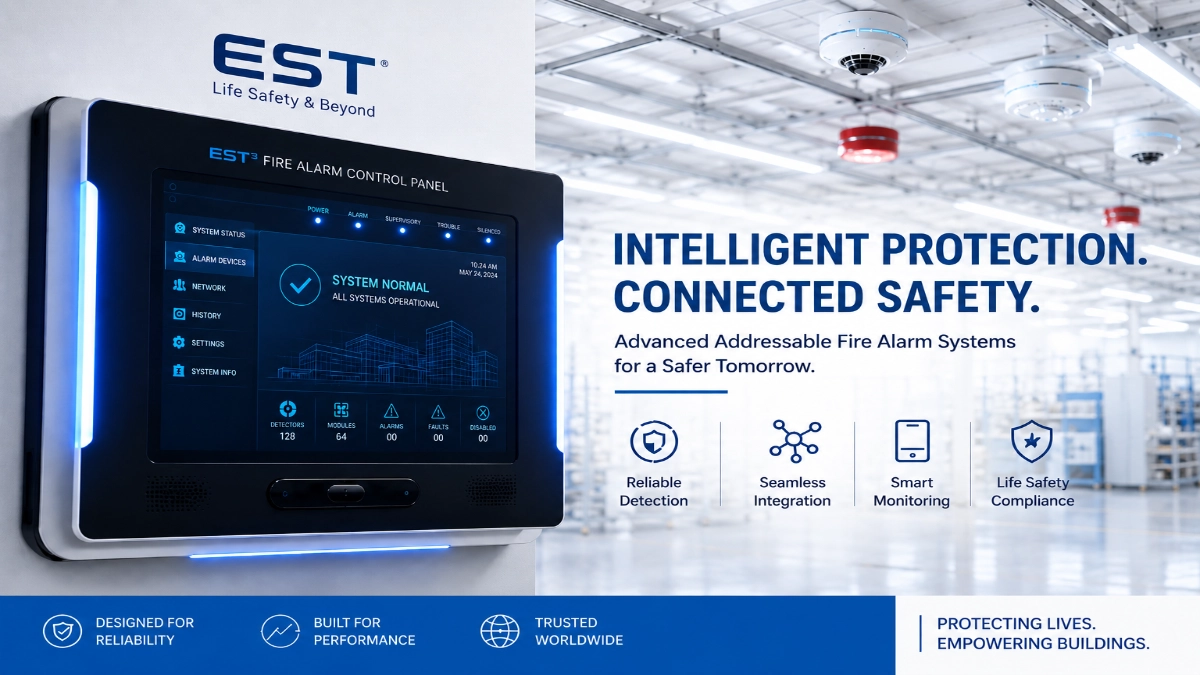
That pressure has intensified. Buildings are growing more complex. Industrial environments are becoming more process-sensitive. Regulatory bodies across the Middle East, Southeast Asia, Europe and North America are tightening code requirements for addressable, intelligent fire detection systems. And insurance underwriters are asking harder questions about platform reliability before they quote premiums.
Against that backdrop, one platform keeps appearing at the specification stage of major industrial, commercial, and institutional projects: Edwards by UTC Fire & Security, now part of Carrier Global Corporation. Not because of aggressive marketing, but because Edwards fire alarm systems have built a multi-decade track record in environments where failure is simply not an option, oil and gas facilities, hospital complexes, high-rise towers, data centres and airport terminals.
This article examines why Edwards occupies the premium tier of the fire alarm market, what technical and operational factors support that position and what decision-makers should understand before specifying any fire safety infrastructure at scale.
Why is Edwards considered a premium fire alarm platform?
Edwards is considered a premium fire alarm platform because of its combination of intelligent detection technology, open-architecture system design, high reliability in demanding environments, global code compliance and a mature ecosystem of compatible devices and control panels. It is engineered for large, complex and life-safety-critical applications where false alarms, system failures and difficult integrations carry serious operational and safety consequences.
Why This Topic Matters Today
The global fire detection and suppression market was valued at over USD 60 billion in 2023 and is projected to grow consistently through 2030, driven by urbanisation, industrial expansion in the Gulf and Asia-Pacific regions, and stricter enforcement of fire codes.
But here is the insight most procurement teams miss: not all growth in the fire alarm market represents improvement in safety outcomes. The market has simultaneously seen an increase in low-cost, non-addressable systems being deployed in applications that genuinely require intelligent, addressable fire alarm infrastructure. The result is a hidden risk: facilities that appear compliant on paper but lack the detection granularity, integration capability and system resilience that complex environments demand.
This gap is exactly where the Edwards platform distinction becomes operationally relevant, not as a brand preference, but as an engineering decision.
What Makes a Fire Alarm Platform “Premium”?
Before evaluating Edwards specifically, it helps to define what the industry actually means by a premium fire alarm platform. This is not about price. It is about capability depth across five dimensions:
| Dimension | What It Means in Practice |
|---|---|
| Detection Intelligence | Can the system distinguish real threats from environmental noise? |
| System Scalability | Does it serve a single building and a multi-site campus equally well? |
| Integration Architecture | How does it interface with BMS, access control, HVAC and evacuation systems? |
| Reliability Under Stress | How does the system perform in extreme heat, humidity, dust, or EMI environments? |
| Lifecycle Support | Are parts, firmware updates, and technical support available over 20+ years? |
Edwards performs at the high end of all five. Let us look at each dimension in detail.
Intelligent Detection: Beyond Smoke and Heat
How Does Edwards Approach Fire Detection Differently?
Conventional fire detectors operate on threshold logic: if smoke density or temperature crosses a preset level, the detector activates. Intelligent fire detection systems like those in the Edwards ecosystem go significantly further.
Edwards detectors use multi-criteria sensing algorithms that analyse combinations of signals, smoke particle size and density, rate of heat rise, ambient temperature patterns, and, in some devices, carbon monoxide levels, simultaneously. The system’s control panel correlates data across multiple devices in a zone before generating an alarm.
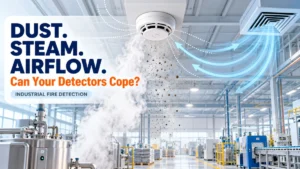
This approach dramatically reduces false alarms in challenging environments: manufacturing floors with dust, commercial kitchens with steam, parking structures with vehicle exhaust and laboratories with chemical vapours.
The Significance of SIGA (Signature) Technology
Edwards’ proprietary SIGA (Signature) series detectors are designed with onboard intelligence. Each SIGA detector performs its own signal analysis at the device level before sending processed data to the fire alarm control panel. This distributed intelligence model means:
- Faster response to genuine fire conditions
- Reduced processor load on the main panel
- More precise alarm differentiation
- Lower susceptibility to wiring noise and EMI interference
For facility managers overseeing complex industrial plants or multi-use commercial towers, this translates to fewer nuisance alarms, lower evacuation costs and greater confidence in the system’s accuracy.
Fire Alarm Control Panels: The Operational Brain
What Should Decision-Makers Understand About Edwards Control Panels?
The fire alarm control panel (FACP) is the operational centre of any fire safety infrastructure. Edwards fire alarm control panels, including the widely deployed EST3 and EST4 platforms, are built around a modular, network-capable architecture that sets them apart from conventional panels.
Key characteristics include:
- Distributed Network Architecture: EST3 and EST4 panels support peer-to-peer network topologies, meaning individual panels can communicate and share data across a facility or campus without routing everything through a single central processor. If one node fails, the rest of the network continues to function independently. This is a fundamental reliability advantage in large-scale deployments.
- Scalability Without Re-architecting: An Edwards panel system can be expanded, adding new detection zones, new buildings, and new device types without replacing existing infrastructure. This matters enormously for growing campuses, phased construction projects, and facilities undergoing renovation.
- Integrated Voice Evacuation: Edwards panels natively support voice evacuation systems, allowing facility managers to deliver zoned, intelligible voice instructions during an emergency rather than generic alarm tones. This is increasingly mandated by code in high-occupancy buildings.
- Open Protocol Integration: Edwards fire alarm control panels support BACnet, Modbus and other open protocols, enabling integration with building management systems (BMS), HVAC controls, elevator recall systems and access control platforms without proprietary middleware.
Edwards Fire Detectors and Devices: Built for Demanding Environments
What Types of Detection Does the Edwards Ecosystem Cover?
The Edwards device ecosystem spans a comprehensive range of fire detectors and life-safety devices:
- Photoelectric smoke detectors for general-purpose applications
- Multi-criteria detectors combining smoke, heat, and CO sensing
- Rate-of-rise and fixed-temperature heat detectors for high-heat environments
- Beam smoke detectors for large open spaces such as warehouses and atriums
- Aspirating smoke detection (ASD) for very early warning in critical environments like data centres and clean rooms
- Manual call points (MCP) for manual alarm initiation
- Flame detectors for petrochemical and industrial applications
- Notification appliances: strobes, horns, speakers for voice and audible evacuation
This breadth matters for EPC contractors and MEP consultants who need a single-platform solution across diverse building types on the same project. Specifying a fire alarm system with device types from multiple vendors creates integration risk, maintenance complexity and accountability gaps. The Edwards platform minimises all three.
Global Code Compliance and Certification
Why Does Certification Matter Beyond Local Compliance?
Edwards fire alarm systems carry certifications from UL (Underwriters Laboratories), FM Global, LPCB (Loss Prevention Certification Board), CE marking, and approvals under EN 54, the European standard for fire detection and alarm systems.
For international projects, particularly in the GCC, Southeast Asia, and emerging markets, this multi-certification profile is critical. Projects funded by international development banks, insured by Lloyd’s or multinational underwriters, or owned by global corporations typically require equipment with recognised international certifications, not just local authority approvals.
Edwards’ certification depth reduces project risk for EPC contractors and gives procurement teams defensible documentation for compliance audits.
Reliability in Harsh Industrial Environments
How Does Edwards Perform in Extreme Conditions?
This is an area where the Edwards platform genuinely differentiates itself from mid-tier alternatives. Industrial environments, such as petrochemical plants, desalination facilities, cement factories, and offshore platforms, impose stresses that standard commercial fire alarm systems are not designed to withstand.
Edwards devices and control panels are rated for:
- Extended temperature ranges (from sub-zero to high-heat industrial environments)
- High humidity and corrosive atmospheres
- Heavy dust and particulate contamination
- Electromagnetic interference from heavy industrial equipment
The system’s supervised loop wiring architecture also provides continuous circuit monitoring, so a wiring fault, due to mechanical damage, corrosion, or rodent activity, is detected and reported before it creates a detection gap.
For industrial plant heads and operations managers, this means the fire alarm system remains functionally reliable in the same conditions that stress every other piece of equipment on site.
Common Misconceptions About Premium Fire Alarm Platforms
Misconception 1: A higher-specification system means more false alarms. The opposite is true with intelligent multi-criteria systems. Edwards’ signal processing architecture is specifically designed to reduce false alarms while improving true alarm sensitivity.
Misconception 2: Premium platforms are only relevant for very large buildings. Edwards panel systems are scalable from small commercial applications upward. The platform advantage applies wherever system integration, long-term support, and detection accuracy matter, which includes mid-sized industrial facilities, hospitals, and educational campuses.
Misconception 3: All addressable fire alarm systems are essentially equivalent. Addressable is a category, not a capability guarantee. Within addressable systems, there are significant differences in device intelligence, network architecture, integration capability, and detector algorithm sophistication. Edwards occupies the upper tier of addressable fire alarm technology.
Misconception 4: The lowest-cost compliant system is the economically rational choice. When lifecycle costs are considered, including false alarm responses, maintenance complexity, system upgrades, and replacement cycles, premium fire alarm infrastructure frequently delivers a lower total cost of ownership over 20 years.
Expert Insights: What Fire Consultants Actually Specify and Why
Experienced fire consultants and loss prevention engineers who work across multiple building types and jurisdictions consistently cite several factors when specifying Edwards:
- System accountability: On large EPC projects with multiple contractors, having a single-platform fire safety infrastructure from detection devices through to the fire alarm control panel and notification appliances creates clear accountability. If a device or system-level issue arises, there is one technical support chain.
- Commissioning confidence: Edwards’ panel software provides detailed commissioning tools that allow verification of every device on a loop, confirming sensitivity calibration, communication integrity, and proper device identification. This matters for projects where the authority having jurisdiction (AHJ) requires witnessed commissioning and detailed documentation.
- Future-proofing: Large facilities change over time. Tenants change. Processes change. The modular architecture of Edwards fire alarm systems means that changes to one zone or building section do not require system-wide reconfiguration.
Common Challenges and How the Edwards Platform Addresses Them
| Challenge | How Edwards Addresses It |
|---|---|
| False alarms in industrial environments | Multi-criteria SIGA detectors with onboard signal processing |
| System integration with BMS/SCADA | Open protocol support (BACnet, Modbus) |
| Phased construction and expansion | Modular, scalable panel architecture |
| Long-term parts and support availability | Global distributor network and long product lifecycle commitments |
| Multi-site management | Networked panel topology with centralised monitoring capability |
| Voice evacuation compliance | Native integration with Edwards voice evacuation modules |
Future Outlook: Where Fire Alarm Technology Is Heading
The fire safety industry is moving through several simultaneous transitions that will shape platform selection decisions over the next decade.
- IoT-integrated fire safety: Building owners increasingly expect fire alarm systems to feed data into broader building intelligence platforms. Edwards’ open protocol architecture positions it well for integration with connected building ecosystems.
- Predictive maintenance through device analytics: The next generation of intelligent fire alarm systems will use device-level data, detector drift, sensitivity changes, and environmental readings to predict maintenance needs before failures occur. Edwards’ distributed intelligence architecture provides the device-level data foundation that this requires.
- Carbon monoxide and multi-hazard detection: Regulatory standards are evolving to mandate CO detection alongside smoke detection in a wider range of occupancies. Edwards’ multi-criteria detector portfolio already addresses this requirement, positioning facilities that specify Edwards to remain code-compliant as standards evolve.
- Wireless addressable systems: Large retrofit projects in heritage buildings and industrial facilities increasingly benefit from wireless addressable fire detection, avoiding the cost and disruption of cable installation. Edwards has developed wireless device options that integrate into its addressable panel architecture.
Conclusion
The premium status that Edwards occupies in the global fire alarm market is not a function of brand perception alone. It reflects a consistent, engineering-grounded approach to fire safety infrastructure, one that addresses the real operational challenges that facility managers, safety engineers, and building owners face every day.
False alarms that cost tens of thousands of dollars per event. Detection failures in extreme industrial environments. Integration complexity across building systems. Regulatory requirements that evolve over decades. These are not theoretical concerns. They are the daily realities that drive specification decisions on serious projects.
Edwards fire alarm systems, fire alarm control panels and fire detectors are specified in demanding environments precisely because they are built for those environments. For decision-makers whose responsibility extends beyond initial compliance to long-term operational reliability, that distinction is worth understanding before a system gets specified.
Read Also: What Industrial Leaders Should Know About AI-Powered Monitoring
Read Also: The Hidden Connection Between Risk Reduction and Business Growth