Not every building requires an enterprise-scale fire alarm system, but every building deserves intelligent fire protection. As offices, schools, retail spaces, healthcare clinics, and growing businesses modernise their infrastructure, selecting the right-sized fire alarm platform has become just as important as choosing the right detection technology. A system that is too basic leaves gaps in coverage and slows down emergency response. A system built for a high-rise or a hospital campus often brings complexity, cost, and maintenance overhead that a 15,000-square-foot office building simply doesn’t need.
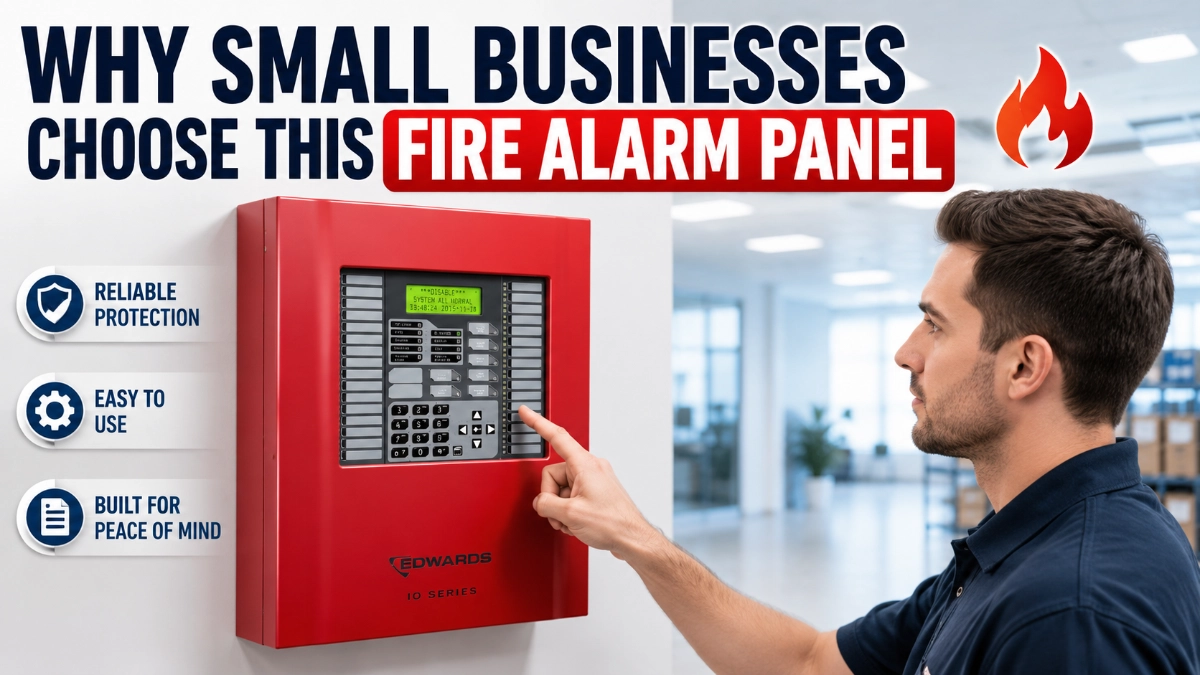
This is the gap that mid-tier addressable fire alarm control panels are designed to close, and it’s where the Edwards IO1000 fire alarm panel has found a consistent place in commercial and light industrial projects.
Small and medium facilities face a specific set of fire protection challenges. Budgets are tighter than they are for large institutional projects. Maintenance teams are often smaller, sometimes without a dedicated life safety technician on staff. Buildings change over time; tenants move in and out, floor plans get reconfigured, new equipment gets installed, and the fire alarm system has to keep pace without a full replacement every few years. At the same time, code requirements for detection, notification, and monitoring don’t scale down just because a building is smaller.
The Edwards IO1000 was engineered around this exact set of constraints: an intelligent, addressable fire detection infrastructure sized appropriately for facilities that need more than a conventional zone-based system but less than a large-scale networked platform. This article looks at what the panel actually offers, which building types get the most value from it, and how facility managers, consultants, and procurement teams can think through the fire alarm control panel selection process more broadly.
The Edwards IO1000 is an intelligent addressable fire alarm control panel built for small and medium commercial buildings. It supports one Signature loop with up to 250 addressable devices out of the box, expandable in 250-point increments to 1,000 addresses using additional loop controller modules. It combines individual device identification, four onboard notification appliance circuits, and simple field expansion, giving smaller facilities the diagnostic precision of an intelligent system without the cost or complexity of an enterprise network panel.
Understanding the Fire Safety Needs of Small and Medium Facilities
Fire protection requirements don’t shrink proportionally with building size. A 20,000-square-foot office still needs full smoke detection coverage, heat detection in mechanical spaces, manual call points at exits, and notification devices that meet audibility and visibility codes throughout. What changes is the operational context around that requirement.
- Offices: Typically need dependable coverage across open floor plans and meeting rooms, with straightforward integration into building access and HVAC shutdown sequences.
- Schools: Deal with high occupant density, strict code enforcement, and the need for administrators, not fire technicians, to understand basic system status at a glance.
- Hotels: Need zone-level clarity so staff can direct guests during an alarm, plus reliable connections to elevator recall and stairwell pressurisation where required.
- Clinics and small healthcare facilities: Carry higher life-safety stakes with less tolerance for nuisance alarms or system downtime during testing.
- Retail stores: Often operate across multiple smaller sites, where consistency in equipment and ease of vendor servicing matters as much as the technology itself.
- Warehouses: Need heat detection tuned to storage configurations and dusty or temperature-variable environments, along with circuits robust enough for large open spans.
- Apartment buildings: Require dependable manual and automatic detection across many small units, often with constrained wiring pathways.
- Small manufacturing units: Deal with process heat, occasional airborne particulate, and equipment changes that shift detector placement needs over time.
Across all of these, the common thread is the same: facility teams need a fire alarm control panel that’s straightforward to operate day to day, but intelligent enough to pinpoint problems quickly and grow as the building does.
What Is the Edwards IO1000 Fire Alarm Panel?
The Edwards IO1000 is an intelligent addressable fire alarm control panel designed for small to mid-sized commercial applications. Unlike conventional panels, which report alarm and trouble conditions by zone, the IO1000 uses electronic addressing so each connected device a smoke detector, heat detector, manual call point, or interface module reports its own individual status back to the panel.
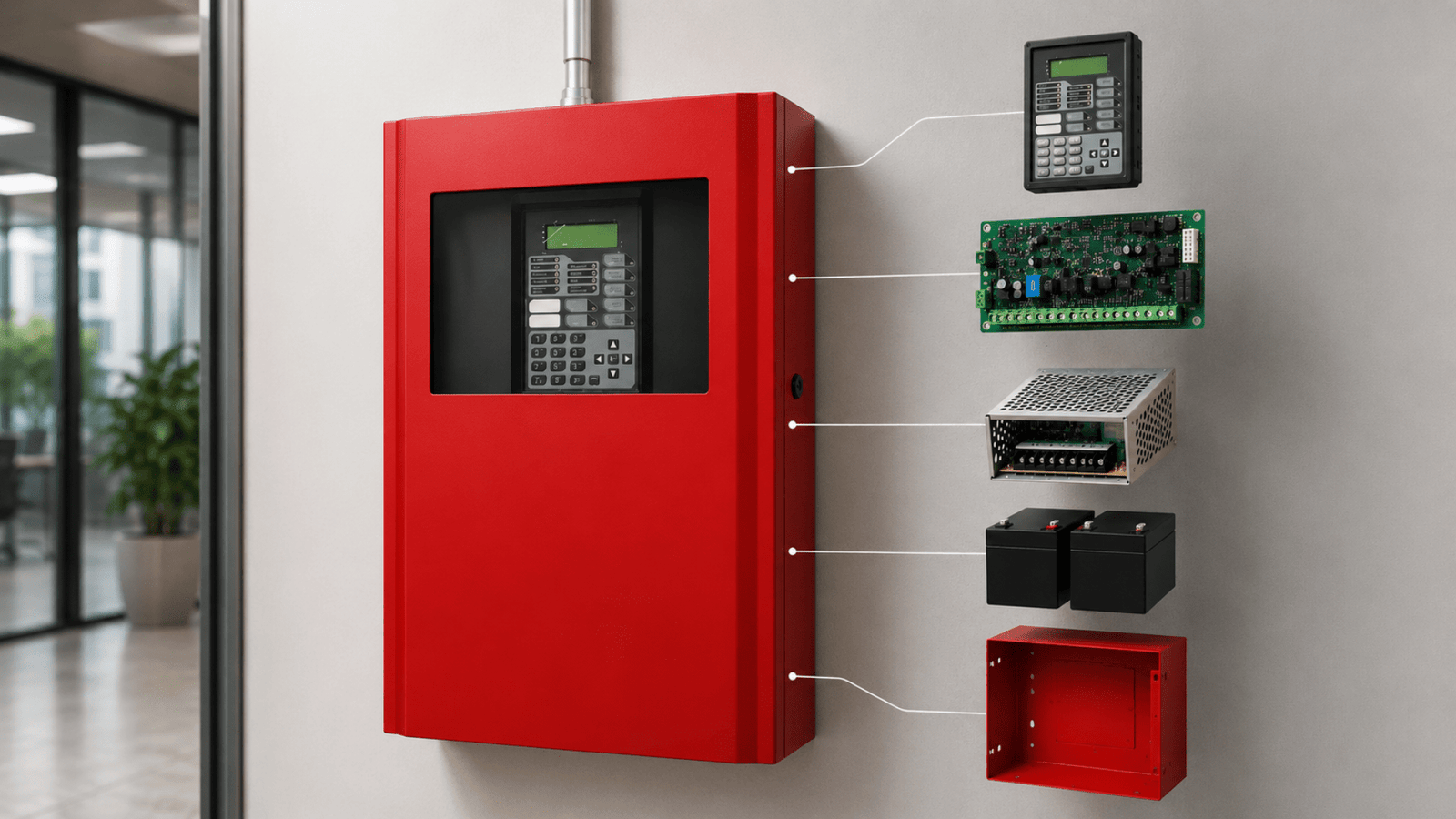
The panel ships with one Signature loop, wired as Class A or Class B, supporting up to 250 addressable devices in a mix of detectors and modules. Facilities that need more coverage can add a second loop controller module in the same cabinet, and further expansion cards extend total system capacity up to 1,000 addresses in 250-point increments. This gives a building room to grow without forcing a full panel swap.
Four onboard notification appliance circuits handle horns, strobes, and other notification devices, configurable for Class A or Class B wiring depending on the survivability requirements of the installation. The panel includes a backlit LCD for local programming and diagnostics, Form C relay outputs for auxiliary functions such as HVAC shutdown or elevator recall interface, and automatic device mapping that reduces the manual configuration typically required during commissioning.
Optional accessories a dual-line dialer for central station reporting, an Ethernet interface card for remote diagnostics, and serial or LED annunciators for secondary display locations, letting the base platform be configured up or down depending on the project. None of this requires marketing language to explain: it’s a fire detection and notification platform built around individual device identification, useful expansion headroom, and a manageable footprint for a building that doesn’t need and shouldn’t have to pay for a large-scale networked fire alarm network.
Key Reasons Small and Medium Facilities Choose IO1000
Right-Sized Scalability
A 250-point starting capacity fits most small commercial buildings without paying for unused capacity, while the path to 1,000 addresses means a facility manager isn’t boxed in if the building expands, gets renovated, or adds a wing.
Simplified Operation
The onboard LCD and straightforward menu structure mean building staff can check status, silence a trouble signal, or walk through a basic diagnostic without needing a fire alarm technician on-site for routine tasks.
Intelligent Addressable Detection
Because every detector and module has its own address, the panel can distinguish between a dirty smoke detector in Room 214 and an open circuit at a manual call point near the loading dock, information a conventional zone-based system simply can’t provide.
Faster Fault Identification
Pinpointing the exact device in trouble, rather than narrowing a problem down to a zone covering a dozen rooms, cuts the time technicians spend walking a building during service calls.
Easier Maintenance
Scheduled testing and inspection go faster when the panel reports device-level status, since technicians can verify sensitivity and function from the panel or a laptop interface instead of manually testing every device in a zone.
Long-Term Flexibility
Auto-programming and device mapping reduce the labour involved when devices are added, removed, or relocated during a renovation, a common event in leased commercial space.
Reliable Emergency Response
Individual device addressing gives responding staff and fire department personnel a clearer picture of exactly where an alarm originated, which supports faster, more targeted response inside the building.
Cost-Effective Lifecycle Management
Because the platform expands with additional loop cards rather than requiring panel replacement, facilities avoid the capital cost of a full system swap when square footage or device count grows moderately over time.
Which Types of Buildings Benefit Most from IO1000?
| Building Type | Why IO1000 Fits |
|---|---|
| Office Buildings | Moderate device counts, straightforward zoning, and integration with HVAC/access control needs |
| Schools | Individual device addressing helps administrators and maintenance staff manage large occupant counts with clear fault reporting |
| Hotels | Zone-level clarity supports staff-directed evacuation; expansion path accommodates additions or renovations |
| Hospitals & Clinics (smaller facilities) | Precise fault isolation reduces nuisance-alarm downtime in sensitive care environments |
| Warehouses | Loop capacity and Class A wiring options suit large open floor areas and long cable runs |
| Retail Outlets | Consistent platform across multiple smaller locations simplifies servicing and technician familiarity |
| Restaurants | Compact footprint and simple operation suit smaller footprints with kitchen-area heat detection needs |
| Mixed-Use Buildings | Expandable capacity supports blended occupancy types (retail, residential, office) under one system |
| Small Factories | Heat detection tuning and module flexibility accommodate process equipment and changing floor layouts |
IO1000 vs Conventional Fire Alarm Panels
| Factor | Edwards IO1000 (Addressable) | Conventional Panel |
|---|---|---|
| Detection Capability | Individual device-level detection and reporting | Zone-level detection only |
| Device Identification | Each detector/module has a unique address | Devices grouped by circuit; no individual ID |
| Maintenance | Faster fault isolation reduces technician time on-site | Requires manual zone-by-zone testing |
| Expansion | Modular loop cards scale to 1,000 addresses | Limited by available zone circuits; often requires new panel |
| Troubleshooting | Pinpoints exact device in trouble or alarm | Narrows only to a zone, often covering multiple rooms |
| Operational Efficiency | Auto-programming and device mapping speed commissioning and changes | Manual wiring and zone assignment for every change |
| Lifecycle Value | Expansion cards extend usable life of the panel | Capacity ceiling often forces early replacement |
| False Alarm Management | Device-level diagnostics help identify and correct nuisance sources | Harder to isolate the specific device causing false alarms |
Planning for Future Growth
Even a small facility rarely stays static. Tenant improvements, added square footage, equipment upgrades, and code updates all put pressure on a fire alarm system that was sized only for the building’s condition at installation. A panel with no practical expansion path means that even modest growth can trigger an unplanned, disruptive, and costly system replacement.
This is why scalability matters even for buildings that don’t expect to become large facilities. A 40,000-square-foot office adding a mezzanine, a school building a new wing, or a warehouse adding racking and additional detection zones all benefit from a fire alarm control panel that can absorb that growth with an expansion card rather than a new installation. Planning for this upfront, even conservatively, protects the initial investment and avoids downtime during future renovations.
Common Mistakes When Selecting Fire Alarm Panels
- Buying only for current needs: Sizing a panel exactly to today’s device count leaves no room for even minor renovations without a costly upgrade path.
- Ignoring future expansion: Skipping the question of how (or whether) the panel can scale locks a building into its original footprint indefinitely.
- Choosing based only on price: The lowest upfront cost often carries higher long-term maintenance and troubleshooting costs, especially with conventional zone-based systems.
- Poor detector planning: Placing smoke and heat detectors without accounting for HVAC airflow, ceiling height, or process equipment leads to nuisance alarms and detection gaps.
- Underestimating maintenance requirements: Fire alarm systems require scheduled testing and inspection regardless of building size; failing to budget for this leads to compliance issues down the line.
Fire Alarm Selection Checklist for Small and Medium Facilities
- Confirm current device count and compare against onboard panel capacity.
- Verify the panel’s expansion path and maximum supported addresses.
- Confirm NAC circuit capacity matches notification device load, including future additions.
- Check compatibility with existing detectors, modules, and notification devices if retrofitting.
- Review code requirements for Class A vs Class B wiring in your jurisdiction.
- Confirm central station reporting method (dialer, IP, cellular) fits your monitoring plan.
- Assess ease of local programming and diagnostics for in-house staff.
- Confirm availability of qualified local service and support for the platform.
- Review integration needs with HVAC shutdown, elevator recall, and access control.
- Budget for scheduled inspection, testing, and maintenance over the system’s lifecycle.
Future Trends in Fire Protection for Commercial Buildings
Fire protection for small and medium facilities is shifting alongside broader building technology trends.
- Smart building integration is pushing fire alarm systems to communicate more directly with HVAC, access control, and building management platforms rather than operating in isolation.
- AI-assisted diagnostics are beginning to help distinguish real threats from nuisance conditions by analysing detector response patterns over time.
- IoT-enabled monitoring allows facility teams and service providers to check system status remotely instead of relying solely on scheduled site visits.
- Predictive maintenance is gaining traction as panels and detectors report more granular health data, allowing service providers to address a drifting sensor before it causes a fault or a false alarm.
- Cloud-connected infrastructure is making centralised reporting across multiple sites useful for retail chains and multi-location operators more practical than it’s been with older, standalone systems.
None of these trends eliminates the need for a solid fire detection infrastructure foundation; they build on top of platforms, like intelligent addressable panels, that already report device-level data.
Expert Recommendations
- For facility managers: Prioritise a panel that your in-house team can actually operate day to day. Individual device addressing pays for itself the first time you need to isolate a fault without walking the entire building.
- For building owners: Treat fire alarm panel selection as a lifecycle decision, not a one-time purchase. A platform with a clear, incremental expansion path protects your capital investment against future renovations or tenant changes.
- For consultants: Match panel capacity to realistic five- to ten-year projections for the building, not just the current device count on the drawings. Specify expansion capability explicitly in the design documents.
- For procurement teams: Weigh total lifecycle cost including maintenance labour, troubleshooting time, and future expansion cost against upfront panel price. An addressable fire alarm system with efficient fault isolation often reduces long-term service costs even when the initial price is higher than a conventional alternative.
Read Also: Edwards EST3 vs EST4: Which Fire Alarm Platform Is Right for Your Facility?
Read Also: What Makes Edwards EST4 Panels Suitable for Enterprise Fire Safety?