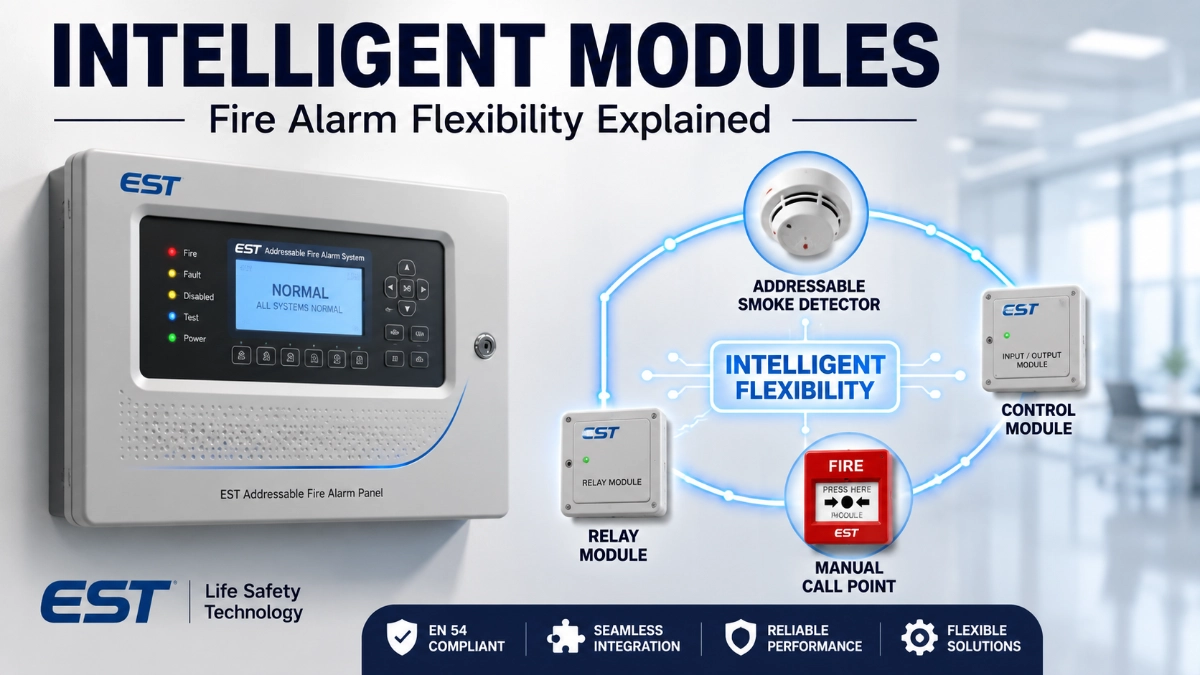
Modern buildings rarely remain unchanged throughout their lifecycle. New floors are added, departments move, production lines expand, and safety requirements evolve. Intelligent fire alarm modules provide the flexibility that allows an addressable fire alarm system to adapt to these changes without redesigning the entire infrastructure.
Introduction
Fire alarm systems are often specified for the building as it exists on day one, yet buildings rarely stay static. A hospital adds a new diagnostic wing. A warehouse reconfigures its racking. A data centre brings a new server hall online. Conventional, hard-wired fire alarm designs struggle with this kind of change because every new device typically means a new wiring run back to the control panel.
Intelligent modules solve this problem at the architecture level. Instead of dedicating a separate circuit to each device, an addressable fire alarm system uses intelligent monitor, control, and relay modules to place individually addressable points on a shared signalling line circuit, commonly called the fire alarm loop. Each module reports its own status and location to the fire alarm control panel, giving engineers a system that can grow, shrink, and reconfigure without a full rewire. This article explains what intelligent modules are, how they work, and why experienced consultants treat them as core design elements rather than optional accessories.
Intelligent modules are addressable devices that connect conventional inputs (detectors, contacts, switches) and outputs (relays, dampers, notification circuits) to an addressable fire alarm control panel over a shared loop. They give each device a unique digital address, allowing engineers to add, relocate, or reconfigure devices with minimal rewiring making the fire alarm loop far more flexible than traditional zoned wiring.
What Are Intelligent Fire Alarm Modules?
An intelligent module is a field device that translates real-world inputs and outputs into digital, addressable communication on a fire alarm loop. Rather than running a dedicated pair of wires from each device back to the panel, intelligent modules allow multiple devices to share a single signalling line circuit while remaining individually identifiable.
Each module holds a unique address, similar to how each smoke detector or manual call point has its own identity on the loop. When the fire alarm control panel polls the loop, it doesn’t just learn that “zone 3” has an alarm; it learns exactly which module, and therefore which device or piece of equipment, triggered the event. This device-level resolution is the foundation of an intelligent fire alarm system, and it’s what separates addressable architecture from older conventional, hardwired designs.
Within the loop, modules sit alongside smoke detectors, heat detectors, manual call points, and notification appliances, all communicating over the same two-wire circuit. This shared communication backbone is what gives designers room to add devices later without adding new home-run cabling for each one.
Types of Intelligent Modules
Monitor Modules
Monitor modules supervise a single input, such as a conventional smoke detector, a sprinkler flow switch, a tamper switch, or a pull station that isn’t natively addressable. The module watches for a change of state and reports it to the panel with its specific address, so the exact device and location are known immediately.
Control Modules
Control modules do the opposite job: they take a command from the fire alarm control panel and use it to switch an output, such as activating a notification circuit, releasing a magnetic door holder, or triggering a relay that shuts down an air handling unit. Control modules are what allow a fire alarm system to actively manage equipment during an event, not just detect it.
Relay Modules
Relay modules provide a set of dry contacts that can be used to interface with other building systems: elevator recall circuits, HVAC shutdown, access control, or a building management system (BMS). Because the relay module is addressable, its operation can be individually programmed and tested rather than lumped into a larger zone.
Input Modules
Input modules are a broader category that includes monitor modules but also covers supervised inputs from third-party equipment, such as generator status contacts or security system interfaces. They allow non-fire equipment to be visible on the fire alarm loop without compromising the integrity of life safety circuits.
Output Modules
Output modules manage notification appliances horns, strobes, and speakers along with auxiliary functions like fan shutdown or damper actuation. Because each output module is addressable, engineers can program notification zones with far more precision than a conventional, hardwired notification circuit would allow.
How Intelligent Modules Improve Fire Alarm Flexibility
- Easier system expansion: Adding a new device to an intelligent, addressable loop generally means adding an address and running a spur to the nearest loop wiring, rather than pulling an entirely new circuit back to the panel.
- Integration with third-party equipment: Relay and input modules give fire alarm designers a structured way to interface with elevators, HVAC, access control, and building management systems without introducing unsupervised, unmonitored connections.
- Device-level control: Because every module has its own address, facility managers and technicians can isolate, test, or disable a single point without affecting an entire zone, which reduces both nuisance alarms and testing downtime.
- Simplified retrofits: In older buildings, replacing a conventional zoned system with an addressable one is far less disruptive when intelligent modules can be dropped onto an existing loop rather than requiring new conduit runs throughout the building.
- Better zoning strategies: Since modules report individually, “zones” become a software concept as much as a wiring concept, letting engineers group devices logically by floor, department, or hazard type rather than by cable run.
- Reduced wiring complexity: A single fire alarm loop can carry dozens of intelligent devices, cutting down on the volume of cabling, junction boxes, and conduit compared with a conventional home-run architecture.
- Improved maintenance efficiency: Technicians can pinpoint a faulted or dirty detector, an open circuit, or a failed relay down to the specific module address, which shortens troubleshooting time significantly compared with tracing a conventional zone.
Real-World Applications
- Hospitals rely on intelligent modules to interface fire alarm systems with smoke control dampers, elevator recall, and door holders across constantly changing wings, where phased renovations are the norm.
- Manufacturing plants use control and relay modules to shut down process equipment, ventilation, or conveyor lines during an alarm, often as part of a broader industrial fire protection strategy.
- Warehouses benefit from adding modules as racking layouts change, without redesigning the entire loop each time storage configurations shift.
- Data centres depend on monitor modules to supervise gas suppression status, early-warning detection, and environmental controls, each reporting individually for precise diagnostics.
- Universities use intelligent modules to manage phased campus expansions, connecting new buildings to existing fire alarm infrastructure incrementally.
- Commercial office buildings apply relay modules to coordinate with building management systems for HVAC shutdown, elevator recall, and tenant notification.
Intelligent Modules vs Conventional Wiring
| Criteria | Intelligent Modules (Addressable) | Conventional Wiring |
|---|---|---|
| Flexibility | High—devices added or moved with minimal rewiring | Low—each device typically needs a dedicated circuit |
| Scalability | Loop can accommodate many additional addressable points | Limited by zone capacity and available circuits |
| Maintenance | Fault isolated to a specific device address | Fault often isolated only to a zone |
| Expansion | Incremental, phased expansion is straightforward | Expansion often requires new wiring runs |
| Diagnostics | Device-level status reporting to the panel | Zone-level status only |
| Wiring Complexity | Reduced—shared loop wiring | Higher—multiple home-run circuits |
| Lifecycle Value | Strong—supports retrofits and long-term changes | Weaker—rigid layout ages poorly with renovations |
Best Practices for Module Planning
- Module placement: Position modules for accessibility during testing and maintenance, not just for the shortest wiring run.
- Loop planning: Calculate loop capacity with room for future devices; don’t design to the exact current device count.
- Address allocation: Reserve blocks of addresses by floor or system type so future additions don’t require renumbering existing devices.
- Documentation: Maintain an accurate, updated device address schedule; undocumented modules are a common source of commissioning delays.
- Future expansion: Identify likely expansion zones during design so spare loop capacity is located where it will actually be needed.
- Testing and commissioning: Verify every module’s response individually, not just at the zone level, to confirm addressable reporting is functioning correctly.
Expert Insights
- Over-designing module capacity is cheaper than it looks: Adding 15–20% spare loop capacity upfront is far less expensive than opening walls and pulling new conduit two years later.
- The most common specification mistake is treating modules as an afterthought: Consultants who plan module types and addresses during design rather than during installation avoid costly field changes.
- Phased expansions are where intelligent modules earn their keep: A campus or hospital that grows in stages benefits from a loop architecture that accepts new devices without disturbing existing ones.
- Lifecycle planning matters more than first-cost: A system that’s marginally cheaper to install but expensive to modify later often costs more over a 15–20 year building lifecycle.
- Relay modules deserve more design attention than they typically get: Poorly documented relay interfaces to HVAC or access control are a recurring source of commissioning delays.
- Address mapping should mirror the building, not the installation sequence: Grouping addresses by physical location makes troubleshooting dramatically faster.
- Module diagnostics are underused as a maintenance tool: Many facility teams only check module status during an alarm, missing early signs of loop degradation.
Key Takeaways
- Intelligent modules give each field device its own address on the fire alarm loop.
- Monitor modules report inputs; control modules manage outputs.
- Relay modules provide the structured interface fire alarm systems need to communicate with a building management system.
- Addressable architecture reduces wiring complexity compared with conventional zoned systems.
- Device-level diagnostics shorten maintenance and troubleshooting time.
- Spare loop capacity is a low-cost way to prepare for future expansion.
- Documentation and address planning are as important as the physical installation.
- Lifecycle value, not just initial cost, should guide fire alarm system design decisions.
Intelligent modules are what allow an addressable fire alarm system to function as adaptable infrastructure rather than a fixed installation. Platforms such as the EST Fire Alarm System, built around EST detectors and devices, illustrate how monitor, control, and relay modules work together within a single loop architecture to support commercial fire protection and industrial fire protection projects that evolve. For organisations sourcing these systems locally, working with an established EST Fire Alarm System distributor in India can help ensure module selection and loop design align with project-specific expansion plans from the outset.
Read Also: How Fire Alarm Networks Improve Operational Visibility
Read Also: Understanding Cause-and-Effect Programming in Enterprise Fire Alarm Systems