Most businesses buy a CCTV system for the problem they have today. Few buy one for the business they’ll have in three years. That gap is where expensive mistakes happen.
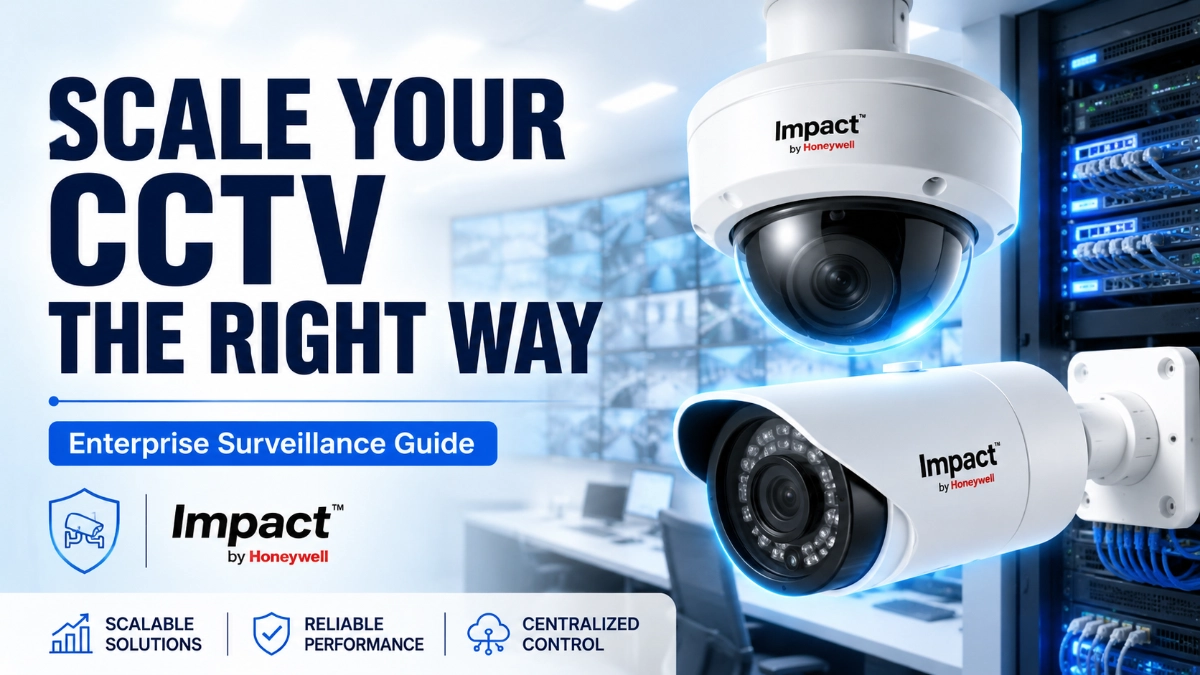
A warehouse adds a second building. A retail chain opens ten new stores. A hospital adds a wing. In every case, the surveillance system installed years earlier starts to strain too few recorder channels, too little storage, and no way to centralise monitoring across sites.
This article explains what scalable surveillance infrastructure actually means, why it matters for growing organisations, and how to evaluate systems so today’s investment doesn’t become tomorrow’s liability.
Why Scalable Surveillance Matters
Surveillance infrastructure isn’t just cameras. It’s a network of cameras, recorders, storage, cabling, software, and cybersecurity controls working together. When one piece can’t grow, the whole system hits a ceiling.
What is scalable surveillance infrastructure? Scalable surveillance infrastructure is a CCTV system designed so cameras, storage, network capacity, and analytics can expand without replacing the core architecture. It uses open standards, modular hardware, and flexible storage so growth means addition, not replacement.
Why should businesses invest in scalable CCTV systems? Businesses invest in scalable CCTV because expansion new sites, more cameras, higher resolution, added analytics is nearly certain over a five-to-ten-year equipment lifecycle. Scalable systems absorb that growth at a fraction of the cost of forklift upgrades or full replacements.
A facility manager who plans only for current headcount and current square footage is planning for a business that no longer exists by the time the contract is signed.
Signs Your Current CCTV Infrastructure Cannot Grow
Certain warning signs show up long before a system fully breaks down. Watch for these:
- The NVR is at or near its maximum channel count.
- Storage retention has been quietly reduced to “make room”.
- Adding one camera means removing another.
- The network switch has no free ports and no PoE budget left.
- Different buildings run different, incompatible video management systems.
- IT has no visibility into camera firmware or patch status.
- Bandwidth spikes during peak hours cause dropped frames or lag.
Key takeaway: If expansion requires ripping out existing hardware rather than adding to it, the infrastructure was never scalable; it was sized for a single moment in time.
Network Infrastructure Considerations
Cameras generate constant data traffic, and that traffic only grows as resolution and camera count increase. Network design decisions made early either enable or block future scaling.
Key considerations include:
- PoE switch capacity: Leave 20–30% headroom for future cameras.
- Bandwidth planning: Higher resolution and frame rates multiply data load quickly.
- VLAN segmentation: Isolate camera traffic from general business traffic.
- Redundancy: Dual uplinks prevent single points of failure.
- Industrial-grade switches: Necessary for outdoor or harsh-environment deployments.
A network built with spare capacity costs more upfront and less over five years by avoiding repeated forklift replacements.
Storage Planning for Future Expansion
Storage is often the first component to run out of headroom, because retention requirements and camera counts both grow simultaneously.
| Storage Model | Best For | Key Trade-off |
|---|---|---|
| On-Premise NVR | Single site, high control needs | Limited by physical hardware capacity |
| Cloud Storage | Multi-site, remote access priority | Ongoing subscription cost, bandwidth dependent |
| Hybrid (Edge + Cloud) | Growing enterprises, redundancy needs | Higher initial complexity, best long-term flexibility |
Expert tip: Calculate storage needs using resolution, frame rate, compression standard, camera count, and required retention days, then add 25% buffer for growth and unplanned retention extensions.
Modern recorders, including Impact by Honeywell NVRs, are designed with expandable bays and support for higher-capacity drives, which lets storage grow alongside camera count instead of forcing a full recorder swap.
Edge AI vs Centralised Video Analytics
Video analytics can run at the camera (edge) or on centralised servers. Each approach scales differently.
- Edge AI processes video directly on the camera, reducing bandwidth and central server load.
- Centralised analytics processes video on dedicated servers, offering more processing power but requiring more network bandwidth and infrastructure investment.
For organisations planning significant camera growth, edge AI generally scales more efficiently because each new camera brings its own processing power rather than adding load to a shared server.
Importance of Open Standards and Integration
Proprietary, closed systems are one of the most common causes of scaling failure. When cameras, recorders, and software only work with each other, growth options shrink to a single vendor’s roadmap.
What features should businesses prioritise? Businesses should prioritise ONVIF compliance, open API access, multi-brand camera support, and VMS platforms that integrate with access control and alarm systems. These features prevent vendor lock-in and let organisations add best-fit hardware as they grow.
Products like Impact by Honeywell Bullet Cameras and Impact by Honeywell Dome Cameras are built on open standards, which allows them to sit alongside existing infrastructure rather than requiring a complete system overhaul.
Cloud, Hybrid, and On-Premise Deployment Models
| Model | Scalability | Upfront Cost | Ongoing Cost | Ideal Use Case |
|---|---|---|---|---|
| On-Premise | Moderate, limited by hardware | High | Low | Single-site, security-sensitive operations |
| Cloud | High, near-instant expansion | Low | Recurring subscription | Multi-site, distributed teams |
| Hybrid | Highest, flexible mix | Moderate | Moderate | Growing enterprises with mixed needs |
There’s no universally “best” model; the right choice depends on site count, IT resources, compliance requirements, and growth pace.
Cybersecurity Considerations
Surveillance systems are network-connected devices, and every camera is a potential entry point. Scalable infrastructure must scale its security posture too.
Best practices include:
- Changing default credentials on every device.
- Segmenting camera traffic on its own VLAN.
- Scheduling regular firmware updates.
- Enforcing multi-factor authentication for VMS access.
Common mistake: Treating cameras as “set and forget” hardware. Unpatched cameras are a well-documented attack vector that multiplies with every device added to an insecure network.
Cost of Poor Planning
What are the risks of choosing a non-scalable solution? Non-scalable surveillance solutions lead to premature hardware replacement, emergency budget requests, security coverage gaps during expansion, and inconsistent video quality across sites. Long-term, they cost more than a slightly higher upfront investment in scalable architecture.
Poor planning shows up as repeated “small” purchases that add up to more than one well-planned system would have cost, plus the disruption of migrating footage and retraining staff each time.
When should an organisation upgrade its surveillance infrastructure? Organisations should upgrade when hardware reaches capacity limits, when analogue or unsupported systems can no longer receive security patches, or when business expansion, new sites, added headcount, and new compliance requirements outpace current coverage.
Future Trends in Enterprise Surveillance
Several trends are shaping how organisations plan surveillance investments:
- AI-driven analytics moving from novelty to standard feature.
- Cloud-managed VMS platforms reducing on-site IT burden.
- Convergence of video, access control, and alarm systems into unified platforms.
- Cybersecurity-by-design becoming a procurement requirement, not an afterthought.
Working with an established Impact by Honeywell CCTV Distributor in India gives businesses access to product roadmaps and technical guidance that align with these industry shifts, rather than reacting to them after the fact.
Key Takeaways
- Scalable surveillance infrastructure expands through addition, not replacement.
- Network headroom and expandable storage are the most common scaling bottlenecks.
- Open standards like ONVIF prevent vendor lock-in and enable multi-brand growth.
- Cybersecurity must scale alongside camera count, not lag behind it.
- Hybrid deployment models offer the most flexibility for growing enterprises.
- Planning for 5-year growth upfront costs less than repeated emergency upgrades.
Conclusion
Surveillance infrastructure that can’t grow becomes a recurring expense disguised as a one-time purchase. The businesses that avoid this trap plan for expansion before they need it, sizing networks with headroom, choosing expandable storage, and standardising on open, interoperable hardware.
Whether evaluating a single-site upgrade or a multi-location rollout, the questions are the same: can this system add cameras without a redesign, can storage grow without a recorder swap, and can security keep pace as the network expands? Systems built around these principles protect both the physical facility and the long-term technology budget.
Internal Linking Suggestions
- Industrial Ethernet Switches
- AI CCTV Analytics
- Network Video Recorders (NVR)
- Enterprise Surveillance Solutions
- CCTV Storage Planning
- IP Camera Buying Guide
- Outdoor Security Cameras
- Industrial Network Infrastructure
- Smart Building Security
- Video Surveillance Best Practices
Read Also: AI Cameras and the Future of Industrial Operations
Read Also: How Enterprise CCTV Helps Reduce Operational Blind Spots