The Factory Floor Is Learning to See
A machine starts overheating at 2 a.m. No one is on the floor to notice. Ten years ago, that meant a costly breakdown by morning.
Today, a camera catches it. It flags the heat signature, alerts the maintenance team, and stops the failure before it starts.
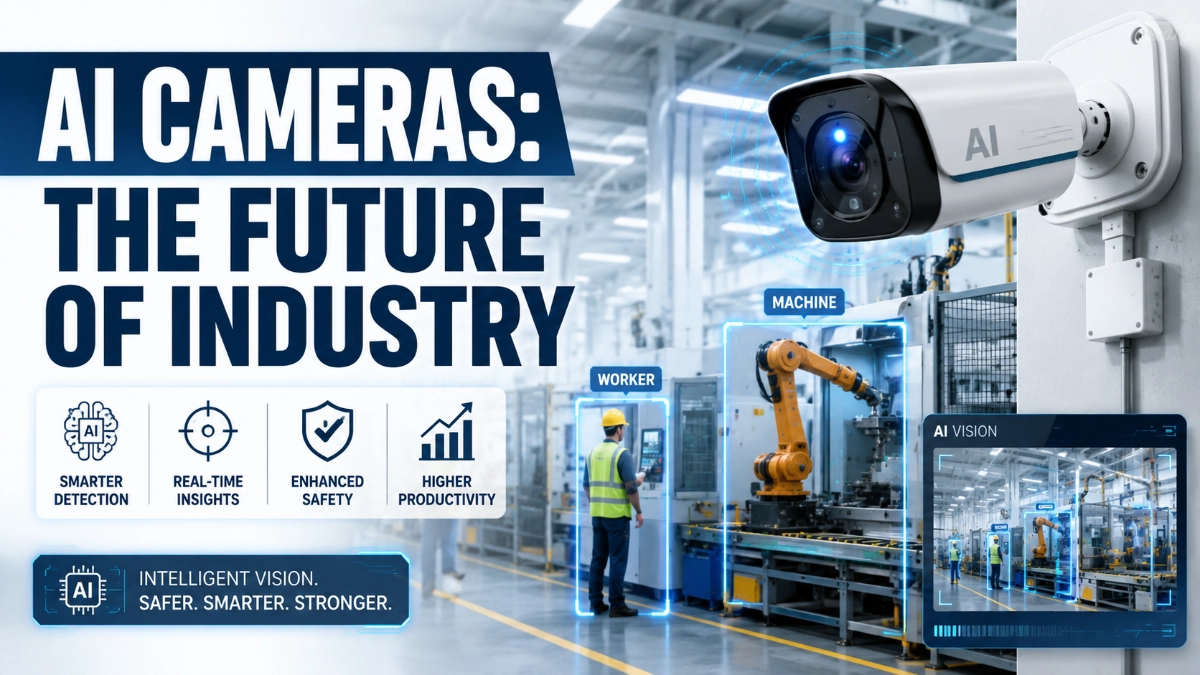
This is not science fiction. It is the quiet reality inside modern plants, warehouses, and utility yards right now.
AI cameras have moved past passive recording. They now watch, interpret, and act. For plant managers and industrial decision-makers, that shift changes everything about how operations are run, monitored, and protected.
This article breaks down what AI cameras are, how they work, where they deliver the most value, and what to consider before deploying them across industrial environments.
What Are AI Cameras?
AI cameras are intelligent imaging devices that combine traditional video capture with computer vision and machine learning. Unlike conventional CCTV, they do not just record footage for later review. They analyse video in real time, recognise patterns, detect anomalies, and trigger automated responses without constant human supervision.
In an industrial setting, this means a camera can distinguish between a worker walking safely and a worker entering a restricted zone. It can distinguish normal machine vibration from an early sign of mechanical failure.
This capability comes from embedding artificial intelligence directly into the camera’s processing pipeline, often supported by edge computing hardware near the device.
Why AI Cameras Are Transforming Industrial Operations
Industrial operations run on uptime, safety, and precision. Traditional surveillance was built for a different purpose: after-the-fact investigation.
AI cameras flip that model. They are built for prevention, not just documentation.
Industry experts suggest that this shift toward proactive monitoring reflects a broader move across manufacturing and logistics toward predictive rather than reactive operations. A camera that only records an incident after it happens offers little value compared to one that predicts the conditions leading to that incident.
Three forces are driving rapid adoption:
- Labour constraints: Skilled supervisory staff are harder to find, so plants rely on automated eyes to fill monitoring gaps.
- Rising safety expectations: Regulatory pressure and worker safety standards continue to tighten across manufacturing and logistics sectors.
- Data-driven operations: Plant managers increasingly want operational intelligence, not just security footage.
Several manufacturing studies indicate that facilities integrating intelligent video analytics into daily operations report improved visibility into safety incidents and equipment behaviour, though results vary by facility type and implementation quality.
How AI Cameras Actually Work
AI cameras work by combining a high-resolution image sensor with an onboard or connected processing unit trained to recognise specific visual patterns. The camera captures video, runs it through machine learning models, and classifies what it sees: a person, a vehicle, a spill, a piece of missing PPE, an unusual heat pattern. When the system detects a defined condition, it triggers an alert, logs an event, or activates another connected system.
The process generally follows four stages:
1. Image capture: The camera records continuous or triggered video using industrial-grade sensors built to handle dust, vibration, and variable lighting.
2. Object detection and classification: Computer vision models identify people, equipment, vehicles, or specific conditions within the frame.
3. Analysis and decision-making: The system compares what it sees against trained patterns and thresholds, often using deep learning models refined over large industrial datasets.
4. Action and alerting: The camera or connected platform sends a notification, logs the event, or triggers an automated response, such as stopping a conveyor line or alerting a safety officer.
Much of this processing now happens at the edge, meaning inside or near the camera itself, rather than in a distant data centre. This reduces latency and keeps critical decisions fast even when network connectivity is limited.
What Is Edge AI?
Edge AI refers to running artificial intelligence models directly on local hardware, close to where data is generated, instead of sending everything to the cloud for processing. In industrial AI cameras, this means detection and analysis happen within milliseconds, right at the camera or a nearby edge device. This reduces bandwidth strain, improves response time, and allows critical safety alerts to function even during network outages.
What Is Intelligent Video Analytics?
Intelligent video analytics is the software layer that interprets camera footage to extract meaningful operational insights, rather than simply storing raw video. It identifies behaviours, counts objects, tracks movement patterns, and flags anomalies automatically. In industrial settings, this turns video from a passive security tool into an active operational intelligence system that supports safety, quality, and efficiency decisions.
Traditional CCTV vs AI Cameras
| Capability | Traditional CCTV | AI Cameras |
|---|---|---|
| Primary function | Records footage for later review | Analyses footage in real time |
| Response speed | After-the-fact investigation | Immediate alerts and automated action |
| Human dependency | Requires constant monitoring | Reduces need for continuous manual review |
| Data value | Raw video only | Structured operational insights |
| Incident detection | Manual review required | Automatic anomaly and pattern detection |
| Integration | Standalone system | Connects with IIoT, access control, safety systems |
| Scalability | Limited without more staff | Scales through software, not headcount |
Are AI Cameras Better Than Traditional CCTV?
AI cameras generally outperform traditional CCTV in speed, accuracy, and operational value because they interpret events as they happen rather than relying entirely on human review afterwards. Traditional CCTV still serves a role in basic recording and legal evidence, but it cannot proactively prevent incidents or generate real-time operational data the way AI-enabled systems can.
Industrial Applications
AI cameras are not confined to one industry. Their use cases span nearly every sector that depends on physical operations, from heavy manufacturing to pharmaceutical cleanrooms.
- Manufacturing: Detecting defects on production lines, monitoring machine health, and verifying PPE compliance on the shop floor.
- Warehouses: Tracking inventory movement, monitoring forklift traffic, and identifying unsafe stacking or blocked emergency exits.
- Logistics: Verifying loading dock activity, monitoring vehicle flow, and confirming cargo handling procedures.
- Oil & Gas: Monitoring remote pipelines and facilities for leaks, intrusions, or equipment anomalies in hazardous zones.
- Smart Buildings: Managing access control, occupancy analytics, and energy-efficient lighting based on real-time presence detection.
- Utilities: Watching substations and infrastructure for intrusion, vegetation encroachment, or equipment faults.
- Automotive: Supporting quality inspection on assembly lines and monitoring robotic work cells for safety compliance.
- Food Processing: Verifying hygiene protocol adherence and monitoring for foreign object contamination risks.
- Pharmaceutical Facilities: Ensuring cleanroom protocol compliance and monitoring restricted access areas.
Across these sectors, cameras are no longer just watching. They are informing decisions.
Key Benefits
- Predictive Monitoring: AI cameras can flag early warning signs, such as unusual equipment vibration or heat, before a full failure occurs.
- Faster Incident Detection: Real-time analysis means safety and operational incidents are flagged in seconds, not discovered hours later during footage review.
- Worker Safety: Cameras can detect unsafe behaviour, restricted zone breaches, or missing personal protective equipment automatically.
- PPE Compliance: Automated PPE detection reduces reliance on manual spot-checks and helps maintain consistent workplace safety standards.
- Operational Intelligence: Beyond security, cameras generate data on workflow efficiency, bottlenecks, and equipment utilisation.
- Reduced Downtime: Early fault detection through predictive monitoring helps prevent unplanned production stoppages.
- Better Decision-Making: Managers gain access to real operational data instead of relying on assumptions or delayed reports.
- Lower Operating Costs: According to industry reports, reducing unplanned downtime and manual monitoring labour contributes meaningfully to long-term operational savings, though actual figures depend on facility size and deployment scope.
Did You Know? Many industrial AI cameras can process video directly on the device itself, meaning critical alerts can still function even if the facility’s internet connection temporarily goes down.
Challenges and Considerations
AI cameras deliver strong value, but deployment brings friction. Industry analysts expect adoption to keep growing, though success depends on addressing a few practical challenges.
- Privacy: Employee monitoring raises legitimate privacy concerns that require clear policies and transparent communication.
- Cybersecurity: Connected cameras expand the attack surface, making strong network security and access controls essential.
- Integration: Legacy industrial systems may not easily connect with newer AI-enabled platforms without careful planning.
- Bandwidth: High-resolution video across multiple cameras can strain network infrastructure without adequate capacity planning.
- Storage: Continuous analytics-driven monitoring generates significant data volumes requiring scalable storage strategies.
- AI Accuracy: Detection models require proper training and calibration to reduce false positives in complex industrial environments.
- Environmental Conditions: Dust, vibration, extreme temperatures, and variable lighting can affect camera and sensor performance if hardware is not rated for industrial use.
Expert Insight Manufacturing experts recommend piloting AI camera deployments in one production zone before scaling facility-wide, allowing teams to fine-tune detection accuracy and integration workflows early.
Future Trends
Industrial camera technology continues evolving quickly. Several trends are shaping what comes next.
- Edge AI Expansion: More processing will move directly onto cameras and local edge devices, reducing dependency on centralised cloud infrastructure.
- Vision AI Maturity: Detection models will continue improving in accuracy, particularly for complex tasks like fine-detail quality inspection.
- Digital Twins: Camera data increasingly feeds digital twin models, creating virtual representations of physical operations for simulation and planning.
- Robotics Integration: AI cameras are becoming the “eyes” for autonomous robots performing inspections, material handling, and quality checks.
- Autonomous Inspections: Camera-equipped drones and mobile robots are beginning to handle routine inspection tasks in hard-to-reach or hazardous areas.
- Predictive Maintenance: Combining visual data with sensor data strengthens predictive maintenance models across industrial equipment.
- Cloud and Edge Collaboration: Hybrid architectures will balance real-time edge processing with cloud-based analytics and storage.
- Industrial 5.0 Alignment: International industrial standards increasingly emphasise human-centric, resilient manufacturing, a direction AI-enabled visual systems directly support.
Best Practices Before Deployment
- Define clear objectives: Identify whether the priority is safety, quality, efficiency, or a combination before selecting hardware.
- Audit existing infrastructure: Assess current network capacity, storage, and system compatibility.
- Start with a pilot zone: Test detection accuracy and integration in a limited area before scaling.
- Prioritise industrial-grade hardware: Choose cameras rated for the facility’s dust, temperature, and vibration conditions.
- Build a cybersecurity plan: Segment camera networks and apply strong access controls from day one.
- Establish clear privacy policies: Communicate monitoring purposes transparently to employees.
- Plan for scalability: Choose systems that can grow with additional zones, cameras, and analytics needs over time.
Practical Tip: Involve floor-level supervisors early in the planning process. They understand daily operational patterns that help fine-tune what the AI system should flag as normal versus abnormal.
Common Mistakes to Avoid
- Deploying facility-wide before validating detection accuracy in a pilot area.
- Ignoring network bandwidth requirements for multiple high-resolution feeds.
- Overlooking cybersecurity segmentation for camera networks.
- Failing to train staff on how to respond to automated alerts.
- Choosing non-industrial-rated hardware for harsh environments.
- Treating AI cameras as a one-time install rather than an evolving system.
Final Thoughts
Industrial operations are becoming more automated, more data-driven, and more safety-conscious every year. AI cameras sit right at the intersection of all three shifts.
They are no longer just a security upgrade. They are becoming a core layer of industrial intelligence, working alongside industrial IoT sensors, edge computing platforms, and automation systems to keep operations running smoothly.
Solutions such as Impact by Honeywell CCTV illustrate how established industrial camera technology is evolving toward AI-enabled capabilities, giving plants a practical entry point into smarter, more proactive monitoring.
The plants that adopt this technology thoughtfully, starting small and scaling with clear objectives, will be the ones best positioned for the next decade of industrial operations. The factory floor is learning to see. The question now is how quickly operations teams will learn to see with it.
Key Takeaways
- AI cameras analyse video in real time, moving beyond passive recording into proactive operational intelligence.
- Edge AI allows detection and alerts to function locally, reducing latency and dependency on constant connectivity.
- Industries from manufacturing to pharmaceuticals use AI cameras for safety, quality, and efficiency monitoring.
- Key benefits include predictive monitoring, faster incident detection, PPE compliance, and reduced downtime.
- Deployment challenges include privacy, cybersecurity, integration, and environmental durability.
- Future trends point toward deeper edge AI, digital twins, robotics integration, and Industrial 5.0 alignment.
- Successful deployment starts with a clear pilot, industrial-grade hardware, and strong network security planning.
Read Also: How Enterprise CCTV Helps Reduce Operational Blind Spots
Read Also: Beyond Surveillance: Business Applications of Enterprise CCTV