Enterprise IT networks are rarely designed only for today’s users. They are built with scalability, redundancy, centralised management, cybersecurity, and future expansion in mind. Surprisingly, these same engineering principles are becoming equally important in modern fire alarm infrastructure. As buildings become smarter and more connected, life safety systems must evolve from standalone panels into resilient enterprise networks.
Introduction
For decades, fire alarm systems were treated as isolated, building-specific installations: a control panel, a few loops of detectors, and a set of notification devices. That model worked when buildings stood alone, and requirements rarely changed. Enterprise campuses, hospitals, airports, and industrial parks have outgrown it.
Today’s facilities expand in phases, integrate with a Building Management System (BMS), and require life safety data to be visible from a single command centre. This is exactly the problem enterprise IT architects solved decades ago. Applying their design philosophy of scalability, redundancy, segmentation, and centralised visibility to an Enterprise Fire Alarm Network produces systems that are safer, easier to maintain, and ready for growth without costly redesign.
Why should fire alarm infrastructure be designed like enterprise IT networks? Because both systems must reliably serve multiple buildings, scale over time, and remain operational during a failure. Applying IT principles redundancy, modular architecture, segmentation, and centralized monitoring to an Intelligent Fire Alarm System improves reliability, simplifies expansion, and strengthens life safety outcomes across large facilities.
What Enterprise IT Networks Teach Fire Protection Engineers
IT architects rarely design for a single moment in time. They design for growth, failure, and change. Several principles translate directly to fire protection engineering.
- Scalability means building capacity for tomorrow’s device count, not just today’s.
- Modularity allows individual components to be added, replaced, or upgraded without disrupting the whole system.
- Redundancy ensures that a single failed link or node doesn’t take down the network.
- Centralised management gives administrators one place to monitor status, faults, and performance.
- Network segmentation isolates problems so they don’t cascade across the entire system.
- Lifecycle planning treats infrastructure as a long-term asset, not a one-time project.
Applied to fire protection, these principles turn a Fire Alarm Control Panel from an isolated device into a coordinated node within a larger, resilient network.
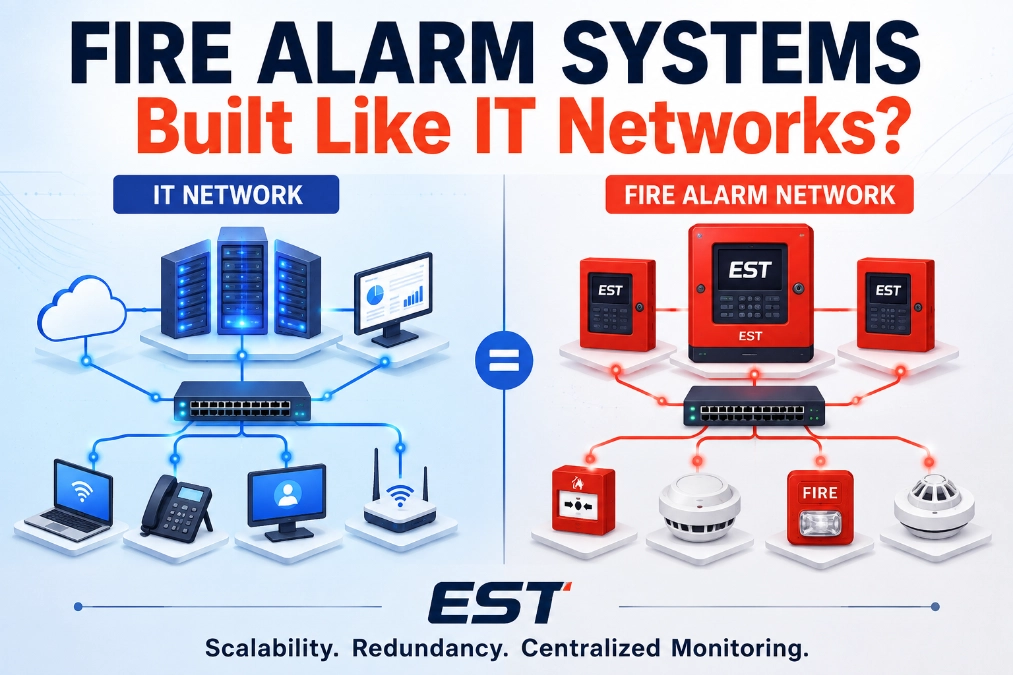
Similarities Between Enterprise IT Networks and Intelligent Fire Alarm Systems
An Addressable Fire Alarm System already behaves structurally like a data network; each device has a unique address, communicates status continuously, and reports back to a central point.
| Enterprise IT | Fire Alarm Infrastructure |
|---|---|
| Servers | Fire Alarm Control Panels |
| Network Switches | Fire Alarm Network Controllers |
| Endpoints | EST Detectors and Devices |
| Network Monitoring | Central Fire Alarm Monitoring |
| Redundant Links | Redundant Communication Loops |
| User Management | Event & Alarm Management |
This overlap matters because it means proven IT design patterns, not experimental ideas, can be applied directly to Distributed Fire Alarm Architecture with predictable, well-understood outcomes.
Key Infrastructure Principles Every Fire Alarm System Should Follow
Design for Future Expansion
Buildings are rarely finished. A campus that starts with one wing often adds three more within a decade. Sizing a panel and network only for current device counts forces a costly rip-and-replace later. Enterprise-grade platforms should reserve address capacity and network bandwidth for growth from day one.
Build Redundancy Into Critical Communication Paths
Just as enterprise networks use redundant links between switches, fire alarm networks benefit from Redundant Communication paths between panels. If one path fails, alarm and status data still reaches the central monitoring point, supporting Fault Tolerance and High Availability.
Standardise Devices Across Buildings
Using consistent smoke detectors, heat detectors, manual call points, monitor modules, and control modules across every building in a portfolio simplifies training, spare parts inventory, and troubleshooting, the same logic IT teams apply when standardising hardware across office locations.
Use Modular Network Architecture
A modular design allows new buildings, floors, or zones to be added as independent network segments rather than forcing changes to the entire system. This mirrors how enterprise networks add new sites without redesigning the core.
Centralise Event Monitoring
Centralised Monitoring consolidates alarms, faults, and supervisory signals from every building into a single interface. This shortens response time and gives facility teams a real-time operational picture, similar to a network operations centre.
Simplify Maintenance Through Intelligent Diagnostics
Intelligent detectors and modules that self-report drift, contamination, or wiring faults reduce unplanned downtime and allow maintenance teams to act before a device fails, the fire protection equivalent of proactive IT infrastructure monitoring.
Common Mistakes When Fire Alarm Systems Are Designed Like Standalone Installations
Many enterprise fire alarm problems trace back to designs that never considered the building as part of a larger system.
- Limited panel capacity that leaves no room for future devices.
- No network planning, resulting in ad-hoc connections between buildings.
- Poor documentation, making troubleshooting and expansion difficult years later.
- Lack of scalability, forcing full panel replacement during renovations.
- Difficult expansion, where adding one building disrupts others.
- Single points of failure in communication paths between panels.
- Inconsistent device selection, complicating maintenance and spare parts management.
Consultants should treat these as design risks to eliminate at the planning stage, not issues to solve after installation.
The Role of EST3 and EST4 in Enterprise Infrastructure
Enterprise-grade platforms illustrate how these principles come together in practice. The EST3 Fire Alarm Panel and EST4 Fire Alarm Panel are examples of intelligent, networkable platforms designed to support distributed architecture across multiple buildings, with capacity for modular expansion as facilities grow.
These panels are built to integrate into a wider Fire Alarm Network, supporting centralised monitoring, event management, and coordination across a campus rather than functioning as isolated boxes. Paired with EST Detectors and Devices, including smoke detectors, heat detectors, manual call points, monitor modules, and control modules, they demonstrate how an EST Fire Alarm System can be structured using the same enterprise design thinking used in IT infrastructure. Facilities evaluating such platforms often work with an established EST Fire Alarm System Distributor in India to align product selection with long-term infrastructure planning.
Real-World Enterprise Scenarios
- Hospital Campus: Multiple buildings, 24/7 occupancy, and critical care areas require redundant communication paths and centralised monitoring so no single fault interrupts life safety coverage.
- Airport: Continuous expansion of terminals and concourses demands a distributed architecture that lets new zones join the network without reconfiguring existing infrastructure.
- Data Centre: High-value equipment and strict uptime requirements make fault tolerance and segmentation essential, mirroring the same resilience standards applied to the IT network itself.
- Industrial Manufacturing Plant: Harsh environments and process-critical operations benefit from standardised, intelligent detectors that simplify maintenance across large floor areas.
- University Campus: Phased construction over many years favours modular network architecture that accommodates new buildings incrementally.
- Commercial Business Park: Multi-tenant buildings with varying occupancy schedules rely on centralised monitoring to coordinate alarm response across the entire property.
Consultant Framework for Enterprise Fire Alarm Design
- Evaluate current infrastructure and existing panel capacity.
- Plan for long-term growth, not just current code requirements.
- Design a distributed architecture across buildings and zones.
- Build redundancy into critical communication paths.
- Standardise devices to simplify maintenance and training.
- Integrate with the Building Management System where applicable.
- Validate network performance before final commissioning.
- Maintain lifecycle documentation as a living infrastructure record.
Future of Enterprise Fire Alarm Infrastructure
Smart buildings are increasingly treating life safety data as part of a broader digital ecosystem. Digital twins allow facility teams to visualise device status spatially. Predictive maintenance uses device diagnostics to flag issues before failure. Remote diagnostics let integrators troubleshoot without an on-site visit. Enterprise dashboards consolidate alarm, fault, and maintenance data across a portfolio. AI-assisted infrastructure management is beginning to support pattern recognition in maintenance and fault trends, while lifecycle analytics help facility owners plan capital replacement cycles with more accuracy than reactive maintenance schedules allow.
Expert Insights
- Infrastructure architecture has a greater long-term impact on system success than any single panel specification; a well-designed network survives multiple panel generations.
- Standardising devices and architecture across a multi-building portfolio reduces operational complexity far more than optimising any one building in isolation.
- Redundancy borrowed from IT networking principles doesn’t just improve uptime; it directly strengthens life safety resilience during real emergencies.
- Distributed architecture is what makes future campus expansion feasible without disruptive, costly redesign of existing buildings.
- Documentation should be treated as infrastructure in its own right, not project paperwork filed away after commissioning.
- Consultants who prioritise lowest initial installation cost over scalability often shift a larger cost burden onto the owner during future expansion.
- Centralised visibility improves both emergency response time and long-term maintenance planning by giving teams one accurate operational picture.
Key Takeaways
- Treat fire alarm systems as enterprise infrastructure, not standalone installations.
- Design network capacity for future growth, not just current device counts.
- Build redundant communication paths into every critical link.
- Standardise devices across buildings to simplify maintenance.
- Use modular, distributed architecture to support phased expansion.
- Centralise monitoring to improve response time and operational visibility.
- Maintain lifecycle documentation as an ongoing infrastructure asset.
- Evaluate platforms like the EST3 and EST4 panels for their networking and scalability capabilities, not features alone.
Read Also: Managing Fire Alarm Obsolescence in Enterprise Buildings
Read Also: Fire Alarm Integration Without Increasing System Complexity