In enterprise fire protection, reliability alone is no longer enough. Hospitals, airports, data centres, manufacturing plants, and commercial campuses require fire alarm systems that remain operational even when individual components fail. This engineering philosophy, known as high availability, focuses on eliminating single points of failure and ensuring continuous life safety protection under real-world conditions.
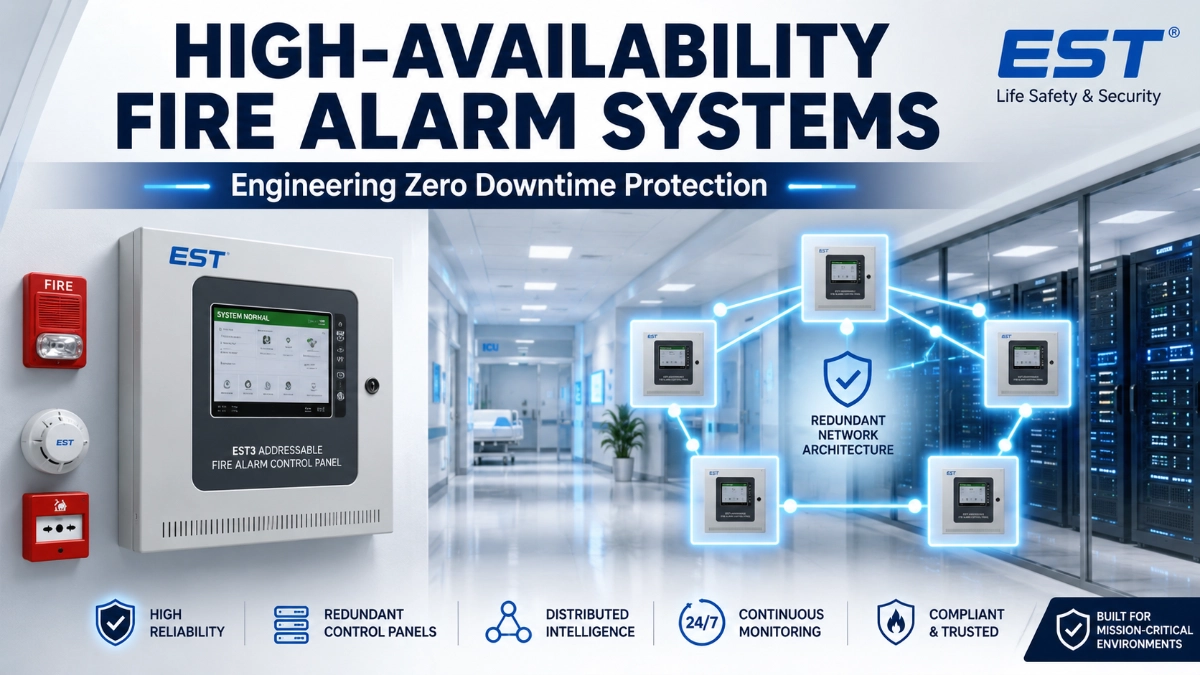
A reliable device performs its function correctly. A highly available system stays operational even when a device, a cable path, or a network node fails. That distinction matters enormously in life safety design, where downtime isn’t an inconvenience; it’s a hazard. As buildings grow larger, more automated, and more interconnected with Building Management Systems (BMS), enterprise organisations are increasingly treating fire alarm infrastructure as critical infrastructure, not isolated safety equipment.
A high-availability fire alarm system is engineered to maintain continuous operation despite hardware faults, wiring damage, or network disruptions. It relies on redundant communication paths, distributed architecture, and intelligent diagnostics rather than a single control point. The goal is uninterrupted detection, notification, and monitoring regardless of localized failure supporting business continuity and occupant safety.
What Is a High-Availability Fire Alarm System?
High availability describes a system’s ability to continue functioning correctly even after a component fails. In fire alarm engineering, this means detection, signalling, and notification must not depend on any single wire run, panel, or communication link.
Reliability measures how likely a device is to work correctly. Availability measures how likely the entire system is to remain operational over time, including during faults, maintenance, or partial failures. An addressable fire alarm system with individually identifiable devices improves diagnostics, but availability comes from how those devices are networked, powered, and supervised, not simply from the intelligence of individual sensors.
A truly available system exhibits:
- Fault tolerance at the device, loop, and network level.
- Automatic isolation of faults without system-wide impact.
- Continuous event logging and status visibility.
- Scalable, distributed control rather than centralised dependency.
Core Engineering Principles Behind High Availability
Redundant Communication Paths
Redundant communication ensures that if one data path fails, an alternate route maintains connectivity between panels, network nodes, and monitoring stations. This is foundational to any enterprise fire alarm network spanning multiple buildings or floors.
Distributed System Architecture
Rather than routing all intelligence through one central point, a distributed fire alarm architecture places processing capability across multiple panels and nodes. A single point of failure no longer disables the entire system; only the affected segment.
Modular Expansion
A modular fire alarm system allows capacity to grow without redesigning the core architecture. Modularity also supports isolated maintenance: technicians can service one module without disrupting protection elsewhere.
Intelligent Device Addressing
Individually addressed smoke detectors, heat detectors, manual call points, monitor modules, and control modules allow the system to pinpoint exact device status and location, reducing troubleshooting time and improving fault visibility.
Automatic Fault Isolation
When a wiring fault or short occurs, the system should isolate the affected segment automatically, preventing it from taking down an entire loop or network branch. This is one of the clearest markers of mature fault tolerance engineering.
Network Monitoring
Continuous supervision of communication links, power supplies, and device status allows faults to be detected before they escalate into system-wide outages.
Intelligent Diagnostics
Intelligent diagnostics and detailed event logging give facility teams early warning of degrading components, shifting maintenance from reactive to predictive.
High Availability vs Standard Fire Alarm Systems
| Factor | Standard Fire Alarm System | High-Availability Fire Alarm System |
|---|---|---|
| Uptime | Vulnerable to single-point failures | Engineered for continuous operation |
| Redundancy | Minimal or none | Redundant communication and power paths |
| Scalability | Limited without redesign | Modular, expandable architecture |
| Maintenance | Reactive, disruptive | Predictive, isolated by module |
| Fault Recovery | Manual troubleshooting | Automatic fault isolation |
| Network Design | Centralized | Distributed |
| Lifecycle Value | Shorter effective service life | Long-term, adaptable infrastructure |
| Business Continuity | Higher operational risk | Supports uninterrupted operations |
Where High-Availability Fire Alarm Systems Deliver the Most Value
- Hospitals cannot evacuate patients on short notice, so detection and notification must remain active through every fault condition.
- Airports operate continuously across vast, multi-building footprints where a single outage could affect passenger safety and operations.
- Data centres depend on uninterrupted monitoring to protect both life safety and mission-critical equipment.
- Pharmaceutical plants and manufacturing facilities often involve hazardous processes where any detection gap carries outsized risk.
- University campuses and commercial business parks span multiple structures that benefit from a single, distributed enterprise fire alarm network rather than isolated, disconnected panels.
Across all these environments, infrastructure resilience and system uptime directly support business continuity, not just code compliance.
The Role of EST3 and EST4 in Enterprise Fire Alarm Infrastructure
Enterprise-grade platforms such as the EST3 Fire Alarm Panel and EST4 Fire Alarm Panel are built around the same engineering principles described above: distributed architecture, redundant communication, modular scalability, and intelligent diagnostics. These platforms support networked configurations where multiple panels share status information, event logging is centralised for visibility, and expansion can occur incrementally as a facility grows.
As part of the broader EST Fire Alarm System ecosystem, EST Detectors and Devices, including addressable smoke and heat detectors, monitor and control modules, and notification appliances, are designed to integrate into this networked structure rather than function as standalone components. Facilities sourcing this equipment, including through an EST Fire Alarm System Distributor in India, should evaluate not just individual device specifications but how the complete architecture supports long-term availability.
Designing for High Availability: A Consultant Checklist
- Eliminate single points of failure in wiring, power, and control architecture.
- Design redundant communication paths between panels and network nodes.
- Standardise intelligent devices for consistent diagnostics and serviceability.
- Build modular infrastructure that supports isolated maintenance.
- Plan future expansion into the initial network topology, not as an afterthought.
- Validate system performance through commissioning and fault-simulation testing.
- Maintain documentation of architecture, addressing, and wiring paths.
- Schedule preventive maintenance informed by diagnostic and event-log data.
Common Design Mistakes That Reduce Availability
- Single communication paths between panels, creating a hidden single point of failure.
- No spare capacity, forcing disruptive redesigns during expansion.
- Poor documentation, which slows fault diagnosis and increases downtime.
- Limited diagnostics, leading to reactive rather than predictive maintenance.
- Weak network planning, especially in multi-building campuses.
- Inadequate testing, particularly of fault-isolation and failover behaviour.
- Ignoring lifecycle planning, resulting in systems that age out of support prematurely.
Consultants should treat these not as installation details but as architectural decisions made at the earliest design stage.
Future Trends in High-Availability Fire Protection
AI-assisted diagnostics are beginning to identify device degradation patterns before failures occur. Predictive maintenance models, informed by historical event logs, are replacing fixed-interval servicing. Digital twins are being used to simulate fault conditions and validate architecture before installation. Remote health monitoring and cloud-assisted analytics applied carefully, with appropriate cybersecurity controls, are giving facility teams enterprise dashboards that consolidate status across multiple buildings. These trends point toward smarter, more self-aware critical infrastructure, though foundational engineering redundancy, distribution, and fault isolation remains the basis on which they operate.
Expert Insights
- Availability must be considered at conceptual design, not retrofitted later: Architecture decisions made in early planning determine whether redundancy is structural or patched on afterwards.
- Redundancy alone does not guarantee high availability: Redundant paths that share the same failure mode, like a single power source, provide false confidence.
- Distributed architecture reduces operational risk across enterprise campuses by containing faults to smaller segments instead of entire networks.
- Lifecycle planning directly influences long-term availability: Systems designed without expansion headroom degrade in effectiveness as facilities grow.
- Intelligent diagnostics reduce downtime more effectively than reactive maintenance, because they surface degrading components before they cause outages.
- Standardised infrastructure simplifies long-term expansion, reducing the integration risk of mixing incompatible device generations.
- Enterprise fire protection should be managed as critical infrastructure, with the same rigour applied to network design, documentation, and testing as any other mission-critical system.
Key Takeaways
- High availability is an architectural outcome, not a purchased feature.
- Distributed, modular design reduces the impact of any single failure.
- Redundant communication paths are essential for multi-building networks.
- Intelligent diagnostics shift maintenance from reactive to predictive.
- Documentation and testing are as important as the hardware itself.
- Lifecycle and expansion planning should begin at the design phase.
- Hospitals, airports, data centres, and industrial sites carry the highest availability requirements.
- Enterprise-grade platforms like the EST3 and EST4 panels illustrate how these principles are applied in networked fire alarm control panel design.
Read Also: Why Fire Alarm Infrastructure Should Be Designed Like Enterprise IT Networks
Read Also: Managing Fire Alarm Obsolescence in Enterprise Buildings