A facilities director managing six commercial buildings across three cities discovers, during an annual maintenance review, that the buildings run five different fire alarm panel architectures, three different smoke detector series, and four separate documentation formats for as-built drawings. When a detector head fails in Building 4, the technician has to check which of three spare-parts kits applies before ordering. When the fire safety consultant issues a new specification for Building 6, the procurement team has to re-evaluate vendors almost from scratch because nothing from the earlier projects carries over.
This is not a hypothetical inconvenience. It is a common outcome of procuring fire alarm systems project by project, without a shared specification framework across a portfolio. Each project makes locally reasonable choices: a panel that fits the budget, a detector series a contractor prefers, a documentation format a consultant is used to and the sum of those choices is a portfolio that is expensive and slow to manage.
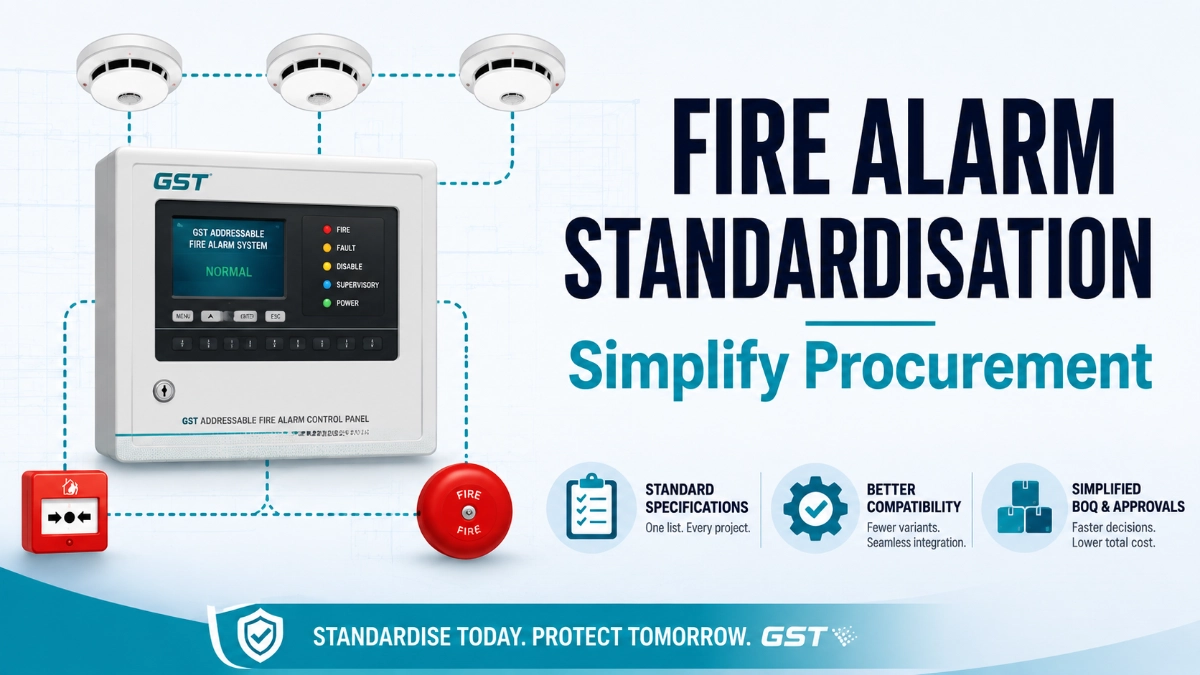
Fire alarm standardisation is a response to this problem. It does not mean forcing every building onto identical equipment. It means agreeing, in advance, on the specifications, product families, documentation formats and procurement workflows that will govern how fire alarm systems are selected and purchased, while still leaving room for each building’s actual fire risk, occupancy and design to shape the final system. This article explains where procurement complexity comes from, what standardisation can and cannot fix, and how procurement teams, consultants and facility owners can build a standardisation approach that holds up across multiple projects.
What Is Fire Alarm System Standardisation?
Fire alarm system standardisation is the practice of defining consistent technical specifications, approved product families, naming conventions, documentation formats and procurement workflows that apply across multiple projects or facilities, so that recurring procurement decisions do not have to be made from scratch each time.
It is useful to separate standardisation from four related but distinct activities:
- Specification is the written description of what a system must do: detection coverage, panel capacity, notification requirements, cause-and-effect logic. Standardisation defines how specifications are structured and reused, not the specific values in any one building’s specification.
- Product selection is the act of choosing which panel, detector or module satisfies a given specification. Standardisation narrows the pool of products a team selects from, typically to an approved product family, without dictating the final choice for a specific room or zone.
- System design is the engineering process of laying out loops, zones, devices and interfaces for a particular building. Standardisation supplies common building blocks for that design; it does not replace the design process itself.
- Code compliance is the set of statutory and regulatory obligations a system must meet, for example under national fire codes, building codes or local authority requirements. Standardisation must operate inside those requirements, not around them. A standardised specification that ignores applicable codes is not a shortcut; it is a liability.
Standardisation, in short, is an organisational and procurement discipline. It works alongside engineering judgment and code compliance; it does not substitute for either.
Why Fire Alarm Procurement Becomes Complex
Procurement complexity in fire alarm systems rarely comes from a single cause. It tends to build up from a series of individually small decisions made without a shared framework.
- Too many product variants: When every project is free to select from an unrestricted catalogue, procurement teams end up managing dozens of near-duplicate detector models, panel variants and accessory types across a portfolio, most of which serve the same functional purpose.
- Different manufacturers across projects: A commercial owner with facilities built at different times, by different contractors, often ends up with panels from several manufacturers. Each manufacturer has its own proprietary protocol, its own detector range, and its own spare-parts catalogue, none of which is interchangeable with the others.
- Inconsistent specifications: Without a reference specification to draw from, each consultant or contractor writes system requirements in their own format and level of detail, which makes it harder for procurement teams to compare submittals against a common baseline.
- Multiple detector types for similar conditions: The same office environment might be fitted with different smoke detector models across buildings simply because each project sourced from whatever was locally available at the time, not because the environments genuinely required different detection technology.
- Different panel architectures: Some buildings run conventional zone-wired panels; others run addressable loop-based panels from different manufacturers with incompatible protocols. Expanding or interconnecting these systems later becomes a design exercise rather than a straightforward addition.
- Compatibility concerns: Detectors, modules, sounders and interface devices are frequently manufacturer-specific. Mixing devices from different ecosystems, even when physically similar, risks protocol conflicts, unsupported combinations or invalidated listings.
- Incomplete or inconsistent BOQs: Bills of quantities that describe devices generically (“smoke detector – 1 no.”) rather than by specification make it difficult for suppliers to quote accurately, which leads to clarification cycles and pricing disputes.
- Unclear technical submittals: When submittal packages vary in structure from project to project, consultants and authorities having jurisdiction spend more time reviewing format than reviewing substance, slowing approvals.
- Difficult spare-parts planning: A facility team supporting five different panel families has to stock, or arrange rapid access to, five different sets of spare batteries, detector heads, modules, and sounders, which increases both inventory cost and the risk of holding the wrong part when it is needed.
- Lack of an approved product list: Without a pre-vetted list of products that are known to meet the organisation’s specifications and code requirements, every procurement cycle restarts the evaluation process, including compliance checks that may already have been done for a previous, functionally identical project.
None of these causes is really about the fire alarm technology itself. They are about the absence of a shared reference point that procurement, design and facilities teams can all work from.
8 Ways Standardisation Reduces Procurement Complexity
1. Simplifies Product Selection
When an organisation defines a set of approved product families that meet its baseline specifications, panel capacity ranges, detector types, and notification devices, procurement teams and consultants select from a known, pre-qualified pool rather than evaluating the entire market on every project. This does not eliminate engineering choice; it removes the repeated work of re-qualifying products that have already been proven to meet the organisation’s requirements.
2. Makes BOQ Preparation More Consistent
Standardised device descriptions and category naming allow a bill of quantities to be built from a reusable template rather than drafted from scratch. A BOQ line item such as “addressable optical smoke detector, [approved family], including base” means the same thing on every project, which reduces ambiguity for suppliers pricing the work and for the team checking delivered quantities against the design.
3. Reduces Vendor Comparison Complexity
Comparing three vendors offering three structurally different panel architectures is a much harder evaluation than comparing three vendors’ pricing and delivery terms for the same approved product family. Standardisation shifts vendor evaluation from a technical architecture comparison to a commercial comparison, which is faster and less prone to error.
4. Improves Device Compatibility
Fire alarm panels, detectors, input/output modules and notification appliances are frequently designed to work as a matched ecosystem, with compatibility governed by the panel manufacturer’s approved device list. Standardising around a defined product family, for example, a consistent range of panels and compatible field devices such as a GST fire alarm system reduces the risk of a technician later discovering that a replacement device is not supported on the installed loop protocol.
5. Simplifies Technical Submittals
A standard submittal template covering panel data sheets, device schedules, loop drawings, battery calculations and cause-and-effect matrices in a consistent order reduces the review burden on consultants and authorities having jurisdiction. Reviewers become familiar with the structure, which tends to shorten review cycles even though the underlying design still has to be checked on its own merits.
6. Makes Spare-Parts Procurement Easier
If an organisation’s buildings draw from two or three approved panel families instead of six or seven, the facility team can hold a smaller, more predictable spares inventory, and can negotiate better terms with a smaller number of suppliers. A regional facilities manager supporting several sites can stock common detector heads, sounder bases and battery packs instead of maintaining separate kits per building.
7. Supports Multi-Site Procurement
Organisations operating multiple facilities retail chains, warehousing groups, hospital networks, educational campuses can negotiate framework pricing, common warranty terms and consistent lead times when procurement is based on a shared specification and approved product family, rather than negotiating a new commercial arrangement for every individual site.
8. Reduces Training Complexity
Facility technicians, fire wardens and system integrators who work across a standardised portfolio only need to learn one, or a small number of, panel programming interfaces and device ranges, instead of relearning a new architecture for every building they support. This shortens onboarding for new staff and reduces the risk of operator error during commissioning or maintenance.
9. Improves Lifecycle Planning
A defined product family with a known roadmap makes it easier to plan for future expansion, phased replacement and eventual end-of-life migration, because the organisation is tracking the lifecycle of a small number of product lines instead of many unrelated ones scattered across its portfolio.
10. Reduces Procurement and Project Risk
Fewer unnecessary product variations mean fewer opportunities for specification errors, fewer compatibility surprises during installation, and fewer delays caused by procurement teams sourcing a device that turns out to be unsupported or discontinued. Standardisation does not remove risk from a fire alarm project, but it removes a category of risk that has nothing to do with the building’s actual fire safety needs.
A Realistic Procurement Comparison
Consider an organisation operating six commercial facilities that have been built or renovated over eight years, each procured independently.
Non-standardised approach: Each building’s fire alarm system was specified by whichever consultant and contractor were engaged for that project. The result is a portfolio with detectors and panels from four different manufacturers, three different documentation formats for as-built records, and no shared list of approved products. When Building 5 needs additional detection coverage after a floor renovation, the facility team must first identify the installed panel’s manufacturer and protocol, confirm which detector models remain compatible and available, and separately vet a supplier, none of which is informed by the previous five projects.
Standardised approach: The same organisation defines a baseline specification covering panel capacity tiers, an approved addressable and conventional product family, a common documentation format for submittals and as-builts, and a pre-qualified list of suppliers. Each new project still undergoes its own fire risk assessment and system design zone counts; detector placement and cause-and-effect logic remain project-specific — but the underlying components, documentation structure and supplier relationships carry over. When Building 5 needs additional coverage, the facility team already knows the panel protocol, has an existing spares relationship, and can extend the system using a pre-vetted detector range.
| Factor | Non-Standardised Portfolio | Standardised Portfolio |
|---|---|---|
| Panel manufacturers across sites | Multiple, unrelated | Small number of approved families |
| Detector compatibility | Varies by building | Consistent within approved families |
| BOQ preparation | Rebuilt from scratch each project | Reusable templates |
| Technical submittal review | Variable format, slower review | Consistent format, faster review |
| Spare-parts inventory | Separate kits per building | Shared spares across sites |
| Vendor evaluation | Full re-evaluation each time | Commercial comparison within approved list |
| Technician training | Repeated per building type | Common across portfolio |
| Expansion planning | Constrained by legacy architecture | Predictable within product roadmap |
The standardised approach does not make every building identical; detector counts, zone layouts and notification strategies still differ according to occupancy and floor area. What changes is the procurement and documentation framework the buildings sit inside.
How GST’s Product Ecosystem Fits Into a Standardisation Framework
Gulf Security Technology (GST) produces a range of conventional and addressable fire alarm panels together with a compatible range of field devices, detectors, modules, call points and notification appliances designed to work within the same protocol family. For an organisation building a standardisation framework, a product ecosystem of this kind is relevant in a specific way: it offers a conventional fire alarm panel range for smaller or lower-complexity buildings and an addressable fire alarm panel range for larger or higher-risk facilities, both drawing on the same manufacturer’s compatible device catalogue, which can simplify keeping devices such as conventional detectors and addressable detectors within a single supported ecosystem across a portfolio.
This matters for procurement specifically because it reduces the number of separate compatibility matrices, spare-parts lists and submittal formats a team has to manage. It does not, on its own, guarantee compliance with any particular jurisdiction’s code, and it is not a substitute for confirming that the selected panel and device range are certified to the applicable standard whether that is IS 2189, IS/ISO 7240 once fully in force, EN 54, NFPA 72 or another framework relevant to the project and are listed as suitable for the specific occupancy and hazard class involved. A standardised product family should be treated as one input to the specification process, evaluated against the project’s actual code and performance requirements, not as a default that removes the need for that evaluation.
In India, GST fire alarm systems are supplied through regional and national distributors; Innxeon Technologies Pvt. Ltd. operates as a PAN-India GST fire alarm system distributor in India, supplying panels, detectors and accessories to consultants, integrators and contractors working on commercial, industrial and institutional projects.
Conclusion
Effective fire alarm standardisation is not about purchasing the same products repeatedly for their own sake. It is about building a repeatable procurement framework with consistent specifications, a defined and compatible product family, reusable documentation formats, and a clear line between what is fixed in advance and what stays project-specific.
Done this way, standardisation makes vendor evaluation faster, BOQs more accurate, submittals easier to review, spare-parts planning more predictable, and multi-site expansion less disruptive without asking engineers to compromise on what a specific building’s fire risk actually requires. The organisations that get the most value from standardisation are the ones that treat it as a procurement and documentation discipline sitting alongside sound fire engineering, not as a replacement for it.
Read Also: What Happens Inside an Addressable Fire Alarm Network During an Alarm?
Read Also: Why Addressable Fire Alarm Systems Are Becoming the Standard Across India