The cost of maintaining a fire alarm system is often assumed to begin after installation. In reality, many maintenance challenges are set years earlier when engineers decide how the system is structured, networked, documented, and expanded. Two buildings with nearly identical detectors and panels can have very different maintenance experiences simply because of architecture.
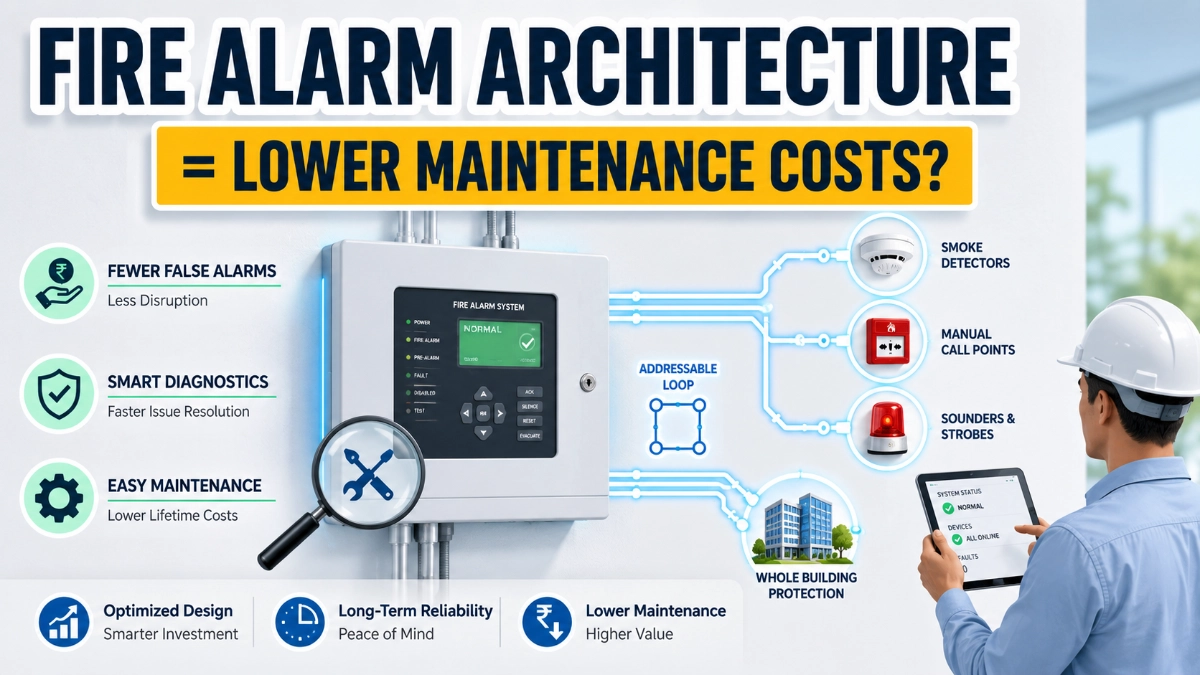
Maintenance cost is not just spare-parts pricing. It is shaped by how quickly a technician can find a fault, how easily a device is identified, and how prepared the system is for future change. The cheapest system to install is not always the cheapest to operate over ten or twenty years, and architecture deserves the same scrutiny as detection performance.
How Does Fire Alarm System Architecture Affect Maintenance Costs?
Architecture affects maintenance costs by shaping how quickly technicians can isolate faults, access devices, and diagnose network issues. Centralised versus distributed layouts, loop segmentation, network topology, and documentation quality all influence troubleshooting time, downtime, training needs, spare-parts planning, and future expansion effort.
What Does Fire Alarm System Architecture Actually Mean?
Architecture is broader than the choice of a control panel. It is how the entire system is structured: panel arrangement, loop and circuit layout, device distribution, network topology, power architecture, and how the system interfaces with BMS, access control, HVAC, and elevators. On multi-building campuses, it also defines how buildings connect and how the system is segmented for supervision.
An EST Fire Alarm System illustrates this well: an intelligent, networkable platform can be configured in many architectural forms depending on building size and operational needs, and that configuration, not just the panel model, ultimately shapes long-term supportability.
Why Maintenance Cost Starts With Design
Maintenance involves far more than replacing a detector or battery; it includes travel and access time, fault investigation, testing, documentation updates, and downtime. A useful conceptual framework: Lifecycle cost = equipment cost + maintenance effort + downtime + technical support + future modification effort.
This is not a formal formula, but a reminder that equipment price is only one input; a system low to buy but slow to troubleshoot can demand far more technician effort over a decade than one with a higher initial cost but a more maintainable architecture.
8 Architectural Decisions That Can Influence Future Maintenance
1. Centralised vs Distributed: Centralised control simplifies access but creates dependency on a single panel. Distributed architecture localises issues but adds more nodes to coordinate.
2. Loop and Circuit Design: Well-segmented loops let a technician narrow a problem quickly; broadly grouped loops may require checking more devices.
3. Network Architecture: Networked systems add communication paths between panels and nodes, and diagnosing a network fault requires understanding topology, not just device logic.
4. Device Distribution: Physical location and logical grouping affect how easily a technician can reach and confirm a device against its reported address.
5. Power Architecture: Power supplies, backup batteries, and supervision points must be distributed and monitored, affecting how fast a power fault is traced.
6. System Interfaces: Integration with BMS, HVAC, and access control adds value, but each interface must also be tested and verified.
7. Expansion Planning: Systems without reserved capacity often need more invasive modification as the building grows.
8. Documentation and Configuration: Accurate schedules, drawings, and cause-and-effect records determine how fast an unfamiliar technician can act on the system.
Why Fault Isolation Matters More Than Engineers Think
A well-architected system lets a technician quickly determine which device, area, or network segment is affected. When architecture doesn’t support this consistent addressing, loops spanning unrelated areas, a single fault can require checking a much wider portion of the system.
This is one reason an EST Fire Alarm System should be evaluated not only for detection capability but also for how its architecture supports fault isolation, diagnostics, and long-term maintenance. Diagnostic clarity reduces the time spent narrowing a problem before physical work begins.
How EST Detectors and Devices Can Influence Maintenance Planning
Field-device architecture directly affects maintenance planning: how devices are identified, where they are located, and how well documentation reflects their configuration.
The architecture of EST Detectors and Devices should be considered alongside accessibility, identification, compatibility, and replacement procedures. A detector in a hard-to-reach location, or poorly documented, can turn a routine inspection into a time-consuming task regardless of its own reliability.
Network Architecture Can Create Hidden Maintenance Costs
Networked systems allow coordinated monitoring and centralised supervision across a building or campus, but add network nodes, communication paths, and interface configuration that must be diagnosed and documented. Networking is not inherently expensive or problematic; it can significantly improve system-wide visibility, but without disciplined engineering and documentation, network faults can take longer to isolate because the communication layer is less visible than a physical device.
Why Future Expansion Should Be Part of the Initial Architecture
When a building expands, the original architecture determines how smoothly growth is absorbed. A system with reserved loop, panel, and network capacity can accommodate new devices with contained effort; one designed at exact capacity often needs disruptive modification such as extra panels or wholesale reprogramming. Planning for growth during initial design is one of the more overlooked decisions with long-term consequences.
The Documentation Factor: One of the Most Overlooked Maintenance Costs
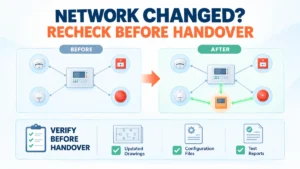
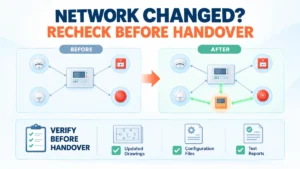
Documentation quality directly affects technician time, though it is rarely priced into project budgets. Outdated drawings, incorrect labels, and unrecorded field modifications force technicians to reconstruct information that should already exist. Accurate device schedules, current network diagrams, and maintained configuration records reduce investigation time and preserve institutional knowledge when personnel change.
Simple Architecture vs Complex Architecture: Which Is Easier to Maintain?
This has no universal answer. Simple architecture is not always better, and complex is not always worse; a large hospital, data centre, or campus may genuinely need sophistication for scalability, redundancy, and integration. The goal is appropriate complexity with controlled maintainability: architecture matched to actual needs, backed by proportional documentation and training.
| Design Consideration | Potential Maintenance Impact |
|---|---|
| Centralized system | Central access but broader dependency |
| Distributed system | Localised architecture but more nodes to manage |
| Networked system | Better coordination but more communication infrastructure |
| Larger loops | Fewer circuits but broader fault impact |
| Segmented architecture | Better isolation but more infrastructure |
| Extensive integration | More functionality but more interfaces to maintain |
| Expansion capacity | Easier future modifications |
Actual outcomes depend on the specific design and how well the architecture is documented and supported.
How Architecture Can Influence Technician Time
Maintenance cost is often driven more by labour than parts: finding the fault, accessing equipment, identifying the device, testing, isolating the area, restoring the system, and updating documentation all take technician time. An architecture that reduces any of these steps can produce meaningful lifecycle benefits, even at a higher initial equipment cost, a qualitative relationship worth planning for, not a guaranteed saving.
How Architecture Influences Fire Alarm Modernisation
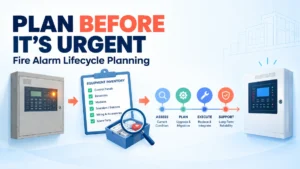
Modernisation is rarely just a panel swap. Existing wiring, device compatibility, network structure, prior configuration, and documentation quality all influence how smoothly an old system can be upgraded. A system originally designed with clear segmentation and reserved capacity is generally easier to modernise incrementally; one without these considerations often needs broader rework extending well beyond the panel.
EST3 and EST4: Why Architecture and Lifecycle Planning Matter
EST3 and EST4 are examples of intelligent, networkable fire alarm platforms built around distributed application concepts and system-wide information sharing. Rather than comparing specs, it’s more useful to recognise what they demonstrate conceptually: scalability, network architecture, and system information management are treated as core design considerations, not afterthoughts, reinforcing that fire alarm selection should weigh architecture and lifecycle requirements, not just individual features. Engineers should evaluate how any selected platform will be documented, diagnosed, and supported over the building’s life, and verify current capabilities against manufacturer documentation and the project specification.
10 Questions Engineers Should Ask Before Finalising Fire Alarm Architecture
- How will technicians isolate faults to a specific device or area?
- Can devices be identified quickly and unambiguously?
- How will network-level faults be diagnosed?
- Is future expansion capacity built into the design?
- Are system interfaces clearly defined and documented?
- Is the documentation approach practical to maintain?
- Can technicians access equipment safely and efficiently?
- What training will maintenance teams need?
- How will modifications be recorded and version-controlled?
- Can the architecture stay maintainable across the building’s lifecycle?
Why Lifecycle Support Should Influence Procurement
Procurement decisions should weigh more than installation cost; long-term technical support, documentation practices, spare-parts availability, and product longevity all affect how sustainable a system is to operate.
For projects with long operational lifecycles, an EST Fire Alarm System Distributor in India can be involved during planning to help coordinate product selection, documentation, availability, and future support alongside the equipment specification, aligning architecture decisions with realistic long-term maintenance expectations.
Expert Insights
- Maintenance cost begins with design decisions, not the first service call.
- Technician time is a real lifecycle cost, even if it never appears on an equipment invoice.
- Fault isolation should actively influence architecture, not just detection coverage.
- Documentation is part of maintainability, not an administrative afterthought.
- Expansion planning during initial design prevents costly compromises later.
- Sophisticated architecture delivers real benefits but needs proportionally stronger maintenance planning.
- A system should be judged across its lifecycle, not installation-day performance alone.
Key Takeaways
- Weigh fault isolation during architecture selection, not after commissioning.
- Match loop segmentation to how the building will realistically be maintained.
- Treat network architecture as a maintenance discipline, not just a feature.
- Reserve spare capacity for future devices, panels, and nodes.
- Maintain accurate documentation as an ongoing responsibility.
- Evaluate interfaces for long-term testing effort, not only function.
- Involve support and procurement planning early on long-lifecycle projects.
- Judge architecture by lifecycle maintainability, not installation cost alone.
Read Also: Why Fire Alarm Fault History Is More Valuable Than Most Teams Realise
Read Also: Why Fire Alarm System Specifications Are Becoming More Important Than Product Features