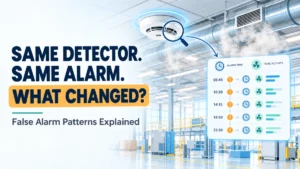
Most maintenance teams see a fire alarm fault, correct it, reset the panel, and move on. But what if the real value isn’t that it occurred once, but the pattern hidden across months of system history? Repeated faults can sometimes reveal issues individual inspections fail to show.
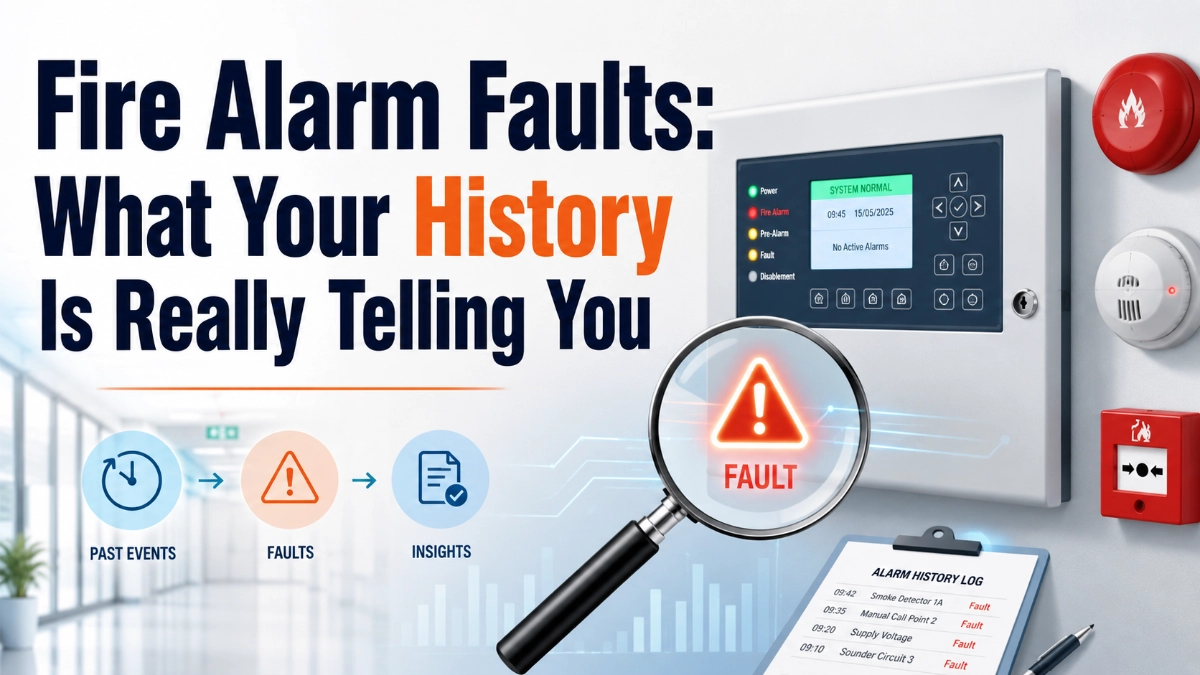
Fire alarm fault history is often treated as little more than a log of trouble conditions that get cleared and forgotten. But intelligent fire alarm systems typically capture far more than a single event when, where, and how often something occurred. Viewed over time, that information can point toward recurring device problems, environmental influences, or configuration issues a single service visit would never surface. Clearing a fault restores the system to normal; it doesn’t necessarily explain why it happened, or whether it will happen again.
Why Is Fire Alarm Fault History Important?
Fire alarm fault history helps engineers identify recurring device problems, communication issues, environmental influences, configuration errors, and maintenance patterns not obvious from a single inspection. It is an investigative tool that highlights where to look more closely, not standalone proof of a root cause. Interpreting it correctly means combining historical data with physical inspection and testing.
What Is Fire Alarm Fault History?
Fire alarm fault history is the recorded log of events generated by a control panel and its connected devices over time. Depending on capability and configuration, this can include fault, alarm, and supervisory events, trouble conditions, communication and power-related problems, network events, and system resets and restorations.
Exact event types, detail level, and retention duration vary by manufacturer, model, firmware, and architecture. Engineers should confirm what a specific system logs, and for how long, before relying on it for analysis.
Why One Fault Tells You Less Than a Pattern
A single fault is an event. A repeated fault is closer to a signal.
- One detector faulting once may just need investigation and a reset.
- The same detector faulting repeatedly is a stronger reason to look deeper.
- Multiple devices in one area showing similar issues may point to a shared environmental or wiring condition.
- Repeated communication faults across devices may suggest a network or interface concern.
- Faults clustering around similar times may correlate with operational activity.
None of these automatically prove a root cause. They create investigation leads and reasons to look in a specific place instead of starting from zero.
7 Things Fire Alarm Fault History Can Help Engineers Investigate
1. Recurring Device Problems: Repeated faults on one device justify closer inspection, testing, or configuration checks before any replacement decision.
2. Wiring or Communication Issues: Recurring communication events may warrant checking wiring, terminations, and network infrastructure.
3. Environmental Conditions: Dust, humidity, temperature, construction, or industrial processes can influence detector behaviour; a fault doesn’t automatically identify the cause, but can prompt a site review.
4. Power-Related Events: Recurring power trouble deserves investigation into supply quality, battery condition, and wiring integrity.
5. Configuration Problems: Incorrect mapping, programming errors, or unintended changes after modifications can generate faults that look device-related but aren’t.
6. Maintenance Patterns: Faults that consistently follow maintenance visits may mean the procedure itself needs review.
7. System Ageing: A gradual rise in fault frequency across a panel or network can contribute to a lifecycle discussion.
Fault History vs. Fault Reset: Why the Difference Matters
Resetting a fault restores the system to normal. Analysing a fault means understanding why the event occurred. Treating these as equivalent is one of the most common gaps in fire alarm maintenance practice.
When a fault occurs, documentation should capture: what happened, where, when, what action was taken, whether it returned, and whether the root cause was confirmed. This doesn’t mean every recurring fault requires replacement; it means the response should be based on evidence, not habit.
How Intelligent Fire Alarm Systems Make Historical Data More Useful
Intelligent, addressable systems can generally provide more device-level detail than conventional ones: identification, event history, diagnostic status, network information, and fault location data.
An EST Fire Alarm System can be evaluated not only for its alarm and detection capabilities but also for the quality of system information available during troubleshooting and lifecycle management. More granular data doesn’t by itself solve a problem; it gives engineers a clearer starting point, provided it’s reviewed and interpreted correctly.
Why EST Detectors and Devices Matter to Fault Analysis
Device-level identification matters once a team starts grouping and comparing historical events. Knowing a device’s exact location, type, and address lets engineers correlate fault frequency and timing with a specific point in the building rather than a vague area. When recurring events are tied to individual EST Detectors and Devices, engineers can use that information as one input alongside physical inspection, not instead of it.
A Practical Fire Alarm Fault Analysis Framework
Record → Group → Compare → Investigate → Test → Correct → Monitor
Record the event accurately, including time, device, and location. Group recurring events by device, area, fault type, and frequency. Compare the grouped data for patterns. Investigate physical, electrical, environmental, and configuration conditions. Test the suspected cause rather than assuming it. Correct based on the confirmed condition. Monitor whether the event returns.
Fault history supports this framework; it does not replace the inspection and testing steps within it.
The Fault History Table Engineers Should Maintain
| Information | Why It Matters |
|---|---|
| Date/time | Identifies patterns and recurrence intervals |
| Device/location | Identifies recurring areas or points |
| Fault type | Supports classification of the issue |
| Frequency | Reveals whether the issue is isolated or repeating |
| Corrective action | Documents what was actually done |
| Test result | Confirms whether the action was effective |
| Recurrence | Indicates whether the issue remains unresolved |
| Technician notes | Preserves context that raw event logs do not capture |
Maintained consistently, this table turns scattered service tickets into usable maintenance intelligence over the life of the system.
Real-World Examples of Hidden Information in Fault History
1. One detector keeps reporting faults: Isolated recurrence, even after resets, justifies deeper inspection and testing.
2. Multiple devices in one area show similar events: May prompt examination of shared environmental conditions or wiring infrastructure.
3. Communication faults increase after building modifications: A rise in network events after renovation or IT changes justifies reviewing them.
4. Faults reappear after routine maintenance: If a fault consistently returns after service, the procedure itself may need review.
5. Fault frequency increases over time: A gradual upward trend may justify a lifecycle review rather than continued point repairs.
None of these proves a root cause on their own; they show why the pattern is worth investigating.
How Fault History Can Improve Preventive Maintenance
Historical fault data helps teams prioritise high-frequency problem areas, recurring devices, and ageing equipment the practical difference between calendar-based maintenance, which services everything on a fixed schedule, and condition-informed maintenance, which uses evidence to focus attention where needed, without abandoning routine, code-driven inspection.
Why Fault History Should Influence Fire Alarm Upgrade Decisions
Long-term fault patterns can reasonably contribute to decisions about panel modernisation, device replacement, network upgrades, and documentation improvements. Rising fault frequency across an ageing system is often one of several indicators a lifecycle review is due. Upgrade decisions, however, should rest on a comprehensive engineering assessment, inspection, testing, compliance review, and manufacturer guidance, not fault history alone.
Lifecycle support matters as much as initial selection. Documentation, product availability, spare parts, and technical coordination all affect how usable fault history remains years after commissioning. For long-term projects, involving an EST Fire Alarm System Distributor in India during procurement and lifecycle planning can help maintain continuity as the system ages.
What Fault History Cannot Tell You?
Fault history alone generally cannot establish the exact root cause, confirm a device is defective, prove wiring is responsible, or determine whether replacement is necessary. Reaching those conclusions typically requires physical inspection, functional testing, electrical measurements, manufacturer guidance, and configuration review. Fault history narrows where to look; it does not replace the work of confirming why.
8 Questions Engineers Should Ask When Reviewing Fault History
- Is the same device appearing repeatedly?
- Are faults concentrated in one area?
- Are multiple devices showing similar events?
- Do events occur at particular times?
- Did the pattern begin after a building modification?
- Was the same corrective action repeated without success?
- Did the fault return after maintenance?
- Is the frequency increasing over time?
Each “yes” is a reason to dig deeper, not a confirmed diagnosis.
EST3 and EST4: Why Historical System Information Matters
Modern networked platforms such as EST3 and EST4 reflect a broader shift in how fire alarm systems present information: event history, diagnostics, device-level status, and configuration detail. This doesn’t mean one platform is universally superior; capabilities should be verified against current manufacturer documentation. The principle holds across platforms: more available information supports better decisions only when engineers apply sound judgment to interpret it.
Expert Insights
- The most useful fault is sometimes not the first occurrence, but the repetition.
- A recurring event deserves pattern analysis before another reset-and-replace cycle.
- Fault history is most reliable combined with inspection, not as a substitute for it.
- Well-documented history preserves technical knowledge after personnel change.
- Records become genuinely useful only when they include action and recurrence.
- Rising fault frequency can serve as an early lifecycle warning signal.
- Intelligent systems generate more data, but judgment turns it into a decision.
Key Takeaways
- Treat a cleared fault as an event, not a closed case, until the cause is understood.
- Look for patterns across time, device, and location, not isolated faults.
- Document corrective actions and recurrence, not just the fault.
- Use device-level data to narrow investigation, not skip inspection and testing.
- Review environmental and infrastructure conditions when devices exhibit similar behaviour.
- Reassess maintenance procedures when faults consistently return after service.
- Use rising fault frequency as one input into lifecycle planning, not the sole basis.
- Maintain a consistent log format so that history remains useful through personnel changes.
Read Also: Why Fire Alarm System Specifications Are Becoming More Important Than Product Features
Read Also: Why Fire Alarm Integration Projects Fail Even When the Hardware Works