A fire alarm panel may offer more zones, more devices, more connectivity, and more advanced features, but does that automatically make it the right system for a project? Not necessarily. In modern fire alarm engineering, the better question is whether the system satisfies the project’s technical specification, integration requirements, environmental conditions, compliance obligations, and lifecycle needs.
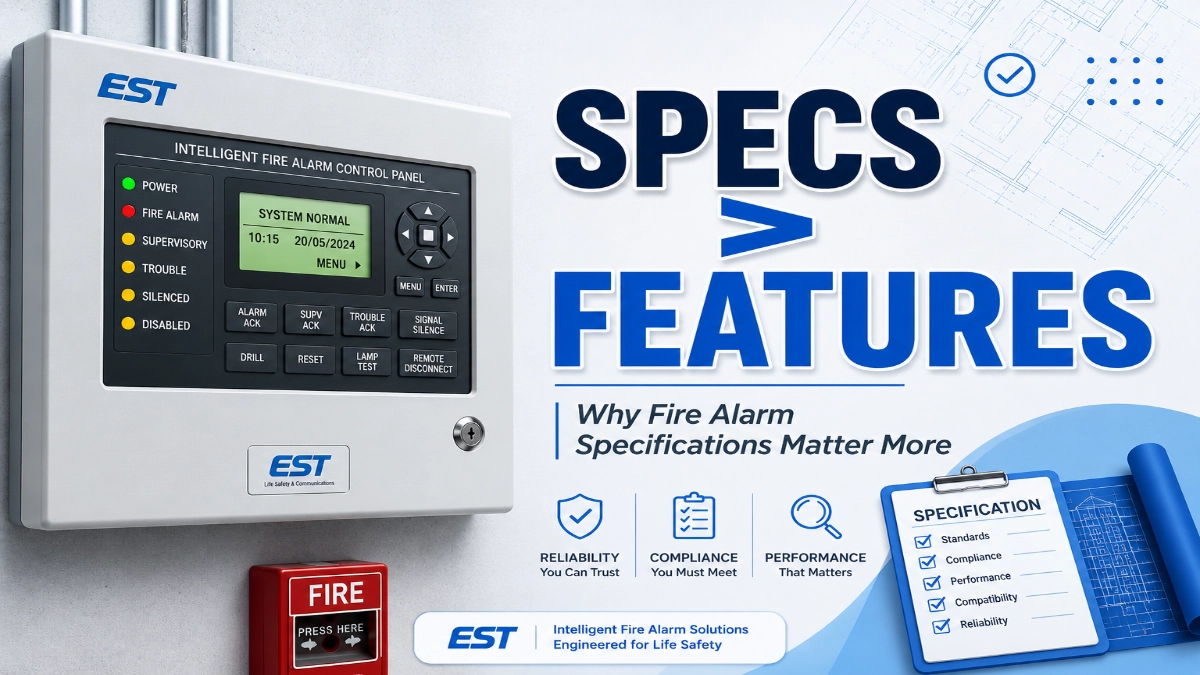
Product marketing naturally emphasises features: device capacity, diagnostics, communication options, sensing technology. These details matter, but they describe what a component can do in isolation, not what a project needs the complete system to do. As buildings become more interconnected with BMS platforms, elevators, HVAC controls, and emergency management systems all expected to work together, fire alarm system specifications are becoming the real deciding factor in system selection, ahead of any single product’s feature list.
This article explains why experienced consultants increasingly evaluate the specification first and the feature sheet second.
Why Specifications Matter More Than Features
Specifications define the complete set of requirements a project needs: architecture, capacity, power, communication, integration, cause-and-effect logic, testing, and lifecycle support. A product feature only has value when it directly satisfies one of these defined requirements; otherwise it adds cost and complexity without improving suitability.
Product Features and System Specifications Are Not the Same Thing
A product feature is a capability built into a device or panel. A system specification is a project requirement that the complete installed system must satisfy. These are related but fundamentally different, and confusing the two is one of the most common causes of procurement and design misalignment.
| Product Feature | System Specification |
|---|---|
| Device capacity | Required device capacity for the project |
| Network capability | Required network architecture |
| Detector technology | Required detection strategy |
| Communication | Required interface and communication method |
| Battery capacity | Required standby/alarm performance |
| Panel capability | Required system architecture |
| Diagnostics | Required monitoring and maintenance capability |
| Expansion capability | Required future expansion |
The right-hand column matters more because it reflects the building, the occupancy, and the teams who will operate and maintain the system for years. A feature that doesn’t map to a genuine project requirement is, at best, unused capability and at worst, added complexity during commissioning and maintenance.
Why Feature Lists Can Be Misleading
A feature can look impressive on a datasheet and still be irrelevant to a specific project:
- A panel supports a very large number of devices, but the project’s approved architecture calls for a distributed, networked configuration instead.
- A system offers advanced communication protocols, but the required third-party BMS integration was never validated against that interface.
- A detector uses sophisticated sensing technology, but the environment a dusty warehouse or a humid process area calls for a different detection strategy.
- A panel has generous device capacity, but the project’s cause-and-effect logic and network segmentation are the real limiting factors.
- A system offers extensive diagnostics, but the maintenance team lacks the workflow or software access to use that data.
In each case, the mismatch between the feature and the actual requirement is the problem, which is why engineers should always ask: “Is this feature relevant to the project?”
What Should a Modern Fire Alarm System Specification Include?
A well-developed specification should address the following as a coordinated framework, not a checklist of isolated items.
- System Architecture: Conventional, addressable, or intelligent fire alarm system; single-panel or networked, distributed configuration; overall topology relative to the building layout.
- Detection: Detector types suited to the environment, device requirements for specific hazards, and coverage tied to ceiling height, airflow, and occupancy.
- Capacity: Device counts, loop and circuit requirements, and spare capacity for future expansion.
- Power: Primary and secondary power, battery backup sized for standby and alarm duration, and supervision of power sources.
- Communication: Network architecture, monitoring requirements, and interfaces to other building systems.
- Cause-and-Effect: Alarm sequences, control logic, and system responses linking detection to notification and other coordinated actions.
- Integration: Requirements for BMS, HVAC, elevators, access control, and other emergency systems.
- Testing & Commissioning: Testing methodology, documentation standards, and acceptance criteria.
- Maintenance: Diagnostic access, spare parts availability, serviceability, and lifecycle support.
Why System Architecture Matters More Than Individual Features
Architecture describes how panels, devices, loops, networks, and power sources relate to one another as a whole. A technically advanced individual component can still be unsuitable if it doesn’t fit within the architecture the project actually requires.
What matters: how panels communicate with field devices, how loops and circuits are segmented, how the network is structured across buildings, and how monitoring and expansion are handled as the facility grows. An EST Fire Alarm System, for example, should be assessed according to how its architecture fits a project’s panel-to-device relationships, network structure, and expansion needs, not by comparing isolated datasheet entries against a competing product.
This is why experienced consultants often spend more time reviewing system diagrams than comparing feature checklists.
The Specification Must Match the Building, Not Just the Product
Fire alarm requirements vary significantly by building type, and the “best” system depends entirely on the application.
- Hospitals involve complex occupancy classifications, critical operational areas, and extensive integration with life-safety and building systems.
- Data centres demand mission-critical reliability, tightly controlled environmental conditions, detailed documentation, and complex integration with suppression systems.
- Manufacturing facilities present industrial conditions, large open spaces, and processes that change over time, all affecting detection strategy.
- Warehouses require coverage across large areas and high ceilings, with storage configurations that may change over time.
- Commercial buildings must accommodate multiple tenants, base-building service coordination, and future tenant modifications.
No single product line is inherently “best” across all of these. The specification shaped by occupancy, environment, and operational needs determines what a suitable system looks like for each one.
Why Compatibility Matters More Than a Feature Checklist
System selection should weigh compatibility across the full chain: panels, detectors, modules, notification devices, power supplies, network components, configuration software, and third-party interfaces. A feature only delivers value when it operates correctly within the intended architecture.
Compatibility between the control panel and EST Detectors and Devices should be considered as part of the complete system specification rather than as an isolated product decision. Field-level functionality, addressing schemes, and configuration requirements all need to align with the panel architecture and detection strategy, something a feature list alone cannot confirm.
Specifications Reduce Integration and Commissioning Problems
Detailed specifications reduce ambiguity around interfaces, cause-and-effect logic, device quantities, panel capacity, network requirements, and documentation responsibilities among contractors.
When specifications are vague, projects commonly encounter substitution disputes, unresolved interface problems, rework during commissioning, documentation gaps, and unplanned costs discovered late. A clear specification gives consultants, contractors, and integrators a shared reference point, often the difference between a smooth commissioning process and a delayed one.
Why “More Features” Does Not Always Mean “Better System”
It’s tempting to assume the system with the longest feature list is automatically best. Experienced engineers use a different chain of logic instead: Feature → Requirement → Application → Integration → Lifecycle.
A feature only earns its place in that chain if it connects to a genuine requirement, fits the application, integrates correctly, and remains supportable over the system’s lifecycle. If a panel supports a particular communication capability but the project’s monitoring architecture doesn’t require or support it, the feature may add little practical value and even unnecessary configuration complexity.
The 10 Questions Engineers Should Ask Before Selecting a Fire Alarm System
- Does the system meet the project specification?
- Does it support the required architecture?
- Are the detectors and devices compatible with the panel?
- Does it provide the required capacity, including spares?
- Does it support required interfaces with other systems?
- Can it accommodate future expansion without major redesign?
- Can it be tested and commissioned within project timelines?
- Is fault diagnosis practical for the maintenance team?
- Is required documentation manageable and complete?
- Can the system be supported throughout its lifecycle?
EST3 and EST4: Why Architecture Matters
EST3 and EST4 are examples of intelligent, networked fire alarm platforms built around distributed application processing, device-level information, and system-wide monitoring. Rather than comparing them feature-by-feature, the more useful exercise is asking how each platform’s architecture, network structure, scalability, and integration approach aligns with a specific project’s requirements.
This is not a claim that one platform is universally superior. Any specific technical detail, capacity figure, or performance claim about either system should be verified against current manufacturer documentation and the approved project specification. The broader point holds regardless of platform: architecture and project fit determine suitability far more reliably than a side-by-side feature comparison.
Specifications Should Influence Procurement Decisions
Procurement decisions based primarily on initial price, feature count, or brand popularity often overlook what determines long-term project success: compliance with the approved specification, technical compatibility, integration readiness, testing and commissioning requirements, documentation, and lifecycle considerations.
For larger projects, an experienced EST Fire Alarm System Distributor in India can be involved early in procurement so that product selection stays aligned with the project specification, system architecture, and lifecycle support rather than being driven by a feature comparison alone.
The Future of Fire Alarm Procurement Is Specification-Driven
As buildings adopt more intelligent, networked fire alarm architectures, digital documentation, and broader building integration, specifications are becoming the common technical language connecting consultants, manufacturers, distributors, contractors, and facility teams. This trend is likely to continue as smart building strategies mature, though the pace will vary by project type, region, and applicable codes.
Expert Insights
- A feature has real value only when it solves an actual project requirement, not simply because it exists on a datasheet.
- The best system for a project is not necessarily the one with the longest feature list.
- A well-written specification reduces ambiguity between design intent and procurement execution.
- Compatibility across the full system chain matters more than the isolated capability of any single component.
- Commissioning requirements should shape system selection from the earliest design stage, not the final testing phase.
- Lifecycle support belongs in the specification itself, not as an afterthought once installation is complete.
- Product selection should follow the project’s defined requirements, never the other way around.
Key Takeaways
- Evaluate the project specification before comparing feature lists.
- Treat architecture, capacity, and integration as primary selection criteria.
- Confirm detector and device compatibility during system design, not after procurement.
- Match detection strategy to the specific building environment.
- Include testing and commissioning requirements in the specification from the start.
- Build lifecycle and maintenance support into procurement decisions.
- Use the ten-question framework before finalising any selection.
- Verify technical or performance claims against current manufacturer documentation.
Read Also: Why Fire Alarm Integration Projects Fail Even When the Hardware Works
Read Also: How Fire Alarm Engineers Should Think About System Resilience