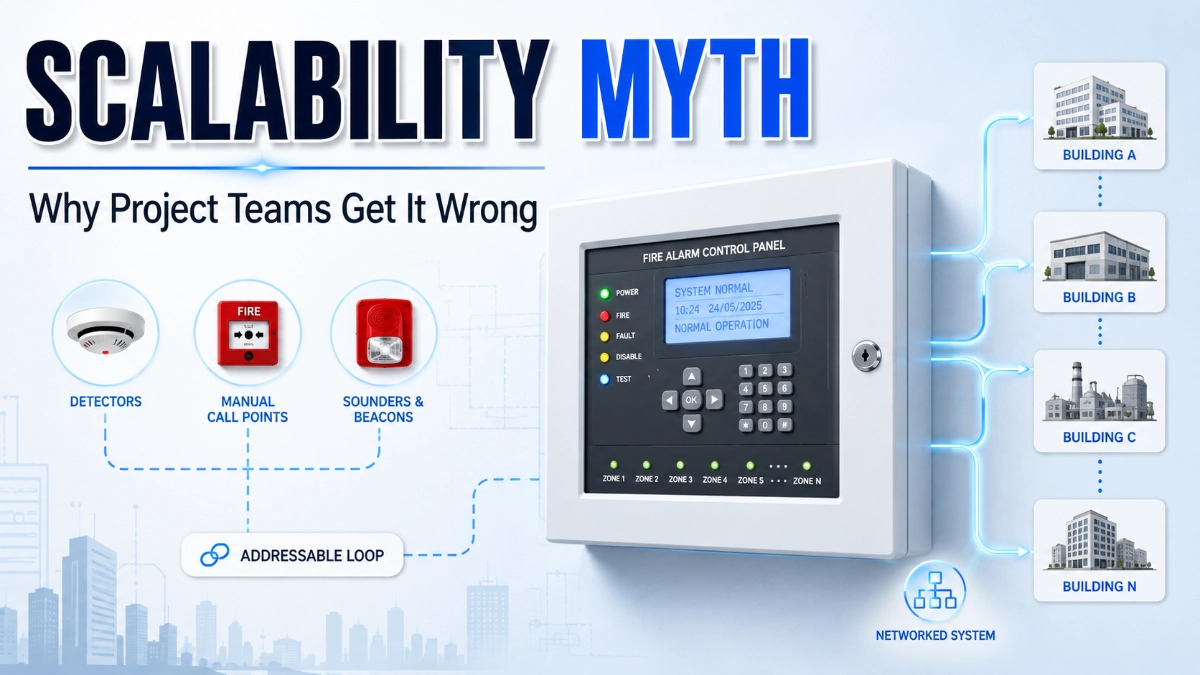
Most project teams treat fire alarm scalability as a spare-capacity number on a datasheet: how many more devices a panel can technically hold. In practice, scalability is rarely limited by the panel. It’s limited by the wiring topology, power budgets, and network architecture, all decided months before anyone thought about expansion at all.
This gap shows up constantly during retrofit and expansion projects. A facility adds a production line, a warehouse extends its racking, or a hospital opens a new wing, and the team discovers that “the panel had room” was never the real question. The real question was whether the loops, power supplies, and network structure were designed to absorb growth without re-engineering the whole system.
This article looks at why that misunderstanding happens, what actually determines scalability in an intelligent fire alarm system, and how engineers can plan for growth without over-designing every project from day one.
Fire alarm scalability is misunderstood because most teams equate it with spare panel capacity, when it actually depends on loop design, power headroom, cabinet space, and network architecture. A panel can have unused points and still be difficult to expand if the wiring topology, power budget, or network segmentation weren’t planned for growth. True scalability is a design decision, not a purchasing decision.
The Panel Is Not the Bottleneck — the Architecture Is
Engineers new to a project often start by checking how many spare addresses a control panel supports. That number matters, but it’s the least useful figure for judging real scalability.
An addressable fire alarm system identifies each device individually on a signalling line circuit, or loop. The loop has physical limits: maximum device count, maximum cable length and resistance, and a power budget shared across every detector, module, and notification appliance on that circuit. A panel can report plenty of free addresses while its loops are already close to their practical wiring or power ceiling.
This is why a facility can have an “underused” panel and still face a difficult expansion. The constraint isn’t the panel’s intelligence; it’s whether the physical circuit connecting it to the field has room to carry more current, more devices, or more cable distance.
Why Project Teams Get This Wrong
Scalability gets misjudged for a few recurring reasons that tend to compound on each other.
Procurement teams often specify panels based on point count alone, without input from the engineer designing the loop layout. Design teams, under schedule pressure, size loops for the current construction phase rather than known future phases. Maintenance teams then inherit systems where as-built documentation doesn’t reflect years of incremental changes, so nobody actually knows how much headroom remains.
None of these is an engineering failure on its own. Together, they create a system that looks scalable on paper and isn’t scalable in the field.
System Architecture: Where Scalability Actually Lives
Scalability in a modern fire alarm control panel environment is a function of several layers working together, not one spec sheet number.
- Loop capacity: How many detectors and modules a signalling line circuit can support, and how much cable run remains before voltage drop becomes a problem.
- Power supply sizing: Standby and alarm current budgets, including battery backup calculations assuming full device load during a real event.
- Network architecture: How panels communicate across a building or campus, and whether that network was designed for additional nodes.
- Cabinet and field space: Physical room in enclosures and junction boxes for future modules and conductors.
- Addressing and cause-and-effect programming: Whether the logic can accommodate new zones without a full reprogramming exercise.
For projects evaluating an EST Fire Alarm System, this layered view matters: platform selection should reflect how these layers align with the site’s current and anticipated architecture, not point count alone.
Real-World Scenarios That Expose the Misunderstanding
- Manufacturing plant expansion: A facility adds a second production hall next to the original building. The existing panel has spare loop capacity on paper, but the new hall sits beyond the practical wire run limit for that loop. The fix isn’t a bigger panel; it’s a new loop, possibly a new expansion cabinet, tied into the existing network.
- Warehouse racking increase: A distribution centre adds high-bay storage and doubles its detector count in one zone. The power supply was sized for the original device load, and without recalculating standby and alarm current, the added devices push the circuit past its safe margin, a problem that surfaces during commissioning, not design.
- Multi-building campus growth: A hospital or corporate campus adds a new building years after commissioning. If the original network wasn’t designed with spare node capacity or a documented expansion path, integrating the new building often requires a network-level redesign rather than a simple panel addition.
In each case, the equipment wasn’t wrong; the assumption that “there’s room” was.
Traditional Approach vs. Engineering-Led Approach
| Factor | Traditional Approach | Engineering-Led Approach |
|---|---|---|
| Capacity planning | Based on spare address count | Based on loop, power, and network headroom |
| Future phases | Addressed when they occur | Considered during initial design |
| Documentation | Updated inconsistently | Maintained as a living as-built record |
| Power budgeting | Sized for current device load | Sized with margin for known future load |
| Network design | Single-panel focus | Multi-panel, multi-building awareness |
| Device selection | Standardised regardless of environment | Matched to hazard, environment, and growth plan |
A Practical Decision-Making Framework
Before assuming a system can scale, project teams should be able to answer these questions with confidence:
- What is the actual spare capacity on each loop, not just on the panel?
- Has the power supply been recalculated for added device load, including battery standby time?
- Is there documented spare space in cabinets and enclosures for future modules?
- Does the network support additional panels or nodes without redesign?
- Is the cause-and-effect logic modular enough to add zones cleanly?
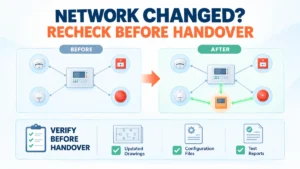
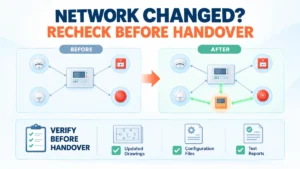
- Is there current as-built documentation reflecting the system’s real condition?
If any answer is uncertain, that uncertainty is not the panel’s marketed capacity; it is the actual constraint on scalability.
Where EST3 and EST4 Fit Into This Discussion
Both EST3 and EST4 platforms are used across a range of project scales, and platform choice should follow the same reasoning outlined above rather than an assumption that one is automatically better suited to growth. Relevant factors include expected phasing, existing infrastructure on a retrofit, integration requirements with other building systems, and the manufacturer’s current documentation on network and expansion architecture. Neither platform should be chosen purely because it is newer; the decision should follow how its architecture matches the site’s actual growth pattern.
The same logic applies to field devices. The selection of EST Detectors and Devices should be based on the protected environment, the detection objective for each zone, and how those devices fit into the loop and power budget already established for the site, not simply chosen because they are compatible with the panel.
Common Mistakes That Undermine Scalability
- Sizing loops and power supplies for the current phase only, with no allowance for known future phases.
- Treating spare panel addresses as proof of scalability without checking loop and power headroom.
- Failing to update as-built documentation after incremental changes, leaving no accurate baseline.
- Assuming new devices are compatible with an existing loop without verifying the power budget and addressing capacity constraints.
- Designing network architecture around the current building count with no provision for additional nodes.
- Delaying cause-and-effect programming structure until after installation, making later zone additions harder to integrate.
- Ignoring cabinet and enclosure space during initial design, forcing costly replacement during expansion.
Expert Insights
- A panel’s spare address count tells you almost nothing about whether its loop can actually grow.
- Power supply calculations done for day-one occupancy rarely hold up after two or three rounds of expansion.
- Scalability planning is cheapest at design stage and most expensive during commissioning of an expansion.
- Documentation gaps, not equipment limitations, are the most common reason expansions run long.
- Network decisions made for a single building often become the hardest constraint when a campus grows.
- Device selection should follow the hazard and environment, not the equipment catalogue.
- A fire alarm system should be evaluated as an integrated architecture, not a panel with accessories attached.
Key Takeaways
- Scalability depends on loop, power, and network headroom, not panel point count alone.
- Plan power supply and battery calculations with margin for known future phases.
- Maintain accurate as-built documentation as changes occur, not retroactively.
- Involve the loop and network designer early, not after panel selection.
- Treat cabinet and enclosure space as a design variable, not an afterthought.
- Structure cause-and-effect programming to allow modular zone additions.
- Evaluate platform choice, including EST3 or EST4, against actual project growth patterns.
- Verify device and system compatibility against current manufacturer documentation before every expansion.
Fire alarm scalability isn’t something a system either has or doesn’t have; it’s the outcome of design decisions about loops, power, network structure, and documentation. Teams that treat it as a purchasing checkbox tend to discover the real constraints during an expansion, when they’re most expensive to fix.
If your facility is planning an expansion or multi-phase build-out, it’s worth reviewing your current system’s loop and power headroom before assuming the existing architecture will absorb the next phase. A qualified fire alarm engineer or system integrator can help you verify your actual capacity.
Read Also: Why Fire Alarm System Modernisation Is Not Just About Replacing the Panel
Read Also: Why Fire Alarm Engineers Should Treat Configuration Files Like Critical Assets