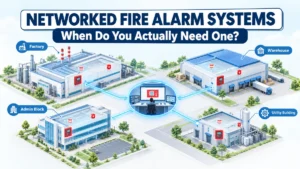
A manufacturing campus often starts small. One production building, one fire alarm control panel, one detection zone map that fits on a single sheet. Years later, the same site has grown into something else entirely: a second production block, a warehouse, a utility building, an administration wing, and several new process areas. Each addition arrived with its own fire alarm panel, installed to code, commissioned, and left to operate independently.
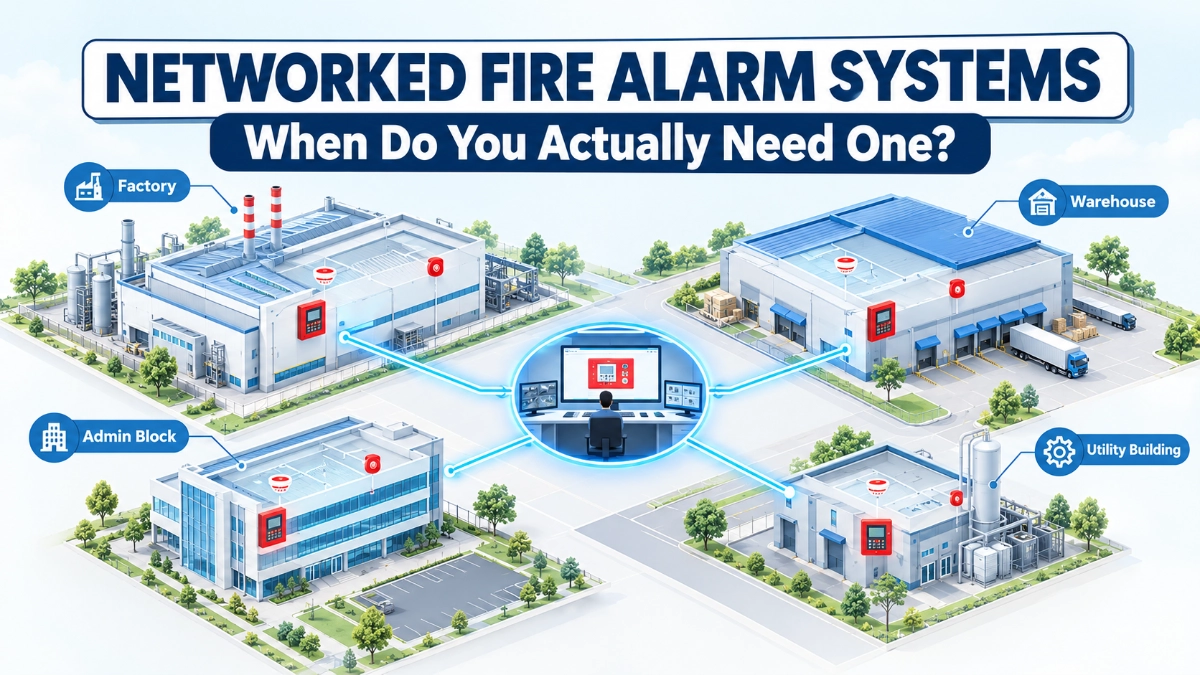
At that point, the engineering problem stops being about detection coverage. Every individual system may be functioning correctly, yet the facility as a whole has no consistent way to see events, coordinate response, document activity, or plan for the next expansion. That gap not a code violation, not a design flaw is what pushes engineers to evaluate a networked fire alarm architecture.
This is an architectural decision, not a product feature. A large building, multiple buildings, several independent panels, and a coordinated fire alarm network are four different conditions, and conflating them leads to over-specified or under-specified systems. This article walks through the actual decision factors, using the EST Fire Alarm System as the reference platform, without assuming networking is the default answer.
An industrial project may need a networked EST fire alarm system when the facility has multiple buildings, multiple fire alarm control panels, significant physical distribution, a requirement for centralised event monitoring, cross-building cause-and-effect, or planned future expansion that makes managing isolated systems impractical. Size alone does not create this requirement. The final architecture should be determined by the approved project design, applicable codes and standards, client operational requirements, and manufacturer documentation, not by assumption.
What Is a Networked Fire Alarm Architecture?
In general terms, a networked fire alarm architecture allows multiple fire alarm control panels or system nodes to exchange relevant information and operate within a coordinated system design, rather than each panel functioning as a fully isolated installation. The specific behaviour, what information is shared, how nodes interact, and what redundancy exists depends entirely on the platform selected and the approved system design.
It’s useful to separate three conditions that are often described loosely as “the same thing”:
| Architecture | Typical Characteristics | Engineering Consideration |
|---|---|---|
| Standalone | One primary system serving a defined area | Suitable when the facility is relatively self-contained |
| Multiple independent systems | Separate systems with limited coordination | Can create fragmented visibility |
| Networked architecture | Multiple system nodes coordinated within a defined architecture | Useful when centralised visibility or coordination is required |
None of these is inherently correct. Each fits a different set of project conditions, and the job of the design engineer is to identify which condition actually describes the facility in question.
Does a Large Industrial Building Automatically Need a Networked Fire Alarm System?
No. Physical size by itself does not determine whether networking is required.
A single large industrial building, even one with an extensive floor area, multiple detection zones, and a high device count, can often be served effectively by a well-designed standalone system, provided the panel architecture, loop design, and notification zones are properly engineered for that footprint.
What actually drives the networking discussion includes:
- Building layout and how detection zones are distributed
- Number and location of panels required to serve the facility
- Number of distinct operational areas
- Travel distances for maintenance and testing personnel
- Whether a control room requires consolidated event visibility
- Complexity of cause-and-effect logic
- Integration with other building or process systems
- Future expansion plans
- Client-specific operational requirements
- Applicable local codes and standards
“Large” and “distributed” are not the same engineering problem. A large building with a single, well-managed set of detection zones may not need networking. A smaller site split across several separate structures might.
The First Major Indicator — Multiple Buildings
Multiple buildings are one of the strongest practical reasons to evaluate a networked fire alarm system. Common industrial configurations include:
- A main manufacturing building
- A warehouse or storage facility
- A utility building housing mechanical or electrical plant
- An administration block
- A security or gatehouse building
- An electrical substation
- Dedicated process buildings
- Separate hazardous-material storage
When each of these has its own independent panel, event visibility becomes fragmented by default. An alarm in the warehouse may not be visible from the administration building’s reception desk, and a fault in the utility building’s panel may go unnoticed until someone physically checks it. This doesn’t mean networking is mandatory; some multi-building sites operate perfectly well with independent systems and defined manual coordination procedures. It means the condition is present and should be evaluated against the project’s actual operational needs.
When Centralised Monitoring Becomes Important
Centralised monitoring requirements typically originate from how the facility is operated, not from the fire alarm system itself. Relevant scenarios include:
- A central control room responsible for the entire site
- A security control room monitoring multiple functions, including fire
- A facility management centre tracking building status
- A requirement for building-to-building event visibility
- A need for consolidated alarm and fault status awareness
These requirements should be defined during the design stage as part of the basis of design, the client’s operational brief, or the risk assessment rather than discovered after installation. Retrofitting centralised visibility onto a set of independently designed panels is possible in some cases, but it is far less efficient than designing for it from the outset.
When Multiple Fire Alarm Panels Create an Architecture Problem
Adding panels to a site does not automatically create a coordinated system. Two panels installed in different buildings can be entirely unaware of each other’s status unless the project specifically designs for that interaction.
As panel count grows, engineers should evaluate:
- How events from each panel are made visible to operators
- How alarm acknowledgement is handled across panels
- How fault conditions are surfaced and tracked
- How maintenance activity is coordinated across multiple panels
- How system documentation is kept consistent
- Whether operators need a single point of awareness or can work from separate panels
The central question is straightforward: are these panels simply installed in different physical locations, or do they need to function as part of one coordinated architecture? The answer determines whether a networked design is worth pursuing, but it should be based on documented project requirements and verified manufacturer capabilities, not assumed.
How EST3 and EST4 Fit Into the Architecture Discussion
Platform selection, including whether EST3 or EST4 is appropriate for a given project, should follow the required system architecture rather than precede it. Once the number of buildings, panel count, monitoring requirements, and integration needs are understood, the platform decision becomes a matter of matching documented capabilities to the project scope.
Neither platform should be treated as universally superior. Panel capacity, device capacity, network topology, communication methods, redundancy options, and lifecycle status vary by model, firmware, and configuration, and should be confirmed against current manufacturer documentation for the specific project. Where a direct comparison is needed, it should be built from verified specifications rather than general assumptions.
What Role Does the EST Fire Alarm System Play in a Networked Project?
A networked design is ultimately built from the same core elements as any fire alarm project; it’s the coordination between them that changes. The EST Fire Alarm System should be evaluated as a complete system, covering:
- Control panels and their role within the architecture
- Detection devices and coverage
- Notification appliances and zoning
- Monitoring points, local and centralised
- The network architecture connecting system nodes
- Cause-and-effect logic across the site
- Interfaces with other building systems
- Power supply and battery calculations
- System documentation
- Ongoing maintenance requirements
Defining the architecture before selecting individual panels, modules, or devices avoids a common failure mode: a system that is technically compliant building-by-building but incoherent as a whole.
Cause-and-Effect Becomes More Important as the Site Expands
Cause-and-effect logic naturally becomes more complex as a facility grows across multiple buildings. Typical interfaces include:
- Notification appliance activation
- Process or equipment shutdown
- HVAC system interfaces
- Access control interfaces
- Smoke control operation
- Process-specific interfaces
- Central monitoring notifications
Networking can increase the importance of clearly answering: which event occurs, where it occurs, what should respond, which building or area is affected, and what should remain independent of the rest of the site. Networking itself does not determine this logic; the cause-and-effect matrix must come from the approved project design, risk assessment, and applicable code requirements. It only raises the stakes of getting that matrix right.
Field Devices Still Matter in a Networked Architecture
Networking coordinates systems; it does not compensate for poor field-level design. EST Detectors and Devices still need to be selected and installed based on:
- Detector type and application suitability
- Environmental conditions at each location
- Distribution of devices across zones and buildings
- Maintenance accessibility
- Addressing and configuration requirements
- Loop or circuit architecture
- Fault visibility down to the device level
- Capacity for future device additions
A well-designed network built on top of poorly selected or poorly installed field devices will still produce unreliable detection and nuisance alarms. Architecture and field-device engineering are separate disciplines that both need attention.
When Future Expansion Justifies Network Planning
A facility might not need networking today and still benefit from architecture that anticipates it. Common growth patterns include new production blocks, warehouse expansion, additional process areas, new utility buildings, broader campus development, and additional panels to serve any of the above.
This is the distinction between a current requirement and a planned architecture. A site may have adequate capacity now but still warrant a scalable design if expansion is documented in the client’s master plan. This should be an explicit design decision, not a retrofit forced by circumstances, and it should never be assumed that networking automatically delivers scalability; that depends on the specific platform and how the architecture is designed and documented.
Networked vs Independent Systems — Practical Comparison
| Consideration | Independent Systems | Networked Architecture |
|---|---|---|
| Multiple buildings | Each may operate separately | Can support coordinated architecture where designed |
| Central visibility | May require separate arrangements | Can be part of network design |
| Event management | Potentially fragmented | Can provide coordinated visibility depending on platform |
| Expansion | May require separate system planning | Architecture can be planned for future nodes |
| Maintenance | More isolated systems | Requires network-aware maintenance |
| Documentation | Multiple system records | Requires coordinated architecture documentation |
| Complexity | Lower initially in some projects | Higher engineering complexity |
Neither column is universally better. The right choice depends on which conditions actually apply to the project.
When Should Engineers NOT Automatically Choose a Networked System?
A standalone or independent architecture may remain the right choice when the project involves:
- A small or operationally simple building
- A limited system scope with a single defined area
- No requirement for central visibility beyond the local panel
- No meaningful operational interaction between buildings
- Simple, single-building cause-and-effect
- No documented plans for future expansion
- Project specifications that don’t call for networking
Specifying a networked architecture where none of these conditions exists adds cost and complexity without a corresponding operational benefit.
Questions Engineers Should Ask Before Specifying a Networked EST System
- How many buildings are involved?
- How many fire alarm panels are required?
- Is centralised monitoring required?
- Do buildings need coordinated event visibility?
- Is there a central control room?
- Are there cross-building cause-and-effect requirements?
- What happens if network communication is interrupted?
- What future buildings or expansions are planned?
- Who will maintain the network?
- How will configuration changes be documented?
- What level of redundancy or resilience does the project require?
- What does the manufacturer documentation specify for the selected platform?
There are no universal answers to these questions; each should be resolved against the specific project’s design basis.
Common Mistakes When Designing Networked Industrial Fire Alarm Systems
- Assuming every large facility needs networking size alone isn’t the driver.
- Treating networking as an installation-stage decision means it needs to be part of the initial design basis.
- Adding networking after cause-and-effect is finalised forces rework of already-approved logic.
- Ignoring future buildings, undersized architecture becomes a costly retrofit later.
- Failing to define central monitoring requirements leads to systems that technically network but don’t serve operational needs.
- Selecting panels before defining architecture locks the project into constraints before requirements are known.
- Ignoring communication-failure scenarios: every networked design should address what happens when a link goes down.
- Underestimating documentation requirements: networked systems need more detailed, more current records.
- Failing to train maintenance teams: A network-aware system needs network-aware maintenance staff.
- Treating the network as an IT-only issue: Fire alarm networking is a life-safety engineering decision first.
Why Technical Supplier Support Matters in Networked EST Projects
Networked industrial projects benefit from working with a technically capable supplier, such as an EST Fire Alarm System Distributor in India, who can support:
- Product selection aligned with the approved architecture
- Access to current system documentation
- Architecture-level technical discussions
- Product availability and lead-time planning
- Field-device planning
- Technical coordination across design and installation teams
- Project-specific assistance through design and commissioning
- Spare-part planning for long-term maintenance
- After-sales and lifecycle support
This kind of support helps ensure that architecture decisions made on paper translate correctly into a working, maintainable system.
Practical Decision Framework
A structured way to reach the final architecture:
PROJECT SIZE
   ↓
BUILDING DISTRIBUTION
   ↓
NUMBER OF PANELS
   ↓
CENTRAL MONITORING
   ↓
CAUSE-AND-EFFECT
   ↓
INTEGRATION
   ↓
FUTURE EXPANSION
   ↓
NETWORK REQUIREMENTS
   ↓
MAINTENANCE & LIFECYCLE
   ↓
FINAL ARCHITECTURE
Networking should be the output of this assessment, not the starting assumption.
Key Takeaways
- An industrial project does not need a networked EST fire alarm system simply because it is large. Networking becomes worth evaluating when building distribution, multiple panels, centralised visibility, coordinated response, operational complexity, or future expansion creates a requirement that isolated systems cannot efficiently address.
- “Large building” and “distributed facility” are distinct engineering conditions.
- Multiple buildings and multiple panels are strong indicators, not automatic triggers.
- Centralised monitoring requirements should be defined during design, not added afterwards.
- Cause-and-effect complexity increases with site distribution and needs to be explicitly mapped.
- Field-device selection remains critical regardless of architecture.
- Future expansion plans can justify scalable architecture even without a current requirement.
- Final architecture decisions should rest on approved design, standards, client requirements, and manufacturer documentation.
Read Also: How to Evaluate Edwards Fire Alarm Products for a Large Industrial Project
Read Also: Why “No Fault Found” Does Not Mean the Fire Alarm System Is Healthy