A large manufacturing facility, a warehouse campus, a process plant, or a multi-building industrial site is preparing its fire alarm bill of quantities. The project team is comparing panels, detectors, modules, notification appliances, networking components, and integration interfaces across multiple vendors. The default approach is often to select individual products based on datasheet specifications and unit price.
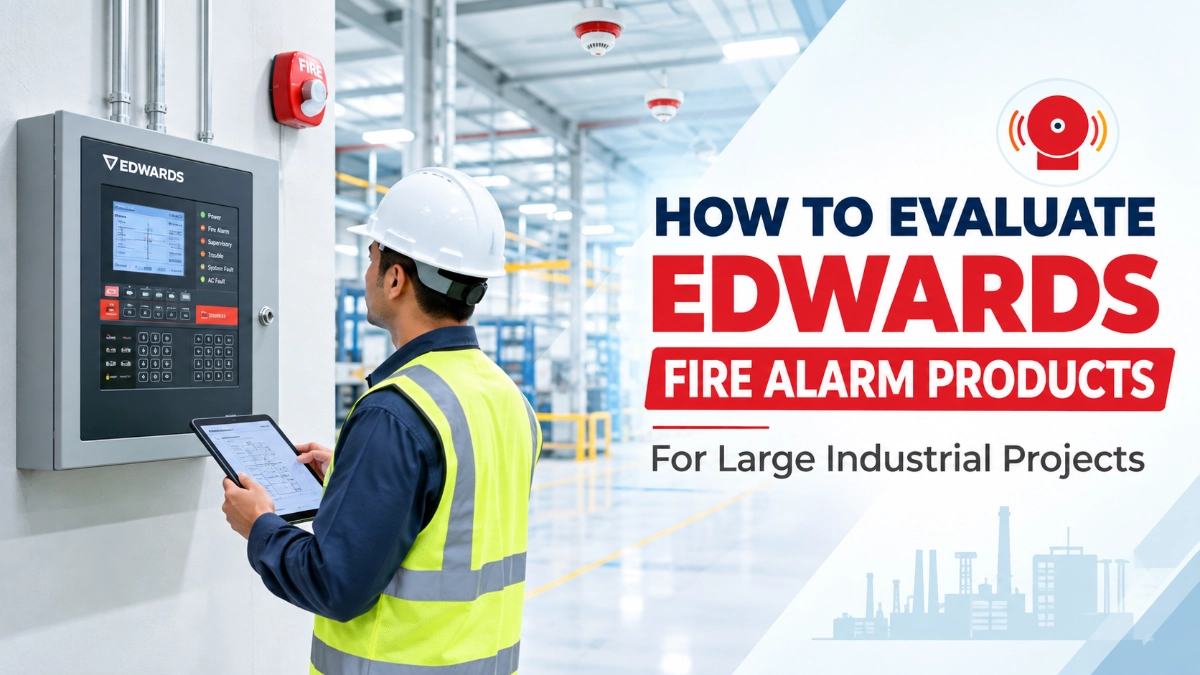
This approach creates risk. A device can satisfy its own specification sheet and still be the wrong choice for the project once architecture, environment, power, networking, cause-and-effect, and lifecycle requirements are considered. A detector rated for one application may not suit the ceiling height or airflow of a production hall. A panel that meets a point-count requirement on paper may still create integration or expansion problems once the full site is mapped out.
Large industrial sites compound this risk because they involve multiple buildings, large detection areas, varying environmental conditions across zones, multiple loops and panels, distributed field devices, inter-panel networking, extensive cause-and-effect logic, integration with other ELV and building systems, and long-term expansion plans. None of these factors shows up on a single product datasheet; they only appear once the project requirements are mapped and the system is evaluated as a whole.
This article outlines how engineers should evaluate Edwards fire alarm products for a large industrial project: by starting with system requirements and working down to individual devices, rather than starting with a catalogue.
Engineers should evaluate Edwards fire alarm products by assessing the complete system against documented project requirements, not by comparing individual specifications. This includes detection requirements, panel architecture, device compatibility, environmental suitability, power and battery loading, networking between panels or buildings, cause-and-effect logic, integration with other systems, scalability, maintenance access, and lifecycle/documentation support. Product suitability should always be confirmed against current manufacturer documentation and the approved project design.
What Should Engineers Evaluate Before Selecting Edwards Fire Alarm Products?
Before comparing individual panels, detectors, or modules, engineers need a structured evaluation framework that reflects how the finished system will actually operate on site.
| Evaluation Area | What Engineers Should Review |
|---|---|
| Project architecture | Centralised, distributed, or networked requirements |
| Detection | Detector types and application |
| Panel | Required system architecture and functionality |
| Field devices | Device suitability and compatibility |
| Power | Panel, device, notification and standby requirements |
| Networking | Inter-panel or system communication requirements |
| Cause-and-effect | Required control logic |
| Integration | Interfaces with other systems |
| Environment | Temperature, dust, moisture, process conditions |
| Expansion | Future capacity and physical infrastructure |
| Maintenance | Diagnostics, access, serviceability and documentation |
| Lifecycle | Support, spares, training and future modifications |
The exact criteria under each area should come from the project specification, applicable local and international standards, the approved fire alarm design, and current Edwards/EST manufacturer documentation, not from general assumptions carried over from smaller projects.
Start With the Industrial Building — Not the Product Catalogue
Industrial sites rarely have uniform conditions. A single facility can include manufacturing floors, warehouse racking areas, utility rooms, electrical rooms, control rooms, server or IT spaces, loading docks, production zones, high-ceiling process areas, and in some cases outdoor or semi-exposed locations.
Each of these spaces has different detection needs. High-ceiling areas may need detection technology suited to stratification and delayed smoke rise. Areas with dust, heat, humidity, or airflow from process equipment need detectors that won’t generate nuisance alarms under normal operating conditions. Electrical and control rooms may require a different detection approach than open warehouse space.
There is no single detector type that is correct for every zone. Detector selection should follow the application and the documented environmental conditions of each space, confirmed against manufacturer application guidance, not applied uniformly across the site for simplicity.
Evaluate the Fire Alarm Architecture Before Individual Products
Once the building and hazard mapping is complete, the next step is architecture before any panel or device is chosen.
Engineers should determine:
- How many panels are required, and how they are distributed across buildings.
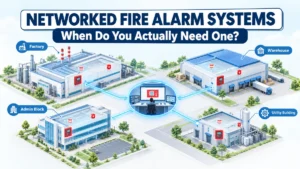
- Whether building-to-building communication is required.
- How loops and zones should be structured.
- What network architecture the project needs.
- Where central monitoring and annunciation will occur.
- How cause-and-effect relationships will be implemented across panels.
- Whether resilience or redundancy is specified.
- How the architecture accommodates future expansion.
This is where the complete EST Fire Alarm System needs to be understood as a system, not as a collection of parts. Architecture decisions made at this stage determine which panel platform, network configuration, and device types make sense later; reversing this order tends to create rework during detailed design or commissioning.
How Should Engineers Evaluate the Fire Alarm Control Panel?
Panel evaluation should be driven by the architecture already defined, not by a generic “biggest panel available” decision. Engineers should review:
- Required system size relative to the mapped detection and I/O requirements.
- Detection architecture and how it aligns with loop/zone structure.
- Number and type of devices the panel needs to support.
- Input/output requirements for cause-and-effect and interfacing.
- Notification requirements across the facility.
- Event handling, logging, and annunciation needs.
- User interface requirements for operators.
- Networking capability required for multi-panel or multi-building sites.
- Integration requirements with other systems.
- Power requirements at the panel level.
- Room for future expansion.
- Maintenance and diagnostic access.
- Documentation requirements for approval and commissioning.
Exact panel capacities, loop counts, I/O limits, and networking specifications should never be assumed. These values change across product lines and revisions, so engineers should verify current figures against official Edwards/EST documentation and confirm they meet the specific project requirement, not a generic industry expectation.
EST3 and EST4 — What Should Engineers Compare?
Two platform names that commonly appear in Edwards fire alarm evaluations are EST3 and EST4. When evaluating which platform aligns with a given project, engineers should compare them against the project’s required architecture, scale, integration needs, lifecycle position, and expansion plans, not select one by default.
Relevant evaluation questions include:
- Which platform is currently supported and documented for new industrial projects?
- Which platform architecture matches the site’s panel distribution and networking needs?
- What integration and compatibility requirements does the project specify?
- What lifecycle and long-term support position does each platform currently hold?
These questions should be answered using current manufacturer documentation and the project’s technical requirements. Any specific capacity, networking, redundancy, or compatibility differences between EST3 and EST4 should be verified directly rather than assumed, since platform documentation is updated over time.
How to Evaluate EST Detectors and Devices for Industrial Conditions
Field-device evaluation is where environmental mismatches most often occur. When reviewing EST Detectors and Devices for an industrial application, engineers should assess:
- Detection principle and its suitability for the hazard.
- Intended application per manufacturer guidance.
- Environmental conditions at the installation point.
- Ceiling height and smoke travel path.
- Air movement and ventilation patterns.
- Dust or contamination exposure.
- Ambient temperature range.
- Humidity levels.
- False-alarm risk under normal process conditions.
- Maintenance and cleaning access.
- Compatibility with the selected loop and panel.
- Any monitoring or control functions the device must support.
A detector suited to a clean office environment is frequently unsuitable for a production floor with dust or airflow, even if both fall under the same general detector category. Specific environmental ratings and limits should always be confirmed against current product documentation rather than assumed from general product families.
Don’t Evaluate Detection Devices in Isolation
A field device is one link in a longer chain:
Detector → Loop/Circuit → Panel → Cause-and-Effect → Notification → Integration → Monitoring
A detector can be technically correct for its environment and still create project complications if its wiring, addressing, loop loading, maintenance access, or integration requirements weren’t reviewed alongside the rest of the chain. Evaluating a device in isolation purely against its own datasheet misses how it performs inside the full system it belongs to.
Power and Battery Requirements Should Be Reviewed Early
Power is frequently treated as a late-stage calculation, but on large industrial sites it can become a hidden design constraint. Engineers should review:
- Panel power requirements.
- Total connected device load.
- Notification appliance load.
- Standby duration requirements.
- Alarm-condition load.
- Battery sizing implications.
- Power distribution across buildings or panels.
- Auxiliary loads from additional interfaces.
- Headroom for future expansion.
Actual battery and power calculations must follow the approved design, applicable local standards, and current manufacturer documentation, not general assumptions carried from smaller or unrelated projects.
Evaluate Networking and Multi-Building Requirements
Large industrial sites often require more than a single panel location. Engineers should ask:
- Are multiple buildings or zones involved?
- Is centralised monitoring required at a control room or FACP?
- How will events be communicated between panels?
- What happens if communication between panels is interrupted?
- Is the intended network architecture documented and approved?
- How will future buildings or site extensions connect into the network?
- What maintenance access does the network architecture require?
Specific EST networking capabilities, protocols, or topologies should not be assumed. These should be confirmed directly against current manufacturer documentation and matched to the project’s approved architecture.
Cause-and-Effect Is Part of Product Evaluation
Product selection should also be tested against the project’s cause-and-effect matrix. Typical interfaces on industrial sites include fire alarm notification, equipment or process shutdown, HVAC interfaces, door and access-control interfaces, smoke control interfaces, and connections to other monitoring systems.
Not every product in a fire alarm system supports every possible integration. Cause-and-effect requirements should be defined early in the approved design, and product selection should be checked against that matrix rather than assumed compatible by default.
Environmental Conditions Can Change Product Selection
Industrial environments vary significantly from standard commercial spaces. Engineers should evaluate dust, heat, humidity, airflow, contamination, vibration, electrical interference, process-specific conditions, and maintenance accessibility for each zone.
Environmental suitability, including any IP ratings, temperature limits, or approvals, should always be confirmed from current manufacturer documentation and matched against the actual project conditions, not generalised across the site.
How Should Engineers Evaluate Scalability?
Scalability is often confused with unused nominal capacity. A panel with spare loop or point capacity is not automatically “scalable” if physical cabling infrastructure, panel space, network bandwidth, or cause-and-effect complexity can’t reasonably absorb future growth.
Engineers should assess future building expansion, additional detection devices, additional I/O needs, network expansion, incremental power requirements, physical cable pathways, available panel space, growing cause-and-effect complexity, documentation upkeep, and the resulting maintenance workload. Genuine scalability accounts for all of these, not just remaining device slots on a panel.
Maintenance, Diagnostics and Lifecycle Considerations
Procurement decisions should extend beyond installation day. Engineers should review how faults are identified, how event history is retained, what maintenance access the system design allows, the site’s replacement and spares strategy, documentation completeness, training needs for facility staff, ongoing service support, configuration management practices, and how future modifications will be handled. Specific diagnostic features should be confirmed against current documentation rather than assumed.
What Should Be Included in an Edwards Fire Alarm Product Evaluation Checklist?
- Project Requirements: Building type, occupancy/use, hazard profile, environmental conditions, applicable standards, client specifications.
- System Architecture: Panel architecture, device distribution, networking, I/O, cause-and-effect, integration.
- Product Evaluation: Detector suitability, module suitability, notification devices, control equipment, power requirements, compatibility.
- Lifecycle: Maintenance, spares, documentation, training, technical support, expansion.
- Procurement: Approved manufacturer/product list, current documentation, compliance requirements, lead-time considerations, supplier technical capability.
Common Mistakes When Evaluating Fire Alarm Products for Industrial Projects
- Selecting products before defining architecture.
- Comparing products only by price.
- Choosing detectors without reviewing environmental conditions.
- Ignoring future expansion.
- Treating panel capacity as total system scalability.
- Reviewing networking too late in the design process.
- Leaving cause-and-effect definition until commissioning.
- Ignoring maintenance and diagnostic access requirements.
- Failing to verify device and panel compatibility.
- Approving products without checking current manufacturer documentation.
Why the Distributor’s Technical Capability Matters
For large industrial projects, supplier evaluation extends beyond product availability. Working with an experienced EST Fire Alarm System Distributor in India can matter for technical product knowledge, engineering support during design, documentation support for approvals, assistance with product selection against project requirements, project coordination across multiple buildings, availability of the specific devices required, spare-parts planning, installation or commissioning support where offered, and after-sales technical support. No single distributor is automatically the right fit for every project; this should be evaluated against the project’s own technical support needs.
A Practical Decision Framework for Engineers
- Define project requirements.
- Map building and hazard conditions.
- Define system architecture.
- Determine detection requirements.
- Evaluate panels and devices.
- Verify compatibility.
- Review power requirements.
- Review networking and integration.
- Assess future expansion.
- Review maintenance and lifecycle.
- Verify documentation.
- Complete technical approval.
Final product selection should be based on documented compliance with project requirements, not brand familiarity or catalogue browsing alone.
Key Takeaways
- Fire alarm product evaluation should start with project requirements, not catalogue specifications.
- The correct way to evaluate Edwards fire alarm products for a large industrial project is to evaluate the complete system against project requirements, not to select individual products in isolation.
- Detector selection should follow application and environmental conditions, zone by zone.
- Panel selection depends on defined architecture, not assumed capacity.
- Power, networking, and cause-and-effect should be reviewed early, not left to commissioning.
- Scalability means usable future capacity across the whole system, not just spare panel slots.
- Maintenance, documentation, and lifecycle support are part of the evaluation, not an afterthought.
- All specifications should be confirmed against current manufacturer documentation before approval.
Read Also: Why “No Fault Found” Does Not Mean the Fire Alarm System Is Healthy
Read Also: Difference Between Fire Alarm Capacity and Real-World System Scalability