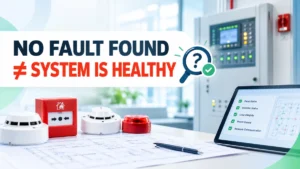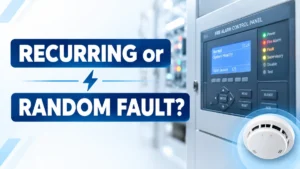
A facility reports a fire alarm fault. An engineer attends, checks the panel and the field device, reviews the available information, and finds no active fault. The system looks normal, so the ticket is closed.
Several days later, the same issue appears again.
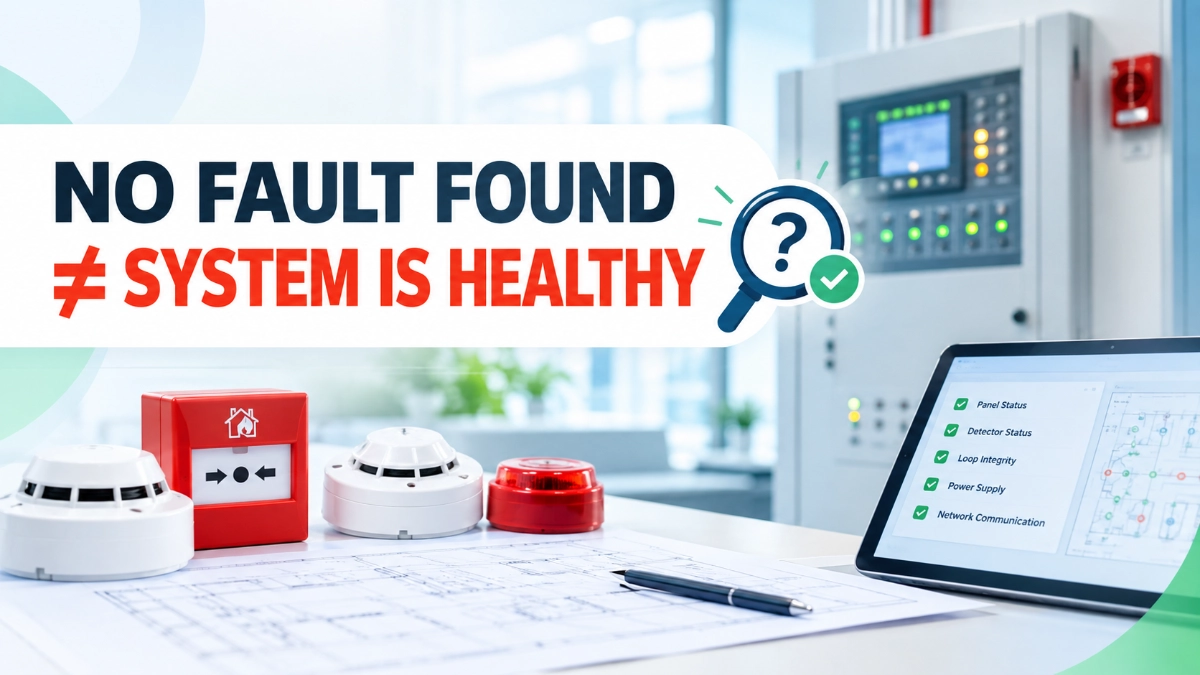
Was the system healthy, or was the investigation simply unable to reproduce the condition?
Intermittent fire alarm faults are hard to diagnose because the evidence often exists only while the condition is active. “No fault observed” and “no fault exists” are different statements. Treating them as the same is how recurring problems survive several site visits.
Nothing here points to a specific cause yet. The fault may relate to devices, wiring, the panel, or the installation. The task is to gather evidence before deciding.
Does “No Fault Found” mean a fire alarm system is healthy?
No. “No Fault Found” only means the reported condition could not be reproduced or confirmed during that particular inspection. It does not establish that the system is free from intermittent, environmental, wiring, power, communication, configuration, or device-related problems. Treat it as an investigation result, not a health certificate, and review history and patterns before concluding anything.
What Does “No Fault Found” Actually Mean?
In fire alarm maintenance, the phrase generally means:
- The reported fault was not active during inspection.
- The condition could not be reproduced.
- No obvious abnormality was identified at that moment.
- Available diagnostics did not provide enough evidence to confirm a cause.
It records the limits of the investigation, not the condition of the system.
| Finding | What It Means | What It Does Not Prove |
|---|---|---|
| No active fault | No fault is currently displayed | The system has never experienced a fault |
| Device tests normal | Device responds during the test | The device cannot fail intermittently |
| Wiring appears normal | No obvious wiring issue was observed | Intermittent connection problems are impossible |
| Event log is quiet | No useful recent event is visible | No previous abnormal condition occurred |
Why Can a Fire Alarm Fault Disappear Before the Engineer Arrives?
These are investigation categories, not automatic diagnoses:
- Intermittent wiring or connections: loose terminations or marginal joints that change with movement or load.
- Temporary power conditions: Supply disturbances that clear before anyone attends.
- Environmental change: Temperature or humidity variation affecting a device or its cabling.
- Electrical work or nearby changes: Modifications that altered installation conditions.
- Device-specific behaviour: A component that misbehaves only occasionally.
- Communication disturbances: Brief interruptions on a data path.
- Configuration or system-state conditions: Behaviour tied to a particular operating state.
- Transient events: Short-lived conditions no longer present.
Each is a hypothesis. None is confirmed until evidence supports it.
The Difference Between a Temporary Fault and an Unresolved Fault
A fault that clears has not necessarily been resolved. It may have been transient, or it may simply be dormant.
| Situation | Possible Interpretation | Engineering Response |
|---|---|---|
| Fault disappears once | Transient or intermittent condition | Record and monitor |
| Fault repeatedly returns | Recurring condition | Investigate pattern |
| Fault follows environmental changes | Environmental relationship may exist | Correlate conditions |
| Fault moves after component replacement | Root cause may be elsewhere | Reassess diagnosis |
| Fault appears after electrical work | Recent change may be relevant | Review modification |
No single row proves a particular cause. Each is a prompt for the next investigative step.
What Should Engineers Check Before Closing the Fault?
Each item helps establish whether an event is isolated or part of a pattern.
- Exact fault message: The wording narrows the fault category.
- Device, address, and location: Shows whether events cluster.
- Date and time: Reveals timing patterns.
- Frequency: Separates a one-off from recurrence.
- Event history: Shows what happened before and after the report.
- Recent electrical work: Site changes can alter conditions the system relies on.
- Recent fire alarm modifications: Additions or reconfiguration can introduce new behaviour.
- Environmental conditions: Links occurrence to temperature, humidity, or site activity.
- Power observations: Supply disturbances can produce symptoms elsewhere.
- Wiring and connections: Physical condition of terminations and routes.
- Network or communication events, where applicable: Brief interruptions may leave only a trace.
- Maintenance history: Earlier visits, replacements, and outcomes.
- Occurrence elsewhere: The same condition in other areas suggests a broader cause.
- Acknowledged, reset, or cleared before investigation: Evidence may already have been lost.
Why Event Logs Matter When the Fault Is Gone
When the physical fault is no longer present, the fire alarm event log held in the control panel may be the best remaining evidence. Review:
- Timestamp: When events occurred and whether times repeat.
- Sequence: What happened before and after the reported fault.
- Repeated events: Recurrence nobody reported.
- Device and location: Whether events concentrate.
- Event type: Alarm, supervisory, and trouble conditions mean different things.
- Relationships: Events close together may share a source.
Event logs are evidence, not proof of root cause. Content and retention vary by system, so consult the manufacturer documentation for the installed panel.
Device-Level Fault vs System-Level Problem
Separate device-level symptoms from system-level causes. In an addressable fire alarm system, one device repeatedly reporting abnormal behaviour may point to that device or its immediate connection. Several devices on one circuit showing related symptoms, events across different areas, faults after electrical modifications, or similar faults under similar site conditions point toward something shared.
Work through the sequence:
WHAT → WHERE → WHEN → HOW OFTEN → WHAT CHANGED
A pattern does not confirm a cause, but it decides where to look first.
Why Replacing the Device Is Not Always the Correct Solution
Replacing the detector or module that reported the fault is a common reflex. It can:
- Leave the actual cause in place.
- Remove useful evidence.
- Create configuration or documentation work.
- Increase maintenance cost.
- Delay root-cause identification.
Replacement is appropriate when evidence supports it, for example, a device that fails repeatable testing under approved procedures. It should be a conclusion, not a default first step.
How This Applies to EST Fire Alarm System Architecture
Intermittent problems often sit between components rather than inside one. When investigating an installed EST Fire Alarm System, consider the architecture as designed: connected devices, system configuration, communication paths, power arrangements, and documented cause-and-effect. Compare what is installed and configured against the approved design and fire alarm commissioning records. Any drift from them is a candidate for investigation.
EST3 and EST4: Why Platform Context Matters During Troubleshooting
Confirm which platform is installed before interpreting a fault. Procedures, architecture, interfaces, configuration, and available fire alarm diagnostics can depend on whether the project uses EST3 or EST4, and on how it was designed. Do not assume behaviour from one platform applies to the other. Rely on the manufacturer documentation, approved design, configuration records, and project-specific procedures.
Why the Field Device Matters as Much as the Panel
A panel indication reports what the panel detects. It does not always explain why. Device condition, location, environment, wiring, addressing or configuration where applicable, and maintenance history all matter. Considering EST Detectors and Devices in their installed context, rather than the panel display alone, gives a fuller picture. Confirm device-specific behaviour against the relevant product documentation.
When Should “No Fault Found” Become “Further Investigation Required”?
Consider escalating when:
- The same fault returns repeatedly.
- Multiple devices show related symptoms.
- The fault follows a timing or environmental pattern.
- The fault appears after system modification.
- The fault affects fire alarm monitoring or supervision.
- Event history repeatedly shows related events.
- The issue cannot be reproduced but has operational significance.
- Earlier corrective actions have not stopped recurrence.
Any recurrence threshold should be set as project-specific guidance, not assumed to be universal.
A Practical “No Fault Found” Investigation Workflow
The framework:
Reported Fault → Observation → Pattern → Context → Investigation → Root Cause → Corrective Action → Verification
- Record the original complaint.
- Capture the exact event or fault description.
- Identify location and affected device or area.
- Review event history.
- Check recent changes.
- Check environmental and site conditions.
- Inspect relevant physical infrastructure.
- Look for recurrence or patterns.
- Avoid unsupported component replacement.
- Perform corrective action based on evidence.
- Verify under appropriate operating conditions.
- Document the result.
Follow approved procedures and safe working practices throughout.
Common Mistakes Engineers Should Avoid
- Closing the ticket immediately after a reset.
- Assuming the reporter was mistaken.
- Replacing the first device indicated.
- Ignoring event history.
- Ignoring recent electrical work.
- Treating intermittent faults as random without checking patterns.
- Failing to document when the fault occurs.
- Assuming a normal panel display proves complete system health.
- Repeating the same test without changing the approach.
A reset clears a displayed condition. It does not show that the underlying cause was addressed.
What to Ask Before Selecting or Supporting an EST Fire Alarm System
Supportability shapes how well future intermittent faults can be investigated. When engaging an EST Fire Alarm System Distributor in India, project teams can reasonably ask about:
- Technical support capability.
- Documentation quality.
- Product and system knowledge.
- Project-specific engineering support.
- Availability of relevant devices.
- Maintenance and lifecycle considerations.
- Expansion requirements.
- Handover and documentation support.
These are evaluation criteria. No distributor is universally the right choice, so match the answers to project needs.
Key Takeaways
- “No Fault Found” describes what was observed during an investigation; it does not automatically certify that the fire alarm system is healthy.
- A disappearing fault does not identify a root cause.
- Event history, timing, and site changes turn isolated events into patterns.
- Separate device-level symptoms from system-level causes.
- Replace components only when evidence supports it.
- Confirm the installed platform and follow manufacturer documentation and approved procedures.
- Verify the corrective action and document the outcome.
Read Also: Difference Between Fire Alarm Capacity and Real-World System Scalability
Read Also: Why ELV Integration Fails When Cause-and-Effect Is Designed Too Late