Consider a facility with separate production, warehouse, utility, and administration buildings. Each building has its own fire alarm panel. During individual inspections, every panel shows normal status, and its local device and circuit checks are satisfactory.
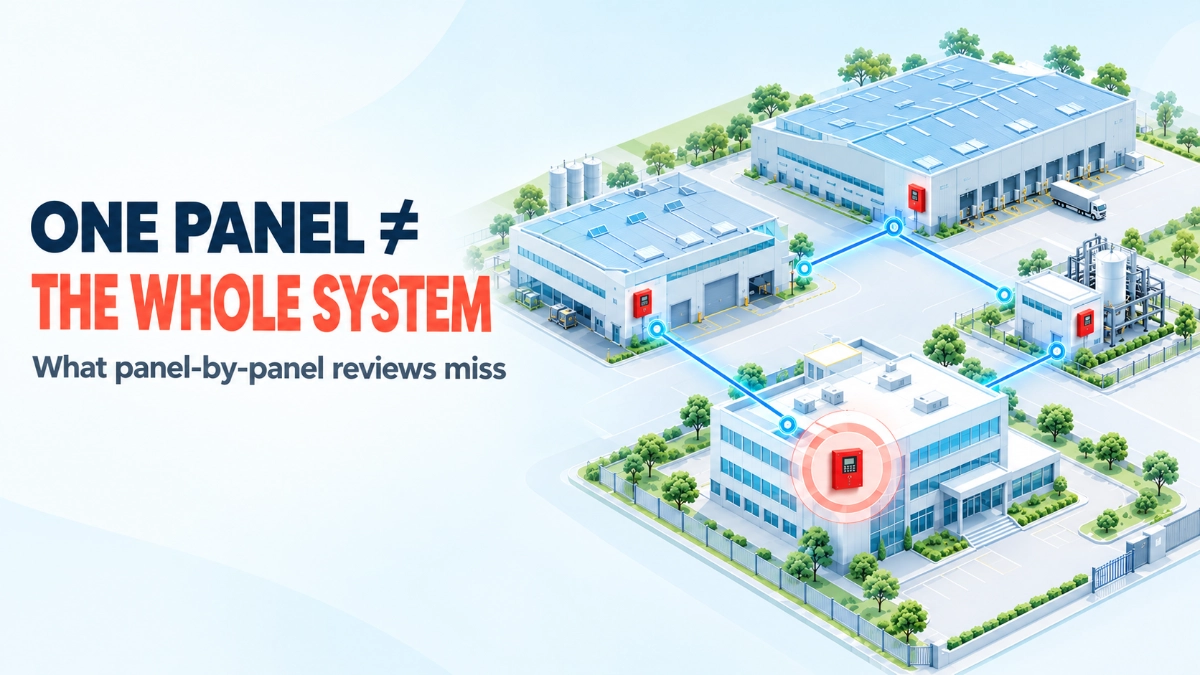
A wider review then raises different questions. How are alarm events communicated between buildings? Which team handles shared functions? Who owns each interface? Do the records still match the installed arrangement after several years of changes?
This scenario is illustrative, not a specific project. It shows the central problem: local functionality and system-level coordination are different things. Reviewing panels one at a time is necessary, but it does not always show how the complete fire alarm system architecture is intended to operate.
Reviewing a fire alarm system one panel at a time is sometimes insufficient because a panel review assesses local condition and local functions. It may not reveal dependencies between panels, cross-building interfaces, cause-and-effect sequences, monitoring paths, shared infrastructure, documentation gaps, or unclear operational responsibilities. A complete review should add a system-level check wherever the approved design or project requirements involve more than one panel, building, or interfaced system.
Why Panel-by-Panel Reviews Are Not Enough
A panel-level inspection is valuable. It can confirm the panel’s condition, its power status, its event history, and the operation of its connected devices and circuits. These checks form the foundation of any fire alarm panel inspection.
The limit is scope. Five layers should be kept distinct:
- Local panel condition: status, faults, and stored events.
- Local device and circuit function: detectors, modules, and outputs served by that panel.
- System communication: how the panel exchanges information with other panels or systems.
- Shared cause-and-effect requirements: responses that depend on more than one panel or area.
- Complete installation performance: whether all required functions work together as designed.
A normal panel status speaks mainly to the first two. It does not, on its own, show that the remaining layers have been verified. This is a limit of the method, not a criticism of panel inspections.
Five System-Level Issues Engineers Can Overlook
| Review area | What an individual panel review may miss | What to verify |
|---|---|---|
| System boundaries | Unclear responsibility between buildings or systems | Approved architecture and interface ownership |
| Communication paths | Dependencies between panels or remote monitoring arrangements | Required communication and fault indications |
| Cause-and-effect | Sequences involving multiple systems or areas | Approved cause-and-effect documentation and required verification |
| Shared infrastructure | Common power, cabling, pathways, or other dependencies | Design requirements and relevant infrastructure records |
| Documentation | Differences between drawings and the installed configuration | Current as-built records, configuration details, and change history |
These are review considerations, not proof that a particular installation has a defect. Many installations will pass every item. The purpose is to confirm that each has been checked rather than assumed.
When Individual Panels Work but the Overall Architecture Is Unclear
Each panel can pass its own checks while questions remain about how the complete arrangement behaves.
Take a hypothetical site with a production building and a utility building, each served by its own panel. Both panels are healthy. Local tests pass. Yet several questions sit outside either panel’s view:
- Is an alarm in the utility building meant to be reported at the production building, at a central location, or both?
- Which panel is responsible for reporting a supervisory or fault condition from the shared area between them?
- If a shared function exists, such as a common monitoring connection, who tested it and when?
- Do the current records show the arrangement that was approved, or an earlier version?
None of this suggests a fault exists. A multi-panel fire alarm system can be entirely correct. The point is that these answers live in the approved design, the interface records, and integrated test evidence, not in either panel’s local status.
Why System Boundaries and Inter-Panel Dependencies Matter
Boundaries define who is responsible for what, and dependencies define what must work across them.
A system-level review should establish:
- Which building or area each panel serves.
- Where one system’s responsibility ends, and another begins.
- What communication is required between panels or other systems.
- Which alarm, supervisory, and fault reporting responsibilities apply.
- How shared monitoring and escalation procedures operate.
- How building extensions, renovations, and operational changes have altered the original arrangement.
Change deserves particular attention. A new warehouse bay, a repurposed room, or a changed shift pattern can shift what the design intended. A boundary that was clear at handover may be less clear years later.
The correct architecture depends on project requirements and the approved design. There is no universal rule that all panels must be interconnected. Some facilities are properly served by independent panels; others require networked fire alarm systems. The review question is whether the installed arrangement matches what was approved and required.
Cause-and-Effect Must Be Reviewed Beyond Individual Panels
When required functions cross panel, building, or system boundaries, engineers should assess the complete approved cause-and-effect strategy, not only each panel’s local logic.
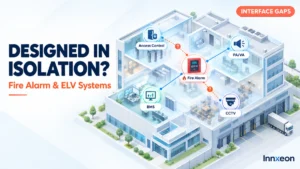
A fire alarm cause-and-effect matrix may involve inputs in one building and outputs in another. It may also involve interfaces to other systems, where applicable, such as:
- Access control.
- Emergency communication or PA/VA.
- Building management systems.
- Remote monitoring.
An important distinction applies here: an interface existing physically is not the same as its required function being verified. A cable may be terminated, and the connected equipment may be operational, yet the intended response may not have been demonstrated end to end.
This article does not prescribe universal alarm sequences. The approved design, applicable requirements, and manufacturer guidance determine the correct response for each project. The engineer’s task is to confirm that the documented sequences were tested as designed, including those spanning several panels or buildings.
What Engineers Should Verify During System-Level Testing
Check that panel results, communication, sequences, interfaces, responsibilities, and retesting have all been evidenced.
Integrated testing should be scoped from the approved design, functional impact, applicable requirements, and manufacturer instructions. A practical review covers:
- Panel-level results and event records: Confirm local tests are complete and review relevant event history.
- Communication. Verify required communication between panels and with remote systems, including fault indications.
- Cause-and-effect: Confirm approved sequences were exercised, particularly those crossing boundaries.
- Interface operation: Check that each interface performs its required function and reports faults as intended.
- Responsibility: Identify who tests each interface, especially where several contractors are involved.
- Evidence and open items: Look for records of integrated testing and any outstanding issues.
- Retesting after change: Confirm what must be retested following modifications, and whether it was.
Good records matter as much as the tests. A test that was performed but not recorded is difficult to rely on during later maintenance.
EST3, EST4, and the Wider Fire Alarm Architecture
When a facility uses EST3 or EST4 equipment, the same principle applies: checking a panel alone does not establish system-wide performance.
The appropriate review should consider:
- The actual installed configuration.
- The approved design.
- Documented interfaces.
- System boundaries.
- Applicable manufacturer guidance.
Capabilities, compatibility, capacity, and topology for any specific installation should be confirmed from the manufacturer’s current documentation and the project design. A review should not assume them. The goal is to understand how a given site was designed and configured, not to generalise about a platform.
For broader planning, the EST Fire Alarm System should be understood as part of the complete architecture, including how its panels, devices, and interfaces are meant to work together on that particular project.
Why EST Devices and Documentation Must Be Reviewed in Context
Field devices, device locations, panel assignments, circuit or loop information, interface records, and as-built drawings together describe the installed system. Each is a piece of the wider picture.
A device can be correctly installed and functioning locally while the wider documentation, or its intended system relationship, still needs verification. For example, a detector may respond correctly at its panel, but the records may not show which area it protects, which sequence it contributes to, or whether a relocation was captured.
When reviewing EST Detectors and Devices, check device addressing and location records against the as-built drawings. Then confirm that panel assignments and any interface records match what is actually installed. Differences between these sources are worth resolving early, because they complicate fire alarm system maintenance and later modification.
A Practical Framework for Reviewing the Complete System
This seven-step framework suits design reviews, commissioning reviews, and existing-system assessments.
- Map: Identify panels, protected areas, system boundaries, and relevant interfaces.
- Trace: Establish the required communication and functional dependencies.
- Compare: Check the installed arrangement against approved drawings and documentation.
- Verify: Review required panel-level and integrated test evidence.
- Assign: Clarify responsibility for each interface and unresolved issue.
- Document: Record findings, configuration differences, changes, and corrective actions.
- Maintain: Preserve the system-level information needed for future service, expansion, and troubleshooting.
The framework identifies what is known, what is documented, and what remains unverified. It does not presume that anything is wrong, and it does not lead automatically to replacing equipment.
Common Mistakes to Avoid
- Treating a normal panel status as proof of complete system performance.
- Reviewing panels without understanding system boundaries.
- Assuming every interface is verified because its connected equipment is operational.
- Overlooking changes made after the original commissioning.
- Relying on outdated drawings or incomplete configuration records.
- Failing to assign ownership for interface testing.
- Recommending wholesale replacement before identifying the actual problem.
Key Takeaways
- Panel-level inspection verifies local condition and function. It is necessary but not always sufficient.
- System boundaries, communication paths, and shared infrastructure need their own review.
- An interface that exists physically has not necessarily been verified functionally.
- Cause-and-effect should be assessed against the approved design wherever it crosses panels or buildings.
- Current as-built records and change history support maintenance and future modification.
- A review should identify actual issues before any equipment is considered for replacement.
Technical product support and early coordination help projects keep this information consistent. As an EST Fire Alarm System Distributor in India, Innxeon supports fire alarm and ELV projects with product guidance, system planning input, and coordination between project stakeholders. Final architecture decisions remain with the project’s approved design and applicable requirements.
Read Also: What Happens When Fire Alarm and ELV Systems Are Designed in Isolation?
Read Also: How False Alarm Patterns Can Point Toward Environmental Changes