If you manage a building, oversee a fire safety project, or work as a system integrator, you have probably heard the terms “commissioning” and “functional testing” used almost interchangeably. They are not the same activity, and mixing them up can leave a fire alarm system technically installed but practically unreliable.
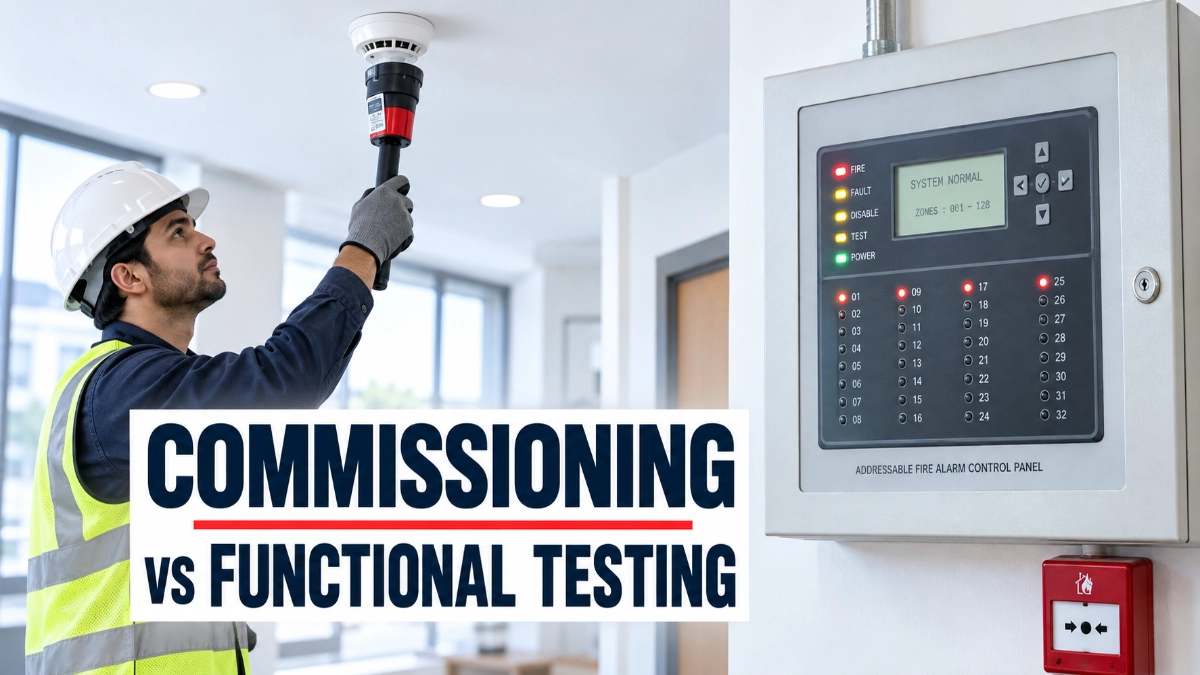
This article explains what each term means, how the two activities differ, who performs them, and why a building owner or facility manager should never accept one as a substitute for the other.
Commissioning vs Functional Testing
Fire alarm commissioning is the complete process of verifying that a newly installed fire alarm system is correctly installed, configured, programmed, and ready for operational use. Functional testing is a narrower activity: the physical, device-by-device verification that individual components (detectors, call points, sounders, interfaces) actually trigger the correct response when activated.
In short: functional testing is one part of a much larger commissioning process. Commissioning cannot be considered complete without functional testing, but functional testing on its own is not commissioning.
What Is Fire Alarm Commissioning?
Fire alarm commissioning is the structured process of confirming that every element of a fire alarm system, from wiring to software logic, works together as designed before the system is handed over for use. It sits at the end of the installation phase and before ongoing maintenance begins.
A commissioning engineer typically verifies:
- System installation verification: Checking that devices are mounted correctly, cabling meets specification, and installation matches the approved design drawings.
- Device and equipment configuration: Confirming that detectors, call points, sounders, and modules match the project’s device schedule.
- Wiring and connections: Testing loop resistance, earth continuity, and connection integrity.
- Panel programming: Loading the correct system configuration into the fire alarm control panel.
- Device addressing: Ensuring every addressable device reports correctly to the panel with the right zone and location label.
- Cause-and-effect logic: Verifying that a specific trigger (for example, a detector in a plant room) produces the intended output (for example, shutting down an AHU or releasing a fire door).
- Notification appliances: Confirming sounders, strobes, and voice evacuation devices operate as designed.
- Input/output interfaces: Checking connections to lifts, HVAC, access control, and fire suppression systems.
- Power supplies and batteries: Testing mains supply, standby battery capacity, and charging circuits.
- Integration with other building systems: Confirming the fire alarm system communicates correctly with building management systems where applicable.
- Documentation: Compiling as-built records, test certificates, and configuration data.
- Overall system readiness: A final sign-off confirming the system is fit to be handed over.
Commissioning is, in effect, an engineering audit of the entire installation. It answers the question: “Has this system been built and configured correctly?”
What Is Functional Testing?
Functional testing is the hands-on activity of physically operating fire alarm devices to confirm they respond correctly. It is practical and device-specific rather than system-wide.
Typical functional testing activities include:
- Manual call point activation: Pressing each call point to confirm it registers correctly at the panel.
- Smoke detector testing: Using approved test aerosol or a smoke test tool to confirm detector response.
- Heat detector testing: Using a heat source or test tool appropriate to the detector type.
- Alarm notification testing: Confirming sounders, beacons, and voice systems activate as expected.
- Fault and supervisory signal testing: Disconnecting or isolating a device to confirm the panel correctly reports a fault rather than staying silent.
- Input/output testing: Checking that a specific trigger produces its intended output, device by device.
- Alarm transmission testing: Where a system is connected to a monitoring station or fire brigade interface, confirming the signal is transmitted correctly.
- Interface testing: Confirming that connected systems (lift homing, door release, HVAC shutdown) respond to the correct trigger.
- Cause-and-effect verification at device level: Physically confirming, one device at a time, that programmed responses actually occur.
Functional testing produces the raw evidence pass/fail results for individual devices and functions that feed into the broader commissioning sign-off.
Fire Alarm Commissioning vs Functional Testing: Key Differences
| Aspect | Commissioning | Functional Testing |
|---|---|---|
| Purpose | Confirm the entire system is correctly installed, programmed, and ready for use | Confirm individual devices and functions respond correctly |
| Timing | Performed once, after installation and before handover; also after major upgrades | Performed as part of commissioning, and repeated periodically during maintenance |
| Scope | System-wide: wiring, programming, integration, documentation | Device-level and function-level |
| Main objective | System readiness and formal acceptance | Verified, working responses from specific components |
| Typical activities | Panel programming, addressing, cause-and-effect setup, integration checks, documentation | Activating call points, testing detectors, checking sounders, verifying interfaces |
| Personnel involved | Commissioning engineer, system integrator, sometimes a third-party verifier | Testing technician, installer, or maintenance engineer |
| Documentation produced | Commissioning report, as-built drawings, configuration records | Test result sheets, device test logs |
| Outcome | System accepted and handed over for operational use | Confirmation that specific devices or functions pass or fail |
Is Functional Testing Part of Fire Alarm Commissioning?
Yes. Functional testing is a required component within the commissioning process, not a separate or competing activity. A commissioning engineer cannot sign off a system as ready without functional test evidence for the devices and interfaces involved.
However, functional testing also continues after commissioning, as part of routine periodic testing and maintenance. This is where confusion often arises: the same testing activity (for example, activating a smoke detector) happens both during commissioning and later during scheduled maintenance visits, but the context and purpose differ.
What Happens During a Typical Fire Alarm Commissioning Process?
- Pre-commissioning checks: Reviewing installation drawings, device schedules, and cable test records.
- Panel configuration: Loading zone maps, device addresses, and cause-and-effect programming.
- Loop and wiring verification: Confirming loop integrity and correct polarity.
- Device-by-device functional testing: Activating each detector, call point, and interface.
- Cause-and-effect confirmation: Verifying that programmed responses trigger correctly across the building.
- Integration testing: Checking interfaces with lifts, access control, suppression, and HVAC systems.
- Battery and power supply verification: Confirming standby duration and charging performance.
- Documentation compilation: Assembling test records, as-built drawings, and configuration files.
- Handover and sign-off: Formal acceptance by the client or their representative.
What Happens During Functional Testing?
- Identify the device or function to be tested from the device schedule.
- Activate the device using an appropriate test method (test aerosol, heat source, manual activation).
- Confirm the correct signal appears at the fire alarm control panel, including the correct zone and device identification.
- Confirm the correct output occurs: sounder activation, interface trigger, or transmission signal.
- Record the result (pass, fail, or remark) against the device on the test sheet.
- Reset the device and panel before moving to the next test.
- Repeat systematically until every device and interface on the schedule has been tested.
Real-World Example
Consider a mid-sized hotel installing a new addressable fire alarm panel across eight floors. During commissioning, the system integrator programs each floor as a separate zone, sets up cause-and-effect logic so that a fire on any floor releases the corridor fire doors and recalls the lifts to the ground floor, and configures interfaces with the building’s HVAC system.
Functional testing then follows: a technician tests every smoke detector on every floor, confirms each call point registers at the correct zone, checks that the lift recall actually occurs when a detector in the lift lobby is triggered, and verifies the standby battery holds charge for the required duration. Only once all these individual tests pass, and the documentation is compiled, does the commissioning engineer issue a formal handover certificate. The hotel’s facility manager then relies on periodic functional testing, as part of ongoing maintenance, to keep the system reliable over its service life.
Common Mistakes During Fire Alarm Testing and Commissioning
- Testing without verifying installation first: Functional tests can pass even when wiring or device placement does not match the design.
- Incorrect device identification: A detector that alarms correctly but reports the wrong zone or location undermines emergency response.
- Ignoring cause-and-effect logic: Confirming individual devices work is not the same as confirming the system responds correctly as a whole.
- Incomplete documentation: A verbal confirmation that “everything works” is not a substitute for signed test records.
- Not testing interfaces: Lift recall, door release, and HVAC shutdown functions are sometimes overlooked because they are less visible than sounders and detectors.
- Treating a basic alarm test as complete commissioning: Pressing a few call points is functional testing, not commissioning.
- Failing to retest after changes: Any modification to wiring, programming, or device layout should trigger a retest of the affected areas.
- Ignoring backup power: Battery capacity and charging performance are frequently under-checked.
- Poor handover records: Missing as-built drawings or configuration backups create problems for future maintenance.
Why Both Commissioning and Functional Testing Matter
Installation, commissioning, functional testing, and maintenance form a continuous chain. Installation puts equipment in place. Commissioning verifies that the whole system wiring, programming, integration, and documentation are correct and ready. Functional testing supplies the device-level evidence that commissioning relies on. Ongoing maintenance then repeats functional testing periodically to confirm the system continues performing as intended.
Skipping or shortcutting any one stage weakens the others. A system that passes functional tests device by device but was never properly commissioned may still have incorrect cause-and-effect programming. A system that was commissioned years ago but never functionally retested may have devices that have since failed or drifted out of calibration.
What Documentation Should Be Available After Commissioning and Testing?
Good documentation practice generally includes:
- Test records: Device-by-device functional test results.
- Commissioning reports: A formal summary confirming system readiness.
- Device lists: A schedule of all installed detectors, call points, sounders, and modules with addresses and locations.
- Cause-and-effect documentation: The programmed logic linking triggers to outputs.
- As-built drawings: Updated drawings reflecting the actual installed system.
- Configuration records: Backups of panel programming.
- Fault and test results: Any faults identified and their resolution.
- Handover documentation: Signed acceptance records from the client or their representative.
- Maintenance recommendations: Guidance for the ongoing testing and servicing schedule.
Some of these documents may be specifically required by a project specification, a client’s insurer, or an applicable code of practice. Others, such as maintaining a configuration backup, are sound engineering practice regardless of whether a standard explicitly demands it. Confirm project-specific documentation requirements with the relevant design consultant or authority having jurisdiction, since requirements can vary by project and location.
Final Takeaway
Commissioning and functional testing are related but distinct stages in getting a fire alarm system ready for reliable use. Commissioning is the complete verification and acceptance process for the whole system; functional testing is the practical, device-level evidence that supports it. Treating the two as interchangeable or assuming a quick round of device testing counts as full commissioning leaves gaps that are easy to overlook until the system is actually needed.
For facility managers and building owners working with either a new conventional fire alarm panel or a modern addressable fire alarm panel, insisting on a clear commissioning process, complete functional test records, and proper handover documentation is one of the most practical steps toward a dependable fire alarm system. Established manufacturers such as GST, with a long-standing presence in addressable detectors and conventional detectors for commercial and industrial applications, are often specified precisely because their systems are well documented and support structured commissioning workflows, a point worth discussing with your GST fire alarm system distributor in India when planning a new installation or upgrade.
Read Also: When Should an Existing GST Fire Alarm System Be Upgraded?
Read Also: GST Fire Alarm Maintenance: Which Problems Should Be Treated as Patterns?