Introduction
For years, enterprises evaluated CCTV cameras mainly by image quality, resolution, night vision, storage capacity and reliability. Those specifications still matter, but they are no longer enough.
Artificial intelligence is changing what businesses expect from video surveillance.
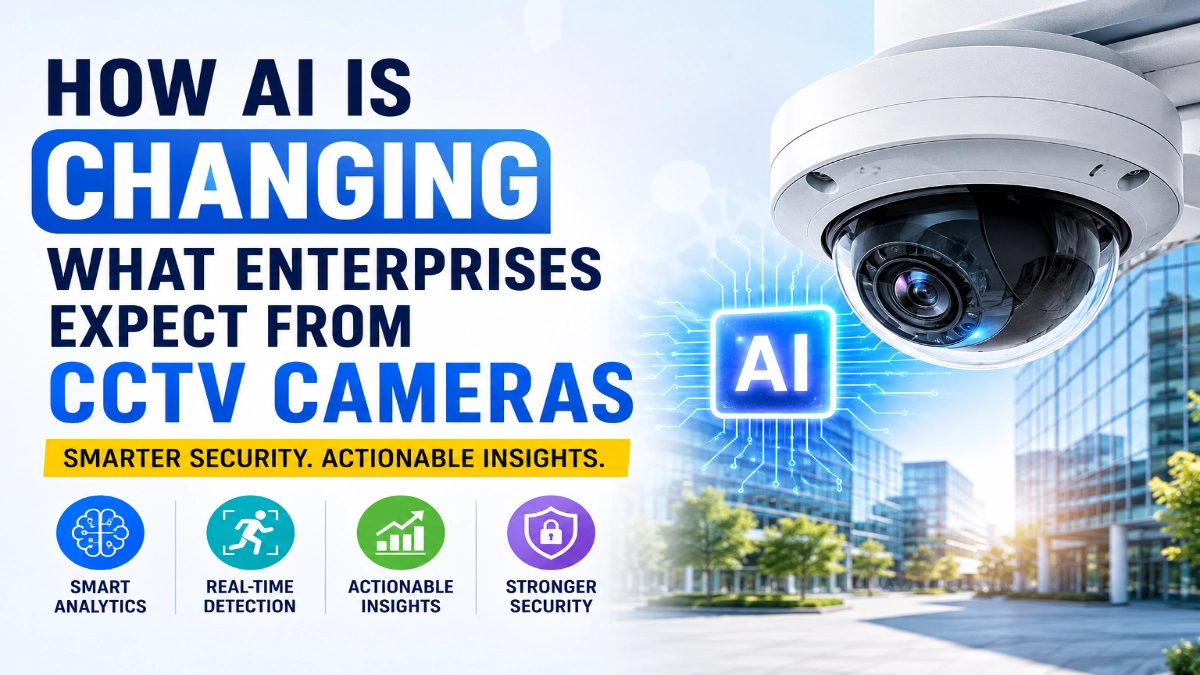
A modern enterprise does not simply want a camera that records what happened. It increasingly wants a system that can identify what matters, understand events, reduce unnecessary alerts and help security teams respond faster.
This shift is moving CCTV from passive recording toward intelligent video infrastructure. AI-powered cameras can detect and classify objects, analyse scenes, generate metadata and trigger events based on predefined rules. Edge-based processing can also perform analytics closer to where video is captured, reducing dependence on centralised processing for some use cases.
For engineers, consultants and facility managers, this means CCTV procurement is becoming less about asking “How many megapixels does this camera have?” and more about asking:
“What useful information can this camera generate, and how will the enterprise use it?”
What Is AI Changing in Enterprise CCTV?
AI adds a layer of intelligence to conventional video surveillance.
A traditional CCTV camera primarily captures and transmits video. An AI-enabled camera or video analytics platform can analyse that video to identify objects, events, patterns or predefined behaviours.
Depending on the system architecture, analytics may run:
- Directly on the camera
- On an NVR or recording platform
- On a dedicated analytics server
- In the cloud
- Through a hybrid architecture
Modern systems can use AI to detect people and vehicles, count objects, identify movement patterns, monitor zones and generate event metadata. ONVIF’s Profile M, for example, provides standardised ways to communicate analytics metadata and events between devices, VMS platforms and other systems.
The result is a fundamental change in the role of CCTV.
The camera is becoming a data source, not just a recording device.
1. Enterprises Now Expect Cameras to Understand Scenes
Motion detection was once considered an advanced surveillance feature.
But basic motion detection answers a relatively simple question:
“Did something move?”
AI analytics can answer more useful questions:
- Was the moving object a person or vehicle?
- Did someone enter a restricted zone?
- Did a vehicle cross a defined line?
- Are people gathering in a particular area?
- Has an object been left unattended?
- Is a specific event occurring repeatedly?
This distinction is important because enterprise security teams cannot investigate every movement detected by hundreds of cameras.
AI-based object classification and scene analysis can help filter events and direct attention toward incidents that matter. Honeywell, for example, describes AI-enabled video analytics that can support object detection, behavioural analysis, people counting, occupancy monitoring and other enterprise use cases.
What this means for engineers
When evaluating an AI camera, do not stop at the phrase “AI-enabled.”
Ask:
- What objects can it classify?
- Which analytics are actually supported?
- Are analytics processed on the camera or elsewhere?
- Can rules be configured by zone?
- Can events trigger alarms or other systems?
- Can metadata be exported to a VMS or third-party platform?
The answers are far more useful than an AI label on a product datasheet.
2. Edge AI Is Becoming an Important Design Consideration
One of the biggest changes in enterprise surveillance is the growth of edge analytics.
In an edge architecture, the camera performs some analysis locally rather than sending every analytical task to a centralised server.
This can provide several advantages.
Lower latency
The camera can analyse an event close to the point of capture, allowing faster detection and response.
Reduced dependence on servers
When suitable analytics run directly on cameras, organisations may reduce the amount of centralised processing infrastructure required for specific applications.
Better scalability
Large deployments can contain hundreds or thousands of cameras. Distributing analytics across capable edge devices can help avoid placing the entire processing burden on a central server.
More efficient data handling
Not every video event needs the same level of attention. AI can help identify relevant events and associated metadata rather than requiring operators to manually inspect every recorded minute.
Edge analytics has become increasingly capable as camera processing hardware and deep-learning technologies have improved.
However, edge AI is not automatically the best architecture for every project.
Engineers should compare camera-side, NVR-side, server-side, cloud and hybrid analytics based on camera count, bandwidth, storage, latency, cybersecurity, analytics requirements and lifecycle cost.
3. CCTV Is Moving From Security Data to Business Intelligence
This is perhaps the most significant change.
Enterprises are beginning to ask whether their CCTV infrastructure can provide useful operational information in addition to security evidence.
For example, video analytics can potentially support:
- People counting
- Occupancy monitoring
- Queue analysis
- Vehicle counting
- Traffic-flow analysis
- Restricted-area monitoring
- Perimeter protection
- Operational anomaly detection
- Business trend analysis
Metadata makes this possible by adding structured information to video. Instead of searching manually through hours of recordings, operators can use analytics-generated information to locate relevant footage or identify patterns. ONVIF notes that analytics metadata can support applications such as object counting, heat mapping, visitor statistics and event-driven workflows.
This creates a new expectation:
Enterprise CCTV should produce information that can support decisions, not just evidence that can be reviewed afterward.
For system designers, this means CCTV increasingly needs to be considered alongside access control, building management, network infrastructure and other enterprise systems.
4. False Alerts Are Becoming a Bigger Procurement Concern
A surveillance system that generates hundreds of irrelevant alerts can overwhelm security personnel.
This is why AI-based classification matters.
Traditional motion detection may trigger because of:
- Moving shadows
- Animals
- Rain
- Vegetation
- Lighting changes
- Reflections
- Non-critical movement
AI analytics can classify objects and apply more specific rules. Depending on the technology and deployment environment, this can help reduce unnecessary alarms and focus operators on events that better match the organisation’s security requirements.
But engineers should avoid assuming that AI means zero false alarms.
Accuracy depends on factors such as:
- Camera placement
- Lighting
- Image quality
- Scene complexity
- Detection distance
- Object size
- Camera angle
- Analytics model
- Environmental conditions
- Configuration
A well-designed AI surveillance system therefore combines good camera positioning with appropriate analytics, rather than relying on AI alone.
5. Enterprises Expect CCTV to Integrate With Other Systems
Standalone surveillance is becoming less attractive for complex facilities.
An enterprise may want CCTV events to interact with:
- Access control
- Intrusion detection
- Fire and life-safety workflows
- Visitor management
- Building management systems
- Parking systems
- VMS platforms
- IoT applications
- Security operations platforms
This is where interoperability becomes important.
Open standards and structured metadata can help different systems exchange information more effectively. ONVIF Profile M, for instance, was designed to standardise analytics metadata and event communication between analytics-capable devices and client systems.
Engineering question to ask
Before selecting an AI CCTV solution, ask:
“Can the analytics generated by this camera be consumed by the rest of our security ecosystem?”
A powerful camera that cannot communicate effectively with the enterprise’s VMS or other systems may create more problems than it solves.
6. Cybersecurity Is Becoming Part of Camera Selection
An intelligent CCTV camera is also a network-connected computing device.
That changes the cybersecurity conversation.
Enterprises should evaluate areas such as:
- Secure device configuration
- Authentication
- Encryption
- Firmware security
- Signed updates
- Network segmentation
- User access controls
- Secure remote management
- Vulnerability management
- Audit logging
Modern enterprise surveillance platforms increasingly treat cybersecurity as part of the overall system design rather than an optional feature. Honeywell, for example, highlights secure architecture and encryption capabilities across some of its AI camera offerings.
For IT and security teams, this means a CCTV camera should be treated much like other connected infrastructure.
Do not evaluate AI capabilities without evaluating the security of the device running them.
7. Camera Specifications Are Becoming More Application-Specific
AI does not eliminate the importance of conventional camera specifications.
Resolution, dynamic range, low-light performance, lens selection, IR performance, frame rate and compression still influence surveillance quality.
But enterprises increasingly need to select specifications according to the analytics application.
For example:
A camera designed for general indoor monitoring may have different requirements from one used for:
- License plate capture
- Perimeter intrusion detection
- Warehouse monitoring
- Traffic management
- People counting
- Industrial environments
- Large outdoor areas
This is why simply choosing the highest-resolution camera is not always the correct engineering decision.
The right question is not “What is the highest specification?” but “What specification supports the intended use case?”
8. NVRs Are Also Becoming More Intelligent
AI is not limited to cameras.
The NVR is evolving from a storage appliance into a more intelligent component of the surveillance architecture.
Depending on the platform, an NVR may support capabilities such as:
- Analytics processing
- Event management
- Intelligent search
- Metadata handling
- Recording management
- Camera health monitoring
- User permissions
- Centralized configuration
This creates another important procurement question:
Should analytics run on the camera, the NVR, a dedicated server, or a combination of these?
The answer depends on the project.
For enterprises planning centralised recording and analytics, evaluating Impact by Honeywell NVR’s alongside compatible cameras can be part of a broader system-design discussion rather than treating the NVR as simply a storage device.
9. Bullet and Dome Cameras Still Have Different Roles
AI does not make camera form factor irrelevant.
The choice between bullet and dome cameras should still depend on the environment, mounting position, field of view, vandal-resistance requirements, aesthetics and intended analytics.
For example:
Bullet cameras
Bullet cameras can be useful where directional coverage is required, including outdoor perimeters, entrances, driveways and specific monitoring zones.
Dome cameras
Dome cameras are commonly considered for indoor environments, offices, retail spaces, corridors and areas where a more discreet form factor is preferred.
The important point is that AI analytics should be considered together with physical camera design.
When evaluating an Impact by Honeywell bullet camera or Impact by Honeywell dome camera deployment, engineers should first define the surveillance objective, scene conditions and analytics requirements before selecting the form factor.
10. Enterprises Are Looking for Future-Proof CCTV Investments
CCTV systems often remain operational for years.
That makes future scalability important.
A camera selected today may eventually need to support:
- New analytics applications
- Additional integrations
- Higher security requirements
- Larger deployments
- New VMS platforms
- More advanced AI capabilities
Therefore, enterprises should evaluate whether a camera platform can accommodate future requirements.
Look beyond today’s feature list and consider:
- Processing capability
- Firmware lifecycle
- Analytics support
- API availability
- Standards compatibility
- Cybersecurity roadmap
- VMS compatibility
- Storage architecture
- Expansion options
The objective is not to buy the most complicated system.
It is to avoid creating a surveillance architecture that becomes difficult or expensive to upgrade.
What Should Engineers Check Before Buying AI CCTV Cameras?
A practical enterprise evaluation can use this checklist:
| Evaluation Area | Key Question |
|---|---|
| Image quality | Is the image suitable for the intended scene? |
| Analytics | Which AI functions are actually required? |
| Processing | Should analytics run at the edge, NVR, server or cloud? |
| Accuracy | How does the system perform in the real installation environment? |
| Integration | Can events and metadata integrate with the existing VMS? |
| Cybersecurity | How is the camera protected and managed? |
| Network | Can the infrastructure support the required video streams? |
| Storage | How will recording and analytics affect storage requirements? |
| Scalability | Can the architecture support future cameras and sites? |
| Lifecycle | What are the long-term maintenance and upgrade requirements? |
This approach prevents a common mistake: buying AI as a feature instead of designing AI as part of the surveillance system.
How AI Changes the Role of the CCTV Camera
The evolution can be summarised simply:
Traditional CCTV
Camera → Video → Recorder → Human Review
AI-enabled CCTV
Camera → Video + Analytics → Metadata/Events → Automated Alerts → Human Decision
Enterprise intelligent surveillance
Camera → AI Analytics → VMS/NVR → Access Control/IoT/Business Systems → Actionable Intelligence
The third model represents the direction in which many enterprise surveillance architectures are moving.
AI does not remove the need for security professionals. Instead, it can help them spend less time searching through irrelevant footage and more time responding to meaningful events.
Conclusion: CCTV Is Becoming an Intelligent Enterprise Sensor
AI is changing the expectations surrounding CCTV.
Enterprises no longer need cameras that simply record everything and leave humans to find the important moments. They increasingly expect surveillance systems to detect, classify, organise, communicate and generate useful intelligence.
That does not mean every enterprise needs the most advanced AI camera available.
Instead, engineers should begin with the operational problem and work backwards:
What needs to be detected? Where does it need to be detected? How quickly must the system respond? Where should analytics run? How will the event integrate with existing systems? And how will the architecture remain secure and scalable?
This approach produces better surveillance designs than choosing cameras based only on megapixels or a long feature list.
For organisations evaluating enterprise surveillance products, exploring the broader Impact by Honeywell CCTV portfolio can help when comparing camera form factors, recording infrastructure and intelligent surveillance requirements. Product selection should still be based on the specific application’s technical and operational needs.
The bigger lesson is clear:
The future of enterprise CCTV is not simply higher-resolution video. It is video that can generate useful intelligence.
As AI capabilities continue to mature, the most valuable CCTV system will be the one that connects high-quality video with reliable analytics, secure infrastructure and clear operational outcomes.
Read Also: The CCTV Design Mistakes That Can Make Expensive Cameras Less Effective
Read Also: Video Intelligence vs Traditional CCTV Monitoring