A camera on a warehouse ceiling used to have one job: record footage that someone might review after something went wrong. That model is disappearing fast. Across plants, distribution centres, and freight yards, the same lenses that once fed a guard’s monitor wall now feed machine learning models that count pallets, flag a missing hard hat, and predict when a conveyor motor will fail, all before a human ever looks at the screen.
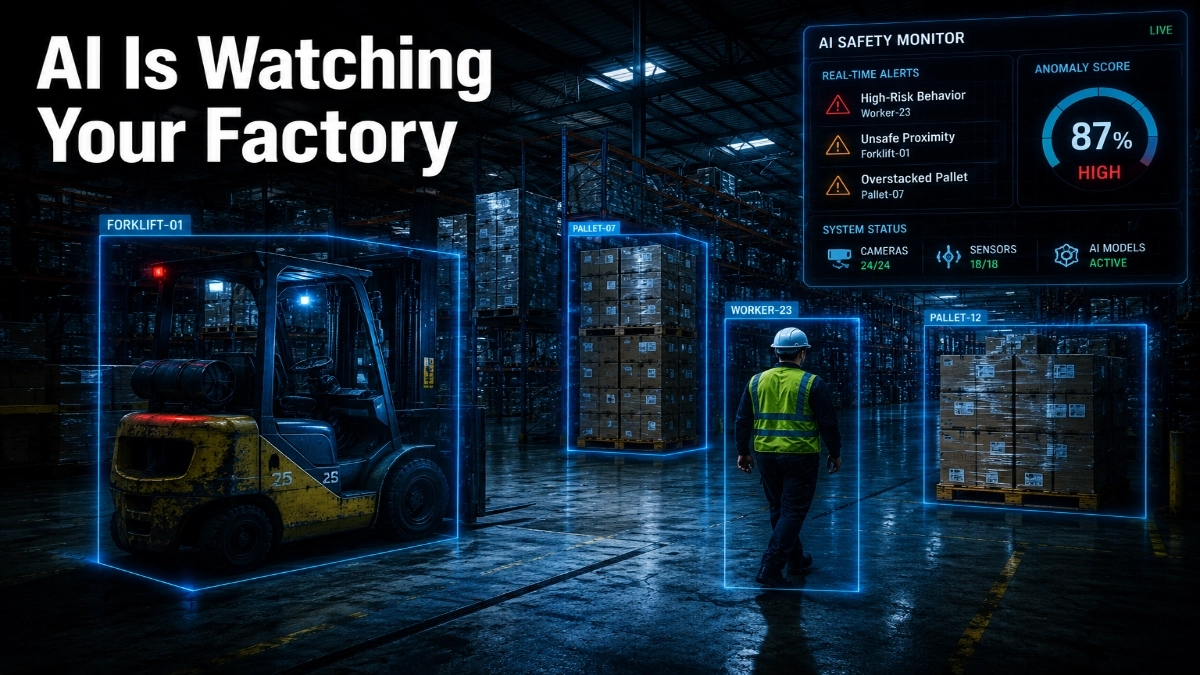
This shift, often called video intelligence, is becoming one of the most consequential technology layers in industrial operations, reshaping how manufacturing leaders and logistics operators think about safety, quality, and throughput.
From CCTV to Cognitive Vision: How Industrial Monitoring Evolved
Traditional CCTV was built for one purpose: forensic review. Footage sat on a DVR, consumed storage, and only mattered after an incident.
Video intelligence inverts that model. Instead of passive recording, AI-powered systems analyse every frame as it arrives, recognising objects and comparing what they see against expected behaviour in real time. A forklift drifting into a pedestrian lane or a pallet stacked outside its marked zone gets flagged in seconds, not discovered the next morning.
This mirrors a broader industrial trend: the move from reactive monitoring to proactive operations. Plants that once relied on periodic audits now have a continuous, automated set of eyes watching every aisle, dock door, and production cell.
What Computer Vision Actually Does on the Plant Floor
Computer vision is the branch of AI that lets a machine interpret visual data the way a trained human observer would, without fatigue, blind spots, or shift changes. In an industrial setting, this typically means a neural network trained to recognise specific objects, postures, or events: a person, a hard hat, a pallet jack, a torn box, a puddle on the floor.
These models run against live video streams and output structured data, a bounding box, a confidence score, a timestamp, and a location. That structured data is what makes video intelligence useful beyond security, turning it into a feed that other systems can query, just like a sensor reading.
Real-Time Anomaly Detection: Catching Problems Before They Escalate
Anomaly detection is where video intelligence delivers some of its clearest value. Rather than relying on predefined rules alone, modern systems learn the normal rhythm of a facility, typical foot traffic, expected machine cycles, and usual queue lengths at a dock door, and automatically flag deviations.
A line that suddenly slows or a staging area that fills up faster than usual triggers an alert before it becomes a missed shipment. For operations heads, this shrinks the gap between “something went wrong” and “someone found out.”
Workplace Safety Monitoring and PPE Compliance
Safety remains the single biggest driver of video intelligence adoption in manufacturing. A large share of industrial injuries stems from preventable lapses, such as missing protective gear, unsafe proximity to machinery, or ignored exclusion zones.
AI-powered cameras now detect whether workers are wearing hard hats, safety vests, gloves, or eye protection in zones where these are mandatory, and they do it continuously rather than during a supervisor’s occasional walk-through. Some systems extend this further, flagging unsafe lifting postures or unauthorised entry into a robotic cell.
This is not surveillance for punishment. Plants that deploy PPE monitoring well use it to coach behaviour and justify targeted safety investment, turning a camera feed into a leading safety indicator rather than a lagging one.
Forklift and Vehicle Movement Analysis
Material handling vehicles cause a disproportionate share of warehouse incidents, and OSHA has long flagged forklifts as a major source of workplace injury. Video intelligence tracks vehicle speed, turning behaviour, and proximity to pedestrians across the entire facility, not just at choke points.
Heat maps built from this data reveal where near-misses cluster and whether speed limits are actually being followed. Some systems pair vehicle tracking with geofencing, automatically alerting when a forklift enters a pedestrian-only zone or exceeds a safe speed near a blind corner.
Intrusion Detection and Perimeter Protection
Perimeter security has matured well beyond simple motion-triggered alarms. Modern systems distinguish between a stray animal, wind-blown debris, and an actual human intrusion, dramatically cutting the false alarms that used to desensitise security teams.
For distribution centres and freight yards spread across large outdoor footprints, this matters enormously. AI-driven perimeter analytics can track an intruder’s path across multiple cameras and alert security personnel with a precise location rather than a vague zone trigger. Established security technology providers have built strong reputations in this space; solutions such as Impact by Honeywell CCTV are deployed across Indian manufacturing and logistics sites specifically for this kind of layered perimeter and asset protection.
Inventory Tracking and Warehouse Visibility
Manual cycle counts are slow and often outdated within hours. Video intelligence offers a complementary layer: cameras positioned over racking and staging areas can recognise pallet positions, flag empty slots, and detect misplaced inventory without a single handheld scanner.
This visual layer doesn’t replace barcode or RFID systems; it strengthens them. When a scanner record and a camera’s visual confirmation disagree, that discrepancy becomes a useful signal, often catching shrinkage or mis-shelving long before a scheduled audit would.
Quality Control Through Video Analytics
On production lines, vision-based quality control has moved well past simple defect detection on a single part. Modern systems compare thousands of visual data points per second against trained models of an acceptable product, catching dimensional inconsistencies, surface defects, or missing components at line speed.
Crucially, this data doesn’t disappear after a part passes or fails. Aggregated over weeks, it reveals patterns: a specific shift, machine, or material batch correlating with higher defect rates, turning quality control from a pass/fail gate into a diagnostic tool for the whole process.
Predictive Maintenance: Seeing Failure Before It Happens
Vibration and thermal sensors have long supported predictive maintenance, but video adds a visual dimension that’s easy to overlook. A camera trained on a conveyor belt can detect fraying, misalignment, or unusual smoke long before a sensor threshold trips.
Combined with traditional sensor data, video-based predictive maintenance gives engineering teams a fuller picture, not just “the vibration is abnormal” but visual confirmation of exactly what’s wrong and where, which shortens diagnosis time considerably.
Operational Efficiency and Worker Productivity Analytics
Video intelligence increasingly informs process design itself. By analysing movement patterns across a facility, operations teams can see where workers walk unnecessary distances or where queues form at specific workstations.
This isn’t about monitoring individual performance done well; it’s aggregate and anonymised, aimed at redesigning layouts and workflows. A distribution centre that notices a recurring bottleneck at a specific dock door can restructure scheduling around real, observed patterns rather than assumptions.
Supply Chain Visibility Beyond the Four Walls
Video intelligence is extending past individual facilities into broader supply chain visibility. Cameras at loading docks can automatically verify load counts against shipping manifests. Yard management systems use vision to track trailer positions without manual spotting.
This connective tissue matters because supply chain disruptions are rarely caused by a single failure; they cascade. Catching a discrepancy at the dock door, rather than three stops down the chain, prevents that cascade from starting.
Smart Factories, Digital Twins, and Video-Driven Automation
Smart factory initiatives increasingly treat video as a live data source for digital twins, virtual models of a physical facility that update in real time. A digital twin fed by video intelligence reflects what’s actually happening on the floor right now, not last quarter’s averages.
This real-time grounding makes digital twins genuinely actionable. Engineers can simulate a layout change against current conditions before committing capital to a physical reconfiguration.
Edge Computing: Why Intelligence Is Moving to the Camera
Sending every video stream to a centralised data centre for processing doesn’t scale, especially across facilities with hundreds of cameras. That’s why much of the recent progress in video intelligence comes from edge computing, running AI models directly on or near the camera, so only relevant events, not raw video, get sent upstream.
This approach cuts bandwidth costs, reduces latency for time-sensitive alerts, and keeps facilities operational during network interruptions. It also addresses data governance concerns, since sensitive footage can be processed and discarded locally rather than transmitted and stored centrally.
Integration with IoT, ERP, MES, and Industrial Automation Systems
Video intelligence delivers the most value when it stops being a standalone system and becomes a data source for the rest of the operational stack. Integrating visual data with a Manufacturing Execution System lets a quality flag automatically pause a line. Linking with ERP systems allows a verified dock-door scan to trigger an inventory update without manual entry.
This integration is also where procurement decisions matter most. Facilities sourcing camera infrastructure increasingly look for vendors with proven industrial deployment experience; many Indian manufacturers, for example, work with an IMPACT by Honeywell CCTV distributor in India, to ensure hardware compatibility with existing automation and access control systems from the outset, rather than retrofitting integration later.
What the Next 5–10 Years Look Like
A few trends are converging that will define the next decade of industrial video intelligence:
- Multimodal AI will combine visual data with audio and sensor inputs, detecting unusual sounds alongside visual anomalies.
- Generative AI for video search will let operators ask plain-language questions instead of manually scrubbing footage.
- Autonomous response will expand, with systems triggering automated actions like pausing equipment or rerouting a robot around a hazard.
- Lower-cost edge hardware will make AI-grade video intelligence affordable for mid-sized facilities, not just large enterprises.
- Stronger data governance frameworks will emerge as regulators address biometric and behavioural monitoring concerns.
Facilities that begin building video intelligence capability now, even modestly, will be better positioned to adopt these capabilities without a disruptive rebuild later.
Conclusion
Video intelligence is no longer an experimental layer bolted onto security infrastructure; it’s becoming core operational infrastructure for manufacturing and logistics. The facilities pulling ahead aren’t necessarily the ones with the most cameras; they’re the ones treating visual data as seriously as they treat ERP, MES, and IoT data, integrating it into how decisions actually get made on the floor. As edge hardware gets cheaper and models get sharper, that gap between early adopters and everyone else is likely to widen quickly.
Read Also: What Happens When Surveillance Systems Become Predictive Instead of Reactive?
Read Also: Has Surveillance Technology Advanced Faster Than Surveillance Strategy?