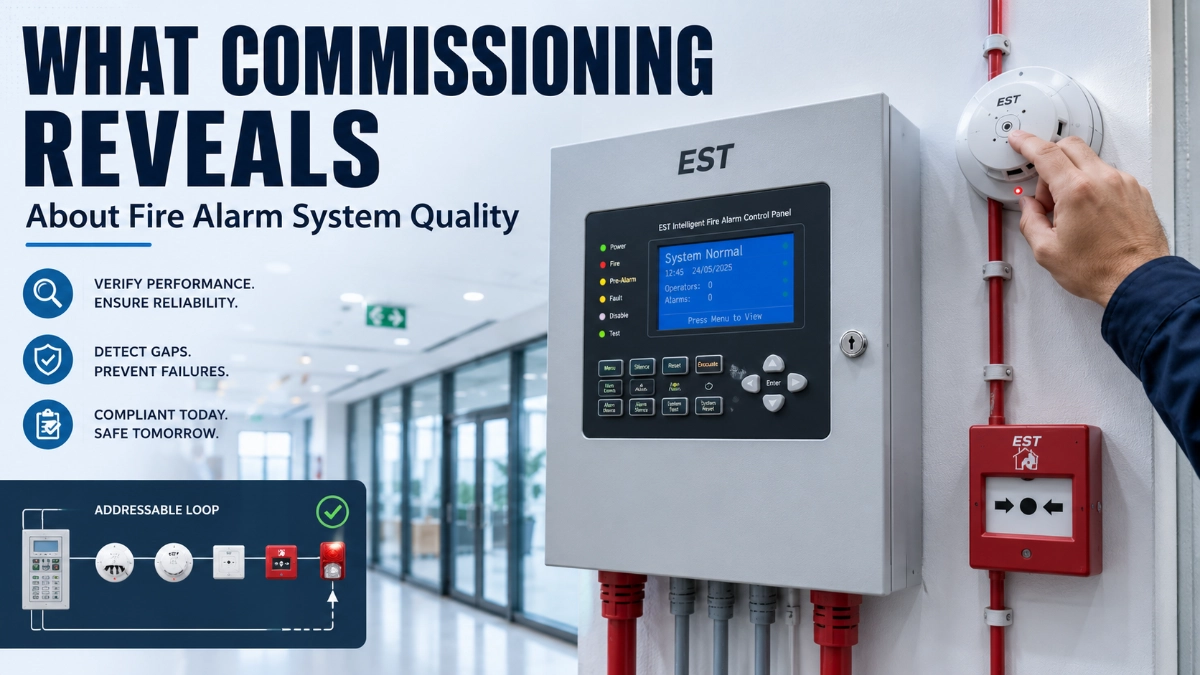
A fire alarm system may look perfectly installed, but appearances alone cannot confirm its reliability. Wiring mistakes, incorrect programming, addressing errors, and integration failures often remain hidden until commissioning begins. This final engineering phase determines whether a system is truly ready to protect lives and property.
Introduction
Every fire alarm installation looks the same on paper: conduits run cleanly, panels are mounted, and indicator lights blink as expected. But a system that “powers on” is not the same as a system that “works.” Cable dressing and device mounting tell you almost nothing about whether the loop will detect a fire correctly, whether cause-and-effect logic will trigger the right notification zones, or whether a fault will be reported accurately at the control panel.
Commissioning closes that gap. It is the structured process of testing, verifying, and documenting that every device, circuit, and program sequence performs as designed under real operating conditions, not just at power-up. For an addressable fire alarm system such as the EST Fire Alarm System, this means confirming every point on the fire alarm loop reports the correct identity, responds to the correct programming, and communicates reliably with the fire alarm control panel. Commissioning validates the entire fire protection ecosystem, not just its individual parts.
Fire alarm commissioning is the engineering process that proves a system performs as designed, not merely as installed. It combines device verification, functional testing, cause-and-effect validation, and integration testing to confirm life-safety performance before occupancy, where design intent, installation workmanship, and programming are all tested together, and a system’s true quality becomes visible.
What Is Fire Alarm Commissioning?
Fire alarm commissioning is the formal, documented process of verifying that a system’s detectors, modules, notification appliances, wiring, and programming operate according to the approved design and applicable codes.
It is distinct from installation and testing. Installation is the physical work of mounting devices, running cable, and terminating connections. Testing typically refers to individual device checks confirming a detector responds to smoke or a horn sounds. Commissioning is broader: it verifies the system as a whole, including how devices interact, how cause-and-effect sequences execute, how faults are reported, and how the system integrates with other building systems such as a Building Management System (BMS).
Commissioning is the final engineering validation because it is the only phase where the system is exercised exactly as it will operate in an actual emergency: detectors activating, control modules releasing dampers, notification appliances sounding in the correct zones, and event logs capturing every action for review.
Why Commissioning Is Essential
Commissioning matters for reasons that go well beyond satisfying an inspector’s checklist:
- Life safety: A fire alarm system’s only job is to perform correctly during the one event that matters most, and commissioning is the last chance to confirm this before a real fire occurs.
- Code compliance: Authorities Having Jurisdiction (AHJs) and standards such as NFPA 72 require documented acceptance testing before a system is placed into service.
- System reliability: Commissioning identifies intermittent faults and marginal wiring connections that basic power-up testing will not reveal.
- Performance verification: It confirms that programmed cause-and-effect logic, for example, a stairwell smoke detector triggering door release and HVAC shutdown, actually executes as designed.
- Long-term maintenance: A properly commissioned system, with accurate documentation, is easier and less costly to maintain over its lifecycle.
- Operational confidence: Facility managers and building owners need assurance the system will perform when required, not just that it passed a cursory check.
What Commissioning Reveals About System Quality
Each stage of commissioning exposes a different dimension of quality. Weaknesses invisible during installation surface immediately once real functional testing begins.
Device Addressing Accuracy
Every smoke detector, heat detector, manual call point, monitor module, and control module on an intelligent fire alarm system carries a unique address. Commissioning confirms each device’s physical location matches its programmed address. Addressing errors are among the most common and most dangerous findings, since a misaddressed device can send responders to the wrong location during an alarm.
Detector Performance
Commissioning verifies that smoke and heat detectors respond within expected sensitivity thresholds. Detectors that are contaminated, misconfigured, or affected by local airflow often reveal problems only during functional smoke or heat testing.
Loop Integrity
Fire alarm loop wiring must maintain communication integrity under fault conditions. Commissioning includes deliberate fault simulation: open circuits, short circuits, ground faults to confirm the panel correctly isolates the affected segment without losing communication with the rest of the loop.
Cause-and-Effect Programming
Cause-and-effect programming defines how the system responds to specific inputs: which notification appliances activate, which doors release, which fans shut down, and in what order. Commissioning tests this logic end-to-end, often revealing gaps between design intent and the as-programmed configuration.
Notification Appliance Operation
Horns, strobes, and voice evacuation speakers must operate at correct candela and sound pressure levels in the correct zones. Commissioning confirms coverage matches design drawings and that appliances are audible and visible where required.
Module Functionality
Monitor modules and control modules interface the fire alarm system with dampers, door holders, elevator recall, and other life-safety equipment. Commissioning verifies each module triggers its intended device correctly and reports status back to the panel.
Fault Detection
A high-quality system must reliably report faults, not just alarms. Commissioning deliberately introduces fault conditions to confirm accurate fault monitoring and annunciation at the panel and any remote annunciators.
Network Communication
For networked panels across multiple buildings or floors, commissioning validates that inter-panel communication is stable and that alarms and faults are reported system-wide as designed.
BMS Integration
Many facilities integrate fire alarm output with a Building Management System for HVAC shutdown or centralised monitoring. Commissioning confirms these integration points function correctly and that signal mapping is accurate.
Documentation Accuracy
Commissioning cross-checks as-built drawings, device schedules, and programming records against the physical installation. Documentation gaps found here often signal broader quality issues elsewhere in the project.
Common Problems Found During Commissioning
| Problem | Typical Impact | Corrective Action |
|---|---|---|
| Incorrect device addressing | Wrong location reported during alarm | Re-address device and verify against as-built schedule |
| Wiring faults (opens, shorts, grounds) | Loss of communication or false alarms | Repair termination, re-test loop integrity |
| Programming errors | Cause-and-effect sequence fails to execute correctly | Revise logic and re-test against design intent |
| Loop communication failures | Devices drop offline intermittently | Inspect splices, replace damaged cable segments |
| Notification appliance issues | Inadequate audibility or visibility coverage | Adjust device placement or candela/dB rating |
| Detector sensitivity problems | False alarms or delayed response | Clean, recalibrate, or relocate detector |
| Integration failures (BMS, access control) | HVAC or door release does not trigger on alarm | Verify signal mapping and interface wiring |
| Documentation mismatches | As-built records do not match installed system | Update documentation and device schedules |
Commissioning Workflow
A disciplined commissioning process follows a consistent sequence:
- Visual Inspection: Confirm devices match approved drawings.
- Device Verification: Check each device against the device schedule.
- Wiring Validation: Test loop resistance, insulation, and terminations.
- Address Confirmation: Verify each address matches its physical location.
- Functional Testing: Activate each device and confirm correct panel response.
- Cause-and-Effect Testing: Trigger inputs and confirm programmed outputs execute correctly.
- Integration Testing: Verify BMS, access control, and elevator/HVAC interfaces.
- Alarm Verification: Confirm notification appliances activate in correct zones and sequence.
- Fault Simulation: Introduce open circuits, shorts, and ground faults to verify reporting.
- Final Documentation: Compile test records, as-built updates, and acceptance sign-off.
How EST3 and EST4 Support Professional Commissioning
Enterprise-grade platforms such as the EST3 Fire Alarm Panel and EST4 Fire Alarm Panel are designed with commissioning workflows in mind. Their event logging captures a detailed history of alarms, faults, and programming actions, giving commissioning engineers a clear audit trail. Built-in device diagnostics support faster identification of wiring or addressing issues on the fire alarm loop, while intelligent addressing simplifies matching physical devices to their programmed identities.
Network visibility features also make it easier to verify communication across multi-panel installations, and structured fault reporting helps teams confirm fault monitoring functions correctly across the range of EST Detectors and Devices, including smoke detectors, heat detectors, manual call points, and monitor and control modules. None of this replaces rigorous testing, but it makes the verification process more transparent and easier to document. Facilities sourcing these platforms typically work with an authorised EST Fire Alarm System Distributor in India to ensure devices, documentation, and commissioning support are aligned from the start.
Best Practices for Successful Commissioning
- Pre-commissioning planning: Review drawings, sequence of operations, and device schedules before testing begins.
- Documentation review: Confirm as-built drawings match the installed system before functional testing starts.
- Device labelling: Physically label every device with its address for faster troubleshooting.
- Test scheduling: Coordinate with other trades (HVAC, access control, elevators) so integration testing isn’t delayed.
- Integrated system testing: Test cause-and-effect sequences with all connected systems live, not in isolation.
- Record keeping: Maintain a formal test log for every device and cause-and-effect scenario.
- Periodic recommissioning: Re-verify performance after renovations, retrofits, or major device additions.
Common Commissioning Mistakes to Avoid
- Rushing acceptance tests to meet a deadline, skipping full cause-and-effect verification.
- Ignoring minor faults, assuming they will resolve on their own after handover.
- Incomplete documentation, leaving facility teams without accurate as-built records.
- Skipping integration testing with BMS or access control due to scheduling conflicts.
- Poor communication between trades, resulting in untested interfaces.
- Failing to simulate real emergency conditions, such as simultaneous alarms or loop faults.
Expert Insights
- Commissioning data should inform the facility’s future maintenance strategy; recurring faults found during testing often predict where service calls will occur later.
- Acceptance testing alone does not guarantee quality; it confirms devices respond, but only full cause-and-effect and integration testing confirms the system behaves correctly as a whole.
- Documentation quality during commissioning often reflects installation quality; sloppy records frequently correlate with sloppy wiring.
- Fault simulation, not just alarm testing, produces a far more accurate picture of long-term reliability.
- Systems commissioned with a structured, sequence-based workflow tend to see fewer nuisance alarms and service callbacks in their first year.
- Integration testing is frequently the weakest point, since it requires coordination across trades; projects that treat it as a formality often discover failures only after occupancy.
- A commissioning report should be a living reference document, revisited after any building modification, not a one-time compliance artefact.
Key Takeaways
- Installation quality cannot be judged visually; only commissioning proves performance.
- Commissioning validates the entire ecosystem, not individual devices in isolation.
- Device addressing accuracy is among the most common, most critical findings.
- Cause-and-effect programming must be tested end-to-end, not assumed correct.
- Fault simulation is as important as alarm testing for confirming reliability.
- BMS and life-safety integrations must be tested live, not assumed to work.
- Accurate documentation is a core deliverable, not an afterthought.
- Recommissioning after renovations preserves system integrity long-term.
Quality Indicators Verified During Commissioning
| Quality Indicator | What It Confirms |
|---|---|
| Device addressing accuracy | Correct device identity and location reporting |
| Loop integrity | Reliable communication under normal and fault conditions |
| Cause-and-effect execution | Programmed logic performs as designed |
| Notification coverage | Adequate audibility and visibility in all zones |
| Fault monitoring | Accurate reporting of wiring and device faults |
| Network communication | Stable multi-panel data exchange |
| BMS/system integration | Correct signal mapping to connected systems |
| Documentation accuracy | As-built records match installed system |
A fire alarm system’s true quality isn’t determined by how it looks installed; it’s proven by how it performs when tested. Commissioning remains the most reliable indicator of whether a fire protection strategy will function as intended when it matters most.
Read Also: Infrastructure Decisions That Reduce Fire Alarm Upgrade Costs
Read Also: The Role of System Redundancy in Modern Fire Alarm Infrastructure