Choosing a fire alarm system is not just a technical decision; it’s also a strategic one.
It is a long-term investment in safety that protects people, assets and ensures business continuity.
Many facility owners compare only the upfront price and miss the real value of reliable detection, faster response and lower lifetime maintenance.
In this guide, you will understand the total cost of ownership (TCO) versus the real value a modern system delivers.
And yes, we will focus on why a GST Fire Alarm System is often worth the investment for commercial, industrial and institutional projects.
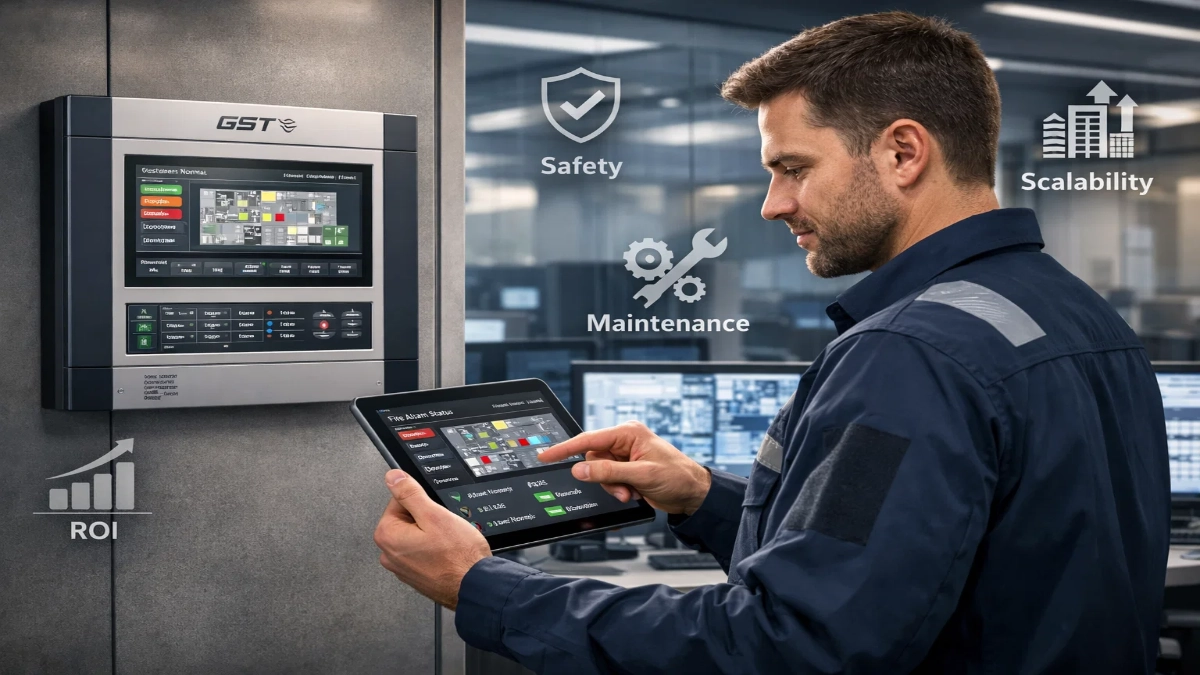
Why “Total Cost” Is Not The Same As “Price”
A fire alarm system can look affordable on paper.
But the real cost includes everything you will pay across the system’s life.
Total cost usually includes:
- Panel cost (main controller)
- Detectors and devices cost
- Cabling and installation cost
- Programming and commissioning
- Testing and certification support
- AMC (Annual Maintenance Contract) cost
- False alarm troubleshooting cost
- Spare parts and replacements
- Expansion and upgrades later
A cheaper system that fails frequently will cost more over time.
A reliable system that supports scalability and diagnostics will save money for years.
That is why smart buyers compare TCO vs Value instead of only comparing quotation totals.
What You Really Pay For In A Fire Alarm System
Let’s break down the fire alarm investment in a realistic way.
This will help you compare GST with other options fairly.
1) Panel Cost: Conventional vs Addressable
Fire alarm panels mainly fall into two types:
Conventional Fire Alarm Panel
These panels work with zones.
You know the zone, but not the exact device location.
Addressable Fire Alarm Panel
These panels identify the exact device address.
You know the exact detector or module in alarm or fault.
Cost difference: Addressable panels cost more upfront.
Value difference: Addressable panels reduce fault-finding time and support larger buildings.
2) Devices Cost: Detectors, Modules, Sounders, MCPs
Your devices make up a major percentage of the project cost.
Common devices include:
- Smoke detectors
- Heat detectors
- Manual call points (MCP)
- Sounder with strobe
- Modules for hooters, dampers, AHU shutdown and elevators
Here, the value is not just hardware pricing.
It is about detection accuracy, stability, and faster service.
3) Cabling And Installation Cost
Cabling depends on system type, distance and integration requirements.
- Conventional systems need zone wiring and more segmentation
- Addressable systems usually reduce cabling complexity in large layouts
- Loop-based designs can be easier to expand
A well-designed system reduces installation errors, which lowers commissioning delays.
4) Programming, Commissioning and Handover Cost
Many projects face cost blow-ups during commissioning.
This happens when the panel is complex or when devices are not stable.
GST systems are widely used because they support:
- Structured programming workflows
- Easier device mapping and address identification
- Clear fault reporting and diagnostics
Better commissioning means lower project delays and fewer post-handover complaints.
Why GST Is A Strong Value Choice In Real Projects
When people ask, “Is GST worth it?”, the right question is:
What value do I get across 5 to 10 years?
A GST Fire Alarm System is often chosen because it offers a practical mix of:
- Reliable detection performance
- Strong support for scalable design
- Easier service and fault tracking
- Suitable options for both small and large sites
Now, let’s compare the full value drivers.
Value Driver #1: Reduced False Alarms And Faster Troubleshooting
False alarms are expensive.
They waste time, disturb occupants and create panic-like situations.
False alarms also cost money because:
- Security teams respond
- Facility teams inspect the building
- Fire brigade calls may happen in some areas
- Business operations pause
With an addressable architecture, you can identify:
- Exact device location
- Device status history
- Fault type (open loop, short circuit, device missing)
So even if the system costs more upfront, it saves money by reducing downtime and man-hours.
Value Driver #2: Faster Fire Response And Better Life Safety
Every second matters during a real event.
A reliable system detects early and alerts quickly.
The value is not just “alarm activation.”
The value is:
- Clear identification of the fire location
- Faster evacuation decisions
- Quicker firefighting response
- Reduced property damage
This is the strongest argument for investing in a quality system.
You are not buying a product.
You are buying time and control.
Value Driver #3: Scalability Without Replacing The Whole System
Many buildings expand over time.
- New floor added
- New warehouse section built
- Additional office wing created
- Tenant fit-outs change the layout
A scalable system prevents “rip and replace” expenses.
GST addressable systems support multi-device additions more smoothly, especially when future planning is done correctly.
A low-cost system may become a bottleneck later.
Then you pay again for a second installation.
That is a double loss.
Value Driver #4: Lower Maintenance Cost Over The Lifetime
Fire alarm maintenance is not optional.
It is mandatory on most professional sites.
Your real cost depends on:
- How often do faults occur
- How quickly technicians can locate issues
- Availability of spares
- Ease of replacing devices
- Stability of loop communication
A reliable system reduces the “repeat visit” problem, where technicians need multiple visits to diagnose the same issue.
That is where GST systems deliver strong value in the long run.
Total Cost Of Ownership: A Simple Example (Realistic Scenario)
Let’s take a practical example of a medium-sized commercial building.
Scenario: Office Building (5 Floors)
- 1 fire alarm panel
- 150 detectors
- 20 MCPs
- 30 sounder strobes
- 10 control modules
Now compare two approaches:
Option A: Cheapest Low-End System
- Lower panel cost
- Lower device cost
- Limited diagnostic clarity
- More false alarms and wiring sensitivity
Likely long-term effects
- Higher maintenance hours
- More frequent replacements
- More downtime and complaints
- Higher service cost
Option B: GST Addressable System
- Higher upfront cost
- Better fault identification
- Cleaner expansion support
- Easier troubleshooting
Likely long-term effects
- Lower operational disruption
- Faster service resolution
- Stable detection and monitoring
- Better safety performance
This is why many engineers recommend GST when the total lifecycle cost matters.
Where GST Fire Alarm System Makes The Most Financial Sense
GST is worth the investment when you have any of these conditions:
1) Large Buildings With Many Devices
Addressable systems shine in complex sites.
More devices means troubleshooting time becomes a major cost factor.
2) Multi-Tenant Commercial Properties
False alarms create tenant dissatisfaction and operational issues.
Better system stability reduces noise and complaint escalation.
3) Industrial Facilities With Harsh Environments
Dust, temperature variation, and electrical noise can affect system performance.
A robust platform helps maintain stable detection.
4) Sites With Frequent Layout Changes
IT parks, corporate buildings, retail areas and campuses often change.
A scalable system saves money during expansions.
5) Projects That Need Future Integration
If you plan integration with:
- PA systems
- Access control
- HVAC shutdown
- Fire doors
- Sprinkler and pump systems
Then investing in a capable platform becomes more cost-effective.
When GST May Not Be The Best Choice
A professional evaluation includes honesty.
GST may not be necessary if:
- It is a very small shop or basic office with minimal risk
- You only need a few zones with basic detection
- Expansion is not expected, and the budget is extremely limited
In such cases, a conventional fire alarm panel may be enough.
But for growth-focused projects, addressable gives better long-term value.
Hidden Costs People Forget To Calculate
Many buyers miss these costs during procurement.
1) Cost Of Downtime
If an evacuation happens due to a false alarm, business stops.
That has a real cost, even if no money is “paid.”
2) Cost Of Poor Documentation
If device mapping is missing, technicians take more time to service.
That increases AMC and visit hours.
3) Cost Of Re-Commissioning
Some systems require significant effort when adding new loops or devices.
A scalable system saves cost here.
4) Cost Of Compliance Delays
If the fire system is not accepted during inspection, you lose time and money.
A stable system with proper commissioning reduces this risk.
GST Return On Investment: How To Measure It Properly
Instead of asking “How much cheaper is the other brand?”, ask these questions:
Question 1: How Much Service Time Will You Save?
If a fault takes 30 minutes to locate instead of 3 hours, that is a major saving.
Question 2: How Many False Alarms Can You Avoid?
Fewer false alarms mean fewer disruptions and fewer emergency responses.
Question 3: How Easy Is It To Expand The System?
If you add 50 devices next year, will it be simple or will it require replacement?
Question 4: What Is The Expected Lifespan?
A better system runs longer with fewer replacements.
When you measure ROI like this, GST becomes a value-driven investment.
Best Practices To Maximise GST Value In Your Project
If you decide to invest in GST, make sure you get the maximum value.
1) Choose The Right System Type From Day One
Do not select conventional if you plan future expansion.
Choose addressable when the device count and building size justify it.
2) Use Proper Loop Segmentation And Protection
Good design reduces faults and makes the system more reliable.
3) Maintain Proper Labeling And As-Built Drawings
Documentation saves hours during maintenance.
4) Use Quality Installation Standards
Clean joints, proper earthing and correct device placement prevent long-term issues.
5) Schedule Preventive Maintenance
A fire alarm system performs best when it is tested regularly.
Final Verdict: Total Cost Vs Value
So, is the GST Fire Alarm System worth the investment?
If you look only at upfront pricing, it may seem higher than basic alternatives.
But if you look at 5 to 10 years of ownership, GST often delivers higher value through:
- Faster troubleshooting
- Better event identification
- Fewer disruptions
- Easier expansion
- Strong compliance readiness
- Reliable life safety performance
A fire alarm system is not the place to cut corners.
Because when it matters most, you need performance, accuracy and reliability.
If you are building for long-term safety and smooth operations, GST is a smart investment.
Quick Answers People Search For
1. Is GST Fire Alarm System Worth The Investment?
Answer: Yes, GST is worth the investment if you want long-term stability, easier maintenance, scalable expansion and faster troubleshooting.
2. What Is Better: Addressable Or Conventional Fire Alarm System?
Answer: Addressable is better for medium to large buildings because it shows the exact device location and reduces troubleshooting time.
Conventional is suitable for small buildings with simple zoning needs.
3. Does A Higher Cost Fire Alarm System Save Money Long Term?
Answer: Yes, it often saves money through fewer faults, fewer false alarms, faster diagnostics and reduced downtime.
4. What Is The Biggest Advantage Of GST Addressable Systems?
Answer: The biggest advantage is improved control, faster fault identification and easier expansion without redesigning the entire system.
Read Also: Networked Fire Alarm Systems: How GST Panels Support Multi-Panel Integration
Read Also: Why Choose Innxeon Technologies for Fire Alarm Systems Across PAN India?