Fire alarm systems go far beyond basic compliance; they are critical safety infrastructures designed to protect lives and assets. However, many organisations still rely on outdated or incomplete performance metrics to evaluate them. This creates a false sense of security, leads to poor investment decisions and increases overall risk.
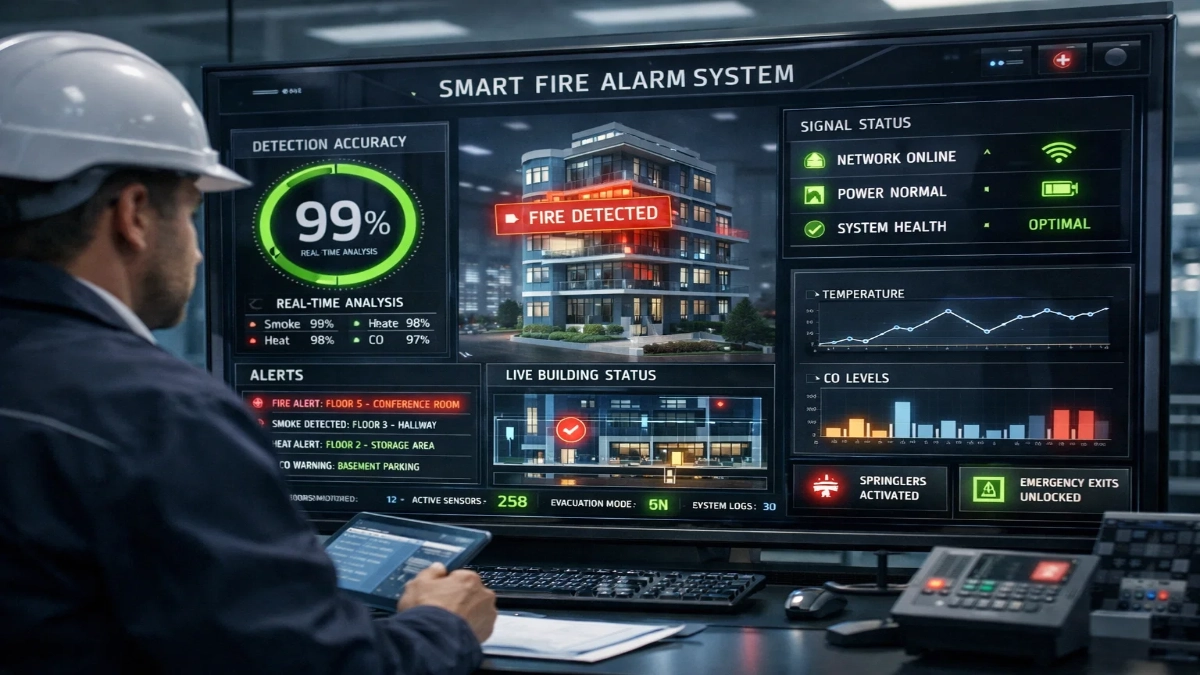
For engineers, facility managers and safety professionals, accurately measuring fire alarm system performance is essential. The real challenge is not the absence of data, but how that data is interpreted and applied in real-world scenarios.
In this article, we will break down:
- What true performance measurement looks like
- Why are commonly used metrics misleading
- How to build a more reliable evaluation framework
- Why do advanced systems like the GST fire alarm system outperform traditional setups
This guide is designed to be practical, data-driven and aligned with modern safety engineering principles.
What Does Fire Alarm System Performance Really Mean?
Fire alarm performance is not just about whether the alarm works. It is about how effectively the system detects, communicates and enables response under real-world conditions.
A high-performing system must deliver:
- Early and accurate detection
- Minimal false alarms
- Fast signal transmission
- Clear identification of the fire location
- System reliability during faults or power failures
However, most organisations reduce performance to a few oversimplified metrics, which is where problems begin.
The Most Common Fire Alarm Metrics (And Why They Mislead)
1. Alarm Activation Success Rate
This metric measures whether the alarm activates during testing.
Why it’s misleading:
- Tests are controlled environments, not real fire conditions
- Does not account for delayed detection
- Ignores false negatives in complex environments
A system can show a 100% activation rate and still fail during an actual fire due to poor detector placement or environmental interference.
2. Number of Devices Installed
Many assume that more detectors mean better coverage.
Why it’s misleading:
- Over-installation can increase false alarms
- Poor configuration reduces effectiveness
- Quantity ≠ quality
For example, blindly adding addressable detectors without proper zoning logic can create confusion during emergencies.
3. False Alarm Rate
Reducing false alarms is important, but focusing only on this metric is dangerous.
Why it’s misleading:
- Systems tuned too aggressively may ignore real threats
- Does not measure detection sensitivity
- Ignores environmental adaptability
A system with zero false alarms may actually be under-sensitive; this is a hidden risk.
4. Compliance-Based Metrics
Many facilities rely on compliance reports to judge performance.
Why it’s misleading:
- Compliance ensures minimum standards, not optimal performance
- Standards do not account for site-specific risks
- Passing audits does not guarantee operational readiness
A conventional fire alarm panel may meet compliance but lack real-time diagnostics or intelligent detection.
5. Response Time (Simplified)
Measured as the time between detection and alarm.
Why it’s misleading:
- Often excludes detection latency
- Ignores communication delays
- Does not measure human response effectiveness
True response time must include:
- Detection delay
- Signal processing
- Notification delivery
- Human action
The Right Way to Measure Fire Alarm System Performance
To truly evaluate a system, you need a multi-dimensional performance framework.
1. Detection Accuracy Index (DAI)
This measures how accurately the system identifies real fire conditions versus non-fire events.
Key factors:
- Sensor intelligence
- Environmental adaptability
- Multi-criteria detection
Advanced addressable detectors in modern systems significantly improve this metric.
2. Detection Time Under Real Conditions
Instead of lab testing, measure detection in:
- High airflow environments
- Dusty industrial areas
- Temperature fluctuations
Systems like the GST fire alarm system use adaptive algorithms to maintain detection speed across varying conditions.
3. Signal Integrity and Communication Reliability
This evaluates how reliably the system communicates alerts.
Important parameters:
- Network redundancy
- Fault tolerance
- Loop stability
An addressable fire alarm panel provides superior communication reliability compared to traditional systems.
4. Fault Detection and Self-Diagnostics
A high-performing system should identify its own issues before failure.
Measure:
- Fault detection speed
- Accuracy of fault reporting
- Maintenance alerts
Traditional conventional detectors lack this capability, making them reactive rather than proactive.
5. System Availability (Uptime)
Measure how often the system is fully operational.
Include:
- Power failures
- Network disruptions
- Device malfunctions
Modern systems with intelligent panels maintain higher uptime through redundancy and self-recovery features.
6. Actionable Alarm Quality
Not all alarms are equal. Measure whether the alarm provides:
- Exact location
- Device identification
- Severity level
An addressable fire alarm panel excels in delivering actionable data, unlike a conventional fire alarm panel, which only indicates zones.
Addressable vs Conventional Systems: A Performance Perspective
Conventional Systems
- Zone-based detection
- Limited diagnostics
- Higher false alarm rates
- Lower initial cost
Best suited for:
- Small facilities
- Low-risk environments
Addressable Systems
- Device-level identification
- Intelligent detection algorithms
- Real-time diagnostics
- Scalable architecture
Best suited for:
- Industrial facilities
- Commercial complexes
- High-risk environments
The integration of addressable detectors ensures precise and faster decision-making during emergencies.
Why the GST Fire Alarm System Stands Out
When evaluating performance beyond basic metrics, the GST fire alarm system consistently delivers superior results.
1. Intelligent Detection Technology
GST systems use advanced algorithms that:
- Differentiate between smoke types
- Reduce false alarms
- Improve detection accuracy
2. Advanced Communication Architecture
With robust loop design and network stability, GST systems ensure:
- Reliable signal transmission
- Minimal communication failure
- High system uptime
3. Real-Time Diagnostics
Unlike traditional systems, GST provides:
- Continuous health monitoring
- Predictive maintenance alerts
- Fault isolation
4. Scalable and Flexible Design
Whether you are upgrading from a conventional fire alarm panel or installing a new system, GST offers:
- Seamless scalability
- Integration with other safety systems
- Future-ready architecture
5. Reduced Total Cost of Ownership
While initial costs may be higher than conventional setups, GST systems:
- Reduce maintenance costs
- Minimise false alarm disruptions
- Improve long-term reliability
Building a Practical Performance Measurement Framework
To avoid misleading metrics, follow this structured approach:
Step 1: Define Risk-Based Objectives
- Identify fire risks specific to your facility
- Align system performance with those risks
Step 2: Use Multi-Layered Metrics
Combine:
- Detection accuracy
- Response time
- Communication reliability
- System uptime
Step 3: Test in Real Conditions
Avoid relying only on lab tests or compliance checks.
Simulate:
- Smoke variations
- Environmental disturbances
- Power failures
Step 4: Analyse Data Continuously
Use system logs and analytics to:
- Identify patterns
- Improve system configuration
- Predict failures
Step 5: Upgrade Strategically
Transition from:
- Conventional detectors → intelligent detectors
- Conventional fire alarm panel → addressable fire alarm panel
This shift significantly improves measurable performance.
Common Mistakes to Avoid
- Relying only on compliance reports
- Ignoring environmental impact on detection
- Over-prioritising false alarm reduction
- Using outdated systems in high-risk areas
- Measuring performance without real-world testing
The Future of Fire Alarm Performance Measurement
The industry is moving toward:
AI-Driven Detection
Systems that learn from environmental data and improve over time.
Integrated Safety Ecosystems
Fire alarms connected with:
- Surveillance systems
- Building management systems
- Emergency response platforms
Predictive Maintenance
Using data to prevent failures before they occur.
The GST fire alarm system is already aligned with these future trends, making it a smart investment for forward-thinking organisations.
Note: Measuring fire alarm system performance is not about ticking boxes; it is about understanding real-world effectiveness.
Most traditional metrics are misleading because they:
- Ignore environmental complexity
- Focus on surface-level data
- Fail to capture system intelligence
To truly evaluate performance, you must adopt a multi-dimensional, risk-based approach.
Upgrading to advanced solutions like an addressable fire alarm panel and investing in intelligent systems such as the GST fire alarm system ensures:
- Higher detection accuracy
- Faster response
- Better reliability
- Reduced long-term costs
In safety engineering, what you measure defines what you improve. Choose the right metrics, and you will choose the right system.
Read Also: Risk-Based Decision Making in Fire Detection System Selection
Read Also: Data Communication Between Fire Alarm and Surveillance Systems