Imagine a fire breaks out in the server room of Building C on a large hospital campus. The local fire alarm panel activates. Staff on that floor begin evacuating. But in Building A, where critical care patients are being prepped for transfer, no alarm sounds. The facilities control room has no immediate visibility. The security team in the main lobby receives no automated alert. And the HVAC system in the adjacent building continues feeding fresh air toward the smoke source.
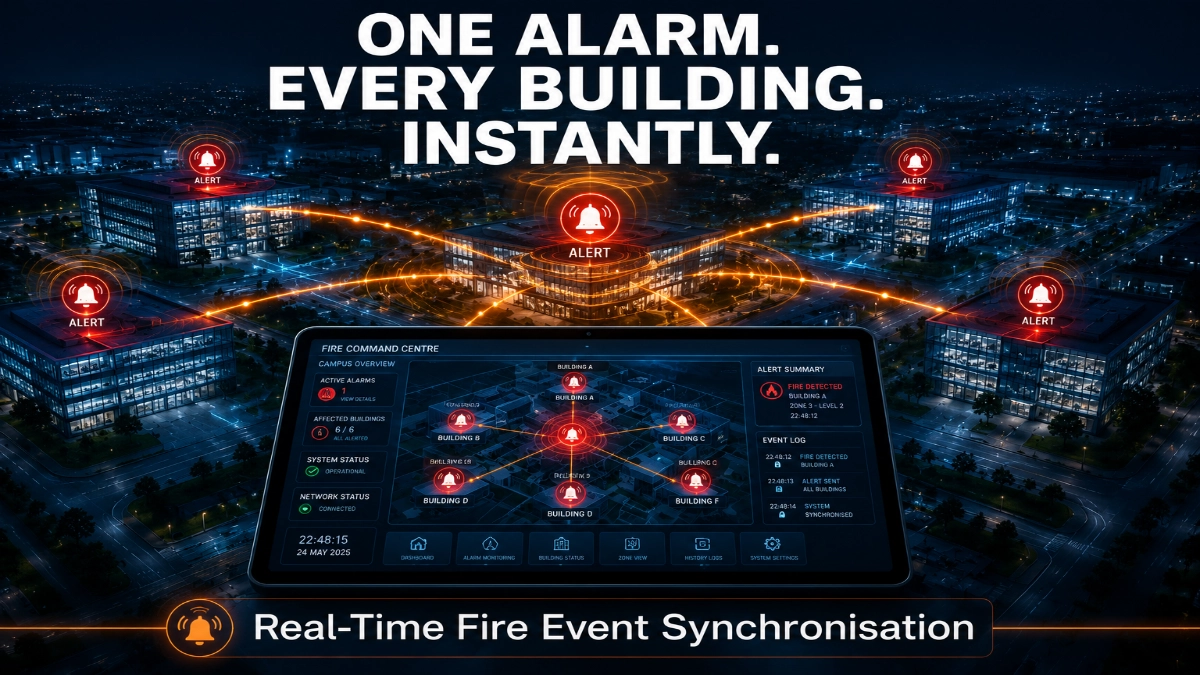
This is not a hypothetical worst case. It is the operational reality of thousands of large facilities that still rely on disconnected, building-level fire alarm systems that were never designed to coordinate across complex, multi-structure environments.
As campuses, smart cities, industrial parks, data centre clusters, airports, and university complexes grow in scale and operational complexity, the limitations of standalone fire alarm systems become impossible to ignore. The question is no longer simply whether a building can detect a fire. The real question is whether the entire facility ecosystem can respond to it together instantly, intelligently, and without confusion.
This article provides a detailed technical and operational guide to real-time fire event synchronisation across multiple buildings, explaining what it is, how it works, where it is being deployed, and why it is rapidly becoming the standard for mission-critical infrastructure worldwide.
What Is Real-Time Fire Event Synchronisation?
Real-time fire event synchronisation refers to the technology architecture that allows fire alarm events detected in any single building or zone to be instantly communicated, replicated, and acted upon across all connected buildings within a facility network without manual intervention or communication delays.
In practical terms, it means that when an addressable detector triggers an alarm in one part of a campus, the entire fire safety ecosystem responds simultaneously: adjacent buildings receive alerts, evacuation protocols activate in relevant zones, emergency communication systems broadcast coordinated messages, building management systems adjust HVAC and access controls, and fire command operators receive a complete, real-time picture of the evolving incident.
This is fundamentally different from simply connecting two fire alarm panels via a telephone line or a basic network link. True synchronisation involves:
- Networked addressable fire alarm panels share event data in real time.
- Cause-and-effect programming that triggers cross-building actions automatically.
- Centralised fire command centres with full-campus situational awareness.
- Redundant communication pathways ensure zero loss of event data.
- Integration with BMS, access control, CCTV, and public address systems.
- Cloud-connected monitoring for remote visibility and reporting.
How Traditional Isolated Fire Alarm Systems Operate
Conventional fire alarm systems, whether conventional fire alarm panels or early-generation addressable panels, were designed to protect individual buildings. Each panel monitors its connected detectors and devices, activates local alarms when thresholds are exceeded, and sends alerts to its own output devices such as sounders and beacons.
Conventional fire alarm panels divide a building into zones, where any activation within a zone triggers a zone-level alert. The operator must physically inspect the zone to identify the specific detector involved. While this approach works adequately for small, single-building premises, it creates serious challenges in multi-building environments:
- No automated communication between separate building panels.
- No shared event log or centralised audit trail across buildings.
- Manual coordination required to escalate alerts to adjacent structures.
- No cross-building cause-and-effect programming capability.
- Operators must check multiple panels separately during an incident.
- Evacuation decisions depend on human communication rather than automated logic.
Even where organisations install multiple addressable fire alarm panels which offer detector-level precision and event logging without a network synchronisation layer, each panel remains operationally isolated. The intelligence exists at the individual building level but does not extend across the campus.
Why Disconnected Systems Create Operational Risk
The risks created by disconnected fire alarm systems go beyond delayed evacuation. They create systemic vulnerabilities across multiple dimensions of emergency management:
1. Delayed Emergency Escalation
When a fire starts in one building, connected buildings may not receive any alert until a human makes a phone call or physically runs to inform the control room. In large industrial or hospital campuses, this delay can be measured in critical minutes.
2. Incomplete Situational Awareness
Facilities teams and fire marshals managing a multi-building incident without synchronised systems have no unified operational picture. They are working from incomplete, fragmented data precisely when accurate information matters most.
3. Conflicting Evacuation Signals
Different buildings may receive contradictory instructions. One building may be evacuated while an adjacent one has no alarm active. This creates dangerous confusion, especially on campuses with shared thoroughfares and assembly points.
4. Manual Communication Bottlenecks
Emergency response coordinators must manually contact each building’s facilities team, security staff, or fire marshals. In large organisations, this creates bottlenecks during the most time-sensitive phase of an incident.
5. Poor Integration with Emergency Services
Fire brigades responding to a large campus incident need accurate, real-time information about which buildings are affected, where the fire source is located, and which evacuation zones are active. Disconnected systems cannot provide this information automatically.
How Synchronised Fire Alarm Ecosystems Work
A real-time synchronised fire alarm ecosystem replaces the collection of isolated building panels with an integrated, intelligent network where every component, from individual addressable detectors to the central fire command platform, shares data, executes coordinated logic, and responds as a unified system.
Here is how each key component contributes to the overall architecture:
Networked Addressable Fire Alarm Panels
The addressable fire alarm panel is the core intelligence unit of any modern fire safety system. Unlike conventional panels, addressable panels communicate with each detector and device individually, identifying the exact location of any alarm event with device-level precision.
When multiple addressable fire alarm panels are connected across a campus network, typically via fibre optic or dedicated IP infrastructure, each panel can share its event data with all other panels in real time. A GST fire alarm system, for example, supports high-capacity addressable networks where panels can be linked to form a unified multi-site system with centralised visibility and cross-panel cause-and-effect programming.
Centralised Fire Command Centres
The centralised fire command centre serves as the operational hub for multi-building fire event management. It aggregates event data from all connected panels, presents a graphical overview of the entire campus, and enables operators to monitor, manage, and coordinate emergency response from a single location.
Operators can see exactly which addressable detectors have activated, in which building, on which floor, and in which zone, without moving between separate panels or control rooms. This dramatically improves situational awareness and response speed.
Real-Time Event Replication
When an alarm event occurs at any panel on the network, the event is immediately replicated to all other connected panels and to the central command platform. This replication happens within milliseconds, fast enough to trigger automated cross-building responses before a human operator has time to assess the situation manually.
Event replication includes not just alarm signals but full event context: the specific detector address, event type (smoke, heat, manual call point), time stamp, zone, and pre-alarm or alarm status. This rich data enables intelligent decision-making at both automated and operator levels.
Cause-and-Effect Programming Across Facilities
One of the most powerful capabilities of a synchronised fire alarm ecosystem is cross-building cause-and-effect programming. This allows facility managers and fire safety engineers to define automated responses that span multiple buildings.
Examples of cross-building cause-and-effect logic include:
- Smoke detector activation in Building A automatically triggers evacuation alarms in the adjacent covered walkway and Building B.
- A confirmed alarm in the chemical storage facility activates emergency ventilation shutdown across the entire industrial block.
- Fire detection in a data centre’s raised-floor zone triggers automatic suppression system activation and alerts the adjacent UPS room.
- Hospital ward alarm activation automatically releases magnetic door holders in the connected corridor and adjacent wards.
Multi-Building Alert Propagation
Alert propagation logic defines which buildings, zones, and systems receive notification when an alarm activates in any part of the network. This logic is configurable based on the physical proximity of buildings, shared evacuation routes, operational dependencies, and risk profiles.
In a university campus scenario, a fire in the chemistry laboratory building might propagate alerts to the adjacent lecture halls, the central security desk, the facilities management team, the campus medical centre, and the university’s cloud monitoring platform all within the same second.
Cross-Building Evacuation Coordination
Synchronised evacuation management is one of the most operationally significant benefits of real-time fire event synchronisation. Rather than each building evacuating independently with no coordination, a synchronised system can manage staged, sequential, or simultaneous evacuation across multiple buildings based on pre-programmed logic.
This is particularly important in environments such as:
- Hospitals, where patient mobility varies, and full simultaneous evacuation may not be safe or practical.
- Airports, where terminal evacuations must coordinate with airside operations.
- High-rise commercial complexes, where phased floor-by-floor evacuation is standard practice.
- Industrial facilities, where evacuation routes must account for hazardous material locations.
Emergency Communication Synchronisation
Synchronised fire alarm ecosystems integrate with public address and voice alarm systems across all buildings, enabling coordinated emergency broadcasting. When an alarm activates, pre-recorded or live voice messages can be delivered to specific buildings, zones, or the entire campus in the correct language, with the appropriate instructions for each area.
This eliminates the scenario where one building’s occupants hear an alarm but have no context for what action to take, while adjacent buildings hear nothing at all.
Intelligent Zoning Logic
Modern synchronised systems support complex, multi-dimensional zoning logic that goes beyond simple floor-level or building-level zones. Intelligent zoning can define:
- Operational zones based on function (labs, office areas, storage, plant rooms).
- Risk zones based on hazard classifications (chemical stores, server rooms, kitchens).
- Evacuation zones aligned with assembly point designations.
- Priority zones where detection triggers immediate escalation regardless of time of day.
Cloud-Connected Monitoring
Cloud integration extends the fire command capability beyond the on-site control room. Facility managers, remote operations centres, and third-party monitoring services can receive real-time event data, access historical logs, generate compliance reports, and respond to alerts from any connected device.
Cloud-connected fire monitoring is particularly valuable for organisations managing multiple geographically distributed facilities, where a central team needs visibility across all sites simultaneously.
Redundant Communication Pathways
No synchronised fire alarm network is operationally complete without redundant communication pathways. Relying on a single communication route, whether fibre optic, IP network, or cellular, creates a single point of failure that could isolate buildings during a real emergency.
Best-practice multi-building fire alarm infrastructure uses:
- Primary fibre optic ring topology allows traffic to route both ways around the ring.
- Secondary IP network path as backup if the fibre ring is broken.
- Cellular or 4G/5G backup for sites where hardwired backup is impractical.
- Peer-to-peer panel communication that allows partial network functionality even if the central command platform fails.
Integration with BMS and Security Systems
Synchronised fire alarm ecosystems gain significant operational power through integration with Building Management Systems (BMS) and physical security platforms. When a fire event occurs, the fire alarm network can automatically trigger:
- HVAC system modifications: Shutting dampers, activating smoke extract, reversing airflow.
- Access control changes: Releasing fire exit door holders, locking high-security areas.
- Lift recall: Returning elevators to ground level and taking them out of service.
- CCTV integration: Automatically directing cameras to the alarm zone for operator visual verification.
- Security barrier control: Opening boom gates for emergency vehicle access.
Event Prioritisation and Escalation Logic
Not all fire events carry equal urgency. A synchronised ecosystem uses event prioritisation logic to determine the appropriate response level for different event types and locations.
For example, a single smoke detector activation in a kitchen might trigger a pre-alarm notification to the facilities team before activating the full building alarm, reducing false alarm-driven disruption. By contrast, a manual call point activation or a confirmed dual-detector alarm in a high-risk area immediately triggers a full campus-level response with no delay.
Standalone vs Synchronised: A Technical Comparison
The table below summarises the key differences between standalone building fire alarm systems and real-time synchronised fire alarm ecosystems:
| Feature / Capability | Standalone Fire Alarm System | Real-Time Synchronised Ecosystem |
| Scope | Single building only | Multiple buildings, campuses, sites |
| Alert propagation | Local alarm only | Campus-wide synchronized alerting |
| Command visibility | Per-panel local display | Centralised command dashboard |
| Cause & effect logic | Building-level only | Cross-building programmable logic |
| Evacuation control | Manual coordination | Automated zone-based evacuation |
| BMS integration | Limited or none | Full BMS, security & access integration |
| Communication path | Single hardwired network | Redundant fibre, IP & wireless paths |
| Remote monitoring | On-site only | Cloud + remote NOC monitoring |
| Scalability | Fixed panel capacity | Unlimited network node expansion |
| Cybersecurity | Not applicable | Encrypted, authenticated network comms |
| Compliance reporting | Manual, per building | Automated, centralised audit logs |
| Emergency services integration | Local only | Real-time first responder data feed |
Practical Deployment Examples
Real-time fire event synchronisation is being deployed across a wide range of infrastructure types. Here are practical examples from key sectors:
Industrial Campuses
Large manufacturing and chemical processing parks use synchronised fire alarm ecosystems to link production facilities, warehousing blocks, utility buildings, and administrative offices. Cross-building cause-and-effect logic automatically activates fire suppression in adjacent storage areas and shuts down process equipment in response to confirmed alarms, all before human operators complete their initial assessment.
Hospitals and Healthcare Campuses
Healthcare facilities present unique evacuation challenges due to patient mobility constraints. Synchronised fire alarm systems enable defend-in-place and progressive horizontal evacuation strategies to be programmed as cause-and-effect logic, with different responses triggered in wards, theatres, ICUs, and corridors based on where the alarm activates.
Universities and Educational Campuses
A large university might have 50 or more buildings spread across a significant area. A synchronised fire alarm network allows campus security teams to monitor all buildings from a single command centre, with automated propagation of alerts to adjacent buildings and automatic escalation to the campus emergency coordinator during out-of-hours events.
Airports
Airport fire safety infrastructure must coordinate across terminals, concourses, airside facilities, cargo buildings, and fuel storage areas. Synchronised fire alarm systems ensure that an event in any part of the airport triggers the correct combination of responses across all connected areas, including airside operations control and the airport rescue and firefighting service.
Data Centres
Data centre operators use synchronised fire alarm infrastructure to coordinate responses across primary data halls, UPS rooms, generator facilities, cooling plant buildings, and administrative offices. Integration with suppression systems, precision air conditioning shutdown, and emergency generator isolation is managed through cross-building cause-and-effect programming linked to the addressable fire alarm panel network.
Warehousing Hubs and Logistics Parks
Large logistics facilities with multiple warehouse buildings and loading dock structures use synchronised systems to manage the fire risk associated with high rack storage, battery charging areas, and goods-in-transit zones. Alert propagation ensures that a fire in one warehouse unit immediately notifies staff in adjacent units and activates fire doors to limit spread.
Mixed-Use Infrastructure Projects
Modern mixed-use developments combining retail, residential, office, and hospitality components present complex fire safety coordination challenges. Synchronised ecosystems manage these environments by applying different cause-and-effect logic to each occupancy type while maintaining a unified command picture for the facilities management team.
Common Challenges in Multi-Building Fire Event Management
Deploying and operating synchronised fire alarm ecosystems across multiple buildings is not without its challenges. Understanding these challenges helps fire safety engineers and facility managers plan more effectively:
Legacy System Integration
Many existing multi-building facilities have a mix of older conventional fire alarm panels and newer addressable systems. Integrating these into a unified, synchronised network requires careful protocol bridging, gateway devices, or phased system replacement, all of which require detailed planning and specialist engineering expertise.
Network Reliability and Latency
The entire value proposition of real-time synchronisation depends on reliable, low-latency communication between all connected panels. Poor network design, shared IT infrastructure, or inadequate bandwidth allocation can introduce delays or failures that compromise the synchronisation capability.
Cybersecurity Vulnerabilities
Connecting fire alarm systems to IP networks and cloud platforms introduces cybersecurity risks that do not exist in standalone, hardwired systems. Unauthorised access to a networked fire alarm system could allow malicious actors to trigger false alarms, suppress genuine alarms, or disrupt emergency response logic.
Best-practice cybersecurity measures for networked fire alarm systems include:
- End-to-end encryption of all panel-to-panel and panel-to-cloud communications.
- Multi-factor authentication for access to command interfaces and remote monitoring platforms.
- Network segmentation isolates the fire alarm network from the general IT infrastructure.
- Regular firmware updates and vulnerability patch management.
- Comprehensive audit logging of all system access and configuration changes.
Complexity of Cause-and-Effect Programming
In a large multi-building environment, the cause-and-effect programming matrix can become extremely complex. A single change to an evacuation strategy or a zone reassignment may have unintended consequences across multiple buildings if the programming is not carefully maintained and documented.
Operational Change Management
Introducing a synchronised fire alarm ecosystem into an organisation that has operated with isolated building systems requires significant change management. Staff need retraining, emergency procedures need rewriting, and the organisation’s entire emergency response culture may need updating.
How Intelligent Synchronisation Improves Fire Response Strategy
Beyond the technical capabilities, real-time fire event synchronisation fundamentally transforms how organisations approach emergency response strategy. Here is how:
Unified Command Reduces Decision Latency
When all fire event data flows to a centralised command centre in real time, emergency coordinators no longer need to gather information from multiple sources before making decisions. The complete incident picture is immediately available, reducing the time from detection to coordinated response.
Pre-Programmed Logic Removes Human Bottlenecks
Critical emergency actions activating adjacent building alarms, shutting process equipment, releasing fire doors, and initiating suppression systems, happen automatically based on pre-programmed cause-and-effect logic. This removes the human communication bottleneck from the most time-critical phase of emergency response.
Improved Firefighter Intelligence
When fire brigades arrive at a campus incident, the synchronised fire command system can provide first responders with real-time building status information: which detectors have activated, which suppression systems are operating, which areas are evacuated, and which access routes are clear. This dramatically improves firefighter safety and tactical decision-making.
Systematic Compliance and Audit Readiness
A synchronised ecosystem maintains a comprehensive, timestamped event log across all buildings. This provides facilities managers with the documentation required for fire safety compliance audits, insurance reviews, and post-incident analysis without requiring manual assembly of records from multiple standalone systems.
Scalability Supports Infrastructure Growth
As campuses grow and new buildings are added, a synchronised fire alarm ecosystem scales naturally. New addressable fire alarm panels are connected to the existing network, cause-and-effect logic is updated to include the new zones, and the central command platform expands its coverage automatically without replacing existing infrastructure.
Operational and Safety Benefits Summary
The operational benefits of deploying real-time synchronised fire alarm infrastructure across multiple buildings are substantial:
- Faster emergency coordination: Campus-wide response activated within seconds of detection.
- Improved evacuation management: Staged, coordinated, zone-specific evacuation replaces building-by-building chaos.
- Reduced confusion during incidents: All staff receive consistent, synchronised information and instructions.
- Better firefighter visibility: First responders receive real-time campus-wide situational awareness.
- Centralised monitoring efficiency: A single operator can manage an entire campus fire alarm network.
- Reduced operational downtime: Faster, more coordinated response reduces fire spread and facility damage.
- Improved compliance readiness: Automated, comprehensive event logging across all buildings.
- Higher system scalability: New buildings integrate without disrupting existing network operation.
- BMS and security integration: Fire events trigger coordinated responses across all building systems.
- Cloud and remote monitoring: Off-site operations teams maintain full visibility of all sites.
The Future of Multi-Building Fire Safety: AI, IoT, and Digital Twins
The synchronised fire alarm ecosystems being deployed today are already highly sophisticated compared to the isolated building systems they replace. But the next generation of multi-building fire safety infrastructure will go significantly further, integrating artificial intelligence, Internet of Things connectivity, and digital modelling capabilities.
AI-Assisted Fire Event Correlation
Artificial intelligence applied to multi-building fire alarm data can identify patterns that human operators might miss, such as a gradual increase in pre-alarm events in a specific zone over several weeks, for example, or an unusual combination of sensor activations that precedes a confirmed fire event. AI correlation engines can flag these patterns for investigation before an incident occurs.
Predictive Event Management
Combining fire alarm event data with environmental sensor data, equipment maintenance records, and historical incident logs, predictive analytics platforms can identify areas within a facility that have elevated fire risk and prioritise preventive maintenance or inspection. This moves fire safety management from reactive to proactive.
IoT-Enabled Fire Infrastructure
The integration of addressable detectors with broader IoT sensor ecosystems monitoring temperature gradients, electrical load anomalies, gas concentrations, and environmental conditions creates a richer data environment for fire risk assessment. IoT-enabled fire infrastructure can detect developing risk conditions before they produce smoke or heat, triggering preventive interventions rather than emergency responses.
Digital Twins for Emergency Planning
Digital twin technology, creating real-time virtual models of physical buildings and their systems, is being applied to emergency planning in sophisticated multi-building environments. A fire alarm digital twin allows facility managers to simulate fire scenarios, test cause-and-effect programming, optimise evacuation routes, and train staff in a virtual environment before applying changes to live systems.
Smart Campus Safety Ecosystems
The fully realised vision of smart campus safety integrates fire alarm synchronisation with occupancy management, people-counting systems, environmental monitoring, and emergency services communication, creating a campus-wide safety intelligence platform where every system informs every other system in real time.
Cloud-Native Fire Monitoring
Cloud-native fire monitoring platforms are moving beyond simple remote viewing of panel events to provide advanced analytics, predictive maintenance alerts, compliance reporting automation, and multi-site management from a single cloud dashboard. These platforms are increasingly being delivered on subscription models, making enterprise-grade fire monitoring accessible to mid-sized facility operators.
Intelligent Emergency Automation
The next frontier in multi-building fire safety is fully intelligent emergency automation, where the fire safety system not only detects and communicates events but also orchestrates the entire emergency response: adjusting HVAC, guiding occupants via smart signage and mobile alerts, coordinating with autonomous security robots, and providing emergency services with a dynamically updated 3D model of the incident in progress.
Practical Deployment Recommendations
For facilities managers, fire safety consultants, and system integrators planning a multi-building fire alarm synchronisation project, the following recommendations reflect best practice in the field:
- Conduct a comprehensive fire alarm audit across all existing buildings before designing the synchronisation architecture, identifying panel types, communication capabilities, and integration requirements.
- Design for redundancy from the outset; single points of failure in a multi-building network are unacceptable. Plan primary and backup communication paths for every panel connection.
- Choose an addressable fire alarm panel platform with proven multi-panel networking capabilities, and ensure the GST fire alarm system or equivalent platform supports the scale of your network.
- Engage a specialist fire safety systems integrator with demonstrable experience in multi-building campus deployments, not simply a supplier who installs individual building systems.
- Develop a detailed cause-and-effect programming matrix before installation, involving fire safety consultants, facilities managers, and key operational stakeholders.
- Plan the cybersecurity architecture for the networked fire alarm system at the same time as the fire safety design, not as an afterthought.
- Budget for staff training and emergency procedure updates as an integral part of the project; without operational adoption does not deliver its potential value.
- Plan for scalability, design the network architecture to accommodate additional buildings, panels, and zones without requiring redesign of the core infrastructure.
Read Also: Identifying Hidden Instability in Fire Detection Infrastructure
Read Also: Why Fire Alarm Systems Need Context-Aware Event Logic in Modern Facilities