Modern hospitals, airports, manufacturing plants and data centres all share one critical requirement: highly reliable fire detection that can scale with complex, constantly evolving infrastructure. A simple panel-and-detector setup may have worked for a single-story office thirty years ago, but today’s facilities demand something far more sophisticated. They need systems that can detect a threat in one corner of a 500,000-square-foot facility, communicate that information intelligently, and trigger the right response across dozens of interconnected subsystems, all in seconds.
This is where intelligent fire alarm ecosystems stand apart from traditional installations. Rather than a collection of independent components, an intelligent ecosystem functions as a unified life safety platform. Every device communicates with every other device. The system learns. It self-diagnoses. It scales as facilities grow.
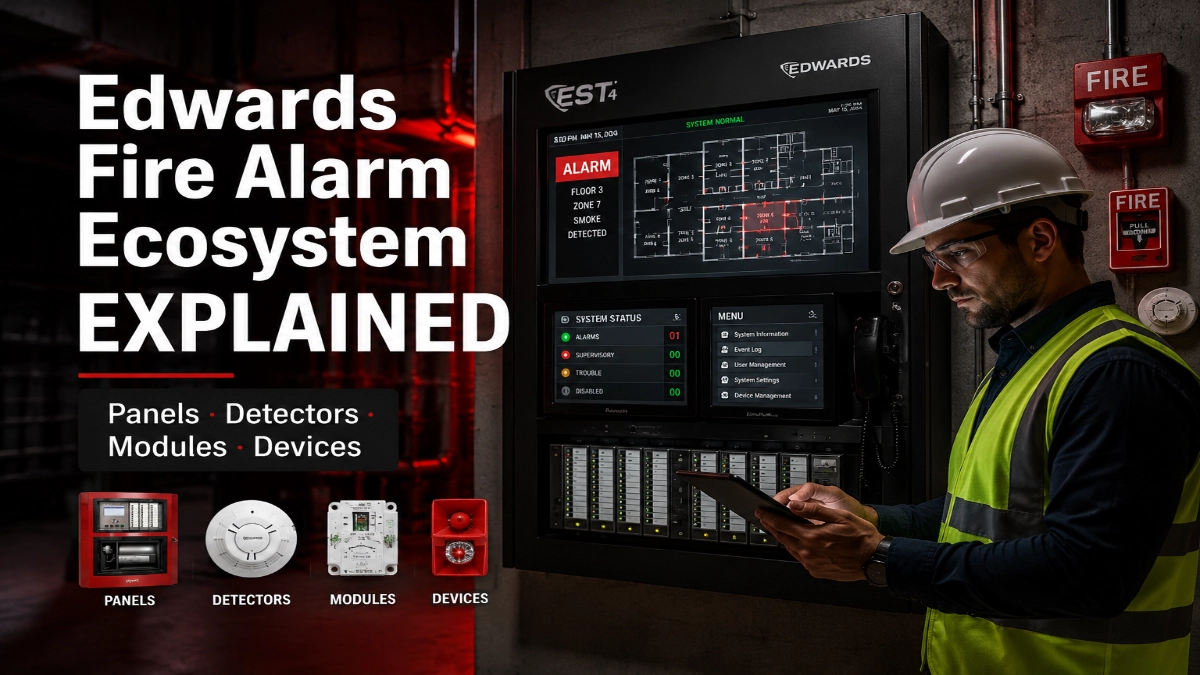
Edwards Fire Alarm System, a part of Carrier Global Corporation, has built one of the most respected intelligent fire alarm ecosystems in the industry. Their platform, spanning advanced control panels like the EST4 and EST3, intelligent SIGA detection devices, addressable modules, and networked notification appliances, is designed to work as an integrated whole rather than a sum of separate parts. This article explains how that ecosystem is structured, how it functions under real-world conditions, and why it matters for engineers, facility managers, and safety professionals.
What Is the Edwards Fire Alarm Ecosystem?
At its core, the Edwards ecosystem is an addressable, intelligent life safety platform, meaning every device on the system has a unique address and can send detailed diagnostic and event data back to the control panel. This is fundamentally different from conventional systems, where detectors simply trigger a zone alarm without identifying which specific device was activated.
Addressable architecture means the panel knows exactly which detector on which floor in which room detected smoke. It knows whether a device is clean or dusty. It can distinguish a real alarm from an environmental nuisance. This level of intelligence is what makes modern life safety management possible.
The ecosystem is also built for centralised monitoring. In large or multi-building facilities, Edwards panels can be networked together so that a single command centre can monitor the entire campus in real time. Events, faults, and system status updates are continuously communicated across the network.
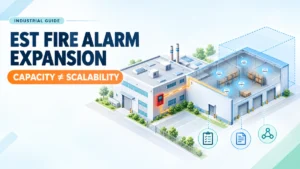
Scalability is another defining characteristic. Whether you are protecting a 2,000-square-foot retail space or a 2-million-square-foot industrial complex, the Edwards platform accommodates the full range through the right combination of panel families, loop capacity, and networked nodes.
Understanding the Four Core Layers of the Edwards Ecosystem
The Edwards ecosystem can be organised into four functional layers, each with a distinct role in the life safety chain.
| Layer | Category | Key Products | Primary Function |
|---|---|---|---|
| Layer 1 | Fire Alarm Control Panels | EST4, EST3, IO Series | System intelligence, event processing, network communication |
| Layer 2 | Detection Devices | SIGA Smoke, Heat, Multi-Sensor Detectors | Environmental sensing, intelligent data reporting |
| Layer 3 | Addressable Modules | SIGA Monitor, Control, Relay, Input Modules | Interface with building systems, third-party equipment |
| Layer 4 | Notification Appliances | Horns, Strobes, Sounders, Speakers | Occupant alerting, mass notification |
Layer 1: Fire Alarm Control Panels
The control panel is the brain of the fire alarm system. It receives signals from every device on the network, processes that data, makes alarm decisions and initiates appropriate responses. Edwards offers three major panel families suited to different facility scales.
- The Edwards EST4 is the flagship intelligent life safety platform, engineered for complex, high-stakes environments such as hospitals, airports, large campuses, and critical infrastructure. It supports high-capacity signalling line circuits, advanced peer-to-peer networking, and deep integration with building management systems. The EST4 is designed for facilities where system downtime is not acceptable and where sophisticated cause-and-effect programming is required.
- The Edwards EST3 is a proven, modular panel platform widely deployed across commercial, institutional, and industrial applications. Its distributed architecture allows it to expand to meet growing facility needs, and it supports voice evacuation, mass notification, and complex network configurations.
- The Edwards IO Series, including the IO500 and IO1000R, serves small-to-medium commercial applications where addressable capability is needed without the complexity of enterprise-scale systems. These panels offer straightforward commissioning, solid addressable device support, and reliable performance in buildings where life safety requirements are clear and consistent.
Layer 2: Detection Devices
Detection devices are the sensory layer of the ecosystem. Edwards SIGA devices (Signature Series) represent the intelligent detection component of the platform.
- SIGA Smoke Detectors use photoelectric or ionisation sensing, or a combination, to detect airborne combustion particles. What distinguishes SIGA devices is their onboard microprocessors, which continuously analyse environmental data and make local detection decisions before reporting to the panel. This reduces false alarms significantly compared to passive detection approaches.
- SIGA Heat Detectors are designed for environments where smoke detection is impractical, such as kitchens, parking garages, dusty manufacturing areas, and spaces with high ambient particulates. They detect abnormal temperature rise or fixed temperature thresholds and report these events with the same address-level precision as smoke detectors.
- SIGA Multi-Sensor Detectors combine smoke, heat, and, in some models, CO sensing into a single device. These are particularly valuable in environments where the nature of a potential fire event is unpredictable, or where maximising detection accuracy while minimising false alarm rates is a primary design goal.
- SIGA Manual Call Points (manual pull stations) round out the detection layer, allowing occupants to manually initiate an alarm. These are addressable, meaning the panel immediately knows exactly which call point was activated.
Layer 3: Addressable Modules
Modules extend the intelligence of the Edwards ecosystem beyond its own native devices. They create the interface between the fire alarm system and the broader building environment.
- SIGA Monitor Modules connect conventional devices, non-addressable detectors, dry contact inputs, flow switches, and tamper switches to the addressable signalling line circuit. This allows older or third-party equipment to participate in the intelligent Edwards network.
- SIGA Control Modules provide supervised switching outputs to control building systems: door holders, dampers, elevator recall, fan shutdown, suppression system activation, and other critical life safety functions. Each control module is monitored for wiring continuity and reports its status back to the panel.
- SIGA Relay Modules provide relay outputs for applications requiring isolated switching, often used to interface with HVAC systems, access control, and building automation systems.
- Input Modules accept supervised input from devices such as waterflow indicators, supervisory switches, and other monitoring points, reporting each as a uniquely addressed event on the system.
These modules are what allow the Edwards ecosystem to function as a true life safety platform rather than just a fire detection system. They orchestrate the entire emergency response sequence.
Layer 4: Notification Appliances
Once the panel has processed an alarm and initiated response sequences through its modules, occupants must be alerted. Edwards notification devices handle this with precision.
- Horns and Horn/Strobes provide audible and visual alerting for general occupant notification. Edwards devices meet ADA requirements for visual alerting, with synchronised strobe flash patterns that comply with NFPA 72 and other applicable standards.
- Speakers and Amplifiers support voice evacuation and mass notification, allowing pre-recorded or live announcements to direct occupants during an emergency. This is particularly important in large or complex facilities where a simple alarm tone is insufficient to guide safe egress.
- Strobes are deployed in areas where hearing-impaired occupants may be present and where visual notification is required by code.
The selection and placement of notification appliances are guided by occupancy type, room acoustics, ambient noise levels, and applicable codes, all factors that experienced fire protection engineers incorporate into the system design.
How All Edwards Components Work Together
Understanding the individual layers matters, but the real value of the Edwards ecosystem is how seamlessly those layers interact during an actual emergency. Here is a step-by-step walk-through of a fire event in a networked Edwards installation:
Step 1: Detection: A SIGA smoke detector in a server room detects abnormal particulate levels. Its onboard microprocessor analyses the data and confirms the reading exceeds the alarm threshold.
Step 2: Intelligent reporting: The detector transmits an alarm signal over the signalling line circuit to the fire alarm control panel along with its specific address, current sensitivity status, and device type.
Step 3: Panel processing: The control panel (e.g., EST4) receives the alarm signal. Based on its programmed cause-and-effect logic, it identifies the alarm zone, cross-references it with building layout data, and begins executing its programmed response sequence.
Step 4: Module activation: The panel activates relevant SIGA Control Modules: HVAC fans serving the server room shut down, fire dampers close, door holders release, and the suppression system pre-action valve opens.
Step 5: Occupant notification: Notification appliances activate in the affected area and, per the evacuation plan, in adjacent zones. If voice evacuation is installed, pre-recorded messages direct occupants to exits.
Step 6: Remote monitoring and emergency response: The event is simultaneously transmitted to the building’s central monitoring station (and to any networked remote annunciators). The monitoring centre notifies emergency services. First responders arrive with precise information about which device triggered the alarm and where.
This entire sequence from smoke detection to emergency notification can occur in under 30 seconds in a properly designed Edwards system.
Why Intelligent Fire Alarm Ecosystems Are Different from Traditional Systems
The distinction between conventional and intelligent addressable systems is significant for anyone evaluating a fire protection investment.
| Feature | Traditional Conventional System | Edwards Intelligent Ecosystem |
|---|---|---|
| Communication | Zone-level: identifies the zone, not the device | Device-level: identifies the exact detector/module |
| Detection accuracy | Fixed sensitivity thresholds | Adaptive, environment-aware sensing |
| False alarm reduction | Limited; environmental factors cause nuisance alarms | Advanced analogue processing, multi-criteria analysis |
| Expandability | Adding zones requires new wiring infrastructure | Devices added to existing SLC; minimal rewiring |
| Maintenance | Manual testing required; no self-diagnostics | Continuous self-monitoring; dirty detector alerts |
| Diagnostics | Fault identification is zone-level only | Device-level fault reporting with root cause detail |
| System reliability | Single-path; faults can isolate entire zones | Supervised wiring; Class A/B configurations available |
| BMS integration | Limited or manual | Native, programmed cause-and-effect integration |
The operational advantages of an intelligent ecosystem become especially apparent in larger, more complex facilities where the cost of a false alarm or worse, a missed alarm, is substantial.
Applications Across Different Industries
The Edwards ecosystem is deployed across a remarkably broad range of industries, and for good reason: the platform’s flexibility allows it to address the specific risk profiles and regulatory requirements of very different environments.
- Hospitals and Healthcare Facilities require smoke compartmentalisation, precise zone identification (critical where patient evacuation is complex), and deep integration with HVAC and medical gas systems. The EST4’s sophisticated cause-and-effect programming and high-reliability networking make it well-suited for healthcare environments where NFPA 101 compliance is mandatory.
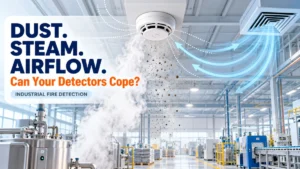
- Manufacturing Plants and Industrial Facilities present environments with dust, heat, and chemical vapours that challenge conventional detection. SIGA heat detectors, specialised multi-sensor devices, and robust monitor modules that interface with process control systems are commonly deployed in these applications.
- Warehouses and Logistics Centres often involve high-piled storage and demanding sprinkler monitoring requirements. Edwards waterflow and tamper monitoring modules integrate cleanly with sprinkler systems, while the addressable architecture helps identify alarm sources quickly in large open-plan spaces.
- Commercial Office Buildings and Mixed-Use Developments benefit from the EST3 or IO Series platforms, which offer the addressable intelligence and scalability needed for multi-tenant environments without over-engineering.
- Data Centres require early warning detection, often using aspirating smoke detection technology integrated with precision cooling systems, suppression systems, and access control. Edwards modules facilitate all of these integrations within a unified life safety platform.
- Airports and Transportation Hubs demand mass notification capability, multi-zone evacuation management, and the ability to coordinate life safety responses across enormous, complex spaces. The EST4’s network architecture and voice evacuation support make it a strong choice for these applications.
- Educational Campuses benefit from the EST3’s campus-wide networking capability, which allows a single security or facilities operations centre to monitor multiple buildings simultaneously while maintaining individual building autonomy.
Choosing the Right Edwards Components for Different Facility Sizes
Not every facility needs an EST4. Selecting the right panel family and device complement for a given application is one of the more important design decisions in any fire alarm project.
| Facility Type | Recommended Panel | Detection Strategy | Key Modules |
|---|---|---|---|
| Small commercial (< 5,000 sq ft) | IO Series (IO500) | SIGA smoke + heat detectors | Basic monitor modules for door holders |
| Medium commercial (5,000–50,000 sq ft) | IO1000R or EST3 | SIGA smoke, heat, multi-sensor | Monitor + control modules for HVAC integration |
| Industrial facilities | EST3 | SIGA heat detectors, multi-sensor | Relay modules for process equipment interface |
| Large commercial campuses | EST3 networked | Full SIGA device complement | Monitor, control, relay modules; voice evacuation |
| Critical infrastructure / Hospitals | EST4 | Full SIGA detection with multi-criteria | Advanced cause-and-effect, full module complement |
These recommendations are starting points. Any actual system design should be developed by a licensed fire protection engineer in accordance with NFPA 72, local codes, and the authority having jurisdiction (AHJ).
Common Mistakes When Designing Fire Alarm Systems
Even experienced teams make avoidable errors in fire alarm system design. The following issues come up repeatedly in field reviews and commissioning inspections.
- Poor detector placement is among the most common problems. Detectors installed too close to HVAC supply registers, in dead-air spaces, or at excessive spacing intervals will either generate nuisance alarms or fail to detect a fire in time. NFPA 72 spacing guidelines exist for good reason; follow them, and supplement with engineering judgment for unusual geometries.
- Wrong panel selection creates problems both immediately and years down the line. Under-specifying a panel for a facility that grows, choosing an IO series panel for a campus that later expands to ten buildings, results in costly replacements. Over-specifying wastes the budget and introduces unnecessary complexity.
- Ignoring future expansion is a related error. Many facilities commission a fire alarm system sized exactly for current needs, with no spare loop capacity, no network ports, and no room in the cabinet for additional modules. Future expansion then becomes a change order nightmare.
- Poor device integration occurs when fire alarm modules are not properly programmed to interface with building systems. A control module connected to an HVAC fan that isn’t properly supervised, or a suppression interface that hasn’t been commissioned, undermines the entire purpose of the intelligent ecosystem.
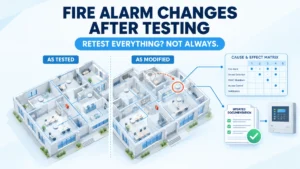
- Skipping the sequence-of-operations review before commissioning leaves cause-and-effect programming untested. In complex systems, a panel might silence a zone that shouldn’t be silenced, or fail to activate a critical controlled device, if the logic hasn’t been walked through against actual building conditions.
Future Trends in Intelligent Fire Detection
The fire alarm industry is undergoing genuine technological evolution, and the trajectory points toward systems that are more autonomous, more predictive, and more deeply integrated with broader building intelligence platforms.
AI-Assisted Diagnostics are beginning to enter the life safety space. Rather than simply reporting a dirty detector, future systems will analyse patterns across hundreds of devices over time, flagging detectors that are trending toward degradation before they fail or generate nuisance alarms.
- Predictive Maintenance takes this further. By correlating environmental data, device history, and maintenance records, intelligent platforms will be able to schedule maintenance interventions before problems occur, reducing both life safety risk and operational cost.
- IoT Integration is enabling fire alarm systems to share data with a broader ecosystem of building sensors, environmental monitors, occupancy sensors, and access control systems, creating a richer situational picture for emergency responders and building operators.
- Building Management System (BMS) Convergence is accelerating. Edwards systems already offer robust BMS integration, but the trend is toward tighter, bidirectional communication where the fire alarm system is one module of a comprehensive building intelligence platform rather than a standalone system.
- Digital Twins represent one of the more exciting near-term developments. A digital twin of a building’s fire alarm system allows engineers to simulate the impact of changes, test cause-and-effect programming, and conduct virtual commissioning before touching live systems, reducing both risk and cost.
- Cloud Monitoring is extending the reach of fire alarm oversight. Remote monitoring platforms that aggregate data from multiple facilities allow facility managers and service contractors to monitor system health, receive real-time fault alerts, and analyse performance trends without being on-site.
Read Also: Why Edwards Is Considered a Premium Fire Alarm Platform Worldwide
Read Also: The Impact of Make in India on Industrial Fire Safety Standards