What Fire Alarm System Is Best for Logistics Parks?
A modern logistics park needs more than a basic fire alarm.
Most large facilities perform best with an addressable fire alarm system. It gives each detector its own identity on the network, so operators know exactly which zone, aisle, or dock has triggered an alarm.
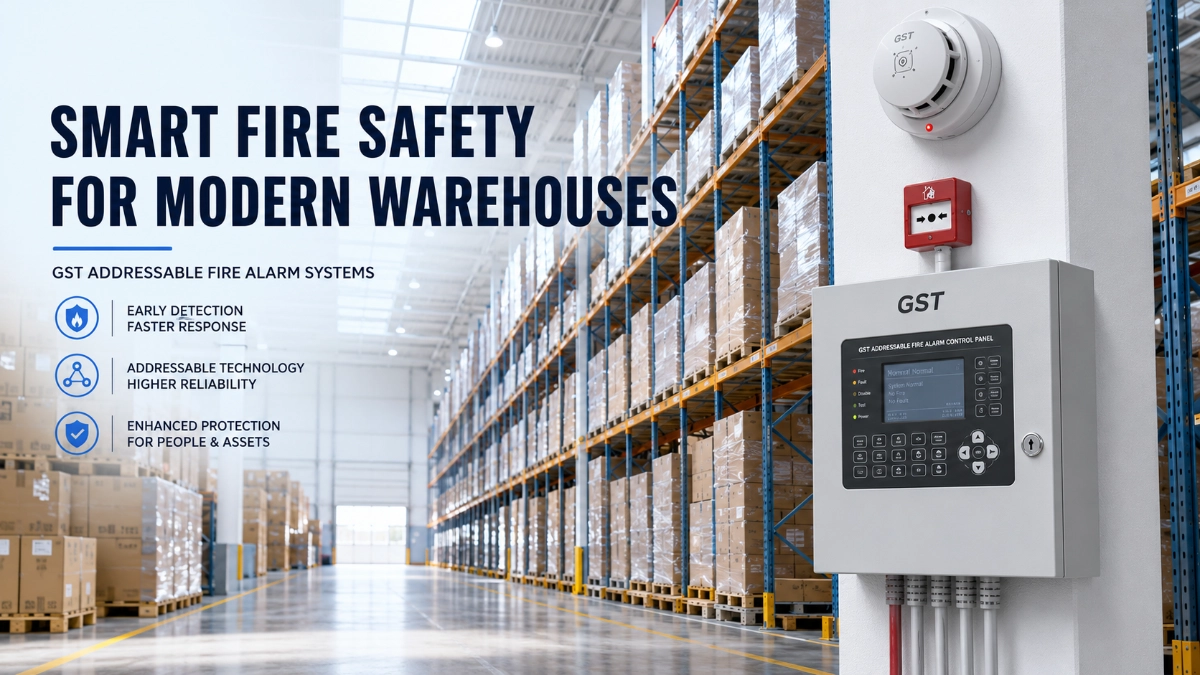
That precision matters. A distribution centre can span hundreds of thousands of square feet. A generic “zone 4 alarm” tells a fire team almost nothing. An addressable point ID tells them the exact rack row.
For very large or multi-building sites, that addressable backbone is usually combined with networked panels, high-ceiling detection technology, and integration with sprinklers and smoke control. We’ll walk through each layer below.
Why Are Logistics Warehouses Considered High-Risk?
Warehouses and logistics parks carry a different risk profile than offices or retail spaces. A few factors combine to make fires harder to detect early and harder to control once they start.
- High fuel load: Palletised goods, packaging, and plastics stack densely and burn fast. Cardboard and shrink-wrap ignite easily and release a lot of heat quickly.
- Vertical storage: Racking can reach 12–30 metres. Heat and smoke rise fast through these flues, but they also stratify, meaning smoke can sit far above a ceiling-mounted detector before ever reaching it.
- Large open volumes: A single compartment can be tens of thousands of square metres. Traditional point detectors, spaced for offices, leave dangerous gaps in this kind of open space.
- Constant material movement: Forklifts, conveyors, and automated storage and retrieval systems (AS/RS) change the fuel layout daily. A detection design that worked on day one may not reflect the racking six months later.
- Concentrated hazards: Battery charging bays, lithium-ion storage, cold storage insulation, and hazardous goods all bring their own ignition and fire-spread characteristics into one site.
Put together, these factors are why insurers and fire authorities treat logistics parks as a distinct occupancy class, not a scaled-up office.
How Fire Behaves Differently in Large Warehouses
Fire science in a 30-metre-high warehouse doesn’t follow office-building assumptions. Understanding this is the foundation of good detector selection.
Smoke Stratification
Hot smoke rises until it reaches a layer of air at the same temperature, then it stops rising and spreads horizontally instead. In tall spaces, that stratification layer can form well below the ceiling, especially with a smouldering, low-heat fire.
A detector mounted at roof level may not “see” smoke that has stratified 10 metres below it. This is the single biggest design challenge in high-bay warehouse detection.
Air Movement
HVAC systems, loading dock doors, and natural ventilation all move air across a warehouse floor. That airflow dilutes smoke before it reaches a detector, and it can also push smoke sideways rather than up.
Racking as Chimneys
Storage aisles between high racks behave like vertical flues. Fire and heat can travel up an aisle far faster than it spreads across open floor, which changes where sprinklers and detectors need to be concentrated.
Key takeaway: Ceiling height and airflow, not floor area alone, should drive detector selection in a warehouse.
Detection Technology: What Works Where
No single detector type suits every part of a logistics park. Good design mixes technologies by zone.
Aspirating Smoke Detection (ASD)
Aspirating systems actively draw air samples through a network of small-bore pipes into a highly sensitive detection chamber. Because they sample air continuously and can be tuned for high sensitivity, they’re well suited to:
- High-bay racking where stratification is a risk
- Cold storage rooms, where condensation affects conventional detectors
- Dust-heavy areas like loading docks
- Server rooms and control rooms within logistics parks
They typically offer the earliest warning of the technologies covered here, which matters when a smouldering fire in dense packaging can go undetected for a long time otherwise.
Beam Detectors
Beam detectors project an infrared beam across open space and detect smoke by the obscuration it causes. They’re a practical, lower-cost option for covering large open volumes such as:
- Atriums and open racking-free storage areas
- Very high ceilings where point detector spacing becomes impractical
- Sites where cabling for point detectors would be disruptive to install
They’re less precise about smoke location than addressable point detectors, so they work best combined with other detection layers rather than as the sole method in critical storage zones.
Intelligent Addressable Point Detectors
These remain the backbone of most warehouse designs: smoke, heat, or multi-criteria detectors that report individually to the panel. Multi-criteria detectors (combining smoke and heat sensing) help reduce false alarms triggered by dust or vehicle exhaust, which is a common nuisance-alarm source in busy logistics environments.
Manual Call Points
Even with sophisticated automatic detection, manual call points remain a code requirement at exits, dock doors, and stairwells, giving staff a direct way to raise an alarm.
Comparison Table: Detection Technology by Application
| Detection Type | Best Suited For | Key Advantage | Key Limitation |
|---|---|---|---|
| Aspirating Smoke Detection (ASD) | High-rack storage, cold storage, dust-prone zones | Very early warning, tunable sensitivity | Higher installation cost, needs pipe network design |
| Beam Detectors | Large open volumes, high ceilings | Wide area coverage, fewer devices needed | Less precise fire location, affected by heavy dust/fog |
| Addressable Point Detectors | General warehouse floor, offices, dock areas | Precise location ID, individual monitoring | Requires more devices for very large open areas |
| Multi-Criteria Detectors | Areas prone to nuisance alarms (forklift exhaust, dust) | Reduced false alarms | Slightly higher unit cost than single-sensor types |
Addressable vs Conventional Fire Alarm Systems
This is one of the most common design decisions facility owners face, and the right answer usually depends on facility size and complexity.
| Feature | Addressable Fire Alarm Panel | Conventional Fire Alarm Panel |
|---|---|---|
| Fault/alarm location | Identifies exact device | Identifies only the zone/circuit |
| Wiring | Loop wiring, fewer cables | Zone-by-zone wiring, more cabling |
| Scalability | Easily expanded with more loops/points | Limited by number of zone circuits |
| Best for | Large, multi-zone, multi-building facilities | Small warehouses, single-zone buildings |
| Diagnostics | Detailed device-level fault reporting | Basic zone-level fault reporting |
| Typical cost | Higher upfront cost | Lower upfront cost |
| Integration with BMS/sprinklers | Straightforward, often built-in | Limited, usually needs interface modules |
For a small ancillary warehouse under a few thousand square metres with a single occupant, a conventional fire alarm panel can still be a sound, cost-effective choice.
For a multi-tenant logistics park, a facility with high-rack automated storage, or any site where response time and precise fault-finding matter, an addressable fire alarm panel is the industry-standard recommendation.
Designing for Special Warehouse Environments
Multi-Tenant Logistics Facilities
Shared logistics parks often lease units to different operators with different fire loads and different hazard classes. The fire alarm design needs to:
- Segregate zones so one tenant’s alarm is clearly distinguishable from another’s
- Allow independent testing and maintenance access per tenant, without disrupting others
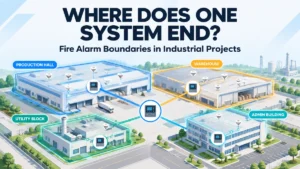
- Feed a common site-wide monitoring point for the fire brigade and facility management
Automated Warehouses and Conveyor Systems
Automated storage and retrieval systems (AS/RS) and conveyor networks introduce moving fuel and moving ignition sources. Detection along conveyor runs, combined with automatic shutdown interlocks tied to the fire alarm panel, helps stop a fire from being physically carried through the building on the conveyor itself.
Loading Docks
Dock areas combine vehicle exhaust, dust, frequent door openings, and stored goods staged for transit. Multi-criteria detectors, or heat detectors where smoke nuisance alarms are a known issue, tend to perform better here than plain smoke detectors.
Cold Storage Facilities
Low temperatures and high humidity can affect standard smoke detector performance and cause condensation-related faults. Aspirating detection, with heated sampling pipes where needed, is a common solution for these zones.
Battery Charging Rooms and Lithium-Ion Storage
Battery charging areas are increasingly common as forklift fleets and logistics robotics expand, carrying a distinct thermal runaway risk. Lithium-ion battery fires can develop rapidly and are difficult to suppress with water alone.
Good practice includes:
- Dedicated, well-ventilated charging zones separated from general storage
- Early-warning detection (often aspirating or gas/off-gas sensing in addition to smoke)
- Fire alarm integration with automatic ventilation and, where specified, suppression systems
- Clear signage and staff training specific to battery-related incidents
Hazardous Goods Storage
Where hazardous materials are stored, fire alarm design should be coordinated with the site’s hazard classification and any local fire authority requirements for that material class. This is a specialist area, and local regulations should always take precedence over general guidance.
Notification: Sounders, Visual Alarms, and Voice Evacuation
Detection is only half the system. People need to hear, see, and understand the alarm.
Sounders and visual alarm devices (VADs) are essential in a warehouse because ambient noise from machinery, forklifts, and conveyors can be loud. Visual strobes help ensure the alarm is noticed even in high-noise zones or by staff wearing hearing protection.
Voice evacuation systems are increasingly common in large logistics parks. Instead of a single tone, a voice evacuation system can give staged, specific instructions directing people in one zone to evacuate while giving an “alert” tone elsewhere. This staged approach matters in buildings so large that a full simultaneous evacuation isn’t always the safest or most practical response.
Integration With Other Building Systems
A fire alarm panel that operates in isolation is a missed opportunity in a modern logistics park. Effective designs integrate the panel with:
- Sprinkler systems: So the panel receives flow-switch and valve-tamper signals and can correlate a fire alarm with sprinkler activation.
- Smoke control systems: Activating smoke curtains, roof vents, or extraction fans to manage smoke movement and protect escape routes.
- HVAC shutdown: Stopping air handling units from spreading smoke through ductwork during a fire event.
- Building Management Systems (BMS): Giving facility managers a single point of visibility across fire, HVAC, and access systems.
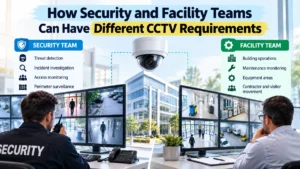
- CCTV integration: Automatically calling up camera feeds for the alarm zone, helping control room staff verify a fire quickly.
- Access control integration: Unlocking designated escape doors and, where appropriate, locking down other access points during an alarm event.
This kind of integration turns the fire alarm system from a standalone device into part of a coordinated emergency response.
Panel Architecture: Centralised vs Distributed
| Factor | Centralised Panel | Distributed/Networked Panels |
|---|---|---|
| Best for | Single building, moderate size | Multi-building logistics parks, campuses |
| Redundancy | Single point of failure risk | Built-in redundancy across panels |
| Expansion | Can require major rework to expand | Designed for phased expansion |
| Response coordination | Simple, single control point | Requires network management, but scales well |
| Cabling | Long cable runs possible in large sites | Shorter local runs, networked back to a master |
For a single mega-warehouse, a well-specified centralised panel with sufficient loop capacity may be enough. For a logistics park with multiple buildings, multiple tenants, and phased construction, a networked, distributed panel architecture is generally the safer long-term choice, particularly because it supports redundancy and future expansion without a full system redesign.
Standards and Compliance
Fire alarm design for logistics parks should always be developed against recognised codes and the requirements of the local fire authority having jurisdiction. Commonly referenced standards include:
- NFPA 72 (National Fire Alarm and Signalling Code): Widely referenced for detector spacing, notification, and system design principles.
- EN 54: The European standard series covering fire detection and alarm system components.
- National Building Code of India (NBC): Governs fire protection requirements for buildings in India, including warehouses and logistics facilities.
- Local Fire Authority requirements: Always take precedence and can add requirements specific to occupancy, hazard class, or region.
This article provides general engineering guidance and is not a substitute for a project-specific fire safety design reviewed by a licensed fire protection engineer and approved by the relevant local authority.
Maintenance, Testing, and Scalability
How Often Should Logistics Facilities Test Fire Alarm Systems?
Testing frequency should follow the applicable code (such as NFPA 72) and manufacturer guidance, but common industry practice includes:
- Weekly visual checks of the panel for fault indications.
- Monthly testing of a sample of manual call points on a rotating basis.
- Quarterly functional testing of detectors, sounders, and VADs per code schedule.
- Annually, a full system inspection and test, including battery backup, network communication, and integration points with sprinklers and BMS.
Redundancy
Large logistics parks should specify backup power, network path redundancy for distributed panels, and, where applicable, redundant communication paths to the monitoring station or fire brigade.
Expansion Planning
Logistics parks rarely stay static; new units get built, tenants change, racking gets reconfigured. Specifying an addressable, networked system with spare loop capacity from day one avoids costly rework later.
Practical Checklists
Pre-Installation Checklist
- Confirm occupancy classification and hazard categories for each zone.
- Identify high-risk areas: battery rooms, cold storage, hazardous goods.
- Review ceiling heights and airflow patterns for detector selection.
- Coordinate with sprinkler, HVAC, and BMS design teams early.
- Confirm applicable code (NFPA 72, EN 54, NBC, local authority).
Design Checklist
- Select detection technology per zone (ASD, beam, point, multi-criteria).
- Choose addressable vs conventional panel based on facility size and complexity.
- Plan panel architecture: centralised or distributed/networked.
- Design notification coverage for high-noise areas (sounders + VADs).
- Specify voice evacuation if staged evacuation is required.
- Plan integration points: sprinklers, smoke control, HVAC shutdown, BMS, CCTV, access control.
Maintenance Checklist
- Weekly panel fault check.
- Monthly rotating manual call point test.
- Quarterly detector and sounder functional test.
- Battery backup verification.
- Documented fault log and closure tracking.
Annual Inspection Checklist
- Full system functional test per applicable code.
- Verify all integration points still function as designed.
- Confirm spare capacity against current racking/tenant layout.
- Review and update as-built drawings and zone maps.
- Verify monitoring station/fire brigade connection.
Warehouse Expansion Checklist
- Reassess detector coverage against new racking heights and layout.
- Confirm spare loop/zone capacity on existing panel.
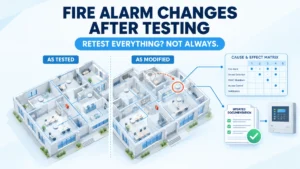
- Update zone maps and cause-and-effect programming.
- Re-test integration with sprinklers, HVAC, and BMS after changes.
- Re-certify system with local fire authority where required.
Key Takeaways
- Logistics parks carry a distinct fire risk profile: high fuel loads, tall racking, and large open volumes all change how fire and smoke behave.
- Detection technology should be matched to each zone: aspirating detection and beam detectors for high-bay and specialised areas, addressable point detectors for general coverage.
- Addressable, networked fire alarm systems are the standard recommendation for large or multi-tenant logistics parks, while conventional panels can suit small, single-zone warehouses.
- Integration with sprinklers, smoke control, HVAC, BMS, CCTV, and access control turns the fire alarm system into part of a coordinated emergency response, not a standalone device.
- Design and installation should always follow recognised standards (NFPA 72, EN 54, NBC India) and local fire authority requirements.
Common Mistakes to Avoid
- Treating warehouse detector spacing the same as office spacing, ignoring ceiling height and stratification.
- Underestimating battery charging and lithium-ion storage as a distinct hazard category.
- Choosing a conventional panel for a facility that’s likely to expand, then facing a costly redesign later.
- Skipping integration with sprinklers, HVAC, and BMS during initial design.
- Deferring maintenance testing schedules, leading to undetected faults over time.
Expert Recommendations
Engage a qualified fire protection engineer early in the design process, before racking layouts and building services are finalised. Retrofitting detection into a fixed racking plan is far more expensive than designing around it from the start.
Where a project calls for GST fire alarm system components, note that Innxeon Technologies operates as a PAN-India distributor of GST fire alarm systems, supplying addressable and conventional detectors and panels to fire protection contractors and system integrators across the country.
Future Trends in Logistics Fire Protection
Expect continued growth in aspirating detection adoption for high-bay and automated storage areas, tighter integration between fire alarm panels and BMS platforms, and increased attention to battery charging and lithium-ion storage design as e-commerce fulfilment and warehouse automation continue to expand. Remote monitoring and cloud-connected panel diagnostics are also becoming more common, giving facility managers earlier visibility into faults across multi-building sites.
Read Also: Why Fire Alarm Expandability Matters More Than Initial Capacity
Read Also: How to Evaluate a Fire Alarm Supplier Beyond Product Pricing