Modern buildings rely on dozens of intelligent systems from HVAC and elevators to access control and building management platforms. When a fire emergency occurs, these systems must work together seamlessly. The challenge isn’t integrating everything; it’s integrating intelligently without creating unnecessary complexity that makes operation, maintenance, or future expansion more difficult.
Introduction
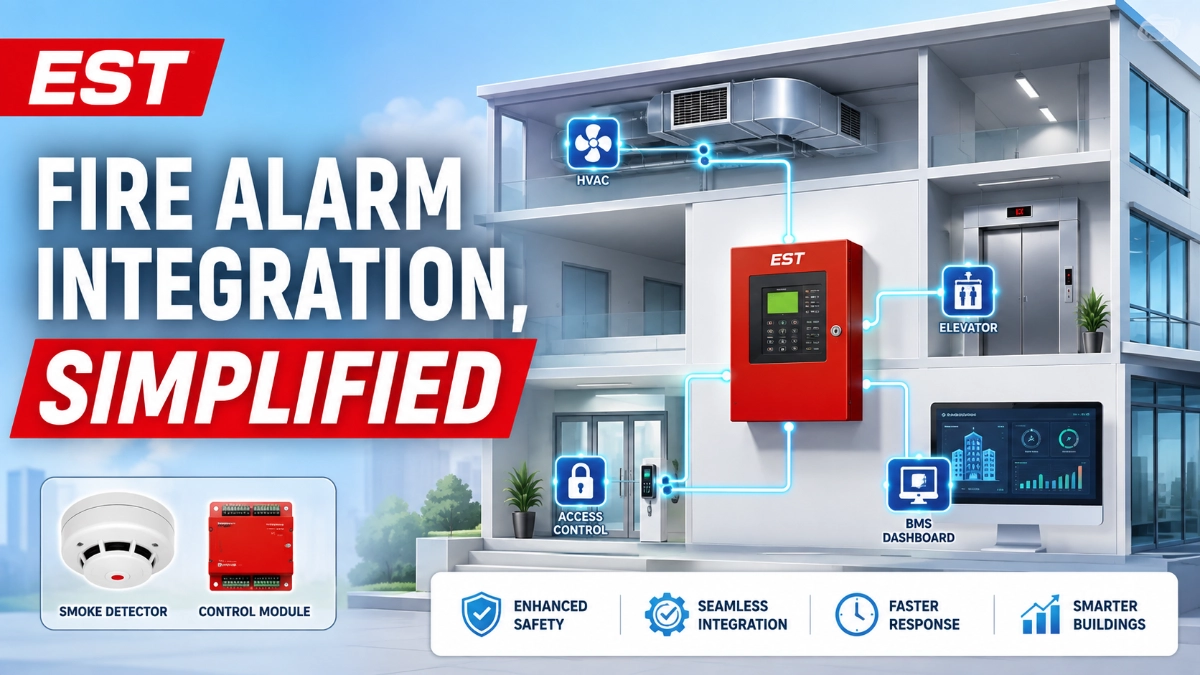
As buildings become smarter, fire protection engineers connect fire alarm systems with a growing list of technologies: HVAC controllers, elevators, access control, CCTV and centralised Building Management Systems (BMS). Done poorly, this creates tangled cause-and-effect logic, fragile interfaces and systems that are hard to troubleshoot during an actual emergency.
Done well, integration does the opposite. It simplifies emergency response by ensuring systems react automatically and predictably: doors unlock, HVAC dampers close, elevators recall, and voice alarm messages play without manual intervention or new points of failure. The goal should never be “more integration.” It should be “the right integration, designed for long-term simplicity.”
Well-planned fire alarm integration connects life safety systems HVAC, elevators, access control, and BMS platforms so they respond automatically during an emergency. When designed with standardized interfaces, modular architecture, and clear cause-and-effect logic, integration improves response speed and occupant safety while keeping the system easy to maintain, test, and expand over time.
What Is Fire Alarm Integration?
Fire alarm integration is the coordinated communication between a fire alarm control panel and other building systems, enabling automated, predictable responses to a detected fire event. It relies on cause-and-effect programming: a defined trigger (such as a smoke detector activation) produces a defined output (such as HVAC shutdown or elevator recall).
True integration is not the same as simply wiring two systems together. Wiring creates a physical connection; integration creates intelligent, tested, and documented interoperability. An addressable fire alarm system using intelligent modules, monitor modules, and control modules allows each device and interface to be individually identified, monitored, and programmed, making the difference between a system that reacts correctly under stress and one that fails silently.
Why Modern Buildings Require Integrated Fire Alarm Systems
Standalone fire alarm systems can detect and notify, but they cannot coordinate a full building response on their own. Integration matters because it enables:
- Faster emergency response through automated triggers rather than manual operator action.
- Coordinated evacuation using PAVA messaging synchronised with detection zones.
- Smoke management via automatic activation of smoke control dampers and pressurisation fans.
- Occupant safety through elevator recall and access control unlocking at the right moment.
- Building automation continuity, allowing normal operations to resume quickly once the event clears.
- Business continuity, since well-integrated systems reduce false-alarm disruptions and downtime.
Building Systems Commonly Integrated with Fire Alarm Systems
Building Management System (BMS)
The Building Management System (BMS) typically serves as the central monitoring layer. Integration with BMS lets facility teams view fire events, device status, and system health alongside HVAC, lighting, and energy data without the BMS controlling fire alarm logic directly.
HVAC Shutdown
HVAC integration stops air handling units and closes fire/smoke dampers in affected zones to prevent smoke from spreading through ductwork. This is one of the most critical and most commonly misconfigured integrations if zoning isn’t carefully mapped.
Smoke Control Systems
Smoke control systems use pressurisation and exhaust fans to keep stairwells and refuge areas clear, giving occupants safer egress routes. This integration depends on precise, verified cause-and-effect logic between detection zones and fan control.
Elevator Recall
Elevator recall automatically sends elevators to a designated floor and disables normal service during a fire event, preventing occupants from becoming trapped between floors.
Access Control Systems
Access control integration unlocks designated egress doors during an alarm condition while maintaining security in unaffected zones, balancing life safety with building security requirements.
Public Address & Voice Alarm (PAVA)
Public Address & Voice Alarm (PAVA) systems deliver zone-specific evacuation messaging, often phased to avoid full-building panic and support orderly evacuation.
Emergency Lighting
Integration with emergency lighting ensures illuminated egress paths activate automatically, coordinated with the same zones triggering evacuation alarms.
Security & CCTV Monitoring
Linking notification appliances and detection events to CCTV allows security personnel to visually verify alarms, reducing false dispatches and improving incident response accuracy.
How to Integrate Without Increasing Complexity
Complexity isn’t a byproduct of integration; it’s a byproduct of poor planning. Engineers can avoid it by following these principles:
- Use standardised system architecture rather than custom, one-off interfaces for each connected system.
- Design modular integration so each subsystem can be added, removed, or upgraded independently.
- Keep cause-and-effect programming clear and minimal; avoid nested conditional logic where simple triggers suffice.
- Rely on intelligent modules for consistent, addressable communication rather than hardwired point-to-point links.
- Centralise monitoring through a single interface without merging control authority across systems.
- Use standard communication protocols to avoid proprietary lock-in and future compatibility issues.
- Design the fire alarm network for scalability from the outset, anticipating future building expansion.
- Document and label everything; every interface, module, and cause-and-effect rule should be traceable.
Common Integration Mistakes
| Mistake | Why It Creates Problems | How to Prevent It |
|---|---|---|
| Overcomplicated programming | Nested logic becomes unpredictable and hard to troubleshoot | Keep cause-and-effect rules simple and modular |
| Poor documentation | Future technicians can’t trace interface logic | Maintain updated interface and logic documentation |
| Excessive custom logic | Non-standard programming increases long-term maintenance cost | Use standardised, repeatable logic templates |
| Incompatible interfaces | Mismatched protocols cause communication failures | Confirm protocol compatibility before design finalisation |
| Lack of testing | Untested integrations fail silently during real events | Perform full integrated system testing, not just panel testing |
| No future expansion planning | Systems become bottlenecks as buildings grow | Design network architecture with spare capacity |
| Weak network architecture | Single points of failure compromise reliability | Use redundant, segmented fire alarm network design |
The Role of EST3 and EST4 in Enterprise Integration
Enterprise-grade platforms such as the EST3 Fire Alarm Panel and EST4 Fire Alarm Panel are built to support multi-system integration at scale. These platforms are commonly deployed in large campuses, airports, and industrial facilities where dozens of subsystems must communicate reliably.
Their value in an integration context comes from a few architectural characteristics: networked communication across multiple panels and buildings, flexible expansion as new zones or subsystems are added, and simplified diagnostics that let technicians isolate faults without disrupting the entire system. When paired with EST detectors and devices including addressable smoke detectors, heat detectors, and manual call points, these panels provide the addressable intelligence needed for precise, zone-specific cause-and-effect programming, which is the foundation of low-complexity integration.
This is not a claim that any single platform is superior to alternatives; rather, it illustrates how enterprise fire alarm architecture, when properly specified, supports the standardised and modular approach outlined above.
Consultant Framework for Successful Fire Alarm Integration
A disciplined, repeatable framework keeps integration projects predictable:
- Identify Building Systems: Catalogue every system that will interface with the fire alarm system.
- Define Integration Objectives: Clarify what each integration is meant to achieve operationally.
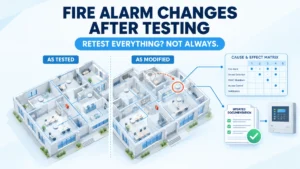
- Develop Cause-and-Effect Matrix: Document every trigger and corresponding response before programming begins.
- Standardise Interfaces: Use consistent module types and communication protocols across the project.
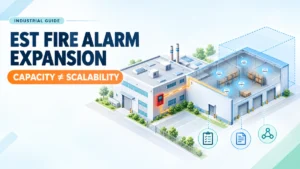
- Design for Scalability: Size the fire alarm network and panel capacity for future growth.
- Validate Integration Logic: Review the cause-and-effect matrix with all stakeholders before implementation.
- Perform Integrated Testing: Test the fire alarm system together with every connected subsystem, not in isolation.
- Document All Interfaces: Deliver as-built documentation covering wiring, logic, and protocol details.
Real-World Integration Examples
- Hospitals rely on integration to coordinate smoke control, elevator recall for staff-only elevators, and phased PAVA evacuation to avoid disrupting critical care areas unnecessarily.
- Airports use zone-based integration across massive terminal footprints, where access control integration and HVAC shutdown must operate independently in each concourse without cross-triggering unrelated zones.
- Manufacturing plants integrate fire alarm systems with process shutdown controls and ventilation systems to contain hazards specific to industrial environments.
- Data centres prioritise integration with HVAC and suppression systems, where false-alarm prevention and precise zoning are essential to avoid unnecessary equipment shutdowns.
- Universities manage large, multi-building campuses where a networked fire alarm control panel architecture allows centralised monitoring across dozens of structures.
- Commercial office buildings typically integrate BMS, elevator recall, and access control as a baseline, prioritising tenant safety with minimal operational disruption.
Expert Insights
- Integration should simplify operations, not add technology for its own sake; every connected system must serve a clear life-safety function.
- Standardised interfaces reduce long-term maintenance costs far more than they add upfront engineering time.
- Documentation, more than hardware selection, often determines whether an integration project succeeds five years later.
- Modular integration architecture makes building expansion projects faster and less disruptive to existing life safety operations.
- Simple, well-documented cause-and-effect programming is generally more reliable in an emergency than heavily customised automation logic.
- Integrated testing must include every connected building system; testing the fire alarm control panel alone does not validate real-world performance.
- Consultants who involve facility management teams early in the design process avoid rework caused by unrealistic operational assumptions.
Key Takeaways
- Fire alarm integration should reduce emergency response complexity, not add to building operational complexity.
- Use standardised, modular architecture rather than custom point-to-point interfaces.
- Keep cause-and-effect programming as simple as the safety requirement allows.
- Prioritise documentation as a core deliverable, not an afterthought.
- Design the fire alarm network with future expansion in mind.
- Test integrated systems together, including HVAC, elevators, access control, and PAVA.
- Choose enterprise platforms like EST3 and EST4 fire alarm panels when scale and multi-system coordination demand it.
- Involve facility managers early to align integration design with real operational needs.
Read Also: Why Large Campuses Need Scalable Fire Alarm Infrastructure
Read Also: Fire Alarm Validation: The Missing Step in Many Infrastructure Projects