Many infrastructure projects complete installation and commissioning, yet hidden programming errors, incomplete cause-and-effect logic, undocumented device changes, or integration issues remain undiscovered until a real emergency occurs. Fire alarm validation is the final engineering step that confirms the entire life safety strategy performs exactly as intended, not just individual devices.
Introduction
Most fire protection schedules are built around two milestones: installation and commissioning. Contractors mount detectors, pull cable, program the fire alarm control panel, and demonstrate that devices respond when tested. Once commissioning sign-off is obtained, the project is often considered complete.
But commissioning confirms that a system can operate, not that it will operate correctly under every real-world condition the design intended. Validation closes this gap. It re-examines the fire alarm network as a complete, integrated life safety strategy, checking that cause-and-effect logic, notification sequences, and interfaces with lifts, HVAC, fire doors, and the building management system (BMS) behave exactly as the design intent requires. For hospitals, airports, data centres, and industrial facilities, validation should be treated as a mandatory engineering process rather than an optional final check.
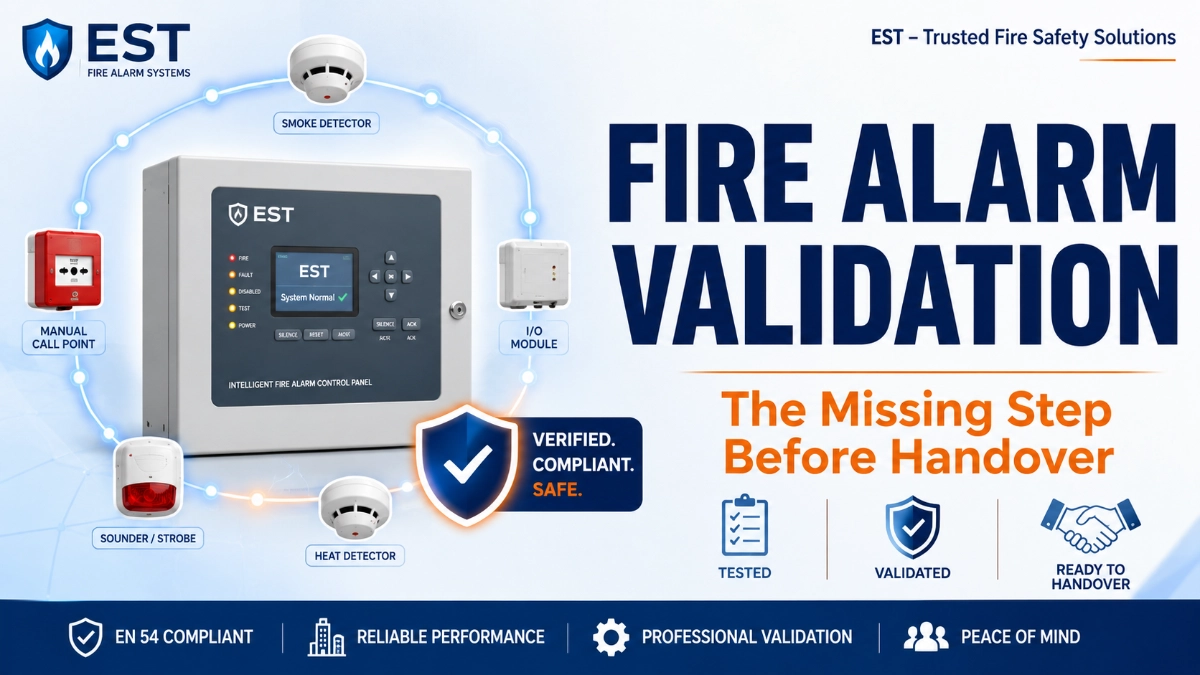
Fire alarm validation confirms that a fully commissioned fire alarm system functions as an integrated life-safety strategy, not just as a collection of working components. It verifies cause-and-effect programming, notification sequences, and interfaces with lifts, HVAC, fire doors, and BMS platforms, ensuring the system behaves correctly during a genuine emergency, not only during a scripted test.
What Is Fire Alarm Validation?
Fire alarm validation is a structured verification process performed after commissioning to confirm that an addressable fire alarm system achieves its intended fire protection outcome across the entire building. It looks beyond individual device response and asks a broader question: does the system, as a whole, protect occupants and assets the way the fire strategy document says it should?
Validation objectives typically include:
- Confirming device addressing matches as-built drawings and the fire strategy.
- Verifying cause-and-effect programming reflects the approved sequence of operations.
- Checking notification appliances, smoke control interfaces, and evacuation signals activate in the correct order and timing.
- Confirming integration with lifts, fire doors, HVAC shutdown, and the BMS.
- Reviewing event logs and network communication for gaps or fault conditions.
The distinction is simple but important. Verifying equipment confirms a smoke detector reports an alarm to the panel. Validating system performance confirms that the alarm correctly triggers lift recall, releases the right fire doors, shuts down the appropriate air-handling units, and notifies the BMS in the correct zone, in the correct sequence, without unintended side effects elsewhere in the building.
Testing vs Commissioning vs Validation
These three stages are often used interchangeably, but each serves a distinct engineering purpose.
| Stage | Purpose | Timing | Scope | Responsibility | Expected Outcome | Documentation |
|---|---|---|---|---|---|---|
| Testing | Confirm individual devices function | During/after installation | Device-level (detectors, call points, modules) | Installation contractor | Device responds and reports correctly | Device test sheets |
| Commissioning | Confirm the system operates as programmed | Before handover | Panel programming, loop, basic cause-and-effect | Commissioning engineer | System activates as configured | Commissioning certificate |
| Validation | Confirm the full strategy performs as designed | Before handover, at major changes | Entire network, integrated systems, real-world scenarios | Fire protection engineer / independent validator | System protects occupants as intended | Validation report, scenario logs |
All three stages answer different questions. Testing asks “does the device work?” Commissioning asks “does the programmed system respond?” Validation asks “does the complete strategy actually protect the building?” Skipping any one stage leaves a gap that only becomes visible during an actual fire event.
Why Validation Is Often Missed
Validation is frequently the first casualty of a tight project schedule, for several recurring reasons:
- Project deadlines: Handover dates are fixed before commissioning finishes, leaving little room for a separate validation phase.
- Budget constraints: Validation is sometimes seen as duplicate effort rather than a distinct deliverable, so it gets value-engineered out.
- Lack of documentation: Without accurate as-built drawings and cause-and-effect matrices, validators cannot confirm what the design intended.
- Assumption that commissioning is sufficient: Teams treat a signed commissioning certificate as proof the system is ready, overlooking that commissioning rarely tests full-building scenarios.
- Poor coordination between disciplines: Fire alarm, HVAC, lift, and BMS teams are often commissioned separately, so cross-system interfaces go untested together.
- Limited understanding of lifecycle risk: Undetected programming errors can remain dormant for years until the exact scenario they affect occurs.
What Should Be Validated?
Device Addressing
Every smoke detector, heat detector, manual call point, and module must report to the panel with the correct address and zone, matching the as-built drawing.
Cause-and-Effect Programming
Panel logic must match the approved matrix, confirming specific alarm inputs trigger the correct combination of outputs.
Alarm Sequence Verification
Validators confirm the sequence of events alert, investigation, general alarm, evacuation unfolds in the correct order and timing.
Notification Appliance Operation
Sounders, strobes, and voice evacuation systems must activate in the correct zones at correct sound levels, without coverage gaps.
Smoke Control Interfaces
Pressurisation fans, smoke dampers, and extraction systems must respond correctly to the fire alarm network’s signal.
Lift Recall Logic
Lifts must recall to the designated floor and stay out of service during an alarm, without stranding occupants.
HVAC Shutdown
Air-handling units in affected zones must shut down to prevent smoke migration, while unaffected zones keep operating normally.
Fire Door Release
Magnetic hold-open devices on fire-rated doors must release on alarm activation, only in the correct zones.
BMS Integration
The building management system must receive accurate fire alarm status for facility teams to monitor and respond appropriately.
Network Communication
Multi-panel networks must maintain reliable communication, with faults correctly reported rather than silently dropped.
Event Logging
Logs must accurately timestamp every alarm, fault, and operator action for post-incident review and audits.
Documentation Accuracy
As-built drawings and cause-and-effect matrices must match the installed, programmed system; a mismatch undermines every other validation step.
Real-World Validation Scenarios
Hospital: Confirms a fire in one ward zone triggers phased evacuation, correct lift recall for patient transport, and HVAC isolation without disrupting life-support systems elsewhere.
Airport: Checks that alarm zones align with terminal wayfinding and that voice evacuation messaging is intelligible across large open spaces.
Manufacturing Plant: Confirms detectors suited to industrial fire protection heat detectors in high-dust or high-heat zones trigger correct process shutdowns without nuisance-alarm downtime.
Data Centre: Verifies early-warning detection integrates correctly with clean-agent suppression logic, without false triggers from sensitive server environments.
Commercial High-Rise: Confirms phased evacuation, lift recall, and stairwell pressurisation activate correctly across multiple connected panels.
University Campus: Checks that a distributed, multi-building system reports consistently to a central monitoring point, with cause-and-effect logic maintained across buildings of different ages.
How EST3 and EST4 Support System Validation
Enterprise-grade platforms such as the EST3 Fire Alarm Panel and EST4 Fire Alarm Panel provide intelligent diagnostics and device-level monitoring that make validation more thorough. Detailed event history logs let validators trace how the system actually responded during scenario testing, rather than relying solely on observation. Network health monitoring across multi-panel configurations helps confirm communication remains reliable, which is central to validating larger, distributed fire alarm networks.
Programming verification tools also support cross-checking cause-and-effect logic against the approved design matrix, giving validators system-wide visibility one reason enterprise projects increasingly specify intelligent, addressable fire alarm systems, such as the broader EST Fire Alarm System range, for facilities where validation depth matters as much as installation quality.
Validation Checklist Before Project Handover
- Confirm as-built documentation matches installed devices and programming.
- Verify device addressing and zone descriptions against design drawings.
- Complete functional testing of notification appliances.
- Test integration with lifts, HVAC, fire doors, and BMS.
- Confirm cause-and-effect programming matches the approved matrix.
- Run fault simulation on loops, modules, and network links.
- Validate communication across all panels on the network.
- Confirm event logs accurately capture test scenarios.
- Deliver operator training aligned with validated behaviour.
- Issue a final validation report, separate from the commissioning certificate.
Common Validation Mistakes
- Assuming installation quality guarantees performance: A perfectly installed device can still be programmed incorrectly.
- Skipping full scenario testing: Isolated device tests miss cross-system failures visible only in a realistic emergency sequence.
- Ignoring third-party interfaces: Lift, HVAC, and BMS integrations are often commissioned separately and never re-tested from the fire alarm side.
- Poor documentation control: Validation without accurate as-built records simply confirms the system matches outdated paperwork.
- Not testing under realistic conditions: A system validated with HVAC in standby may behave differently once fully occupied.
- Failing to revalidate after design changes: Fit-outs and added detection points can quietly break validated logic.
Consultants should treat validation as a living deliverable, not a one-time handover event.
Expert Insights
- Validation should begin during design review; not after installation, catching gaps on paper is far cheaper than discovering them on site.
- Thorough validation reduces lifecycle maintenance costs by surfacing errors before they cause repeated false alarms or missed responses.
- Integrated system validation matters more than device testing, since most failures occur at the interfaces between fire alarm, HVAC, lifts, and BMS.
- Validation documentation becomes a critical reference for future upgrades, giving engineers a verified baseline instead of reverse-engineering behaviour.
- Periodic revalidation is essential for expanding facilities, since every added zone or device can quietly alter previously verified logic.
- Enterprise projects should specify validation as a distinct contractual deliverable, not fold it into commissioning paperwork.
- Independent validation, performed by someone other than the installing contractor, tends to surface issues internal teams overlook.
Key Takeaways
- Installation proves components exist; commissioning proves they operate; validation proves the strategy works.
- Budget validation as a separate project phase, not as an assumed part of commissioning.
- Accurate as-built documentation is a prerequisite for meaningful validation.
- Cross-system interfaces, lift, HVAC, fire doors, and BMS need dedicated validation testing.
- Scenario-based testing reveals failures that device-level testing cannot.
- Enterprise panels with strong diagnostics and event logging make validation more efficient and defensible.
- Validation reports are long-term assets for maintenance, audits, and future upgrades.
- Revalidate after any material change to zones, devices, or building use.
Read Also: What Commissioning Reveals About Fire Alarm System Quality
Read Also: Infrastructure Decisions That Reduce Fire Alarm Upgrade Costs