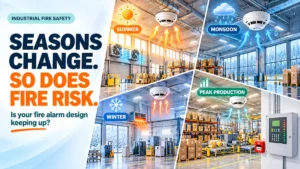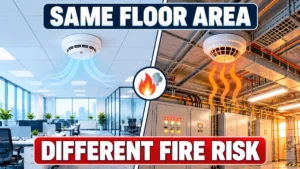
An industrial facility may use the same building all year, but the conditions inside it rarely stay the same. A packaging plant ramps up before a festival season. A cold store takes on extra inventory. A boiler house runs longer in winter. Monsoon humidity rises, ventilation settings change, and a contractor sets up temporary partitions during a shutdown.
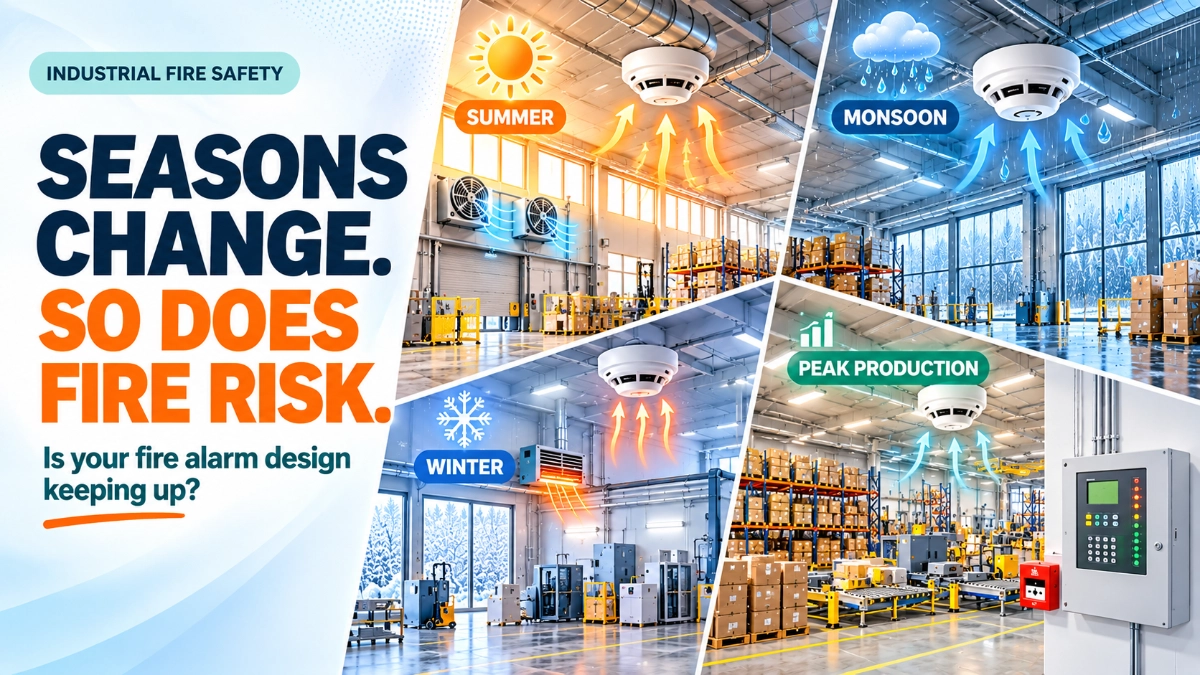
Each shift follows the same chain: seasonal operation → environmental change → process change → changing fire risk → changing detection requirements. A fire alarm system specified around one operating condition may not perform optimally under another.
This does not mean replacing the system every season. It means treating seasonal industrial fire alarm design as a living assumption, one that engineers verify as conditions change. The answers below explain what to review, when, and why.
Why Seasonal Operations Can Change Industrial Fire Risk
Short answer: Seasonal operations change both the environment around detectors and the fire hazards the system must detect.
Two kinds of change matter, and they interact.
- Seasonal environmental changes come from the climate: temperature, humidity, rainfall, and the way outdoor conditions affect indoor airflow.
- Seasonal operational changes come from how the facility runs: production intensity, raw-material and finished-goods quantities, temporary equipment, shutdown schedules, workforce size, loading activity, and HVAC operation.
An environmental change can trigger an operational one. Cold weather leads to more space heating. Peak demand leads to longer machine hours and denser storage. Together they can alter:
- Combustible loading and storage density.
- Ignition sources, from heaters to overloaded circuits.
- Airflow patterns that carry smoke, heat or dust.
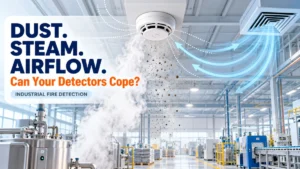
- Dust, steam and moisture levels at detector locations.
- Occupancy and the pace of loading and unloading.
Detection performance depends on these conditions. That is why periodic review belongs in industrial fire safety planning.
Does Seasonal Weather Affect Fire Alarm System Performance?
Yes, it can, depending on the facility, the detector technology and how the environment changes. Weather rarely acts alone. Humidity, temperature extremes and airflow shifts influence detector suitability, contamination and nuisance-alarm behaviour. Engineers should check the manufacturer’s documented operating conditions and the applicable standards for each installed device.
How Summer Conditions Can Affect Fire Alarm Performance
Hot weather does not automatically raise fire risk. The effect depends on the process, the equipment and the building.
Consider what may change:
- Ambient and roof-space temperatures: High temperatures near the ceiling can approach the operating limits of some devices or narrow the margin for heat detector selection.
- Electrical loading: Heavier cooling demand, temporary fans and portable coolers can load circuits and panels differently from the design condition.
- Ventilation: Open dock doors and higher air-change rates can dilute smoke, disrupt stratification and carry dust or pollen to detectors.
- Dust: In dry conditions, some processes shed more particulate that can load detectors.
- Temperature differentials: Air-conditioned zones adjacent to hot process areas may produce unusual airflow at openings.
Ask whether these changes alter the original design assumptions. If they do, evaluate detector type, spacing, location and maintenance interval before assuming any hardware is wrong.
How Winter Operations Can Create Different Fire Detection Challenges
Winter shifts the hazard profile instead of simply raising or lowering it. Not every facility faces the same winter conditions.
Where space heating, boilers or temporary heaters are in use, engineers should consider:
- New ignition sources: Portable heaters and combustion equipment introduce hazards that were absent in summer.
- Reduced ventilation: Closed doors and sealed bays can concentrate smoke, fumes or dust and change how plumes rise and spread.
- Altered airflow: Heaters and destratification fans can disturb stratification and affect smoke movement and detector response.
- Cold-weather storage: Seasonal stock, packaging and temporary insulation may add combustible load in areas not designed for it.
- Maintenance and shutdowns: Winter overhauls often involve hot work, temporary power and disabled zones.
Treat each winter change as a question: what new hazard has been introduced, and does the existing detection design account for it?
How Does Humidity Affect Fire Detection?
Humidity and moisture can contribute to condensation, contamination, corrosion and nuisance alarms, particularly where a detector is not suited to the environment. The effect depends on device design, installation quality and exposure.
Monsoon and high-humidity regions create several practical risks:
- Condensation where cool surfaces meet humid air, such as near chillers or in unconditioned roof spaces.
- Water ingress through conduit entries, junction boxes and poorly sealed enclosures.
- Steam and washdown in food, beverage and chemical processes.
- Corrosion of contacts, terminals and enclosures, especially in coastal or chemical environments.
- Contamination of sensing chambers by moisture-borne particles.
Check each device’s environmental rating against the manufacturer’s documentation and the applicable standards. Ingress protection, operating humidity range and installation method all matter. Where conditions exceed what a standard detector tolerates, consider application-specific detection or protective measures, subject to the manufacturer’s instructions and the authority having jurisdiction.
Seasonal Production Changes Can Be More Important Than Weather
Production changes often alter fire risk more than weather does. The process, not the climate, determines what burns, how much, and where.
Consider these examples:
- A manufacturing plant adds shifts before a major sales season. More machine hours produce more heat, dust and electrical loading.
- A warehouse accepts peak-demand inventory. Aisles narrow, storage heights rise, and combustible packaging increases.
- A food-processing facility changes its schedule to a different product. New ovens, fryers, steam or flour dust enter the picture.
- A chemical or process plant raises raw-material throughput. Inventory and release scenarios change.
- A logistics hub peaks in shipments. Pallets stage in corridors, and forklift activity increases.
- Temporary storage areas appear in spaces never designed for them.
The relationship is direct: seasonal production change → altered fire load → changed fire risk → potential need for design review. More material, more equipment, more people and denser storage can all change how fires start and develop, and how quickly detection must respond.
Should Detector Selection Change With Seasonal Conditions?
Seasonal conditions may justify a design review, not automatic replacement. No detector type is universally better. Selection depends on the fire the system must detect and the environment where the detector operates.
| Detector technology | General strength | Typical consideration |
|---|---|---|
| Smoke detectors | Early warning of smouldering and developing fires | Sensitive to dust, steam and airflow |
| Heat detectors | Robust in dirty, dusty or steamy areas | Slower response; limited to fires producing sufficient heat |
| Multi-sensor detectors | Combine sensing methods to improve discrimination | Suitability depends on the product and application |
| Application-specific detection | Addresses ceiling height, hazard or environment | Requires engineered design and documentation |
Engineers should weigh:
- Expected fire characteristics and growth rate.
- Ceiling height and geometry.
- Airflow and ventilation patterns.
- Dust, steam, temperature and humidity.
- Applicable codes and standards.
- Manufacturer requirements.
- Realistic maintenance conditions.
Addressable and conventional detectors both fit within this analysis. Neither suits every industrial application.
Detector Placement Should Be Reviewed When Operations Change
A detector can stay in the same physical location while the environment around it changes.
Take a warehouse example. A detector was positioned for open floor space. During peak season, the operator installs additional racking and stacks pallets higher. Now stored goods may obstruct coverage, a temporary partition may divert smoke, and a new unit heater may create an airflow plume across the nearest detector.
The detector is unchanged. The conditions it was designed for are not.
Review placement whenever any of these change:
- Equipment locations or production machinery
- Storage configuration and racking
- Temporary partitions or structures
- HVAC layout, diffusers or return paths
- Material storage height
A fire protection engineer should confirm coverage against the applicable standard and the project’s fire strategy.
Addressable vs Conventional Systems in Changing Industrial Environments
Neither architecture is universally superior. Each suits different scale, risk and operational needs.
| Factor | Addressable system | Conventional system |
|---|---|---|
| Device identification | Each device reports individually | Devices on a zone circuit report collectively |
| Zone information | Point-level location | Zone-level location |
| System visibility | Detailed status and event history | Zone-level indication |
| Expansion | Often flexible within loop capacity | Typically organised by zone circuits |
| Troubleshooting | Faster fault and event localisation | May require more on-site investigation |
| Monitoring | Richer diagnostic data | Simpler, less granular information |
| Operational flexibility | Suits areas that reconfigure often | Suits smaller or simpler areas |
An addressable fire alarm panel works with addressable detectors that identify themselves individually. That visibility can help teams spot recurring nuisance alarms, track device behaviour across seasons and locate faults in large or reconfigured areas.
A conventional fire alarm panel with conventional detectors monitors zones and can remain a practical choice for smaller or less complex facilities. Zone design then matters more, because a single alarm indicates an area rather than a device.
Select architecture according to project requirements, scale, risk, applicable standards and operational needs. Manufacturers of both architectures, including the GST fire alarm system range, publish product-specific documentation that engineers should consult.
Seasonal Maintenance Is Part of Fire Alarm Reliability
Reliability depends on inspection, testing and maintenance, and seasonal changes are a practical prompt to perform them. Follow the applicable standards, the manufacturer’s instructions and site-specific procedures.
Before or during a major seasonal change, review:
- Detector condition, cleaning and functional testing
- Alarm and fault history, including repeated nuisance alarms
- Battery condition and power supply
- Fire alarm panel status
- Notification appliances
- Damaged or obstructed devices
- Changes in HVAC, storage or temporary equipment
- System documentation and as-built drawings
Repeated nuisance alarms deserve particular attention. They may indicate contamination, an unsuitable detector for a changed environment, or an altered process. Investigate the cause rather than only silencing the alarm.
A Seasonal Fire Alarm Review Checklist for Industrial Facilities
Use these questions before each seasonal transition:
- Has the production process changed?
- Has combustible loading increased?
- Has the storage configuration changed?
- Have temporary structures been introduced?
- Has HVAC operation changed?
- Have dust or steam levels changed?
- Have new heating or cooling systems been introduced?
- Have detector locations become obstructed?
- Has the facility experienced recurring nuisance alarms?
- Has any area changed its function?
- Have maintenance or shutdown activities altered system availability?
- Has the fire alarm documentation been updated?
Record each answer, assign an owner, and escalate any “yes” that affects coverage or suitability to a qualified fire protection engineer.
Quick Reference: Operational Change and Detection Impact
| Seasonal / Operational Change | Potential Fire Detection Consideration | What Engineers Should Review |
|---|---|---|
| Increased production | Higher equipment and combustible loading | Detector coverage and fire-risk assessment |
| Higher humidity | Moisture and condensation | Environmental suitability and maintenance |
| Increased dust | Contamination and nuisance-alarm risk | Detector selection and cleaning |
| HVAC changes | Altered airflow | Detector location and smoke movement |
| Seasonal storage increase | Different combustible loading | Coverage and storage arrangement |
| Temporary equipment | New ignition and environmental conditions | Detection coverage and system impact |
| Shutdown or maintenance | Reduced system availability | Impairment and restoration procedures |
How Can HVAC Changes Affect Fire Detector Performance?
HVAC changes can alter airflow, which can change how smoke reaches a detector and how quickly it responds. Higher air-change rates may dilute smoke, and new supply or return paths may redirect it away from detectors. Review detector locations whenever diffusers, returns, fans or ductwork change, and follow the applicable standard and manufacturer guidance on airflow.
When Should an Industrial Facility Review Its Fire Alarm Design?
Review whenever a change could affect fire risk, detector suitability or coverage. Typical triggers include:
- Major production changes
- New equipment
- New storage arrangements
- Facility expansion
- Temporary structures
- HVAC modifications
- Repeated nuisance alarms
- Changes in hazardous processes
- Significant occupancy changes
- Seasonal shutdowns
- Changes in combustible materials
Whether a formal review is required depends on the actual change and on applicable codes, the authority having jurisdiction and project requirements.
Conclusion
Seasonal industrial fire alarm design is less about swapping equipment than about keeping design assumptions aligned with operations. Production cycles, storage changes, HVAC operation, humidity and temporary processes can change the environment around detectors. Regular review, verification and maintenance help fire alarm systems stay suited to real conditions.
Read Also: How Dust, Steam and Airflow Can Complicate Fire Detection in Industrial Facilities
Read Also: Why Fire Alarm Coverage Should Follow Hazard Conditions, Not Just Floor Area