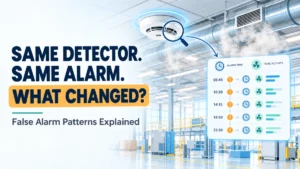
A detector in a production area has generated several false alarms over several weeks. Each time, someone silences it, cleans it, resets it, and occasionally replaces it. The alarms continue.
Then someone overlays the event history on the site calendar. The activations cluster after a process line was extended, an exhaust schedule was modified, and cleaning frequency increased. The detector has not moved, but the space around it has changed.
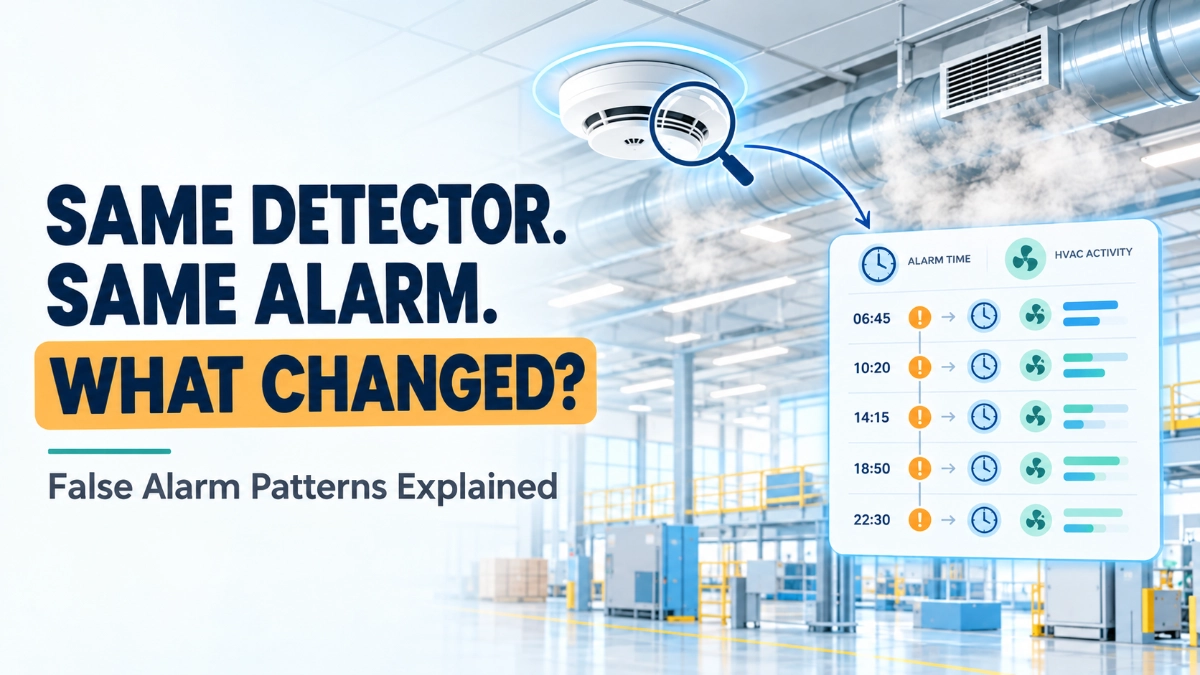
This raises an investigation question, not a diagnosis: is the detector failing, or is the environment no longer suited to the original detection strategy? Only evidence can answer it.
Can false alarm patterns indicate environmental changes? Yes, they can. Recurring activations in the same location, at similar times, or under similar operating conditions can justify investigating environmental changes such as dust, steam, airflow, HVAC changes, production activity, or construction. However, a pattern is a signal to investigate, not proof of an environmental cause. Engineers should compare event history with site conditions, maintenance records, recent changes, and technical evidence before deciding on corrective action.
What Is a False Alarm Pattern?
A false alarm pattern is a set of unwanted fire alarm events that share traceable characteristics. Define it across five dimensions:
- What: The type of event
- Where: The device, zone, or area
- When: Time of day, shift, or day of week
- How often: Frequency, and whether it is changing
- What changed: Any environmental or operational change preceding the pattern
A single isolated event offers limited context. It may reflect a transient disturbance, a contaminated device, or a one-off activity. A recurring pattern narrows the search, but it does not identify the root cause on its own.
Why a False Alarm Does Not Automatically Mean a Bad Detector
Fire detector false alarms have many possible causes:
- Environmental conditions
- Device contamination
- Installation conditions
- Wiring issues
- Configuration problems
- Maintenance conditions
- Electrical interference
- Equipment faults
- Changes in the protected environment
Replacing a detector without examining its surroundings can leave the underlying condition untouched. A new device installed in the same changed environment may repeat the same events. Replacement is sometimes appropriate, but it should follow evidence rather than substitute for it.
The Five Signals Engineers Should Look For
These signals help form an investigation hypothesis, nothing more.
- Location: Does the same detector, or the same area, repeatedly activate?
- Timing: Do events occur at similar times, such as shift changes or start-up?
- Frequency: Are events becoming more frequent over time?
- Operating condition: Do they coincide with production, cleaning, loading, HVAC operation, or other activity?
- Recent change: What changed in the facility before the pattern appeared?
Timing often provides the strongest clue. Events that follow a predictable operational cycle deserve a different investigation path than events scattered randomly across days.
How Environmental Changes Can Affect Fire Detection
Fire detector environment matters because detection performance depends on conditions at the device. The table lists areas worth investigating. None implies automatic causation.
| Environmental Change | What Engineers Should Investigate |
|---|---|
| Dust | Process activity, contamination, airflow |
| Steam | Process equipment, ventilation, detector location |
| Condensation | Temperature differences, humidity, HVAC |
| Airflow changes | HVAC modifications, exhaust, pressure differences |
| New machinery | Heat, dust, vapour, airflow, operating cycles |
| Construction | Dust, temporary partitions, altered airflow |
| Racking changes | Air movement, obstruction, changed storage conditions |
| Cleaning processes | Aerosols, chemicals, temporary environmental conditions |
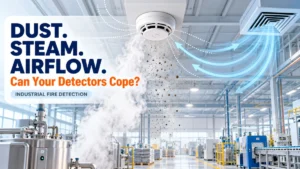
Dust and fire detectors, and steam and fire detectors, are common pairings in troubleshooting discussions. The effect depends on detector type, location, and site conditions, so each case requires verification rather than assumption.
How HVAC Changes Can Create New Fire Detection Conditions
HVAC and fire detection interact through air movement. Engineers should investigate HVAC changes when patterns begin after:
- New air-handling equipment
- Ventilation changes
- Exhaust modifications
- Ductwork changes
- Airflow direction changes
- Changes in operating schedules
- Building pressure changes
These changes can alter how air, particulates, moisture, and temperature reach a detector. Review actual site conditions rather than relying only on original design assumptions. A building that matched its drawings at commissioning may no longer match them after several modification cycles.
Production Changes Can Change the Fire Detection Environment
In industrial environments, engineers may encounter detector surroundings that change without any change to the detector itself. Examples include:
- New production equipment
- Increased production volume
- Different raw materials
- New process stages
- Changes in operating temperature
- New exhaust systems
- Different cleaning procedures
- Increased forklift or material movement
- Temporary production areas
Each can introduce dust, vapour, heat, or airflow that was not part of the original design basis. Ask production and maintenance teams what changed, not only what the fire alarm records show.
Event History: From Alarm Record to Investigation Clue
Event records can help engineers identify repeated locations, repeated time periods, recurring sequences, frequency changes, and relationships with operational activity.
Event-history functionality varies by system, configuration, and installation. Do not assume every platform records the same information. Treat event history as one source of evidence alongside physical inspection, maintenance records, system documentation, and site observations.
For an installed EST Fire Alarm System, begin by establishing what records actually exist, how they are retrieved, and how far back they extend. A pattern visible in the records is a starting point for inspection, not a conclusion.
EST3 and EST4: Why Historical Patterns Matter
Investigating an existing system starts with understanding what is installed. Whether the project uses EST3 or EST4, engineers should confirm:
- The installed platform and its configuration
- Available records and device history
- Current site conditions
- Maintenance history
Avoid assumptions about platform-specific logging, diagnostics, software functions, or troubleshooting procedures. Confirm them against the project’s own documentation and the manufacturer’s current technical information. Findings should stay project-specific and objective.
Detector and Device History Should Be Part of the Investigation
Review the following for the affected devices:
- Detector location
- Device type
- Installation environment
- Cleaning history
- Replacement history
- Previous false alarms
- Accessibility
- Nearby equipment
- Changes around the device
Cleaning and replacement records are especially useful. A device cleaned or replaced several times with no lasting improvement suggests looking beyond the device itself. For product identification, documentation, or replacement planning, refer to the relevant EST Detectors and Devices information and confirm details against project records.
Environmental Change or Equipment Fault? Build the Evidence
| Observation | Possible Direction for Investigation |
|---|---|
| Same detector activates repeatedly | Device/environment/location review |
| Multiple nearby detectors activate | Environmental/system-level review |
| Events begin after HVAC changes | Airflow/environment review |
| Events occur during production | Process/environment review |
| One device behaves differently | Device/wiring/configuration review |
| Events follow construction work | Site/environment/installation review |
These observations suggest investigation paths. They do not prove root cause. Keep the distinction clear:
Observation → Hypothesis → Investigation → Evidence → Confirmed Cause
An environmental hypothesis becomes a confirmed cause only when inspection, measurement, or controlled testing supports it, and when technical alternatives have been addressed.
A Practical False Alarm Investigation Workflow
Event → Pattern → Context → Inspection → Evidence → Root Cause → Corrective Action → Verification
- Event: Record each activation fully before resetting.
- Pattern: Compare events by location, timing, frequency, and conditions.
- Context: Gather facility changes, HVAC schedules, and production records.
- Inspection: Examine devices, wiring, installation, and surroundings.
- Evidence: Collect findings that support or contradict each hypothesis.
- Root cause: Declare a cause only when evidence supports it.
- Corrective action: Address the confirmed cause, whether environmental, installation-related, or device-related.
- Verification: Monitor after the change to confirm the pattern has stopped or changed.
The goal is to stop “reset and replace” from becoming the default troubleshooting strategy.
What Should Engineers Document?
- Date and time
- Device and location
- Event type
- Frequency
- Site activity
- Environmental conditions
- Recent facility changes
- Maintenance history
- Device history
- Inspection findings
- Testing performed
- Corrective action
- Verification result
This record matters most when the issue recurs. Without it, each event looks isolated, and each investigation starts from zero.
When Should Detector Replacement Be Considered?
Replacement may be appropriate when technical evidence supports a device-related issue. Repeated false alarms alone are not that evidence.
Before replacing a device, confirm that the investigation has addressed:
- Environment
- Installation
- Configuration
- Wiring
- Maintenance
- Physical condition
- Recent facility changes
No universal replacement threshold applies. The decision depends on site conditions, device history, and findings.
Common Mistakes During False Alarm Investigation
- Replacing the detector immediately.
- Treating every false alarm as a hardware failure.
- Ignoring event timing.
- Ignoring recent building changes.
- Failing to inspect HVAC changes.
- Ignoring production conditions.
- Looking only at the detector and not the surrounding environment.
- Resetting the system without documenting the event.
- Failing to compare repeated events.
- Declaring a root cause without sufficient evidence.
A Practical Environmental Change Audit
Physical Environment
- Dust
- Steam
- Condensation
- Temperature
- Humidity
- Air movement
Facility Operations
- Production changes
- Cleaning
- Storage changes
- Machinery
- Occupancy
Building Systems
- HVAC
- Exhaust
- Ventilation
- Partitions
- Renovation
Fire Alarm System
- Detector condition
- Device history
- Wiring
- Configuration
- Maintenance records
- Event history
Why False Alarm Patterns Can Become an Early Warning for Design Review
Recurring false alarms may indicate a maintenance issue. They may also indicate that the existing detection strategy no longer matches the current environment.
This does not mean every false alarm exposes a design error. Many systems perform as intended in the conditions they were designed for. But significant facility changes, such as new processes, altered ventilation, or changed storage layouts, can justify a broader engineering review of detector placement and detection suitability.
For existing-system review, product selection, technical documentation, or modification support, an EST Fire Alarm System Distributor in India can provide specialist input alongside the site’s own engineering assessment.
Key Takeaways
- False alarm patterns are investigation signals, not diagnoses.
- Location, timing, frequency, operating condition, and recent change form the core analysis framework.
- Environmental causes remain hypotheses until evidence confirms them.
- Equipment, wiring, configuration, installation, and maintenance causes stay in scope throughout.
- Event history is useful, but its availability depends on the system and project.
- Replacement should follow evidence, not repetition alone.
- Verify corrective action by monitoring afterwards.
Read Also: How to Plan EST Fire Alarm Expansion for a Growing Industrial Facility
Read Also: How Engineers Should Handle Fire Alarm Changes Made After Initial Testing