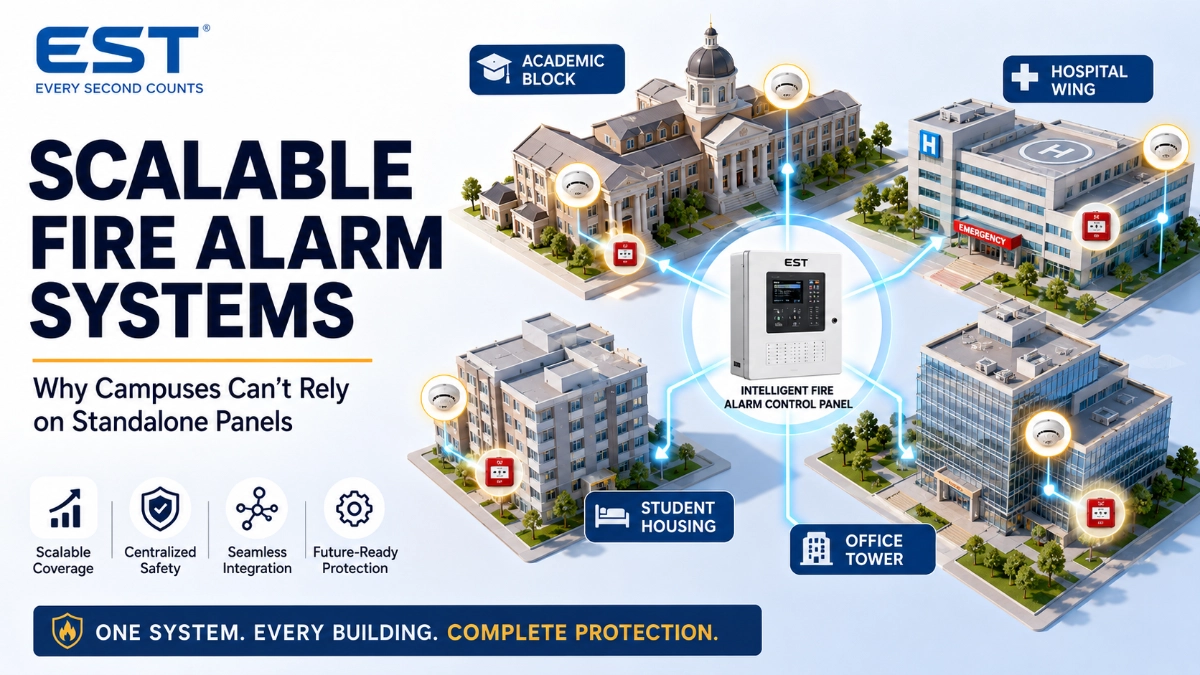
Modern campuses rarely remain the same for long. New academic blocks, hospitals, office towers, warehouses, production units, and research facilities are added over time. A fire alarm system designed only for today’s footprint can become costly and difficult to expand. Scalable fire alarm infrastructure enables organisations to grow while maintaining consistent life-safety protection across the entire campus.
Introduction
Large campuses are living infrastructure. A university adds a hostel block, a hospital opens a diagnostic wing, an industrial park commissions another production line, and each addition changes the site’s fire safety footprint. Standalone fire alarm systems, built as isolated panels for individual buildings, struggle to keep pace. They create fragmented monitoring, inconsistent device standards, and expensive rework every time a new structure comes online.
Scalability is not a marginal feature added late in design. It is a core engineering principle that determines whether a campus fire alarm system can absorb decades of construction and occupancy change without compromising detection speed or emergency response. For consultants and facility owners, understanding this early prevents costly retrofits and protects life safety performance as the campus matures.
Why do large campuses need scalable fire alarm infrastructure? Large campuses grow in phases, new buildings, wings, and utilities are added continuously. A scalable fire alarm control panel and network architecture allows each addition to integrate without replacing existing infrastructure, preserving centralized monitoring, consistent device standards, and predictable emergency response as the facility expands.
What Makes Fire Alarm Infrastructure Scalable?
A scalable system is built on architecture, not just panel size. Key characteristics include:
- Modular architecture: Panels that accept additional loop, network, and power modules without full replacement.
- Addressable technology: Every device on an addressable fire alarm system reports a unique identity, so new points can be added without renumbering the system.
- Enterprise networking: Panels across buildings communicate over a resilient fire alarm network, sharing status in real time.
- Expandable loops: Signalling circuits with reserved capacity for future intelligent detectors, modules, and notification appliances.
- Future-ready infrastructure: Cabling pathways, spare panel slots, and bandwidth planned for buildings that don’t exist yet.
Together, these elements form an intelligent fire alarm system that can grow organically rather than being rebuilt each time the campus expands.
Challenges of Protecting Large Campuses
Multiple Buildings
Each building has its own occupancy profile, construction type, and evacuation strategy. Without a unifying fire alarm network, each structure becomes an isolated island, making campus-wide coordination difficult during an emergency.
Long Communication Distances
Campuses often span hundreds of meters or multiple kilometres. Signal loss and network latency between buildings must be engineered carefully, typically through fibre-optic or redundant network loops connecting panels site-wide.
Different Occupancy Types
A campus may include classrooms, laboratories, data centres, warehouses, and residential blocks. Each demands different detector sensitivity, notification strategy, and code compliance, all managed under one coherent framework.
Phased Construction
Buildings are rarely completed simultaneously. Infrastructure must support partial commissioning, so completed blocks operate fully protected while construction continues elsewhere.
Centralized Monitoring
Security and facility teams need a single point of visibility. Fragmented, standalone panels force operators to check multiple independent systems, slowing recognition and response.
Business Continuity
Hospitals, data centres, and manufacturing plants cannot tolerate downtime. Expansions must happen without disrupting existing life safety coverage or daily operations.
Benefits of Scalable Fire Alarm Infrastructure
- Simplified expansion: New buildings connect to existing network backbones instead of requiring standalone systems.
- Faster emergency response: Centralised event management gives responders exact location data.
- Centralised event management: All alarms, troubles, and supervisory signals appear on one interface.
- Reduced operational complexity: Facility teams manage one integrated platform, not dozens of panels.
- Lower lifecycle costs: Modular growth avoids repeated capital spend on full replacements.
- Easier maintenance: Standardised devices and diagnostics simplify testing across the site.
- Consistent fire safety standards: Every building follows the same detection and reporting logic.
For example, an IT campus that begins with two towers can add five more over ten years without discarding its original fire alarm control panel investment, provided the initial network architecture had spare capacity.
Standalone Systems vs Networked Campus Infrastructure
| Criteria | Standalone Systems | Networked Campus Infrastructure |
|---|---|---|
| Scalability | Limited; each building is separate | Built for phased, ongoing expansion |
| Monitoring | Fragmented, building-by-building | Centralised, campus-wide visibility |
| Expansion | Requires new independent systems | New buildings join existing network |
| Maintenance | Inconsistent across sites | Standardised procedures and diagnostics |
| Fault Isolation | Harder to trace across buildings | Faults isolated to specific loops/nodes |
| Event Management | Multiple interfaces to monitor | Single unified event management platform |
| Lifecycle Value | Declines as campus grows | Improves with each connected phase |
| Operational Efficiency | Lower, more manual oversight | Higher, automated cross-building coordination |
How EST3 and EST4 Support Campus Expansion
Enterprise-grade platforms illustrate how scalable design principles apply in practice. The EST3 Fire Alarm Panel and EST4 Fire Alarm Panel are built around networked architecture that lets individual nodes represent separate buildings while remaining part of one logical enterprise fire alarm network.
This approach supports:
- Network communication between buildings using resilient, redundant pathways.
- Modular growth, adding loops, modules, and panels as construction phases complete.
- Multi-building visibility, giving operators a single reference point for alarms campus-wide.
- Intelligent event management, prioritising signals from EST detectors and devices by location and severity.
- Device scalability, supporting a growing mix of smoke detectors, heat detectors, manual call points, monitor modules, and control modules on shared loops.
- Long-term infrastructure planning, since network capacity can be reserved for buildings planned years in advance.
These characteristics make platforms like the EST Fire Alarm System relevant reference points for enterprise-scale design, without requiring wholesale replacement as the site matures. Organisations evaluating such platforms, including through an EST Fire Alarm System Distributor in India, typically prioritise this long-term network flexibility over short-term panel specifications alone.
Design Considerations for Consultants
- Spare capacity planning: Reserve loop and network capacity beyond current needs.
- Network architecture: Design redundant, fault-tolerant pathways between buildings from day one.
- Device addressing strategy: Establish a logical, site-wide addressing convention early.
- Loop segmentation: Divide loops by floor or zone to simplify fault isolation.
- Redundancy: Plan primary and backup communication paths to the monitoring point.
- Documentation: Maintain accurate as-built records for future expansion teams.
- Future building phases: Align design timelines with the master site development plan.
Real-World Campus Scenarios
- University Campus: Hostels, labs, and academic blocks are added across academic years. A networked multi-building fire protection system lets each new building join the existing backbone without disrupting operational areas.
- Hospital Campus: Continuous operation is non-negotiable. Scalable infrastructure lets new wings be commissioned while existing wards stay fully monitored, without interruption.
- Industrial Manufacturing Complex: Production lines expand as demand grows. Addressable devices across process areas feed into a central fire alarm control panel network, enabling rapid fault isolation in hazardous zones.
- Logistics Park: Warehouses are added incrementally as tenancy grows. A shared network backbone avoids installing a separate standalone panel for every new block.
- IT Corporate Campus: Data centres and office towers require tight integration with the Building Management System (BMS), which networked infrastructure supports consistently across every added building.
- Commercial Business Park: Multiple tenants and phased leasing require flexible zoning. Scalable architecture lets each new tenant block commission independently while reporting into one centralised system.
Common Planning Mistakes
- Designing only for today’s occupancy, ignoring the master plan for future construction.
- Ignoring future expansion, leading to full panel replacement within a few years.
- Limited network capacity, bottlenecking growth once new buildings come online.
- Poor documentation, making future expansion slower and error-prone.
- Inconsistent device selection, complicating maintenance and spares.
- Lack of centralised monitoring, delaying recognition and response in real emergencies.
Consultants should treat these as checklist items during the earliest design review, not problems to fix after construction begins.
Expert Insights
- Scalable infrastructure often matters more than a larger control panel, since panel capacity alone doesn’t solve network, addressing, or monitoring fragmentation across buildings.
- Enterprise standardisation of consistent device types, addressing logic, and documentation reduces long-term maintenance complexity more than any single hardware upgrade.
- Spare network capacity is usually a better investment than emergency retrofits, since retrofitting live, occupied buildings is far more disruptive than planned expansion.
- Centralised event visibility measurably improves emergency decision-making, since responders can locate and prioritise incidents across multiple buildings from one interface.
- Phased expansion should be considered at the earliest design stage, not after the first building is commissioned, since retrofitting network architecture later is disruptive and costly.
- Infrastructure flexibility reduces operational disruptions during future construction, letting new blocks commission without reconfiguring existing protected buildings.
- Consistent device families across a fire alarm network simplify testing cycles and reduce training burden on facility maintenance staff as the campus grows.
Key Takeaways
- Treat scalability as an infrastructure strategy, not a product checkbox.
- Design network architecture before selecting individual devices.
- Reserve spare loop and network capacity for future phases.
- Standardise devices across all buildings from the start.
- Prioritize centralized monitoring over building-by-building oversight.
- Align design timelines with the campus master plan.
- Document as-built architecture for future expansion teams.
- Evaluate platforms like EST3 and EST4 for network flexibility, not just current capacity.
Campus Expansion vs. Fire Alarm Infrastructure Requirements
| Campus Growth Stage | Infrastructure Requirement |
|---|---|
| Single building | Standalone addressable panel may suffice |
| 2–3 buildings | Networked panels with shared monitoring |
| Multi-building campus | Enterprise-grade network with centralised event management |
| Phased construction | Modular panels supporting partial commissioning |
| Long-term master plan | Reserved spare capacity across loops and network bandwidth |
Read Also: Fire Alarm Validation: The Missing Step in Many Infrastructure Projects
Read Also: What Commissioning Reveals About Fire Alarm System Quality