Most fire alarm systems are designed around what should happen during an alarm. Experienced engineers also ask a different question: what happens when something goes wrong? A failed detector, a damaged loop, a communication fault, a power interruption, or a configuration error tests the resilience of the entire architecture. That is why resilience should be considered during design, not after the first fault occurs.
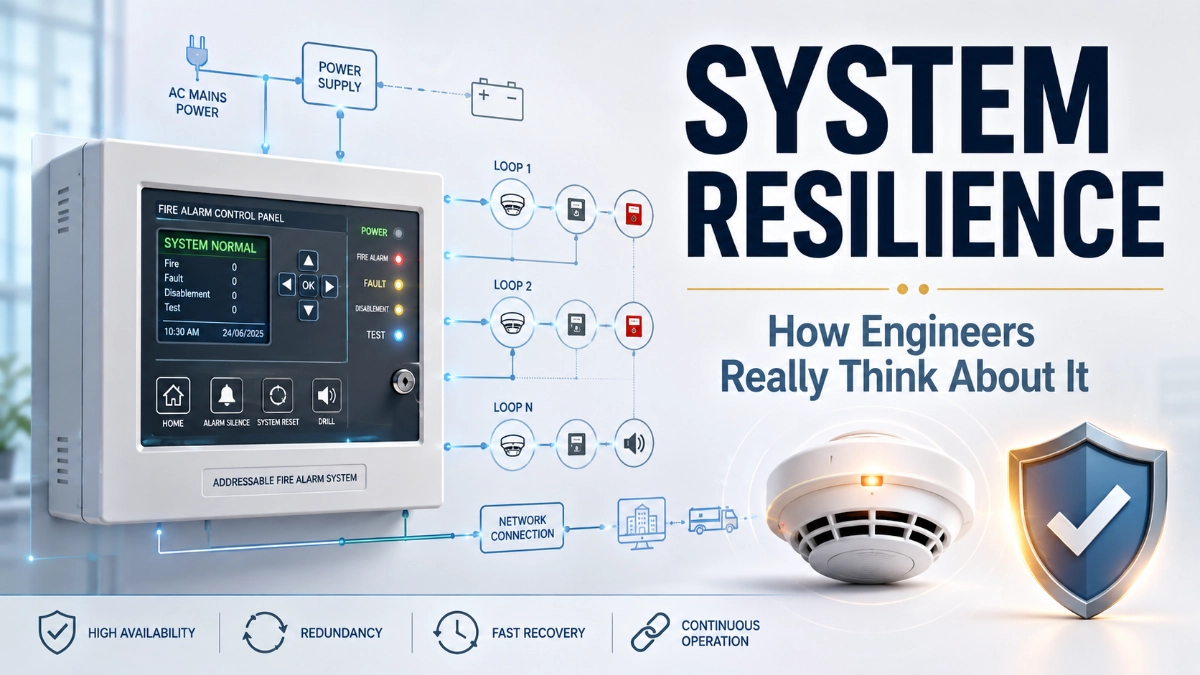
Normal operation is only one part of the job. A system that performs perfectly under ideal conditions still has to function when a device is damaged, a cable is cut, or a power supply degrades. As buildings grow larger and more interconnected, the consequences of an unmanaged fault grow with them. Resilience is the difference between a fault that is contained and reported and one that quietly compromises life-safety coverage.
How should fire alarm engineers think about system resilience?
Engineers should evaluate what happens when components, circuits, networks, power sources, or communication paths fail. Resilience means the system can detect, isolate, report, and manage those failures, keeping the impact contained and giving maintenance teams the information needed to respond quickly, rather than assuming failures will not occur.
What Does “Resilience” Actually Mean in a Fire Alarm System?
Engineers often use reliability, redundancy, and resilience interchangeably, but they describe different things.
- Reliability is how consistently a component performs its intended function over time.
- Redundancy means an additional component or path so a function continues if the primary one fails.
- Fault tolerance is a system’s ability to keep performing defined functions despite certain faults.
- Resilience is broader: the ability of the overall system to withstand, detect, respond to, and recover from foreseeable disruptions, using reliability, redundancy, and fault tolerance as supporting tools.
A resilient system is not simply one that never fails; it is one designed so foreseeable failures are detected, isolated, communicated, managed, and recovered from without unnecessarily compromising critical life safety functions. Not every facility needs maximum redundancy; the right level depends on risk, building type, architecture, criticality, and maintenance strategy.
The First Question: “What Happens If This Fails?”
Resilient design starts with failure-mode thinking, tracing what happens when an element stops working as intended.
| Potential Failure | What Engineers Should Evaluate |
|---|---|
| Detector failure | Is the fault identified and reported? |
| Loop/circuit fault | What devices are affected downstream? |
| Panel failure | What happens to connected functions? |
| Power failure | What backup exists, and for how long? |
| Network failure | What monitoring is lost? |
| Communication fault | Is the fault supervised and reported? |
| Notification circuit fault | Can the affected zone be identified? |
| Configuration error | How is it detected and controlled? |
This is a starting point, not a complete list; the value is in the habit of asking the question for every major element of the architecture.
Resilience Starts at the Detection Layer
The detection layer is the first point of information in any fire alarm system, and its resilience shapes everything downstream. Smoke detectors, heat detectors, multi-sensor detectors, manual call points, monitor modules, and control modules need to be evaluated not just for whether they detect a condition, but for how well they report their own status.
Device-level supervision, individual device identification, fault reporting, correct installation, and consistent maintenance turn a field fault into useful information rather than a silent gap in coverage. The reliability and supervision of EST Detectors and Devices should be considered part of the overall resilience strategy, alongside correct application for the environment.
Fire Alarm Loop and Circuit Resilience
Loop and circuit design is often treated as a wiring exercise, but it is really a resilience decision. Engineers need to evaluate circuit topology, isolation capability, wiring integrity, and how the system behaves under short-circuit or open-circuit conditions.
The objective is not simply having a loop that connects devices to a panel; it is understanding what happens when part of it is compromised: which devices lose communication, whether the fault can be isolated to a smaller segment, and how quickly it can be located. Device distribution and fault localisation directly affect how much of the system stays functional when a single fault occurs.
Power Resilience: More Than Battery Backup
Power resilience is often reduced to a single question: is there a backup battery? That is one piece of a larger picture. Engineers should evaluate primary power quality, secondary power capacity, battery condition, power supply supervision, and distribution to panels and devices.
A backup battery alone does not make an architecture resilient. Battery condition degrades with age and temperature, power supplies need supervision for faults, and distribution must be planned so a single power issue cannot disable multiple critical functions at once. Power should be reviewed as a system, not a checklist item.
Network Resilience in Modern Fire Alarm Systems
As facilities grow to include multiple panels, buildings, and central monitoring, network architecture becomes central to resilience. Distributed fire alarm architectures depend on communication paths between panels, and those paths need the same failure-mode scrutiny applied to detection and power, how they are supervised, how a fault is reported, and how the system recovers once communication is restored. No single topology is universally superior; the right approach depends on panel count, layout, and how critical continuous monitoring is to that site.
What Intelligent Fire Alarm Systems Add to Resilience
Intelligent, addressable systems contribute to resilience primarily through visibility. Richer information about device status, active faults, event history, diagnostics, and network status lets teams see a developing problem before it grows; engineers cannot manage a failure they cannot identify.
When evaluating enterprise-level resilience, an EST Fire Alarm System can be considered as part of a broader architecture that includes detection, control, networking, diagnostics, and lifecycle management, alongside other platforms suited to a project’s requirements.
The Hidden Resilience Factor: Human Response
Technical resilience is only part of the equation. A technically resilient system can still be operationally weak if people do not know how to respond to faults. Operator awareness, documented response procedures, maintenance team training, fault escalation paths, and inter-team communication determine whether a detected fault results in a timely repair or sits unresolved. Resilience engineering that stops at the equipment level is incomplete.
Maintenance Is Part of System Resilience
Resilience is not fixed at commissioning. It decreases over time as batteries age, detectors accumulate contamination, devices are replaced incorrectly, documentation falls out of date, and configuration changes go untracked. Design resilience leads to maintenance, and maintenance sustains it across the lifecycle.
How Smart Buildings Change the Resilience Equation
Integration with BMS, access control, CCTV, HVAC, and other emergency systems increases both capability and complexity. Shared information can be useful, but each integration point is also a new dependency to evaluate. Integration should add coordination without creating dependencies that compromise dedicated fire alarm functions; connectivity alone does not equal resilience, and a BMS should never substitute for the fire alarm system’s own dedicated functions.
7 Resilience Questions Every Fire Alarm Engineer Should Ask
- What are the critical failure points?
- What happens if a single device fails?
- What happens if a circuit or loop is compromised?
- What happens if primary power is unavailable?
- What happens if communication is lost?
- How fast can technicians identify the problem?
- Can the system expand without new vulnerabilities?
Resilience by Building Type
- Hospital: Continuous occupancy and complex layouts make fault isolation and clear escalation especially important.
- Data centre: Critical infrastructure demands close attention to network architecture, monitoring, and controlled maintenance windows.
- Manufacturing facility: Large areas and ongoing expansion require architecture that adapts without new single points of failure.
- Warehouse: Expansive spaces and changing layouts make device accessibility and circuit planning central to coverage.
- Multi-building campus: Distributed panels and communication paths make network resilience and scalability a primary consideration.
EST3 and EST4: Thinking About Resilience at the System Level
EST3 and EST4 are examples of networked, intelligent fire alarm platforms designed to support distributed control, system monitoring, device-level information, diagnostics, and scalability across enterprise applications. In a resilience context, this means visibility into device and network status within a distributed, scalable architecture.
Specific resilience, redundancy, or uptime characteristics should be verified against current manufacturer documentation and the applicable code or standard.
The Resilience Checklist for Fire Alarm Projects
- Detection: device supervision and fault reporting
- Circuit/loop: fault isolation and localisation
- Panels: function continuity during faults
- Power: primary, secondary, and distribution planning
- Communication/network: supervised paths at appropriate scale
- Notification: circuit-level fault identification
- Monitoring: device, panel, and network status visibility
- Configuration/documentation: controlled and current
- Maintenance: consistent inspection and testing
- Human response: trained teams and clear procedures
- Future expansion: planned without new vulnerabilities
Evaluate resilience at every project stage: design, procurement, installation, commissioning, operation, maintenance, and modernisation.
Why Resilience Should Influence Fire Alarm Procurement
Procurement often focuses on price, device count, and basic specifications. Resilience-focused procurement also weighs architecture, fault visibility, maintainability, scalability, documentation, and lifecycle requirements. For large deployments, an experienced EST Fire Alarm System Distributor in India can be part of that discussion alongside technical requirements, availability, and support.
Expert Insights
- Resilience starts with understanding failure, not just confirming normal operation works.
- Redundancy is only useful when it addresses a meaningful, specific failure scenario.
- Fault visibility matters as much as fault prevention; a hidden fault cannot be managed.
- A system that detects faults but cannot communicate them has limited operational resilience.
- Maintenance is not separate from resilience; it preserves resilience over the lifecycle.
- Integration improves awareness but adds dependencies that must be evaluated deliberately.
Key Takeaways
- Treat resilience as a design philosophy, not a final checklist item.
- Distinguish reliability, redundancy, fault tolerance, and resilience.
- Apply failure-mode thinking to every layer of the architecture.
- Evaluate power and communication as systems, not single components.
- Prioritise fault visibility so problems are identified quickly.
- Recognise that maintenance sustains the resilience built in at design.
- Plan future expansion as part of the resilience strategy.
- Verify technical claims against current standards and documentation.
Read Also: Why Fire Alarm System Testing Is Becoming a Data Management Challenge
Read Also: Difference Between a Connected Fire Alarm System and an Intelligent Fire Alarm Ecosystem