A fire alarm panel connected to a network, BMS, or remote monitoring platform may look like a smart fire alarm system. Lights blink on a dashboard, and alarms route to a central station. But connectivity alone does not create intelligence. The real difference shows up in how the system detects conditions, interprets device information, exposes diagnostics, manages data over time, and supports maintenance without compromising its life safety function.
As buildings become more networked, “connected” and “intelligent” are increasingly used as if interchangeable. They are not. Understanding the distinction matters for anyone specifying, integrating, or maintaining a fire alarm system today.
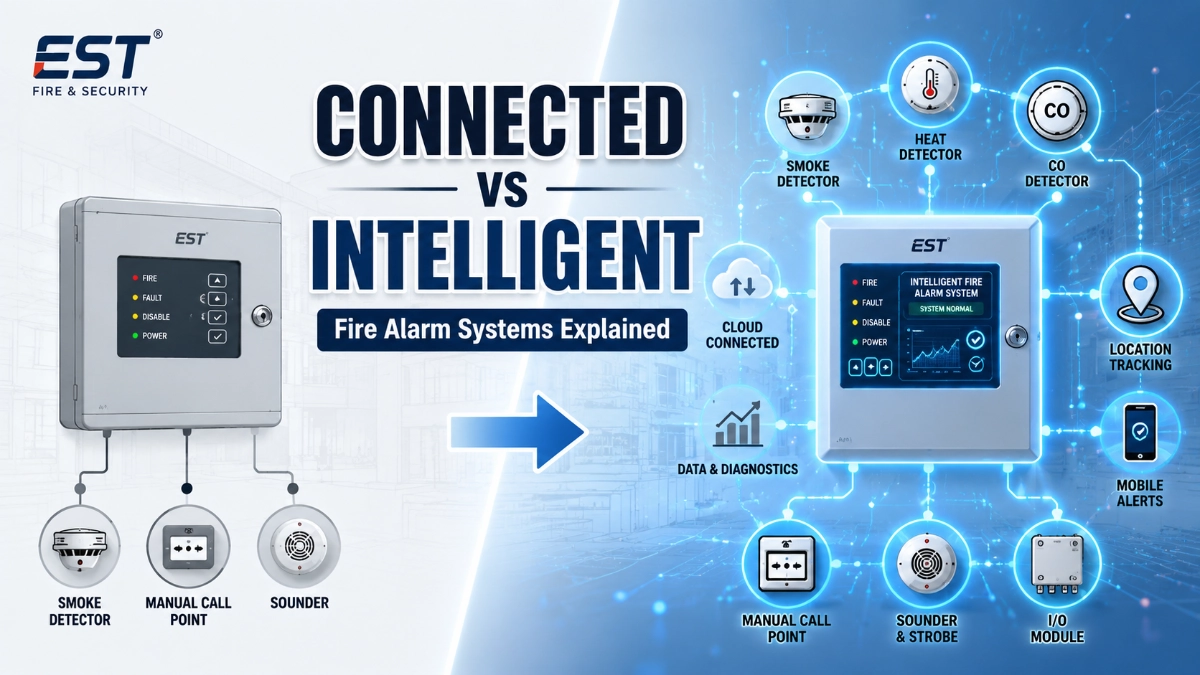
A connected fire alarm system exchanges information between panels, networks, and building systems. An intelligent fire alarm ecosystem uses that connectivity as a foundation, adding device-level diagnostics, data-driven maintenance, and lifecycle management. Connectivity is a communication capability; intelligence is an operational capability built on top of it.
What Is a Connected Fire Alarm System?
What is a connected fire alarm system? A connected fire alarm system links multiple panels, devices, or monitoring platforms through a network so that alarm signals, supervisory status, and trouble conditions can be exchanged across a site. Its primary function is communication rather than analysis: panels linked through a fire alarm network, remote annunciation at a security desk, a BMS interface for status reporting, and centralised event monitoring across buildings.
These are valuable capabilities. A connected architecture lets a facility manager see conditions across a campus without walking to every panel. But connectivity describes a communication pathway, not what happens with the information once it arrives, how faults are diagnosed, or how it supports long-term system health.
What Is an Intelligent Fire Alarm Ecosystem?
What is an intelligent fire alarm ecosystem? It combines networked connectivity with device-level intelligence, diagnostics, structured data, and lifecycle management so information actively supports detection, troubleshooting, maintenance planning, and long-term decisions, not just event notification. It builds on connectivity rather than replacing it: intelligent detectors reporting device-specific fault information, diagnostics that pinpoint fault sources quickly, event history that can be reviewed rather than lost, enterprise-wide visibility, and lifecycle information supporting maintenance and documentation.
Intelligence, here, is not about adding more connections. It is making the information already flowing through the system genuinely useful to the people keeping it reliable.
Connected vs Intelligent: What Is the Real Difference?
| Connected Fire Alarm System | Intelligent Fire Alarm Ecosystem |
|---|---|
| Focuses on communication | Communication plus useful intelligence |
| Systems exchange information | Information supports decisions |
| Network connectivity | Network, data, and diagnostics together |
| Basic centralized monitoring | Richer system visibility |
| Primarily event communication | Event, device, and system information |
| Limited lifecycle context | Lifecycle-oriented management |
| Integration-focused | Integration and intelligence-focused |
| Connectivity is the objective | Better safety management is the objective |
This is not a judgment that every connected system is unintelligent. The distinction is about scope: connectivity answers “can these systems talk to each other?” Intelligence answers “does that help us detect, diagnose, and manage the system better?”
The Four Layers of an Intelligent Fire Alarm Ecosystem
A useful way to frame this is four layers: Detection (smoke, heat, and multi-sensor detectors, manual call points the quality of information here sets the ceiling for everything above), Control (fire alarm control panels, which process inputs, apply cause-and-effect logic, and drive notification, staying dedicated to life safety regardless of what else connects to them), Network and Data (event information, diagnostics, and status carried between panels and monitoring points), and Building and Enterprise Integration (connecting the ecosystem to BMS, security, and enterprise platforms).
External systems at this top layer should never undermine the safety functions below. Integration should add context, not authority over life safety decisions.
Why Intelligent Detectors and Devices Matter
Intelligence begins at the field level. A system can have excellent networking and a well-designed head-end, but if field devices only report a binary alarm or trouble condition, the rest of the architecture has little to work with.
Device-level intelligence typically includes device identification and fault status that support faster fault localisation instead of a technician walking a zone to find one bad sensor. At the field layer, EST Detectors and Devices can form an important part of the information layer supporting intelligent detection and maintenance. A polished dashboard built on vague field data does not become more useful just because it looks sophisticated.
Why Networking Alone Does Not Create Intelligence
A few assumptions deserve pushback. Networked panels do not automatically mean intelligence; networking moves information but does not interpret it. Connecting to BMS does not make a system smart; it adds context, not intelligence. Adding IoT does not automatically improve fire safety, since more sensors without defined purpose and cybersecurity controls can mean more noise. And more data does not always mean better protection; unfiltered data can overwhelm teams as easily as inform them. Architecture, data quality, human interpretation, cybersecurity, and lifecycle processes matter more than the raw number of connected points.
How BMS Fits Into an Intelligent Fire Alarm Ecosystem
Building Management Systems provide valuable context around events such as HVAC response, smoke control sequencing, elevator functions, and emergency notification triggers. It is important to distinguish fire alarm control from building management and automation: the fire alarm control panel retains responsibility for detection, supervision, and notification, while BMS integration provides context and coordination without replacing the fire alarm system’s dedicated control or life safety functions. Any interface should have clear boundaries, be documented in the cause-and-effect matrix, and be verified against applicable code and AHJ requirements.
How Intelligence Changes Fire Alarm Maintenance
Richer information changes how maintenance teams work: device-level diagnostics support faster troubleshooting and precise fault localisation, and event history supports maintenance planning, spare parts strategy, and audit-ready documentation. This is a shift from reactive maintenance, where teams respond to faults with limited context, toward data-supported maintenance, where technicians arrive with a clearer picture. It does not eliminate scheduled testing required by applicable codes; it supports that work with better information.
Real-World Examples
- Hospital: Connected: multiple panels report to a security desk. Intelligent: device diagnostics, campus-wide visibility, and maintenance history integrated with operations.
- Data Centre: Network architecture, diagnostics, and controlled integration matter more than sheer connectivity volume, given uptime expectations.
- Manufacturing Plant: Intelligent device information and lifecycle records help teams manage a large device population across a harsh environment.
- Smart Commercial Campus: Centralised visibility across buildings lets one team manage status without separate silos.
- University Campus: Scalability and enterprise-level management become essential as device counts grow over years.
Where EST3 and EST4 Fit Into This Evolution
The EST3 Fire Alarm Panel and EST4 Fire Alarm Panel are examples of platforms built around networked, distributed control architecture, where multiple panels share system and device data across a site. Discussing them here is educational, not promotional; specific configurations and compliance details should be verified against current manufacturer documentation and applicable code. Distributed architecture of this kind supports modular expansion and diagnostics that feed enterprise-level management as a facility grows. An EST Fire Alarm System can be evaluated as part of an intelligent life safety architecture where networking, diagnostics, integration, and lifecycle requirements are considered together with the project’s risk profile.
Designing an Intelligent Fire Alarm Ecosystem: Consultant Checklist
- Intelligent field devices: Depends on what detectors can report.
- Control architecture: Panel design should match facility scale and risk.
- Reliable network design: Redundancy matters as much as bandwidth.
- Integration boundaries: Define what BMS can and cannot influence.
- Data management: Decide what data is captured and reviewed.
- Diagnostics: Prioritise fault localisation, not just notification.
- Cybersecurity: Every network connection is an attack surface.
- Documentation: Cause-and-effect matrices must stay current.
- Maintenance strategy: Plan how diagnostic data will be used.
- Future expansion: Design for growth in devices and buildings.
- Lifecycle planning: Consider spares and long-term support early.
- Human decision-making: Intelligence supports people, not replaces judgment.
The Biggest Mistakes Organisations Make
| Mistake | Consequence | Better Approach |
|---|---|---|
| Assuming connectivity equals intelligence | Overestimated capability | Define what intelligence requires |
| Connecting everything without purpose | Data overload, low value | Design data flows around specific goals |
| Ignoring cybersecurity | Growing vulnerability | Apply controls at every network layer |
| Poor interface documentation | Confusion during service | Keep documentation current |
| Too much unnecessary data | Information fatigue | Filter and structure data for relevance |
| No maintenance strategy | Diagnostics go unused | Build workflows around available data |
| Treating BMS as a fire alarm substitute | Non-dedicated life safety | Keep fire alarm control independent |
| Designing without future expansion | Costly rework later | Architect for scalability upfront |
What the Intelligent Fire Alarm Ecosystem Could Look Like in the Future
Fire alarm architecture is likely to keep moving toward more intelligent field devices, richer diagnostics, enterprise-level management, and better digital documentation. Predictive maintenance, AI-assisted analytics, and cloud-connected enterprise monitoring are being explored industry-wide, alongside tighter integration with smart building automation. These directions are worth watching, but must be evaluated against applicable fire safety requirements, cybersecurity requirements, and sound engineering practice. Emerging capability should be adopted because it demonstrably supports detection, response, or lifecycle management within a compliant system, not simply because it is available.
For enterprise deployments, an experienced EST Fire Alarm System Distributor in India can support procurement coordination, product availability, and project requirements as intelligent architecture moves from concept to installed system.
Expert Insights
- Connectivity is an infrastructure capability; intelligence is an operational capability built on top of it.
- The value of an intelligent ecosystem depends on the quality of information generated at the field device layer.
- BMS integration should add context without compromising dedicated fire alarm control and supervision.
- More data is not automatically better data; unfiltered information can obscure rather than clarify.
- Intelligent architecture must be designed around maintenance as deliberately as detection.
- Cybersecurity becomes more pressing as connectivity and integration expand.
Key Takeaways
- Connectivity and intelligence are related but distinct capabilities.
- A connected system communicates; an intelligent ecosystem uses that communication productively.
- Device-level intelligence at the detection layer sets the ceiling for everything above it.
- BMS integration should add context, never replace dedicated fire alarm control.
- Networking and IoT alone do not guarantee better fire protection outcomes.
- Diagnostics and event history shift maintenance from reactive to data-supported.
- Cybersecurity and documentation must scale alongside connectivity.
- Plan transitions toward intelligent infrastructure around lifecycle needs, not just current requirements.
Read Also: How Fire Alarm System Architecture Changes When Buildings Become Smarter
Read Also: Designing Fire Alarm Systems That Minimise Operational Interruptions