Testing a fire alarm system sounds straightforward: activate a device, confirm the alarm, record the result, and move on. But that process looks very different when a facility contains hundreds or thousands of addressable devices, multiple fire alarm panels, networked buildings, recurring maintenance schedules, fault histories, and years of accumulated test records. At that point, fire alarm testing becomes as much a data management challenge as a testing exercise.
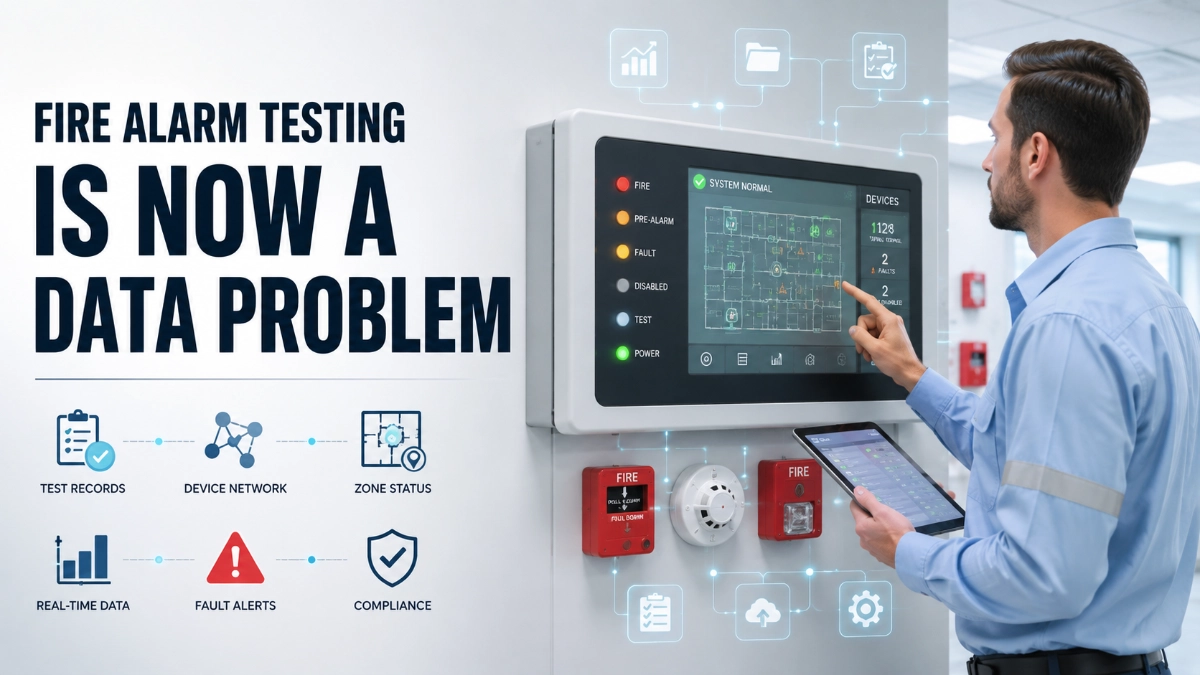
For decades, fire alarm testing was treated as a physical verification task: walk the building, trigger the device, confirm the response, sign the sheet. That still forms the foundation of every credible fire alarm program. But modern systems generate far more information than a paper checklist was designed to hold. Intelligent detectors report status and diagnostics; addressable panels log events by device address; facilities renovate faster than documentation keeps pace. Larger, smarter systems don’t just need more testing; they need better information management around it.
Why Is Fire Alarm Testing Becoming a Data Management Challenge?
Fire alarm testing generates growing volumes of device, event, fault, and maintenance data as systems become larger and more intelligent. Addressable devices, networked panels, and multi-building campuses produce detailed records that must be organised, standardised, and preserved accurately. Without structured data management, results become harder to interpret, verify, and use for maintenance or compliance.
Fire Alarm Testing Is No Longer “Pass or Fail”
A single test event on a modern addressable system can generate a surprising amount of information: identification, location, device type, test status, alarm response, fault condition, panel response, notification response, event history, corrective action, technician identity, test date, and retest status.
On a small conventional system, this is manageable on paper. On a large intelligent system with hundreds or thousands of devices, the data from a single testing cycle can quickly exceed what informal record-keeping can reliably track.
Why Addressable Fire Alarm Systems Create More Testing Data
Conventional systems report by zone. Addressable fire alarm systems report by individual device; each smoke detector, heat detector, pull station, or module has its own address, location reference, and status history. This is one reason addressable technology is valued for troubleshooting and maintenance planning, not a disadvantage.
But that device-level detail means testing generates more data points: addresses, loop assignments, panel associations, device types, fault codes, and event timestamps. Addressability doesn’t make testing inherently harder it makes the information richer, which makes accurate data management more important.
What Data Is Generated During Fire Alarm Testing?
A useful way to think about testing information is in five categories.
1. Device Data: ID, type, location, loop or circuit assignment. The foundation everything else depends on.
2. Test Data: Date, method, result, technician, retest status. Proves what was done and by whom.
3. System Data: Panel status, alarm/fault events, supervisory conditions, network status where applicable.
4. Maintenance Data: Defects, corrective actions, replacements, cleaning, outstanding follow-ups.
5. Historical Data: Prior results, recurring fault patterns, replacement history, long-term maintenance trends.
These categories matter most when connected; a fault is only meaningful when linked to the device that produced it, the test that revealed it, and the action taken.
The Hidden Problem: Keeping Testing Data Accurate
Even well-intentioned programs run into data-quality problems: a device renamed after renovation without updating records, floor plans that no longer match actual locations, a replaced device whose history isn’t carried forward, an incorrect address entered at commissioning, missing history from a prior contractor, duplicate records across spreadsheets, incomplete technician notes, unresolved corrective actions, inconsistent naming between teams, and conflicting documentation versions.
None of this necessarily means a test wasn’t performed correctly. But it means the record may not be trustworthy, and untrustworthy records reduce the value of otherwise sound testing work.
How Large Facilities Turn Testing Into a Data Management Problem
- Hospitals have hundreds of rooms and continuously changing clinical spaces, making location tracking an ongoing challenge.
- Data centres operate under strict change-control requirements, where every test record must be traceable.
- Manufacturing facilities deal with production changes and harsh environments that affect location accuracy.
- Warehouses cover large areas with high device counts and shifting storage layouts.
- Multi-building campuses involve multiple panels, teams, and staggered schedules that must be reconciled into one coherent picture.
- In each case, the physical testing itself may be routine. What becomes complex is organising the resulting information so it stays accurate and usable.
Testing Data vs Testing the System: Why Both Matter
- Physical testing verifies that a device and system actually operate as intended: the detector responds, the panel processes the signal, notification appliances activate.
- Data management verifies that the record of that testing condition, history, and results is accurately captured and remains usable later.
One does not replace the other. A digital record does not prove a device physically operated correctly unless the appropriate test was actually performed by a qualified technician. Data management supports and preserves the value of physical testing; it is not a substitute for it.
How Intelligent Fire Alarm Systems Change the Testing Process
Intelligent fire alarm platforms provide considerably richer information than legacy systems: device status, built-in diagnostics, detailed event history, fault categorisation, precise identification, and system configuration data. This can meaningfully improve troubleshooting speed and maintenance planning.
But richer data also raises the stakes for how it’s managed. An EST Fire Alarm System is one example of an intelligent platform architecture worth considering for modern fire alarm design, diagnostics, and long-term lifecycle management, not just for detection performance, but for how well it supports organised, retrievable testing information over its operating life.
Why EST Detectors and Devices Matter to Testing Data
The field layer is where fire alarm testing data actually originates. Identification, detector type, physical location, status, test history, and fault information all trace back to individual field devices. Accurate device-level information matters when managing large numbers of EST Detectors and Devices across complex facilities, since any inconsistency a wrong location, a missing address, an unrecorded replacement propagates into every report built on top of it.
From Testing Reports to a Fire Alarm Lifecycle Database
A more mature approach treats individual test reports as part of a connected chain: Device → Location → Test → Result → Fault → Corrective Action → Retest → Maintenance History. Rather than filing each test as an isolated event, this structure links every record to the device and location it concerns, supporting faster troubleshooting, better maintenance planning, easier audits, cleaner handovers, and quicker identification of recurring problems.
7 Common Fire Alarm Testing Data Management Mistakes
1. Treating every test as isolated: Recurring faults go unnoticed. Better: link each test to the device’s full history.
2. Not maintaining location records: Technicians waste time; records lose meaning. Better: update locations as spaces change.
3. Failing to record corrective actions: Unresolved defects get forgotten. Better: tie every fault to a documented action and closure date.
4. Inconsistent device naming: Records become impossible to reconcile. Better: adopt one facility-wide standard.
5. Losing historical test information: Long-term trends become invisible. Better: preserve records through contractor changes.
6. Outdated drawings: Field verification slows, and errors increase. Better: update drawings with device changes.
7. Results without technician notes: Context is lost. Better: require brief observations, not just pass/fail marks.
How Engineers Can Improve Fire Alarm Testing Data Management
- Standardise device naming facility-wide.
- Maintain accurate, current location records.
- Record every test consistently, regardless of outcome.
- Link defects directly to corrective actions.
- Track retesting until items are formally closed.
- Keep drawings and floor plans current.
- Preserve historical records through contractor transitions.
- Periodically review recurring faults by device or area.
- Control documentation versions to avoid conflicts.
- Plan documentation for future system expansion.
Where EST3 and EST4 Fit Into Modern Fire Alarm Management
EST3 and EST4 represent intelligent, networkable fire alarm architectures built to support larger device counts, multi-panel networking, and more detailed event and diagnostic information than earlier conventional platforms, relevant here because networked, intelligent systems generate more device- and event-level information by design.
This doesn’t mean any platform eliminates documentation effort; it means the underlying architecture can support more structured environments when paired with disciplined testing and record-keeping. Always verify actual system capabilities against current manufacturer documentation and project requirements.
Why Fire Alarm Testing Data Will Become Even More Important
Several trends point toward more data-intensive testing: growth in intelligent device deployment, larger networked systems, digital documentation, centralised enterprise monitoring, and analytics-supported maintenance planning. These trends support better-informed decisions but don’t remove the need for qualified inspection and physical verification. Predictive maintenance and smart building integration remain developing capabilities, not guaranteed outcomes and never substitute for dedicated testing and inspection functions.
When Choosing an EST Fire Alarm System, Think Beyond Installation
Selecting a fire alarm platform for a large facility involves more than installation. Consider device-level information quality, scalability, testing requirements, maintenance planning, diagnostics, documentation practices, network architecture, lifecycle management, technical support, and readiness for future expansion.
For organisations planning a large deployment, an experienced EST Fire Alarm System Distributor in India can be part of the technical and procurement discussion, particularly where product availability, project coordination, and long-term lifecycle support matter alongside testing and documentation planning.
Expert Insights
- A test report’s value depends on the quality of information captured, not just pass/fail.
- Large systems create an information-management problem alongside the physical testing problem.
- Device location accuracy is often the biggest factor in whether historical records stay useful.
- Corrective actions should always link back to the original test event, not be tracked separately.
- Intelligent systems provide richer diagnostics, but that data only helps with disciplined processes.
- Testing history grows more valuable as a system ages and devices approach replacement.
- Documentation is part of the system lifecycle, not paperwork completed after testing ends.
Key Takeaways
- Fire alarm testing now generates significant device, event, and maintenance data.
- Addressable systems provide richer information but require disciplined management.
- Device-level accuracy underpins every test record’s usefulness.
- Physical testing and data management are complementary, not interchangeable.
- Large, multi-building facilities face the greatest documentation complexity.
- Historical records support better troubleshooting and maintenance planning.
- Poor data hygiene undermines otherwise sound testing programs.
- Preparing for data-driven management strengthens long-term system reliability.
Read Also: Difference Between a Connected Fire Alarm System and an Intelligent Fire Alarm Ecosystem
Read Also: How Fire Alarm System Architecture Changes When Buildings Become Smarter