Fire alarm maintenance is essential, but in an occupied hospital, factory, data centre, or commercial campus, poorly planned maintenance can disrupt operations. The solution is not to reduce maintenance; it is to engineer the infrastructure so testing, upgrades, troubleshooting, and expansion happen with minimal unnecessary disruption.
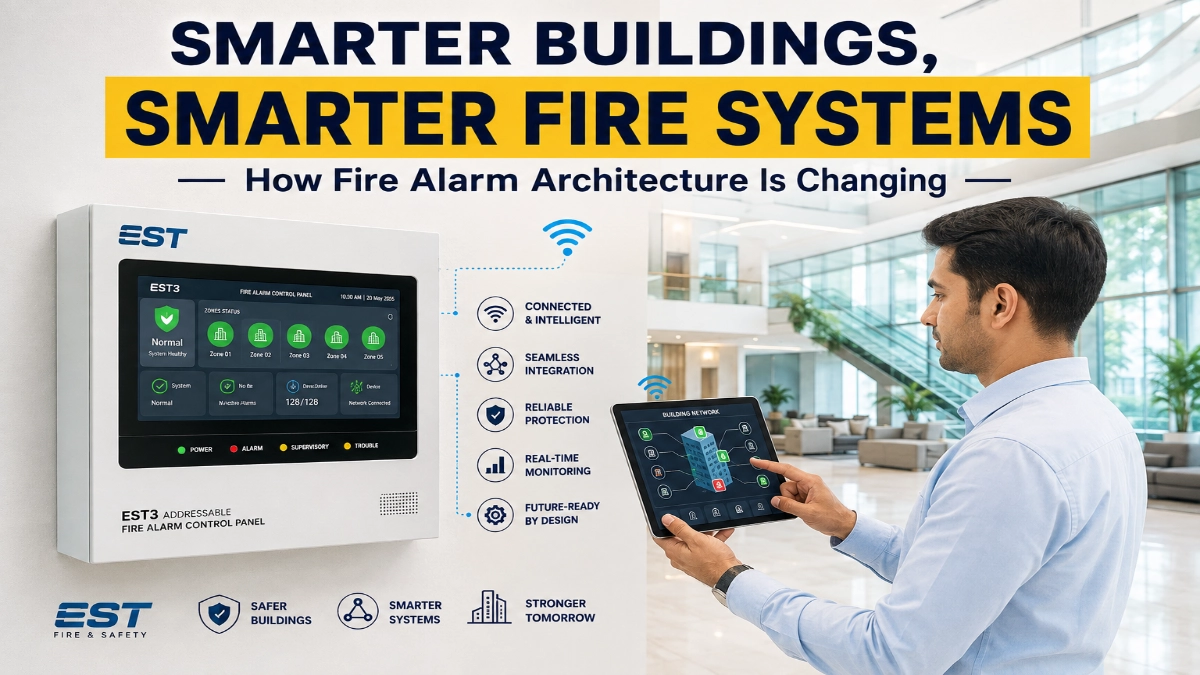
Operational continuity has become a design priority in its own right. Hospitals cannot pause patient care for a device replacement. Manufacturing lines cannot stop every time a detector is tested. Yet fire alarm systems require regular inspection, testing, and maintenance under applicable codes and standards; that requirement does not change. What changes is how much disruption that work creates.
A fire alarm system designed with maintainability in mind distributed architecture, spare capacity, standardised devices, and accurate documentation allows technicians to isolate, test, and service equipment without shutting down entire buildings. Maintainability should be treated as a design requirement from the earliest engineering stage, not something addressed after installation.
Fire alarm systems minimise operational interruptions through distributed architecture, intelligent diagnostics, modular design, spare capacity, standardised devices, and complete documentation. These elements let technicians isolate work to specific zones, identify faults quickly, and perform maintenance in controlled windows without reducing required testing or life safety protection.
Why Fire Alarm Systems Can Disrupt Building Operations
Not every operational disruption is caused by equipment failure. Many are the consequence of decisions made or not made during design and installation.
Common contributors include false alarms that trigger unnecessary evacuation, unplanned testing with no coordinated schedule, fault investigation slowed by limited diagnostics, difficult device access, and poor documentation that forces technicians to trace circuits manually. System-wide shutdowns for work that could have been isolated to a single zone, undocumented configuration changes, capacity exceeded by expansion, ageing infrastructure, and reactive rather than scheduled maintenance all add to the problem.
Reducing disruption is fundamentally an engineering and planning challenge, not a maintenance-reduction exercise.
The Design Principles Behind Low-Disruption Fire Alarm Infrastructure
1. Distributed Architecture
A distributed network of multiple networked panels covering defined zones or buildings, rather than one centralised panel, allows work to be isolated to one segment of the system. A technician servicing one wing does not interrupt monitoring elsewhere, and a fault on one panel does not necessarily affect the rest of the network.
2. Intelligent Diagnostics
Modern addressable systems provide device-level status sensitivity to drift, contamination, and communication faults rather than a simple zone-level indication. This lets teams identify the likely cause of a fault before a technician is dispatched, narrowing the scope of on-site investigation.
3. Modular System Design
Modularity means panels, power supplies, and network modules can be added or reconfigured without redesigning the whole system, simplifying future changes when a building is renovated or repurposed.
4. Spare Capacity
Spare loop, addressable point, and panel capacity planned during initial design reduces the need for major infrastructure changes as a facility adds equipment or floors. Facilities rarely expand exactly as originally planned, and unused capacity absorbs that growth.
5. Device Standardisation
A consistent family of detectors and initiating devices simplifies technician training, spare parts inventory, and troubleshooting. Standardising EST Detectors and Devices across multiple buildings reduces complexity for teams moving between sites, since procedures and part numbers stay consistent.
6. Accessible Documentation
Accurate, current documentation as-built drawings, device schedules, network diagrams, cause-and-effect matrices, and maintenance history is one of the most underrated factors in reducing disruption. Outdated documentation makes even routine troubleshooting take far longer than necessary.
7. Planned Integration
BMS integration, access control interfaces, and other building connections should be considered during initial design rather than retrofitted later, avoiding ad hoc interface work that introduces configuration risk during maintenance.
Planned Maintenance vs Reactive Intervention
| Reactive Approach | Planned Approach |
|---|---|
| Fault discovered unexpectedly | Condition monitored regularly |
| Emergency troubleshooting | Scheduled maintenance |
| Limited documentation | Current documentation |
| Unplanned disruption | Controlled work window |
| Difficult spare availability | Planned inventory |
| Higher operational uncertainty | Predictable maintenance |
Preventive and predictive maintenance support operational continuity by converting unknown, urgent work into scheduled work. This does not reduce the amount of testing required; it changes when and how that work happens, so teams can plan around it rather than react to it.
How to Maintain Fire Alarm Systems in Occupied Buildings
Maintaining a fire alarm system in a continuously occupied facility requires coordination beyond the technical work itself: work-window planning, stakeholder communication before work begins, temporary protection measures applied wherever required by code or site procedures, and isolation limited to the smallest necessary zone. Testing should be formalised through a permit-to-work process, followed by documentation updates and post-maintenance verification confirming the system has been fully restored.
Any temporary impairment of fire alarm protection must be managed strictly according to applicable local codes, standards, and authority-having-jurisdiction requirements, which vary by jurisdiction and facility type and should be confirmed before planning impairment procedures.
Designing Fire Alarm Systems for Phased Upgrades
Modernising an existing fire alarm system in an occupied building is rarely a single-day replacement. It is an engineering project with sequencing considerations: building-by-building or zone-by-zone work, a panel replacement strategy sequenced by age and criticality, network migration planning that lets old and new panels coexist safely, device compatibility verification, temporary coverage arrangements, and staged commissioning of each segment before final system validation.
Treating modernisation as a phased engineering project rather than a hardware swap is what allows upgrades to proceed without forcing an occupied facility to close.
The Role of EST3 and EST4 in Operational Continuity
Networked, addressable platforms such as the EST3 Fire Alarm Panel and EST4 Fire Alarm Panel are examples of enterprise-class architecture built around modular expansion and intelligent device communication. Their distributed structure allows multiple panels to operate as a coordinated system across a campus, supporting zone-based maintenance and phased expansion.
These platforms are typically applied in enterprise strategies where scalability and lifecycle planning matter. A broader EST Fire Alarm System deployment can be evaluated as part of that strategy when future needs are considered at the design stage. No platform eliminates the need for testing or occasional impairment, and none guarantees uninterrupted operation. What networked, modular architecture provides is the flexibility to plan and localise necessary work.
Real-World Scenarios
- Hospital: Distributed architecture lets technicians service one ward’s devices while the rest of the facility stays fully protected.
- Manufacturing Plant: Maintenance windows aligned with planned production downtime avoid line stoppages, while spare capacity accommodates new equipment without a redesign.
- Data Centre: Scheduled maintenance and clear diagnostics shorten any necessary impairment window for sensitive infrastructure.
- University Campus: Multiple buildings and academic-year scheduling make phased, building-by-building planning essential to avoid disrupting classes or housing.
- Commercial Office Campus: Upgrades proceed floor-by-floor, supported by modular panel design, so occupied tenants are unaffected by work elsewhere.
8 Design Decisions That Reduce Future Operational Disruption
- Design for Maintainability: Consider technician access during layout, not after installation.
- Plan Spare Capacity: Allocate extra loop, point, and panel capacity to absorb future growth.
- Use Appropriate Network Architecture: Select a distributed topology matched to building size and risk.
- Standardise Devices: Reduce the variety of detectors and modules used across a portfolio.
- Maintain Accurate Documentation: Keep as-built drawings and configuration records current.
- Plan Integration Early: Define BMS and access control interfaces during design.
- Design for Phased Expansion: Structure the network so new zones can be added without disturbing existing ones.
- Establish a Lifecycle Modernisation Strategy: Plan replacement before the system reaches obsolescence.
Common Fire Alarm Design Mistakes That Increase Disruption
| Problem | Operational Impact | Better Design Approach |
|---|---|---|
| Designing only for current requirements | Disruptive retrofits as facility grows | Build in spare capacity from day one |
| No spare capacity | Expansion forces panel/loop replacement | Allocate margin during initial sizing |
| Poor device accessibility | Longer service times, extended impairment | Plan access clearances during layout |
| Incomplete documentation | Slower fault-finding, higher error risk | Maintain as-built records after every change |
| No phased upgrade strategy | Modernisation forces full shutdown | Sequence upgrades by zone or building |
| Inconsistent device selection | Complex training, spare inventory | Standardise device families across sites |
| Poor network planning | Wide-reaching faults, hard isolation | Use distributed, zoned architecture |
| Reactive maintenance | Unplanned, urgent disruption | Shift to scheduled preventive maintenance |
| Ignoring future integration | Ad hoc, risky interface work later | Plan BMS integration early |
| Treating commissioning as project end | No structured lifecycle plan | Build a long-term modernisation roadmap |
Expert Insights
- Maintainability should be a design requirement, not an afterthought bolted on after commissioning.
- The best fire alarm infrastructure is not the one with the most features; it is the one that can be safely maintained throughout its lifecycle.
- Spare capacity earns its value years later, because future construction rarely follows the original project plan.
- Documentation quality has a direct, measurable effect on how long fault-finding takes in the field.
- Standardisation pays off most in multi-building portfolios, where technicians move between sites and cannot relearn device families each time.
- Phased modernisation is often more practical than large-scale replacement in continuously occupied facilities.
- Reducing interruptions should never mean reducing required testing; the goal is to do that work more efficiently, not less often.
Read Also: Designing Fire Alarm Systems That Minimise Operational Interruptions
Read Also: How Design Decisions Affect Fire Alarm Lifecycle Costs