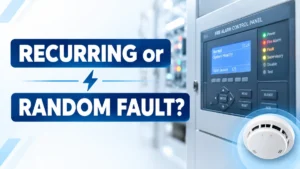
A technician replaces a detector after it reports repeated trouble conditions. The panel goes quiet for several days. Then, without warning, the same fault reappears. A colleague shrugs and calls it “random.”
But is it actually random, or is the system quietly repeating a pattern no one has connected yet?
Every fire alarm engineer eventually faces a fault that resists easy explanation. How it gets labelled recurring or random often determines whether the next site visit fixes the problem or simply resets it.
Is a Recurring Fire Alarm Fault Really Random?
A recurring fault repeatedly appears under identifiable conditions: the same device, the same location, similar timing, or a consistent relationship with site activity. A genuinely random fault shows no such relationship: no consistent location, timing, frequency, environmental trigger, or connection to recent changes.
Many faults that look random early on turn out to be recurring once enough event history and site context are reviewed. The label should follow the evidence, not the other way around.
What Is the Difference Between a Recurring Fault and a Random Fault?
| Characteristic | Recurring Fault | Apparently Random Fault |
|---|---|---|
| Frequency | Reappears | No obvious frequency |
| Location | May repeat at same point | May vary |
| Timing | May follow a pattern | Appears unpredictable |
| Context | May correlate with site conditions | No obvious correlation |
| History | Often visible in event records | May appear isolated |
| Investigation approach | Pattern analysis | Broader elimination process |
Random does not mean impossible to diagnose. It usually means the available data has not yet revealed a relationship; the event history may be short, the interval between occurrences long, or the contributing conditions not obvious from a single visit.
Why Engineers Should Not Call a Fault “Random” Too Early
Labelling a fault random before investigating it closes the door on further analysis. Before reaching that conclusion, five questions deserve answers:
- What happened — the exact fault type and reported condition?
- Where did it happen — which device, loop, zone, or area?
- When did it happen — time of day, day of week, season?
- How often did it happen — first occurrence or repeated event?
- What changed before it happened — any recent work, modification, or activity nearby?
These five dimensions form a practical fault-analysis framework. Gathering evidence against each one is more reliable than relying on an impression from a single service call.
How to Recognise a Recurring Fire Alarm Fault
Certain indicators point toward a recurring fault in a fire alarm system rather than an isolated event:
- The same detector repeatedly reports trouble.
- The same loop repeatedly generates faults.
- The fault occurs at similar times of day.
- The fault returns shortly after a system reset.
- The fault appears following electrical work.
- The fault correlates with particular environmental conditions.
- The fault follows HVAC or equipment operating cycles.
- The fault appears after system expansion or modification.
- Multiple devices show related, correlated behaviour.
- Communication faults repeat along the same network path.
None of these indicators proves a root cause. They are reasons to look closer, not conclusions.
What Makes a Fault Appear Random?
An apparently random fire alarm fault often reflects incomplete information rather than a truly unpredictable event. Common reasons a fault looks random include:
- Insufficient event history to compare occurrences.
- Long intervals between occurrences.
- Environmental variation between visits.
- Intermittent wiring conditions that are hard to reproduce.
- Power fluctuations affecting specific devices.
- Network communication instability.
- Maintenance activity that temporarily masks or triggers conditions.
- Equipment operating cycles that don’t align with the visit.
- Building occupancy or activity changes.
- Recent electrical modifications not yet linked to the fault.
- Multiple interacting variables occurring together.
The absence of a visible pattern is not the same as the absence of one. It often just means more data is needed before it becomes visible.
Use Event History to Find the Pattern
Fire alarm event history is one of the most underused diagnostic tools available to engineers. Reviewing it systematically turns assumptions into evidence. Key fields to examine include:
- Timestamp of each event.
- Device or location identifier.
- Fault type and description.
- Sequence of events surrounding the fault.
- Frequency of occurrence over time.
- Related alarm or supervisory events.
- Restoration events.
- Repeated occurrences at the same point or path.
Consider a detector that reports a fault four times over several weeks. The useful question is not simply “why is this detector failing?” It is:
- Did the faults happen at similar times?
- Did another event occur immediately beforehand?
- Did the area experience an environmental change around those times?
- Was maintenance performed shortly before the recurrence?
- Did another device or communication path show similar behaviour?
Event history should never be read in isolation; it becomes meaningful when interpreted alongside site conditions, maintenance records, and recent works.
Recurring Does Not Always Mean the Same Component Is the Root Cause
A critical distinction separates a repeated symptom from a repeated root cause. A detector may report the same fault repeatedly, but replacing that detector will not resolve the issue if the underlying cause lies elsewhere in wiring condition, connection quality, environmental exposure, power supply, configuration, or a dependency elsewhere in the system.
Treating recurrence as automatic proof that a specific device is defective is one of the more common and costly mistakes in fire alarm fault investigation.
A Practical Fault Investigation Framework
A structured approach helps engineers move from an isolated event to a verified resolution:
1. Individual Fault: Record the exact fault condition and the affected point precisely.
2. Recurrence: Check whether the same condition has appeared before, on this device or elsewhere.
3. Pattern: Compare timing, location, frequency, and event sequence across occurrences.
4. Context: Review environmental conditions, maintenance activity, electrical work, occupancy, equipment operation, and recent modifications.
5. Investigation: Separate device-level possibilities from wiring, power, communication, and configuration-level possibilities.
6. Root Cause: Identify the cause only once the evidence genuinely supports it, not before.
7. Corrective Action: Apply a corrective measure that matches the verified cause, not the symptom.
8. Verification: Confirm the condition has cleared and document the result for future reference.
This sequence — Individual Fault → Recurrence → Pattern → Context → Investigation → Root Cause → Corrective Action → Verification — applies whether the system is a single-loop panel or a large networked platform such as an EST Fire Alarm System spanning multiple buildings.
Device-Level Fault vs System-Level Pattern
Not every recurring fault points to one device. Distinguishing device-level from system-level patterns changes how the investigation proceeds.
Device-level pattern examples:
- One detector
- One module
- One field device
- One localised wiring section
System-level pattern examples:
- Multiple devices
- Multiple panels
- The communication network itself
- Shared power infrastructure
- A common environmental condition
- A common recent modification
When similar symptoms appear across multiple EST Detectors and Devices on different loops, the investigation should shift from single-device replacement toward power distribution, wiring topology, or network-level analysis. Replacing devices one at a time rarely resolves the underlying issue in that scenario.
How Recent Site Changes Can Reveal a Hidden Pattern
Recurring faults frequently begin after a change to the building or system. Common triggers worth reviewing include:
- Electrical modifications
- HVAC changes
- Construction activity
- Cable routing changes
- Fire alarm system expansion
- Panel replacement
- Network modifications
- Building renovation
- Changes to operating conditions
The guiding question is simple: what changed before the fault started? Correlation is not proof of causation, but it is a strong investigation lead worth following.
When a “Random” Fault Deserves Deeper Investigation
Deeper investigation is warranted when:
- The same fault appears multiple times
- Different devices show similar symptoms
- Faults cluster around specific time periods
- Faults begin shortly after a modification
- Faults disappear before the engineer arrives on site
- Faults repeatedly recover after a reset
- Faults appear under similar environmental conditions
- The system repeatedly returns to the same abnormal condition
Engineers should avoid repeatedly resetting a live life-safety system purely to reproduce a fault. Investigation should rely on event history, site review, and controlled testing rather than provoking the system unnecessarily.
Common Troubleshooting Mistakes
- Replacing the device immediately masks the real cause if it lies elsewhere.
- Treating every intermittent fault as random closes off further analysis too early.
- Ignoring event history discards the clearest evidence available.
- Not recording timestamps makes pattern comparison impossible later.
- Failing to review maintenance records misses relevant prior activity.
- Ignoring recent site modifications overlooks a likely contributing factor.
- Looking only at the affected device misses system-level relationships.
- Assuming recurrence proves a defective component confuses symptom with cause.
- Closing the issue after a temporary reset leaves the condition unresolved.
- Failing to verify after corrective action risks the fault reappearing unnoticed.
Practical Fault Investigation Checklist
- What exact fault was recorded?
- Where did it occur?
- Has the same fault appeared before?
- How many times has it occurred?
- At what times did it occur?
- Is the location consistent across occurrences?
- What events happened immediately before it?
- Were there recent site changes or works?
- Are other devices showing related symptoms?
- Does the maintenance history show a similar issue?
- Was the corrective action verified?
- Has the fault remained absent after a monitoring period?
How EST3 and EST4 Can Fit Into a Broader Fault-Analysis Discussion
Fault-pattern analysis is not unique to any single platform, but networked panels illustrate the principles well. On an established platform such as EST3, engineers commonly rely on event logs to build the timeline needed to separate recurring behaviour from isolated incidents.
As sites evolve, expanding coverage or adding network segments, some engineers evaluate newer options such as EST4 for longer-term system planning. The investigation approach, however, stays the same: gather evidence before assigning a cause.
For organisations reviewing their fire alarm infrastructure, working with a knowledgeable EST Fire Alarm System Distributor in India can help ensure fault history, device selection, and system architecture decisions are grounded in accurate technical context rather than assumptions.
When Should Engineers Stop Treating the Fault as “Random”?
Fault classification should evolve as evidence accumulates. A fault may initially appear isolated. After multiple events, engineers may uncover a clear progression:
Fault → Recurrence → Pattern → Context → Root Cause
Good troubleshooting is an evidence-building process, not a guessing exercise. Each occurrence, timestamp, and contextual detail either strengthens or weakens a working theory, never a foregone conclusion.
Conclusion: Diagnose the Pattern, Not Just the Fault
A recurring fault deserves investigation as a pattern. An apparently random fault deserves to remain open to pattern discovery rather than being dismissed. What looks like a random fire alarm fault may actually be a recurring pattern that has not yet been connected.
The objective is never simply to identify which component reported the fault. It is to understand why the condition occurs, whether the same underlying condition is repeating, and whether the corrective action actually resolves it, confirmed through verification, not assumption.
Read Also: How to Identify Single Points of Failure in a Fire Alarm Network
Read Also: How to Choose an EST Fire Alarm System for a New Commercial Project