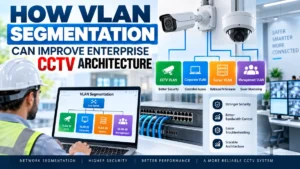
Enterprise CCTV systems are no longer isolated video networks. Modern surveillance environments often connect hundreds of IP cameras, NVRs, video management systems, workstations, analytics servers, access-control systems, and other IT infrastructure.
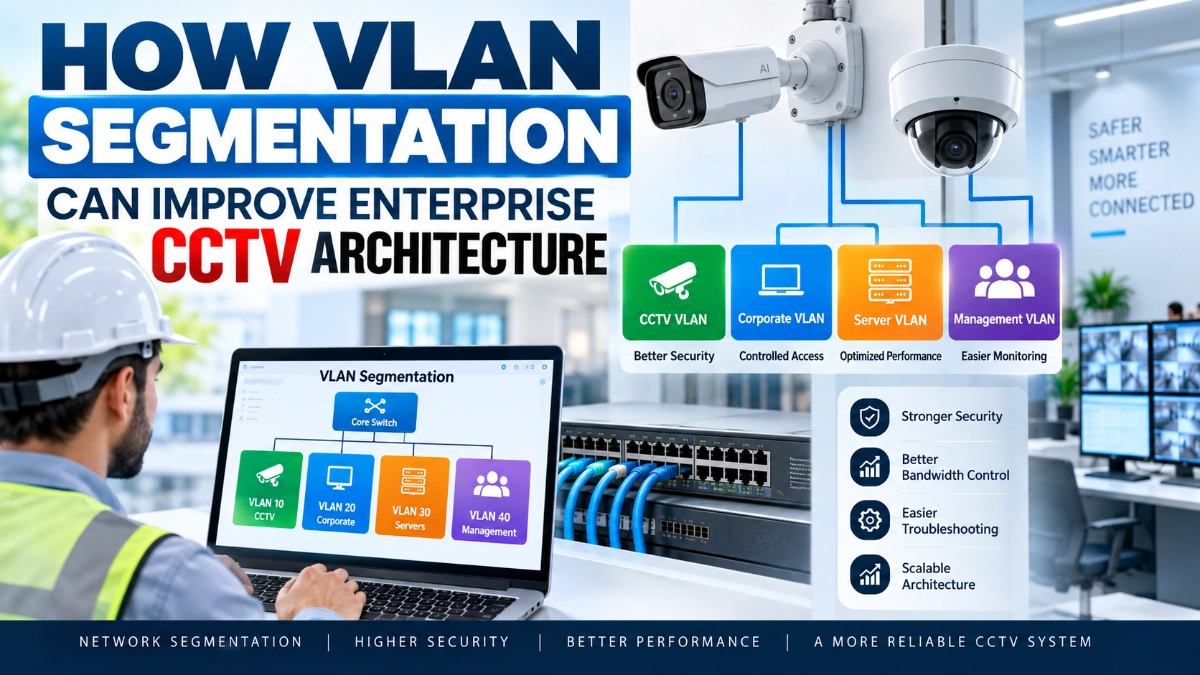
As the number of connected devices increases, network architecture becomes just as important as camera resolution or storage capacity.
One practical way to improve the architecture is VLAN segmentation.
A properly designed CCTV VLAN separates surveillance traffic from general enterprise traffic while giving network engineers greater control over bandwidth, security, troubleshooting, and access. Cisco’s enterprise video-surveillance guidance has long used VLANs to isolate IP video devices and separate different traffic aggregates. At the same time, modern network-segmentation practices also use logical boundaries to restrict unnecessary communication.
For engineers designing large CCTV deployments, VLAN segmentation should therefore be treated as part of the network architecture, not as an optional configuration added after installation.
What Is VLAN Segmentation in CCTV?
A VLAN, or Virtual Local Area Network, logically divides devices on a physical network into separate network segments.
For example, an enterprise network could use:
- VLAN 10 – Corporate users
- VLAN 20 – Servers
- VLAN 30 – CCTV cameras
- VLAN 40 – CCTV management
- VLAN 50 – Guest devices
- VLAN 60 – Building management systems
The cameras can communicate within the CCTV network without being placed on the same logical network as employee computers or guest devices.
This creates a controlled communication path between cameras, NVRs, video management systems and authorised users.
A VLAN does not automatically make a CCTV network secure. Security comes from combining segmentation with routing policies, access-control lists, firewalls, authentication and appropriate device configuration.
Why Does Enterprise CCTV Need Network Segmentation?
A small surveillance system may contain only a few cameras and a single recorder. An enterprise deployment can be very different.
Consider a large facility with:
- 300 IP cameras
- Multiple NVRs
- Several PoE switches
- Security control rooms
- Remote monitoring workstations
- Video analytics servers
- Corporate users
- Wireless networks
- Cloud-connected services
If all these systems share one flat network, surveillance traffic competes with normal business traffic and creates unnecessary communication paths.
A flat architecture can also make troubleshooting more difficult. A broadcast problem, misconfigured device or compromised endpoint can affect a much larger portion of the network.
Segmentation creates logical boundaries that make the environment easier to control.
Cisco describes network segmentation as a method of dividing networks into smaller areas and controlling traffic between them. Its security benefits include limiting lateral movement, reducing incident impact and supporting least-privilege access.
For CCTV, these principles translate into a simple objective:
Cameras should communicate with the systems that need their video, not with every device on the enterprise network.
1. VLANs Help Isolate CCTV Traffic
One of the primary benefits of VLAN segmentation is traffic isolation.
Imagine 200 cameras transmitting video across the same network used by office computers, printers, VoIP phones and other applications.
The network may still function, but troubleshooting and traffic management become more complicated.
Placing cameras in a dedicated surveillance VLAN creates a logical boundary around the video devices.
For example:
Camera VLAN → PoE switches → Distribution switch → Firewall/router → NVR/VMS
Corporate computers can remain on a separate VLAN.
The firewall or Layer 3 routing infrastructure can then determine which traffic is permitted between the two environments.
This architecture gives engineers greater control over the flow of surveillance traffic.
Cisco’s IP video-surveillance architecture demonstrates this concept by placing IP cameras and video infrastructure into dedicated VLANs and mapping those Layer 2 VLANs into separate Layer 3 routing environments.
2. VLAN Segmentation Can Improve CCTV Security
Security is one of the strongest reasons to segment enterprise surveillance networks.
IP cameras are network-connected computing devices. They can have web interfaces, management services, firmware, credentials and remote-access capabilities.
If cameras sit directly on the same network as ordinary employee devices, an incident involving another endpoint can create unnecessary paths toward the surveillance infrastructure.
A dedicated CCTV VLAN reduces that exposure.
For example, an organisation could define a policy such as:
Cameras → NVR/VMS: Allowed
NVR/VMS → Cameras: Allowed
Security workstation → VMS: Allowed
Corporate user VLAN → Cameras: Restricted
Camera VLAN → Internet: Denied unless specifically required
This follows the principle of allowing only the communication required for the system to operate.
Axis also recommends reducing local network exposure through techniques such as VLANs, IP filtering and firewall-based segmentation for surveillance environments.
Important distinction
A VLAN alone is not a firewall.
Devices within the same VLAN can generally communicate according to Layer 2 behaviour and device configuration. Security policies between VLANs should therefore be enforced using Layer 3 controls, ACLs, firewalls or other appropriate security mechanisms.
3. VLANs Help Manage CCTV Bandwidth
High-resolution cameras can generate substantial network traffic.
A camera using 4 Mbps may not appear significant by itself. Multiply that by 100, 300 or 500 cameras and the traffic becomes much more important.
For example:
100 cameras × 4 Mbps = approximately 400 Mbps
This does not represent the complete network requirement because actual traffic depends on compression, frame rate, resolution, scene complexity, recording configuration, multicast/unicast behaviour, and overhead.
A dedicated surveillance VLAN allows engineers to identify and manage this traffic separately.
It becomes easier to:
- Monitor CCTV bandwidth
- Identify congested links
- Plan uplink capacity
- Apply QoS where appropriate
- Investigate packet loss
- Separate camera traffic from business applications
However, VLAN segmentation does not reduce the bitrate generated by cameras by itself.
The benefit comes from better traffic organisation and control.
4. VLANs Make Troubleshooting Easier
Troubleshooting a flat enterprise network can become difficult when hundreds of cameras share infrastructure with unrelated devices.
With segmentation, engineers can narrow the investigation.
Suppose cameras in one building suddenly stop displaying video.
Instead of examining every device on the corporate network, engineers can start with:
- Camera access switches
- Camera VLAN configuration
- Uplink trunks
- VLAN gateway
- Firewall or ACL rules
- NVR/VMS connectivity
- Camera authentication and services
This creates a more structured troubleshooting process.
A well-documented VLAN architecture can also make network monitoring more meaningful because surveillance traffic has a clearly defined logical boundary.
5. VLAN Segmentation Supports Better Access Control
Not every employee needs access to every camera.
Security administrators may need full access.
Facility managers may need access to selected areas.
IT administrators may require network-level access.
Other employees may have no surveillance access at all.
VLAN segmentation provides a foundation for implementing these distinctions.
For example:
| Device/Role | CCTV Access |
|---|---|
| Security control room | Full authorised access |
| NVR/VMS | Camera communication |
| Network administrator | Infrastructure management |
| Facility manager | Selected video access |
| Corporate user | Restricted or no direct camera access |
| Guest network | No CCTV access |
The actual policy should depend on the organization’s security requirements.
The principle is simple: give each user or system only the access it needs.
6. Separate Camera, Management and Recording Networks
For larger installations, a single CCTV VLAN may not provide enough separation.
A more structured design could use multiple segments:
Camera VLAN
Used by IP cameras and related edge devices.
CCTV Management VLAN
Used for authorised management interfaces, monitoring tools and administrative endpoints.
Recording VLAN
Used for communication between cameras and NVRs or recording servers where the architecture requires it.
Security Operations VLAN
Used by control-room workstations and authorised monitoring systems.
This approach can provide additional control over communication paths.
Cisco’s enterprise video-surveillance architecture similarly demonstrates separation between IP cameras, video infrastructure and other enterprise network environments.
The exact design should be based on camera count, recording architecture, network hardware, VMS requirements and security policy.
7. VLANs Can Reduce Unnecessary Broadcast Domains
VLANs also provide a way to divide large Layer 2 broadcast domains.
A large flat network can contain many devices within the same broadcast domain.
Separating systems into logical VLANs reduces the scope of broadcast traffic and creates clearer boundaries between different network functions.
This becomes particularly useful in large campuses, warehouses, factories, hospitals, logistics facilities and multi-building enterprise environments.
However, engineers should avoid creating VLANs simply for the sake of creating more VLANs.
Every additional segment introduces configuration, routing and documentation requirements.
Good segmentation is purposeful segmentation.
8. Multicast and CCTV VLAN Design Need Careful Planning
Some video architectures use multicast to distribute video efficiently to multiple viewers.
For example, one camera stream may need to reach several monitoring clients.
Without proper multicast controls, unnecessary traffic can reach network segments that do not need it.
Engineers should therefore consider technologies and controls such as:
- IGMP snooping
- IGMP queriers
- Multicast routing where required
- VLAN boundaries
- Switch capacity
- Uplink bandwidth
- VMS behavior
Cisco’s video-surveillance documentation highlights multicast behaviour and the importance of network design considerations for enterprise video deployments.
The correct implementation depends on the specific camera and VMS architecture.
9. VLANs Help Create a More Scalable CCTV Architecture
Enterprise CCTV systems rarely remain static.
A company may start with 50 cameras and later expand to 200 or 500.
New buildings may be added. More NVRs may be deployed. Analytics servers may be introduced. Additional security teams may require access.
A structured VLAN architecture makes this expansion easier to plan.
For example:
Building A → CCTV VLAN 110
Building B → CCTV VLAN 120
Building C → CCTV VLAN 130
The organisation can then define consistent routing and security policies across locations.
This approach can make network documentation, monitoring and troubleshooting more manageable as the surveillance estate grows.
10. How VLAN Segmentation Fits Into an Enterprise CCTV Architecture
A simplified enterprise design could look like this:
                    INTERNET
                       |
                    FIREWALL
                       |
                CORE / L3 SWITCH
                 /            \
        CCTV VLAN             Corporate VLAN
             |                     |
       Distribution Switch     User Switches
             |
       CCTV Access Switches
          /    |    \
      Camera Camera Camera
          |
      NVR / VMS
          |
   Security Workstations
The key design principle is that cameras do not need unrestricted access to the corporate network.
Instead, routing and security controls determine exactly where CCTV traffic can go.
For larger environments, engineers may combine VLANs with VRFs, firewalls, ACLs, NAC, IP filtering and other segmentation mechanisms.
Cisco documentation describes combining Layer 2 VLAN segmentation with Layer 3 VRF separation for end-to-end isolation in enterprise IP video-surveillance architectures.
Common VLAN Design Mistakes in CCTV
Even a segmented CCTV network can perform poorly if the design is not carefully implemented.
Mistake 1: Treating VLANs as a complete security solution
Segmentation creates boundaries, but access-control policies are still required.
Mistake 2: Ignoring uplink capacity
A dedicated CCTV VLAN does not solve an undersized uplink.
Mistake 3: Forgetting multicast requirements
If the VMS uses multicast, IGMP and multicast routing need to be designed correctly.
Mistake 4: Placing every CCTV device into one unrestricted segment
Cameras, management workstations and recording infrastructure may have different security requirements.
Mistake 5: Poor documentation
Every VLAN should have a clear purpose, subnet, gateway, routing policy and ownership.
Mistake 6: Allowing unnecessary Internet access
Cameras generally should not have unrestricted outbound Internet connectivity unless a documented requirement exists.
Practical VLAN Design Checklist for CCTV Engineers
Before deploying an enterprise surveillance network, review the following:
- Define the CCTV VLAN architecture.
- Calculate camera bandwidth requirements.
- Size switch uplinks appropriately.
- Separate camera and corporate traffic.
- Define permitted inter-VLAN communication.
- Restrict unnecessary Internet access.
- Plan multicast requirements.
- Configure appropriate ACLs or firewall policies.
- Consider management-network separation.
- Document IP addressing and VLAN assignments.
- Monitor packet loss, latency and utilisation.
- Test failure scenarios before production deployment.
- Review the architecture whenever camera count or VMS requirements change.
How CCTV Hardware Fits Into a Segmented Network
The network architecture should be designed before selecting or deploying surveillance hardware.
Whether an organisation uses Impact by Honeywell CCTV cameras, another IP camera platform, or a mixed-vendor environment, the network still needs clearly defined traffic paths.
Different camera form factors may also have different deployment requirements. For example, Impact by Honeywell bullet cameras may be used for perimeter or outdoor monitoring, while Impact by Honeywell dome cameras can suit indoor or discrete surveillance applications.
Recording infrastructure also needs appropriate connectivity. Impact by Honeywell NVRs can form part of the recording layer, while the network design determines how cameras communicate with recording and monitoring systems.
For organisations evaluating equipment availability and distribution, an Impact by Honeywell distributor in India can also be considered as part of the procurement process. The network design, however, should remain based on engineering requirements rather than on the product brand alone.
Final Takeaway
Enterprise CCTV performance depends on more than camera resolution and storage capacity. The underlying network architecture plays a critical role in determining how reliably video moves between cameras, switches, NVRs, VMS platforms and monitoring workstations.
VLAN segmentation provides a practical foundation for organising that architecture.
By separating surveillance traffic, controlling inter-network communication, planning bandwidth, restricting unnecessary access and creating clear operational boundaries, engineers can build CCTV networks that are easier to monitor, troubleshoot and scale.
The goal should not be to create as many VLANs as possible.
The goal is to create logical network boundaries that match the way the CCTV system actually operates.
For enterprise deployments, that means starting with camera traffic requirements, recording architecture, user access, security policies and future expansion and then designing VLANs around those requirements.
That approach turns CCTV from a collection of network-connected cameras into a structured, manageable enterprise surveillance architecture.
Read Also: Detection, Recognition and Identification: How Should Engineers Specify CCTV?
Read Also: IP Cameras, PoE, Network, NVR and VMS: Where Does CCTV Performance Actually Break?